
Reserve Bank of Australia Annual Report – 1973 The Year in Brief
At the beginning of 1972/73, the major concerns about the Australian economy centred on levels of unemployment, inflation and international reserves. Inflation was the most conspicuous problem at year's end. Some important aspects of the year's performance are depicted in Graphs 1 and 2.
In the international arena, the year saw further severe disruptions in foreign exchange markets which culminated in a second devaluation of the United States dollar in February 1973 and the floating of most other important currencies; following a period of relative stability in the markets, the dollar weakened sharply against some European currencies around the end of the financial year. While markets were seeking, through the recurrent crises, for a way towards some kind of equilibrium, work was in process within the framework of the International Monetary Fund on an outline of a possible structure of a reformed system of international payments.
Notwithstanding the disturbed foreign exchange markets, world output and trade have been rising strongly. But, until recently, there had been little sign of patterns of international trade responding to the end-1971 measures aimed at correcting a growing departure from equilibrium in the balance of payments of the larger countries. Beliefs that further adjustments of exchange parities would be at least a part of any fresh attack on the problem of balance of payments disequilibria have been manifest in concerted attempts from time to time to take or protect positions in various currencies.
These developments had clear counterparts in the Australian balance of payments which was in substantial and increasing surplus at the start of 1972/73. Strong world demand kept exports buoyant and export prices, particularly for wool, were rising; imports reflected the sluggishness in domestic activity and the current account was strengthening rapidly. The capital account was affected by a fairly general view that the Australian dollar was being sold cheaply; this was stimulating both the community's appetite for liabilities repayable in some overseas currencies and the demand by foreigners for assets in Australia. Despite a resumption in the growth of imports and the adoption of measures of restriction against capital flows at the end of September, the overall surplus in the balance of payments assumed very large proportions in the first half of 1972/73 and was not far short of the surplus of $1,442 million recorded for the whole of 1971/72.
The second half of the year saw a sharp turn-around in the capital account, which reflected the effects of the September exchange control measures, some further measures against capital inflow in December, the appreciation of the Australian dollar that month and other currency movements, including the devaluation of the United States dollar in February 1973. Immediately following these events, many thought that the cost of foreign currencies in terms of Australian dollars might rise and were encouraged to move funds out of Australia. For this and other reasons, there was a net outflow of private capital in excess of $650 million in the second half of 1972/73, concentrated in the period between mid February and end April; there had been a net inflow of $945 million in the first six months of the year. While the effects on trade of the appreciation of the Australian dollar were no doubt beginning to be felt, a reduced availability of some rural products for export and the response of imports to growing pressures on domestic supplies were more important factors causing at least a temporary decline in the current account surplus towards the end of the financial year. However, the surplus on current transactions remained high and, in the second half of the year, offset much of the deficit on capital account; consequently, there was a full-year surplus in the overall balance of payments of almost $1,000 million.
1 Selected Indicators
SEASONALLY ADJUSTED
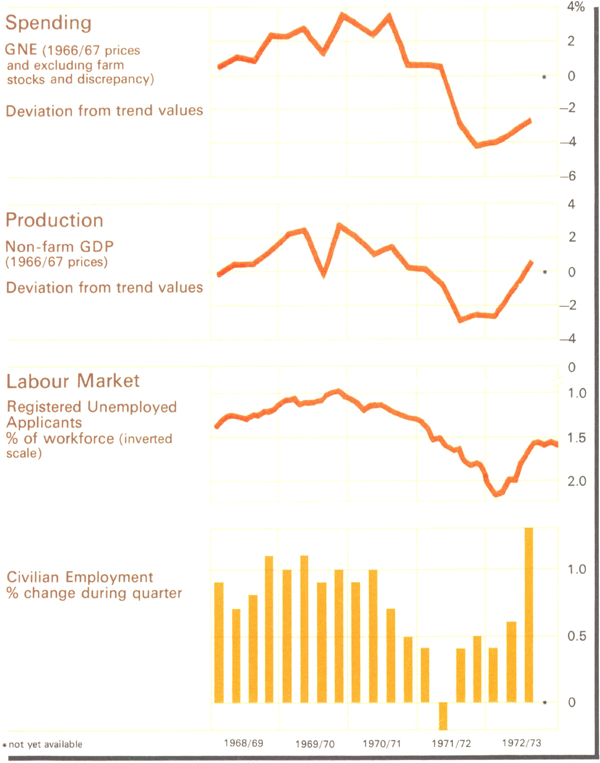
Before the mid-year turn-around, the balance of payments had been a strong force making for a quickening in domestic demand and activity. In addition, a number of fiscal and monetary initiatives had done much to restore consumer confidence in the months leading up to 1972/73 and this process was carried further during the year, mainly through an expansionary Budget and some other fiscal stimuli. In the outcome, spending during 1972/73 continued the strengthening that emerged in the closing months of the previous year.
Domestic spending depended for its strength on the public and household sectors; the latter's outlays on both consumer goods and housing grew firmly. By contrast, the trend in business capital formation was dominated by the tailing-off of the boom in fixed investment by the mining and associated processing industries. Imports met some of the growth in spending but there was a growing call on domestic productive resources, which began to reflect early in 1972/73 in faster growth in employment and reductions in unemployment. Thus, total civilian employment, which had grown by only 1 per cent in the twelve months to August 1972, expanded at an annual rate of more than 3 per cent over the remainder of 1972/73. As for unemployment, the number of registered unemployed applicants, which had grown steadily (in seasonally adjusted terms) for more than two years to reach almost 120,000 in August 1972, was down to 89,000 by end June 1973.
Growth in consumer prices tended to ease a little towards the end of 1971/72 and this process went further in the following six months. In the second half of 1972/73, however, the rate of growth of prices quickened markedly; the rise over the twelve months to June 1973 was somewhat greater than that over the previous year and the largest for any financial year since 1951/52. The respite in the first six months occurred despite some acceleration in the growth of average wage and salary incomes. Part of the reason was that the gains in productivity accompanying the emerging recovery in activity were restraining the rises in unit labour costs; another important factor was the considerable reduction in the rate of increase in charges and taxes imposed by public authorities. These factors continued to operate in the second half of the year and were reinforced by the effects of the appreciation of the Australian dollar. However, earnings continued to rise quite rapidly and, more importantly, a combination of strong demand and, in the case of sheepmeats, restricted supply produced a very sharp rise in meat prices.
2 Selected Indicators
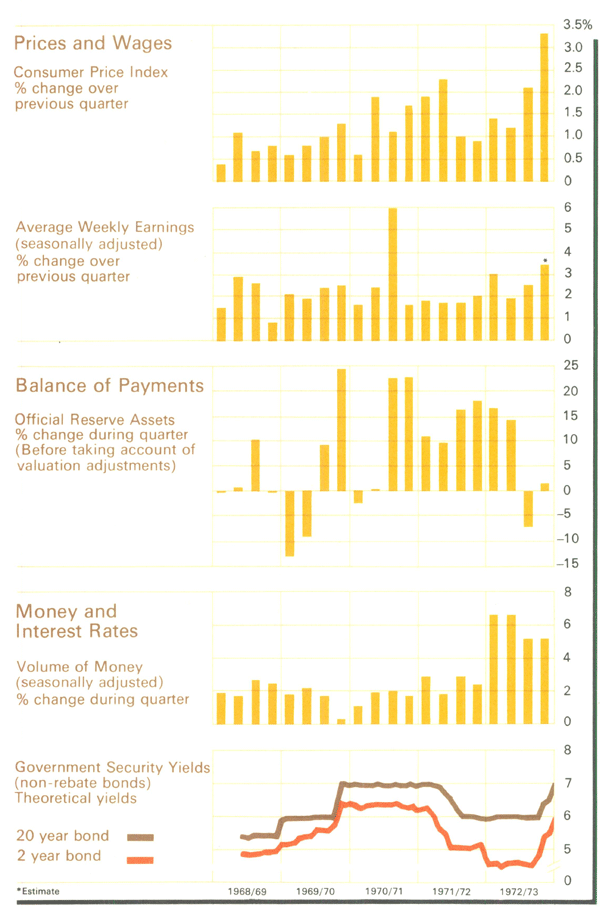
The measures directed at external imbalance tended to moderate a little the prospects for growth in spending and prices. For one thing, the reduced ability and willingness of the private sector to borrow overseas produced a fair degree of tightening in financial conditions. After the middle of February, the previous downward pressures on domestic interest rates gave way to opposite forces.
Notwithstanding these developments, it seemed clear that expenditure would continue to move up faster than available supplies and that prices would rise at an uncomfortable rate. Accordingly, the Bank became unwilling to facilitate attempts by the private sector to liquidate holdings of government securities and yields on these securities rose over the remainder of the year. In addition, further tightening in monetary conditions was effected by the Bank through an increase of 1 percentage point in April in the Statutory Reserve Deposit ratio for the major trading banks. Further increases in this ratio, to take effect during August, have also been announced. On top of these moves, the Government announced, on 18 July, that virtually all tariffs would be cut immediately by 25 per cent.
Looking forward, some large increases in prices are in the pipeline. In the slightly longer run, the measures taken over the last seven months or so and the functioning—shortly to begin—of the Prices Justification Tribunal will exert restraint but it is far from certain that there will be a quick return to acceptable growth rates for prices. The Budget to be brought down in August will, of course, be an important influence on the extent to which aggregate demand adds to pressures on prices in the period ahead. There is scope for further tightening in financial conditions but the gathering strength of private demand suggests that it would not be prudent and probably not sufficient to rely only on monetary policy to achieve the desired restraint.
The year was one during which effects of the deepening malaise in international monetary arrangements became so severe as to force a more vigorous handling of the instruments of external adjustment. A later section of the Report looks more closely at some of the factors surrounding the increased recourse in Australia to policy measures on the external front. It is argued there that policy instruments directed at external adjustment may continue to be needed as an adjunct to domestic policies of demand management if a satisfactory balance of economic activity and price stability is to be achieved.