
Reserve Bank of Australia Annual Report – 1973 Other Activities of the Bank
Some other aspects of the Bank's work during 1972/73 are covered in the following pages. In all of its activities the Bank depends greatly on its contacts in various areas of the community. The Board gratefully acknowledges the assistance provided by these contacts.
Note Issue
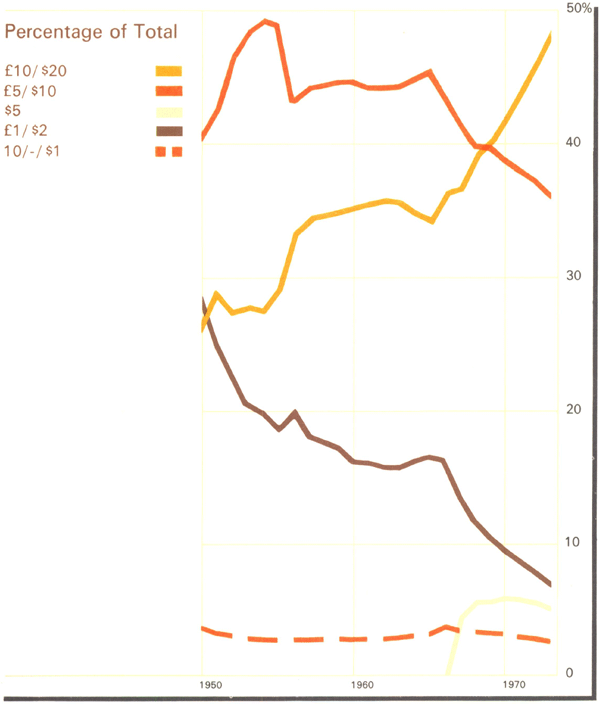
The continuing upward trend in the value of Australian notes on issue resulted in an increase of 17 per cent during 1972/73 to a total of $1,767 million. Much of the increase continued to be centred in the $20 denomination, which accounted for about 48 per cent of the value of notes on issue at the end of June 1973 (Graph 18). A $50 note is to be issued at an early date.
Australian notes are produced by the Printing Division of the Bank's Note Issue Department. The Division also undertakes other types of security printing.
Rural Credits Department
Extensive seasonal finance was again made available by the Bank's Rural Credits Department to assist in the marketing, processing or manufacture of primary produce. Outstanding advances of the Department at 30 June 1973 were $206 million, compared with $261 million a year earlier. The seasonal peak in total advances outstanding during the year was $351 million in February. This was $55 million below the previous year's peak, in March 1972, and $271 million lower than the record peak in March 1970.
Advances for wheat, rice and eggs were lower in 1972/73 than in the previous year but more finance was provided for dairy produce, sugar, peanuts and wine and spirits. Other commodities financed by the Department included canned fruits, barley, oats, cotton, superphosphate and dried fruits.
| As at end June | $1 | $2 | $5 | $10 | $20 and over | Total |
|---|---|---|---|---|---|---|
| 1970 | 40 | 117 | 72 | 466 | 501 | 1,196 |
| 1971 | 42 | 119 | 81 | 521 | 606 | 1,369 |
| 1972 | 44 | 119 | 86 | 564 | 695 | 1,508 |
| 1973 | 48 | 125 | 96 | 643 | 855 | 1,767 |
| Year ended 30 June | Australian Notes | Postage Stamps | Postal Orders | Other Postal Material | Cheques |
|---|---|---|---|---|---|
| 1970 | 306 | 1,194 | 15 | 117 | 9 |
| 1971 | 328 | 1,303 | 17 | 95 | 8 |
| 1972 | 293 | 1,297 | 18 | 92 | 7 |
| 1973 | 232 | 1,223 | 17 | 86 | 8 |
Continued substantial sales by the Australian Wheat Board and a relatively low level of intake into the 1971/72 Pool enabled the Board to clear its seasonal advance from Rural Credits Department without governmental assistance. Adverse seasonal conditions, particularly in New South Wales, caused a substantial drop in wheat receivals into the 1972/73 Pool with a correspondingly lower advance on account of that Pool.
18 Value of Notes on Issue
CLASSIFIED BY DENOMINATION—END OF JUNE
Interest rates on Rural Credits advances remained unchanged during the year at 5 per cent per annum on government-guaranteed loans and 5.25 per cent per annum on other loans.
Bonds and Stock
Through Inscribed Stock Registries conducted at each of its branches, the Reserve Bank manages the loan and debt servicing operations of the Australian Government. During 1972/73, the Government floated four cash and conversion loans and two issues of special bonds; in addition, it raised substantial amounts through the tap issue of Treasury notes. As a result, the value of government debt managed by the Bank rose by $838 million over the year, compared with $690 million in 1971/72.
In addition to the registries conducted for the Australian Government, the Bank for some years has been conducting registries at Brisbane for some semi-governmental authorities, at Port Moresby for the Papua New Guinea Government and at Sydney for loans raised in Australia by the Fiji Government. During the year the Bank established a registry at Melbourne for issues of Fiji Government securities in Australia.
Exchange Control
The year saw major changes in exchange control policy. Virtually no restrictions previously existed on inward capital flows and the only significant restriction on outflow was in respect of portfolio investment abroad by Australian residents. During the year a prohibition was placed on overseas borrowings for periods of two years or less and the restriction on portfolio outflow was eased. Also during the year, guidelines relating to borrowing in Australia by overseas-owned companies were abolished and a variable deposit scheme was introduced in respect of overseas borrowings by Australian residents for periods in excess of two years. These measures and the context in which they were taken are discussed more fully on pages 23–27.
During 1971, Australian banks were requested to refer to the Reserve Bank all inward remittances from abroad of $250,000 and above before they effected the currency conversion to Australian dollars, unless specific approval of the Bank for the transaction was already held. This surveillance procedure continued to operate through 1972/73.
Premises
Both the Brisbane and Perth branches will shortly commence operations in new premises, the former at King George Square and the latter at 45 St George's Terrace. Early in 1973 work commenced on the construction of a building for Hobart branch; the building is scheduled for completion during 1975.
Centralised Cash Facilities
In 1965 centralised cash facilities were introduced to provide for the notes and coin requirements of bank branches in the Sydney metropolitan area to be serviced direct by the Reserve Bank. Those facilities were later extended to include New South Wales country branches and branches of banks in Victoria and South Australia. Following occupation of new premises in Brisbane and Perth, the Bank will make similar servicing arrangements available to bank branches throughout Queensland and Western Australia.
Research Grants
The Rural Credits Development Fund approved grants totalling $876,000 during 1972/73 for research and extension projects concerned with primary production. In addition, three Senior Research Fellowships (Agriculture) were awarded during the year. The Fellowships provide the opportunity for research workers of experience to apply their talents toward the resolution of practical problems in agriculture in the relatively short term. The Fund is financed by a transfer each year (in terms of the Reserve Bank Act) of half the net profits of the Rural Credits Department. Grants are made on the advice of a Committee of Reference which includes representatives from universities and other research institutions. The Board wishes to express appreciation of the help given by the Committee during 1972/73.
The Bank, through the Economic and Financial Research Fund, continued to provide support for post-graduate research in economic and financial topics with particular reference to Australia. In 1972/73, grants from the Fund amounting to $128,245 were approved.
Publications
Three Occasional Papers have been published since the last Report. One continued the series of papers on a project to develop quarterly models of the Australian economy; the second discussed objectives and instruments of economic policy while the third was a second volume of Australian banking and monetary statistics, covering the period 1945–1970.
As well as the normal range of statistical and other information published monthly in the Bank's Statistical Bulletin, Financial, Company and Flow-of-Funds Supplements were released with the Bulletins for September 1972, December 1972 and April 1973, respectively.