
Reserve Bank of Australia Annual Report – 1973 The International Environment
Hopes that the currency realignments and other arrangements of December 1971 (Smithsonian Agreement) would restore a measure of equilibrium to the international monetary system waned during 1972. In the early months of 1973, normal operations in foreign exchange markets were twice suspended as the United States dollar came under heavy selling pressure; the changes which were made included some further substantial currency realignments and the floating of a number of major currencies. For a while, conditions were relatively calm but in the final two months of the financial year the dollar weakened dramatically against major European currencies despite the appearance of some signs of the hoped-for turn-around in balance of payments positions. Work proceeds at an international level directed towards drafting an outline of a possible revised system of international payments.
3 Balance of Payments
SELECTED COUNTRIES – YEAR TO MARCH
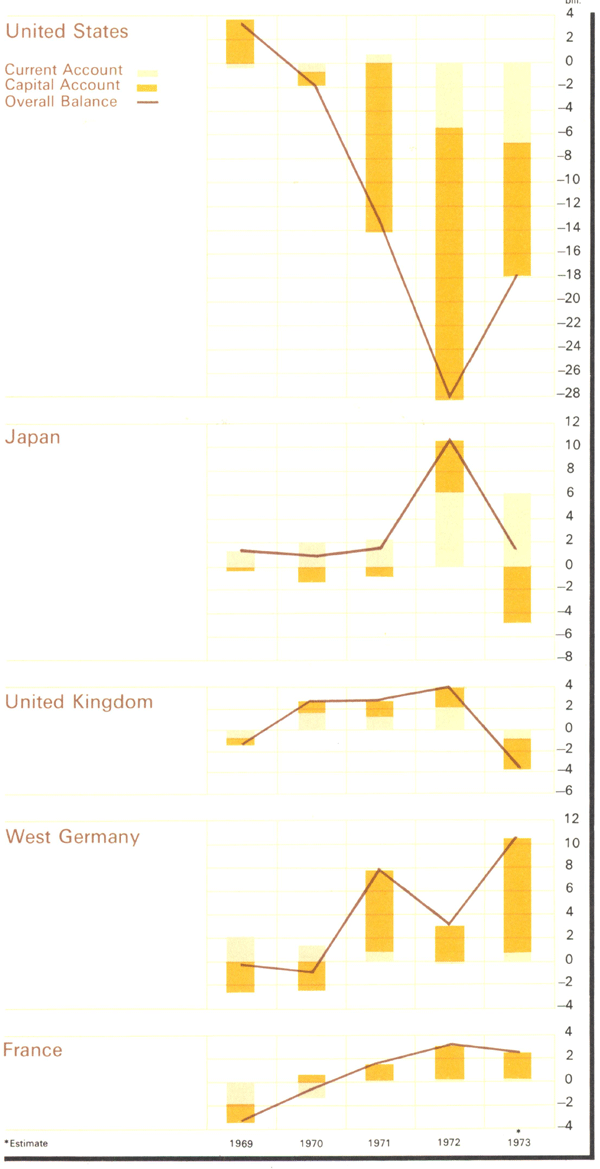
Despite the unsettled conditions prevailing in foreign exchange markets, world output and trade have grown strongly over the last year or so. Growth has been sufficiently large in the case of most of the major industrial countries bring about reductions in unemployment and in margins of spare capacity generally. However, at the same time, the rate of increase in prices has quickened.
International Payments
During 1972 little, if any, headway was being made by the end-1971 exchange rate realignments, and a superior price performance by the United States, in reducing the size of that country's overseas trade deficit. Some lags were to be expected, of course, particularly as cyclical factors were working against an improvement in the United States accounts. But, essentially, it seems that such imbalances as exist have developed over a long period and are not as quickly responsive to the price changes made as some would have hoped.
4 Interest Rates Overseas
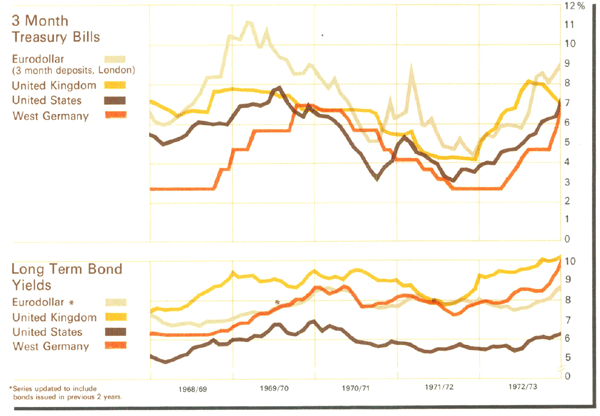
While modified somewhat by the inclusion of invisible items, the pattern of large surpluses and deficits in trade transactions remains apparent in the current accounts for major countries. Such movements of funds as were required in settlement of current accounts, however, were again easily overshadowed in the year to March 1973 by capital flows (Graph 3).
Interest rates in the United States followed a rising trend after July 1972, reflecting initially the upswing in activity and, a little later, a tightening in monetary policy (Graph 4). The yield on three-month Treasury bills started 1972/73 around 4 per cent per annum and finished it at almost double this figure. The rise in long-term rates was less marked.
Rising interest rates in the United States afforded opportunities for other countries to tighten monetary policy; rapid growth in international reserves and expansionary fiscal policies were being reflected in very fast rates of growth in money supply around the world. In general, these opportunities were accepted and interest rates elsewhere than in the United States also began to rise. These movements were accompanied by a wide range of measures designed to guard against their effects on domestic conditions being undone by further heavy capital inflows. Some countries, of course, were more concerned with possible outflows in adopting measures to loosen the connection between their domestic money markets and those in the rest of the world.
In the absence of signs of any rapid improvement in the United States basic balance of payments, however, the exchange and other direct controls in force in major countries did not prevent exchange market pressures from mounting again in the early part of 1973. In an attempt to staunch a large outflow of capital, the Italian authorities announced, on 20 January, that they were adopting a two-tier exchange rate system. Freed to this extent from the previous restraining influence of the lira, the currencies of other countries participating in the E.E.C. narrower margins scheme quickly rose against the United States dollar. On 22 January, following heavy support operations during the day, the Swiss National Bank announced it was suspending intervention purchases of United States dollars and the Swiss franc was allowed to float.
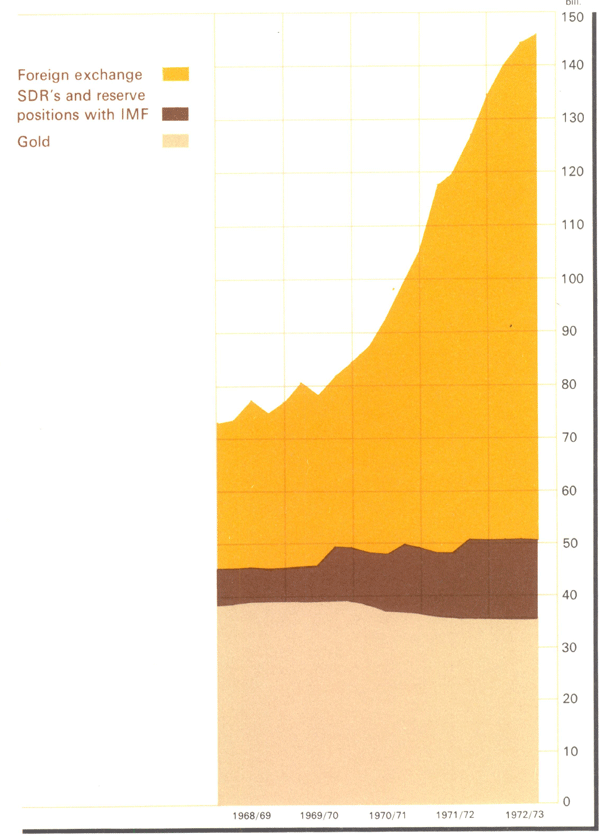
5 World Holdings of International Reserves
AT END OF QUARTER, NOT SEASONALLY ADJUSTED
In the face of continuing strong pressure against the dollar and the take-up of large amounts of dollars by the West German Bundesbank and the Bank Japan in particular, foreign exchange markets were closed after 9 February while deliberations on a parity realignment took place. On 12 February the United States Secretary of the Treasury announced that the United States dollar would be devalued 10 per cent; that the interest equalisation tax and the controls of the Office of Foreign Direct Investment would be phased out; and that comprehensive trade legislation would shortly be sent to Congress. No major country formally devalued with the dollar. Japan and Italy joined the United Kingdom and Ireland, Switzerland and Canada in floating.
The United States dollar crisis continued into March and from 2 March central banks ceased operating in their foreign exchange markets; however, inter-bank trading in foreign currencies continued. After further deliberations, the German mark was appreciated by 3 per cent and its formal connection with the United States dollar was severed; the Austrian schilling was appreciated by 2.25 per cent. It was also agreed that there would be a joint float within a 2.25 per cent band by six E.E.C. countries (West Germany, France, the Netherlands, Denmark, Belgium and Luxembourg), Sweden and Norway. Austria did not formally join this joint float but the Austrian central bank announced it would keep the schilling within the 2.25 per cent band. The United Kingdom and Ireland, Italy, Switzerland, Japan and Canada continued to float separately.
Notwithstanding some signs of improvement in the United States payments position, the dollar came under pressure again around the close of the financial year; there seemed to be some concern about prospects for the economy in view of a worsening inflationary trend and disturbances in the political sphere. The dollar suffered its largest decline over this period against the major European currencies; while this was occurring, West Germany attracted substantial inflows of European currencies under its obligations in terms of the joint float arrangement and, at the end of June, it revalued by 5.5 per cent so that the arrangement could continue. The extent of changes in exchange rate relationships between major countries over recent periods is shown in the table below.
| United Kingdom |
West Germany |
France | Switzerland | Japan | Australia | |
|---|---|---|---|---|---|---|
| End of | POUND | MARK | COMMERCIAL FRANC |
FRANC | YEN | DOLLAR |
| 1971 Dec.* | +6.4 | +12.0 | +6.3 | +11.6 | +14.5 | +6.3 |
| 1972 Mar. | +9.0 | +15.5 | +10.5 | +14.1 | +18.6 | +6.3 |
| June | +1.8 | +16.2 | +11.1 | +16.8 | +20.0 | +6.3 |
| Sept. | +0.8 | +14.3 | +10.8 | +15.1 | +19.6 | +6.3 |
| Dec. | −2.2 | +14.3 | +8.6 | +16.1 | +19.2 | +13.8 |
| 1973 Jan. | −0.7 | +16.1 | +10.8 | +21.1 | +19.5 | +13.8 |
| Feb.** | +3.7 | +29.0 | +22.9 | +39.7 | +35.5 | +26.5 |
| Mar. | +3.1 | +28.7 | +22.4 | +34.8 | +35.3 | +26.5 |
| Apr. | +3.7 | +29.0 | +21.6 | +34.9 | +35.6 | +26.5 |
| May | +7.0 | +35.5 | +27.9 | +41.7 | +36.1 | +26.5 |
| June | +7.6 | +51.0 | +34.1 | +49.6 | +36.8 | +26.5 |
| * United States dollar devalued, in effect, by 7.9 per cent 19/12/71. ** United States dollar devalued, in effect, by 10 per cent 12/2/73. |
||||||
Reflecting especially the heavy outflow of capital in the March quarter of 1973, the deficit in the United States balance of payments in 1972/73 was probably in the region of US $20 billion as it had been in 1971/72 and 1970/71. Once again the deficit was reflected in a very large rise in world holdings of international reserves during 1972/73 as foreign official institutions acquired dollar assets (Graph 5). In the last three years these holdings have more than doubled in terms of United States dollars and have increased by about 80 per cent in terms of Special Drawing Rights.
For the foregoing calculations, national gold reserves have been valued at the official gold price, currently, in effect, a little over US $42 per ounce. The gap between the official price and the free market price increased considerably during 1972/73 and transactions between official parties virtually ceased. The free market price fluctuated around US $65 per ounce over the first seven months of the financial year; it then rose sharply over the next four months to about double that figure early in June and finished the year at US $123 per ounce. The needs of industrial users of gold expanded strongly during the year and the metal came increasingly into favour with investors in the face of inflation and the reduced accessibility and/or attractiveness of some alternative investments.
International Monetary Reform
The par value system has governed international payments arrangements for almost thirty years. The basic tenet of the system was that the par value of a country's currency should only be changed in response to a “fundamental disequilibrium” in its balance of payments. At other times, exchange rates were to be maintained within fairly narrow margins around parities; this required, of course, appropriate demand management, use of interest rates and a buffer stock of international reserves. Thus was it hoped to avoid the competitive devaluations and other “beggar-my-neighbour” policies which had plagued the world in earlier periods and threatened to restrict severely the gains from world specialisation and trade.
With the benefit of hindsight, it is clear that the pendulum was allowed to swing too far in the other direction and par values have been rather less flexible than they needed to be. Intervention aimed at maintaining unrealistic exchange rates, in fact, may well have also tended to reduce growth in world output and trade.
Recent years have seen a marked increase in the responsiveness of capital flows across national frontiers to opportunities for better returns. This, in turn, has been bound up with the increasing internationalisation of banking and of business generally. Moreover, as usually happens, the closing of some channels for transfer of funds has stimulated the growth of alternative machinery—in this case the Euro-currency market. Some estimates suggest that the size of the short-term sector of this market is now around US $100 billion. In these circumstances, controllers face a very formidable task in trying to prevent a flight from weak to strong currencies.
Against this background, a possible structure for a revised system of international payments is being explored within the framework of the International Monetary Fund. The Executive Directors of the Fund submitted a report in July 1972, as commissioned by the Board of Governors of the Fund at their Annual Meeting in September 1971. In this report, they accepted that for the par value system to function satisfactorily, a means would have to be found to ensure that required adjustments were more prompt and hence smaller than hitherto. Possible ways of achieving this, including the use of objective indicators (e.g. changes in international reserves or market rates for currencies) to signal the need for a change in parity or at least consultation about it, were canvassed. The report also focussed on convertibility and possible methods of settling imbalances, the roles of various assets in reserves, the problem of dis-equilibrating capital movements and a possible link between the creation of international liquidity and aid for the developing countries.
Following consideration of this report at the September 1972 Fund Annual Meeting, the work has been continued by a committee of the Board of Governors of the Fund known as the Committee of Twenty on International Monetary Reform and Related Matters. At a meeting of the Committee in March 1973, the Deputies appointed by the Committee gave a progress report on deliberations at their first four meetings. In a communique issued afterwards, the Committee indicated that their discussions had centred on the following points:
- the balance of payments adjustment process should be improved, with both surplus and deficit countries participating;
- adequate methods to ensure timely and effective adjustment would be assisted by improved international consultation including the use of objective indicators;
- the importance of domestic policies for adjustment was underlined;
- the exchange rate regime should be based on stable but adjustable par values;
- floating could be a useful technique in particular situations;
- there should be better international management of global liquidity;
- the role of reserve currencies should be reduced and the Special Drawing Right (SDR) should become the principal reserve asset;
- there should be a strong presumption against controls on trade for balance of payments purposes; and
- developing countries should be exempt wherever possible from controls on trade and capital flows.
The Committee specifically called for further study of questions relating to consolidation of excess reserve currency balances and methods of settlement, and for an intensive study of the problem of disequilibrating capital flows. The Deputies were instructed to proceed urgently with the preparation of a draft outline of a reformed system. To facilitate their work, the Deputies appointed two working groups to consider technical aspects of objective indicators and capital flows respectively. These groups reported to the Deputies at their fifth meeting in late May 1973. A third working group, concerned with the question of a link between Special Drawing Rights and development finance, and related issues, reported to the Deputies' sixth meeting in mid July. There will be a further meeting of the Committee at the end of July to discuss in detail the major issues of reform prior to this year's Annual Meeting of the Fund in September.
Conditions in Overseas Countries
Growth
Led by a sharp recovery in the United States economy, most major western industrial countries are currently experiencing relatively rapid growth in demand and output. Taken together, the major industrial (O.E.C.D.) countries achieved a rate of growth in 1972 comparable with the best results over the previous two decades.
With attempts being made by the United States to curb inflation, there were recessionary tendencies around the world in the late ‘sixties and early ‘seventies; these were reinforced in many countries by domestic anti-inflationary measures. Recovery in the United States was aided initially by an easing in monetary policy but this sharply exacerbated problems with the balance of payments, leading to the dramatic measures of August 1971, as detailed in last year's Report. As far as raising the rate of growth in real output has been concerned, these measures and accompanying expansionary fiscal policies have been very successful. Thus, after showing practically no growth in 1969/70 and 1970/71, real output in the United States expanded by almost 5 per cent in 1971/72 and seems to have risen by at least 7 per cent in 1972/73.
Relying as it did, in part, on the United States, recovery elsewhere generally lagged a little behind events in that country. Only in Japan was it early enough and strong enough to contribute much to the acceleration, mentioned above, in aggregate output in 1972. The quickening in Japan was, in fact, achieved despite a relatively restrained performance by its traditional stimuli, exports and business investment. Given the decline in competitive advantage resulting from the substantial appreciation of its currency and attention to a wider range of aspects affecting the quality of life, an increase in the relative importance of government and consumer expenditure could be a feature of the Japanese economy in the near future. The policies being adopted by the authorities are consistent with this possibility; the budget for the year beginning 1 April 1973 envisaged cuts in taxes and public expenditure 25 per cent higher than in the previous year. The latter figure has been cut back since the budget was framed and monetary policy has been tightened somewhat but very little slackening in growth is expected to occur during 1973.
For the other major industrial countries, growth has also remained quite strong so far in 1973 and a rise in aggregate output in 1972/73 substantially greater than in other recent years seems to have occurred; the United Kingdom contributed importantly to this outcome. During the year under review the United Kingdom, together with Ireland and Denmark, became members of the European Economic Community which now accounts for over one-third of the output of the O.E.C.D. countries.
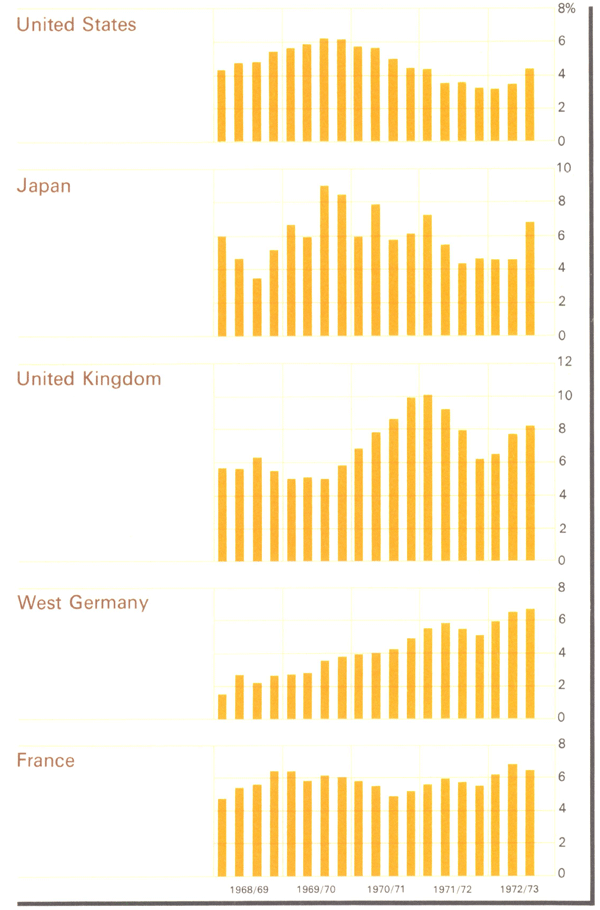
6 Consumer Prices Overseas
PERCENTAGE CHANGE OVER SAME QUARTER OF PREVIOUS YEAR
Idle resources accumulated to a substantial extent during the period of slow growth early in the ‘seventies. Recent rates of growth in most countries have been sufficient to bring these back into production and, towards the middle of 1973, it seems that margins of slack were generally small and diminishing.
Inflation
Most major countries have continued to experience price rises substantially greater than they would like (Graph 6). For a while the United States seemed to be achieving a degree of success in bringing down its rate of inflation. For instance, consumer prices grew by 3 per cent in the twelve months following the imposition of direct controls on prices and wages in August 1971, compared with about 4½ per cent over the previous corresponding period and about 5¾ per cent over the twelve months before that.
Few were prepared to concede that all of the reduction in the rate of inflation in the United States was attributable to controls but most agreed that prices would have increased faster without them. Certainly, many other countries seemed to be impressed by the apparent success of the United States measures and, during 1972, either introduced or extended controls over prices and incomes. In particular, in November, the United Kingdom imposed a general freeze on prices, wages, rents and dividends for three months with an option to extend it for sixty days at the end of that period. The United Kingdom Government subsequently announced (17 January) that the freeze would be extended for sixty days while the succeeding legislation was approved by Parliament. The legislation (which will apply for three years with provisions for extension one year at a time) established a Pay Board and a Price Commission to administer controls on wages, prices and profit margins.
Despite such measures and a general tendency for monetary and fiscal policies to begin to have greater regard for inflation, recent movements in prices have provided little cause for satisfaction. This has been especially so for the United States. Some deterioration in its position relative to other countries had been expected because its upswing was further advanced than elsewhere and Phase 3 of the Economic Stabilisation Programme, announced in January, replaced the bulk of mandatory controls on prices and incomes with voluntary guidelines (though the authorities retained the right to step in and enforce compliance with these guidelines). To these pressures were to be added, from February, the effects of further devaluation of its currency. In the outcome, prices gathered such momentum in the early months of 1973 that, in mid June, the United States again imposed a freeze on retail prices, this time for a maximum of sixty days.
Trade
The broad pattern presented above of rapid rises in output and prices is evident in statistics of world trade. In terms of volume, recent growth in world trade seems to have regained the high rate achieved in the late ‘sixties, i.e. about 9 to 10 per cent per annum. The acceleration in terms of value has been even greater.
Measured in United States dollars, the prices of manufactured goods entering into trade increased by only about 1 per cent per annum during the ‘sixties. The last few years have seen growth closer to 7 per cent per annum. Some of this merely reflects the devaluation of the United States dollar but a large part reflects the inflation experienced in the industrial countries.
Rising incomes in the industrial countries have had a profound effect on prices for the exports of primary-producing countries. For some commodities this has been compounded by disruptions to supply and, on average, export prices received by primary producers in 1972/73 were more than 20 per cent above those in the previous year (when expressed in United States dollars). Increased prices for food contributed importantly to this result but the rise in prices for non-edible agricultural products was even more substantial. In the main, this reflected the behaviour of prices for wool which, as far as the Australian clip was concerned, averaged nearly 150 per cent more at auctions in 1972/73 than they did in the previous year; at their peak (in March 1973) they were almost five times their end-1970 low point. Rising demand for wool during 1972/73 coincided with a contraction of supply, induced partly by the earlier period of poor returns.