
Reserve Bank of Australia Annual Report – 1973 The Australian Economy
There were marked similarities between trends in the Australian economy in 1972/73 and those indicated in the foregoing analysis of conditions elsewhere. For example, Australia, like a number of other countries, has recently entered a new phase of cyclical expansion; as elsewhere, demand responded during the period to fiscal and monetary stimuli and was sufficiently strong to cut into the relatively high volume of idle resources that existed at the start of the year. Thus, the unemployment rate, which started the year at 1.9 per cent and reached 2.1 per cent at its peak in August, was down to about 1.6 per cent by June 1973.
Australia, in common with other countries, also had problems with inflation in 1972/73. Tendencies towards restraint of price increases came from the strengthening of productivity in the nascent upswing of activity and from the appreciation of the currency. In the other direction, strong world demand and, in some cases, restrictions on supplies were raising prices for food and raw materials in particular. In the outcome, prices generally continued to increase here at an uncomfortably rapid rate and the outlook at the end of the year was cause for concern.
Another important common thread was, of course, the difficulties occasioned by the malfunctioning of the international payments mechanism. By some indications, these were greater in Australia than in almost any other country; they required decisive measures. Besides the appreciation of the Australian dollar in December 1972, there were substantial revisions to policies relating to capital flows into and out of Australia.
Domestic Balance
After more than two years of slackening pressures against domestic resources, economic activity in Australia moved to higher levels during 1972/73. The promise of brisker growth in private consumption given by its behaviour late in 1971/72 was fulfilled. To this was added continued strong growth in demand for housing and, as a partial reflection of a marked easing in fiscal policy, an acceleration in the public sector's domestic outlays on goods and services. The cessation of a decline in the rate of accumulation of non-farm inventories was also important. On the other hand, business fixed capital formation had still to join in the general buoyancy at year's end.
After allowing for the net out-turn on overseas transactions, demands on domestic productive resources displayed some quickening and, for all but the early months of the year, were moving up faster than the growth in productive capacity. Accordingly, there was a net reduction over the year in the extent of idle capital and labour.
Demand
Gross national expenditure, measured in constant prices, seems to have grown by about 3½ per cent in 1972/73 compared with only 1 per cent in the previous year. The speed-up was even more marked within the year. A modest slow-down in the growth of export volume was due largely to a curtailment of rural supplies by below-average seasonal conditions.
Public expenditure
In continuance of the easier stance of fiscal policy adopted in the second half of 1971/72, the Budget for 1972/73 provided for a substantial increase in the Australian Government's own spending on goods and services and for even larger rises in its transfer payments to persons (cash benefits) and state governments. Further expenditures approved during the year added to cash benefits in particular. In the outcome, total expenditure from the Budget increased by 14 per cent; this included rises of 9 per cent in outlays on goods and services, 25 per cent in cash benefits and 16 per cent in grants to states. Other sources of funds for state and local governments were also buoyant and it seems that these bodies increased their spending on goods and services by about 14 per cent in 1972/73.
Much of the 1972/73 increase in consumption expenditure by public authorities was absorbed in rising costs, continuing the pattern of other recent years. Consumption outlays in current prices probably rose by about 14 per cent and by about 6 per cent when measured in constant prices; the growth in real outlays came to 2 per cent in 1971/72. Capital outlays by public authorities in 1972/73 appear to have risen by about 6 per cent in current prices but to have declined a little in constant prices; however, the previous year's figures had been inflated by large purchases of civil aircraft overseas and the domestic component of government capital spending would have risen. In aggregate, the rise in spending on goods and services by public authorities in 1972/73 may have come to about 11 per cent in current prices and 3 per cent in real terms. Allowing once again for the pattern of aircraft purchases, the latter figure would include a rise in the domestic component somewhat larger than in other recent years.
Private Consumption
Entering 1972/73, consumers seemed, on the whole, rather more optimistic about the future course of their incomes than during the previous year or two. A number of fiscal initiatives earlier in 1972 had at least partly relieved anxieties about unemployment while prospects for the rural community had improved remarkably. In addition, consumer credit was in plentiful supply.
In the event, private consumption grew firmly during 1972/73; a remarkable rise in disposable incomes overshadowed any increase in the willingness of consumers to spend. Wage and salary incomes rose strongly though no faster than in other recent years; however, a very large rise in farm incomes and a substantial reduction in the rate of growth of net transfers to the Government (reflecting both a reduction in rates of tax on personal incomes and increased social service benefits) made household income buoyant. The rise in disposable incomes of households in 1972/73 may have been around 15 per cent, easily the largest increase in more than twenty years and somewhat greater than the rise in consumption.
The growth in real consumption in 1972/73, about 5 per cent, represented a marked acceleration from rates in the previous two years and a return to the higher rate of the late ‘sixties. Within the year, growth seems to have been somewhat faster in the second half. Outlays on motor vehicles showed signs of strengthening during the year after prolonged sluggishness. However, for the year as a whole they were below their 1971/72 level. Outlays on other items were generally buoyant throughout the year.
Private Fixed Capital Expenditure
Last year's Report noted the sharp reversal late in 1971 of the previous strongly rising trend in capital outlays by mining companies and associated groups in extracting, refining, etc. The downturn continued during the first three quarters of 1972/73 so that, even in current prices, capital outlays by the above groups in the March quarter were running at a rate well below half that recorded in mid 1971.
Amongst other industry groups, commerce and services, in particular, saw the year just ended as a propitious one for increasing outlays; spending by the latter group was kept buoyant not only by the large volume of office-building projects under construction at the start of the period but also by new work commenced during the course of the year. These new projects were begun despite frequent claims of an imminent, if not actual, glut of office space. Such projects are, of course, subject to long gestation periods and there are substantial outlays prior to the commencement stage. But decisions to go ahead could also be a reflection of the relative importance of immediate income and capital appreciation in calculations of expected returns. These returns are probably falling, however, and a period of slower growth in office construction may be near.
As the year advanced, an increasing proportion of manufacturers claimed to be working close to capacity; after excluding groups engaged in extracting, refining, etc., capital outlays by manufacturers during 1972/73 showed a rising trend after being virtually static over the previous two years or so. Outlays by rural producers also seem to have grown. On the other hand, investment in the transport sector was very sluggish.
Notwithstanding the considerable strength in capital spending by some groups, total private fixed business investment, measured in constant prices, declined sharply in the first half of 1972/73. There has been some flattening out since then but the total for the year as a whole was probably about 11 per cent below the previous year's figure; outlays on both buildings and structures, on the one hand, and plant and equipment, on the other, showed a fall of this magnitude.
Housing was in stark contrast with other major components of private capital outlays during 1972/73. Housing finance was in abundant supply during much of the year and local government approvals for the construction of private dwellings increased, in number, by 24 per cent. The rise in private commencements was not as spectacular as this but was still very substantial; there was an overall increase of 15 per cent, comprising increases of 16 per cent and 12 per cent for houses and flats respectively. Rising pressures on industry resources seem to have restricted the rate at which new projects were commenced and also to have lengthened construction times. Accordingly, the rise in the volume of work done was no more than about 9 per cent and prices grew faster than they did in most other areas of the economy. There was a large increase over the year in the number of dwellings under construction.
Stocks
For the second successive year holdings of non-farm inventories appear to have shown little net change over 1972/73; in 1970/71 there had been substantial accretions. These recent movements, combined with the stronger growth in spending, suggest that holdings are no longer above desired levels.
There was a further fall in stocks of farm produce in 1972/73. This was mainly the result of a coincidence of a poor crop and strong demand for wheat, stocks of which declined by about 90 million bushels (2.4 million tonnes).
Exports
The increase in the volume of goods and services exported in 1972/73, at about 6 per cent, was a little smaller than in other recent years. Growth in the first three quarters of the year was quite rapid despite a levelling out in the volume of rural products shipped; there was some decline in the June quarter when shipments of several rural items and some non-rural items fell. It is too early to gauge with any confidence the influence that the year's currency realignments have had on growth in export volume but effects before the end of the year were probably not very large.
Among rural items, the volume of shipments in 1972/73 declined for cereals, in particular, and also for sheepmeat; shipments of beef showed the strongest growth. For non-rural goods the rise was broadly based, but most apparent for iron ore, coal, chemicals, nickel, iron and steel and motor vehicles.
Supplies
Imports and domestic production both contributed to increased supplies in 1972/73 though a decline in farm production kept the rise in the latter to moderate proportions.
Imports
In the June quarter of 1972, the volume of goods and services imported was 12 per cent below its mid-1971 peak. The downtrend was reversed in the early months of 1972/73 and imports thereafter reflected both the magnitude and the composition of increases in domestic spending. By the June quarter of 1973, imports of goods and services, in volume terms, had easily surpassed their previous peak. Much of the impetus came from imports of consumer goods but producers' materials also contributed; on the other hand, the slowness of imports of producers' equipment reflected the sluggishness in domestic capital formation.
Production
The strengthening in demand noted above was met mainly by a marked speed-up in the growth of production in the non-farm sector. Taking the year as a whole, the rise in real gross non-farm product was probably more than double the previous year's 2.5 per cent. The speed-up is more apparent when results for six-monthly periods are examined (Graph 7).
Industrial production ended 1971/72 no higher than it had started, having dipped sharply around the middle of the year. At least before an upsurge of industrial unrest in June 1973, it continued to expand strongly during 1972/73 and, in terms of volume for the year as a whole, was probably about 6 per cent above the previous year's level. Detailed information for the first eleven months of the year shows that the increase was widespread but especially marked in categories for “furniture and household goods”, “textiles, clothing and footwear”, “chemicals and allied industries” and “fuel and power”.
Available information points to some easing in the growth of mineral production in 1972/73 but it nevertheless remained strong. Building and construction, on the other hand, seems to have had a dampening influence on the overall increase estimated for non-farm production; buoyancy in the housing component would have been largely offset by a decline in other building and construction. There are no direct measures of production in the service sector; it probably recorded a rise comparable with that for the non-farm sector as a whole.
In the farm sector, reduced sheep numbers and generally unfavourable seasonal conditions combined to produce a decline of about 5 per cent in the volume of production. The fall in production of wool appears to have been about 14 per cent and, in the face of rising prices for this commodity, there was a much larger fall in the production of lamb and mutton. The effect of these declines on total pastoral production, however, was more or less offset by a very large increase in production of beef and veal; the rise (about 24 per cent) was accomplished without any net depletion of cattle numbers over the year. Agricultural production declined sharply in 1972/73. There were declines in the production of most crops; the wheat harvest was over 20 per cent below that in 1971/72 and the smallest since the late ‘fifties. Production of other rural outputs (mainly dairy produce and pigmeat) showed little change overall.
The fall in rural output constrained the rise in aggregate national production in 1972/73. Real gross domestic product may have risen by about 4 per cent compared with 3 per cent in 1971/72; the average annual increase over the five years previous to that was almost 6 per cent.
The Labour Market
The relationship between increases in production and increases in employment is subject to a number of influences. These include changes in labour productivity (both secular gains and changes reflecting variations in the intensity of use of labour) and in the number of hours worked. The relationship would also be affected by the composition of the increase in production; labour-intensive activities would require a greater increase in the work force for a given increase in production. All these various influences can be distilled into one measure, output per worker (Graph 7). Large increases in this variable typically occur during the early phase of cyclical recovery and are evident in data for 1972/73; available statistics show that increased overtime working contributed to these results. Notwithstanding these movements, the growth in numbers employed quickened early in the financial year.
7 Non-Farm Production
1966/67 PRICES–SEASONALLY ADJUSTED—
HALF-YEARLY PERCENTAGE CHANGES
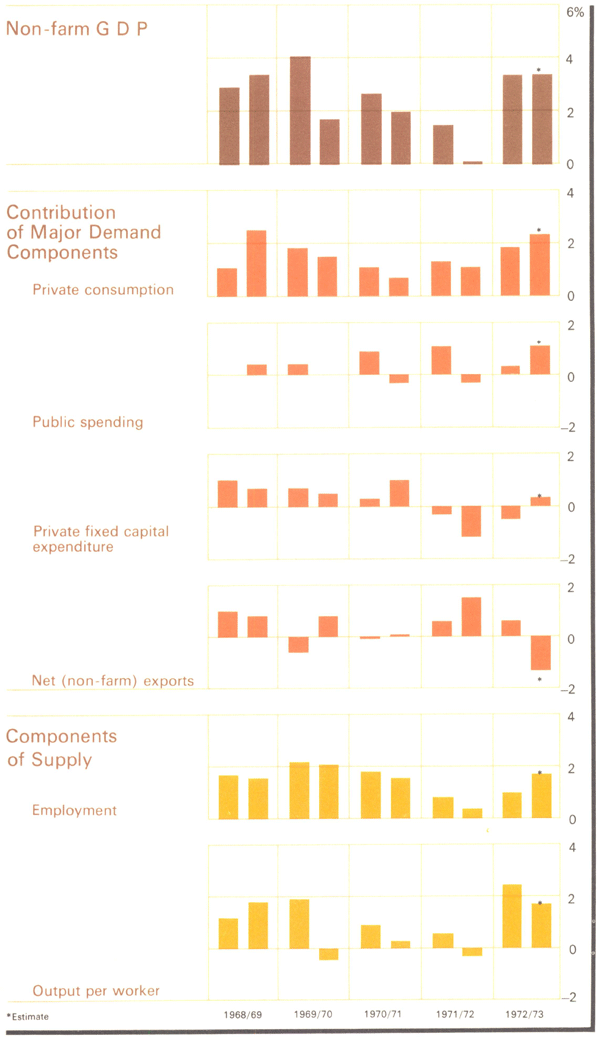
Initially, the acceleration in employment was most apparent in manufacturing; employment had been declining in this sector but then rose strongly over the three months to end November 1972. Thereafter, however, manufacturers met much of their increased need for labour through overtime working and there was little further growth in manufacturing employment over the remainder of the year. Apart from some rises associated with the introduction by the Government of a scheme to reduce unemployment in urban areas, employment in building and construction showed little tendency to grow during the year. Employment in transport and storage was practically static during the year but growth in employment in other service industries accelerated to rates comparable with those achreved prior to the recent slow-down. Overall, the rise in civilian employment over 1972/73 came to about 3 per cent compared with 1 per cent during 1971/72.
Employment needed to expand at an annual rate of about 1.7 per cent during 1972/73 to hold steady the proportion of the working-age population at work. This was the rate at which natural increase and migration were adding to the population of working age and compares with a figure a little in excess of 2 per cent a few years ago when the net inward flow of migrants was greater. Net immigration, of course, is not independent of labour demand and the lower rates recently would have been at least partly the result of the earlier more difficult conditions confronting job-seekers; likewise, any improvement in these conditions could be expected, after a while, to have a positive effect on net immigration. Effects could, of course, be modified by official migration programmes.
As indicated in the statistics of civilian employment, growth in demand for labour during 1972/73 exceeded that in numbers available for employment and, consequently, there would have been a reduction over the year in the proportion of the working-age population not in jobs. Evidence of this is provided in the statistics of applicants registered for employment with the Commonwealth Employment Service.
Entering 1972/73, the ratio of registered unemployed applicants to the work force was at a high level, having increased more or less steadily over the previous two years or so. There was a further rise in the early months of 1972/73 but thereafter demand for labour began to outrun the additions to supply and the ratio tended to decline. In terms of numbers, applicants (not seasonally adjusted) declined from 99,200 at June 1972 to 81,400 at June 1973. For reasons which are not altogether clear at this stage but which could evidence greater selectivity on the part of employers in the face of rapid growth in wages, much of the increased demand for new workers recently has not been satisfied. Over 1972/73, the number of unfilled vacancies on the books of the Commonwealth Employment Service increased by 30,000 to 54,500 (not seasonally adjusted); growth was extremely rapid in the second half of the year. The tightening in labour market conditions has been felt in all states and has affected both metropolitan and non-metropolitan areas. It is apparent in all the major occupational classifications of workers.
Incomes and Prices
In money terms, the rise in gross domestic product in 1972/73 appears to have exceeded 12 per cent; increases of about 10 per cent had occurred in each of the previous three years. The acceleration between the two most recent years reflected not only a larger increase in volume but also a bigger rise in prices. The latter occurred despite a reduction in the growth in prices for non-farm product and reflected a very large increase in prices in the farm sector.
Mainly because of soaring export prices, particularly for wool but also for a number of other important commodities, average returns on farm products may have risen by between 25 and 30 per cent in 1972/73. This rise completely overwhelmed the decline in the volume of production and expanded gross proceeds by more than 20 per cent. After allowing for costs of production, income accruing to farm enterprises in 1972/73 was approximately 75 per cent above its average level over the previous five years and about 20 per cent above its previous peak (in 1950/51).
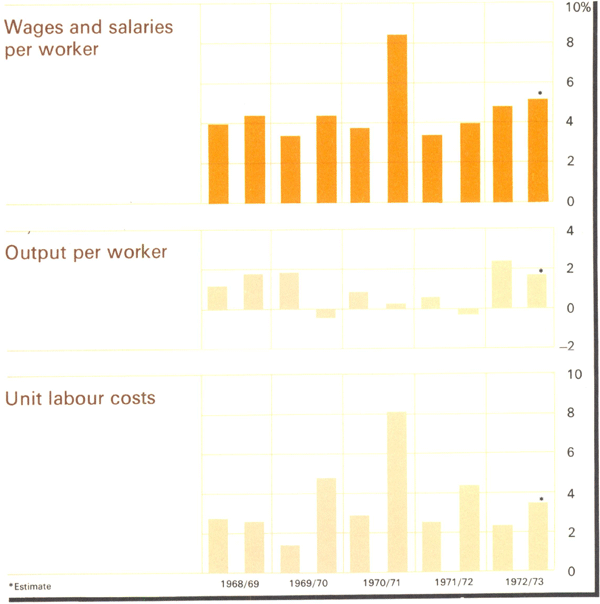
Prices paid for the output of the non-farm sector rose by about 7½ per cent in 1971/72 but appear to have risen by no more than 6 per cent in 1972/73. On a full-year basis, average wage and salary earnings showed a smaller rise in the latest year but the rate of growth was tending to increase during this period (Graph 8). A decision in the 1971 national wage case was delayed and became effective halfway through the second quarter of 1972; it therefore had a sizeable impact on earnings in the first quarter of 1972/73. Further increases in awards and in overtime and other extra-award payments kept earnings rising quite strongly over the next two quarters. The 1972 national wage case opened late in that year but the Bench declined to give a decision so soon after the previous one and ruled that the case should be reconsidered in March 1973. The judgment arising from the adjourned sittings provided for an increase in weekly wages of $2.50 plus 2 per cent of award, and of $9 per week in the minimum wage, effective from the first pay period beginning on or after 29 May. These relatively large rises had some impact on earnings in the June quarter but their full effects (on earnings and prices) are yet to be seen.
The good gains achieved in output per worker during 1972/73 have already been mentioned; as a result of these and the smaller rise in average earnings, labour costs per unit of non-farm output increased somewhat less than they did in 1971/72. There was also a smaller addition to prices in 1972/73 resulting from the activities of the public sector, as indicated in this context by surpluses of public enterprises and indirect taxation. On the other hand, private profits per unit of non-farm output grew faster in 1972/73 than they had in the previous year; growth in the gross operating surpluses of private non-farm trading enterprises went from 6 per cent in 1971/72 to about double this figure in 1972/73.
8 Earnings, Productivity, Unit Labour Costs
HALF-YEARLY PERCENTAGE CHANGES—
SEASONALLY ADJUSTED NON-FARM SECTOR
The relationship between the deflator for gross domestic product and prices confronting Australian spenders, of course, is affected by the terms of trade. It is estimated that average returns on exports of goods and services in 1972/73 were about 16 per cent above those in the previous year; the rise was much more pronounced for rural items than for other goods and services. The general buoyancy in world export prices has already been mentioned (page 14). Against this, various currency realignments acted to reduce unit returns for exports when expressed in Australian dollars. The former influence clearly prevailed.
Prices for imports of goods and services in 1972/73 were also subject to the opposing forces of overseas inflation on the one hand and currency realignments on the other. In their case, the latter predominated. The terms of trade thus moved strongly in our favour in 1972/73 and prices paid for goods and services by Australians rose by substantially less than indicated by the deflator for gross domestic product and somewhat less, in fact, than they had in 1971/72.
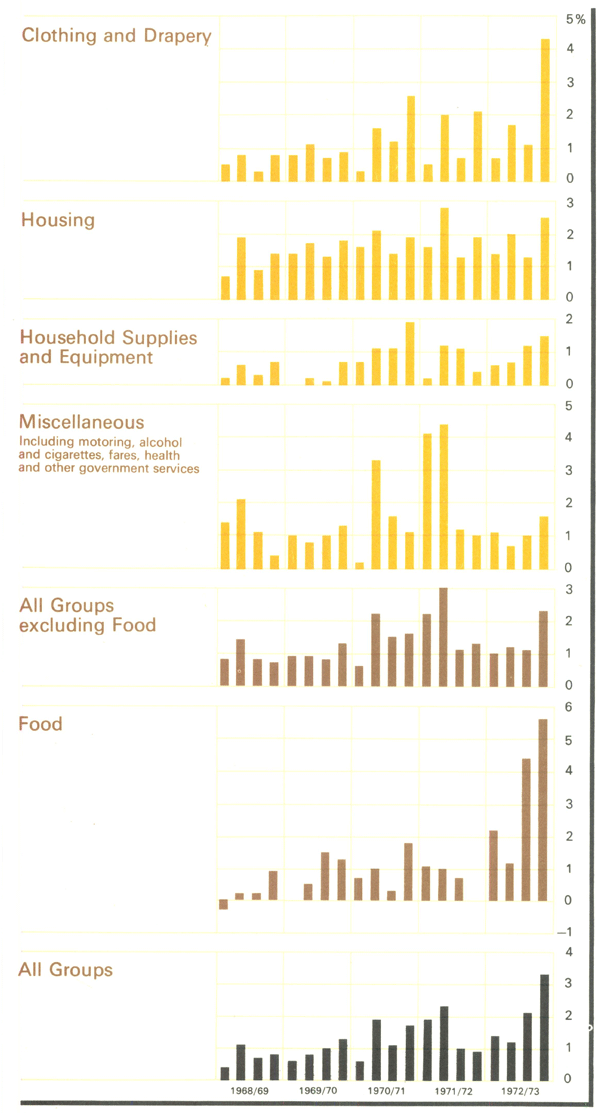
This tendency towards some easing in the growth in prices of domestically-consumed product is apparent in the non-food sector of the consumer price index (Graph 9); the rise for non-food items over the twelve months to June 1973 was 5.9 per cent compared with 7.7 per cent over the previous year. Rises for component groups were: clothing and drapery 8.1 per cent (5.4 per cent in the previous year), household supplies and equipment 4.1 per cent (2.9 per cent), housing 7.4 per cent (7.7 per cent) and miscellaneous items, which benefited, in particular, from the absence of any significant rises in public authority taxes and charges, 4.4 per cent (11.1 per cent). The last-mentioned component is weighted about twice as heavily in the index as each of the other three non-food components. After rising quite strongly in the first half of the year, prices for food soared in the final six months to show a rise of 14.0 per cent for the year as a whole (against 2.8 per cent during 1971/72). Meat, which is heavily weighted in the index and was in strong demand during the year, contributed most to this result. The acceleration in the food component was sufficient to produce a rise in the overall index in 1972/73 somewhat greater than in other recent years; the increase of 8.2 per cent compares with 6.2 per cent over 1971/72 and an average of 3.6 per cent per annum over the five years to June 1971.
Growth in consumer prices in coming months will be restrained by any easing in food prices. Further beneficial effects from the appreciation in December 1972 of the Australian dollar are still likely and these will be added to by the effects of the recently-announced cuts in tariffs. Proposals to impose direct restraint on prices could also be relevant to their rate of growth in the near future. But it remains to be seen to what extent these various factors can offset the strong emerging pressures for price increases; activity is moving to higher levels, domestic costs have risen strongly and inflation elsewhere in the world has yet to be checked.
9 Consumer Price Index
QUARTERLY PERCENTAGE CHANGE IN COMPONENTS
Balance of Payments
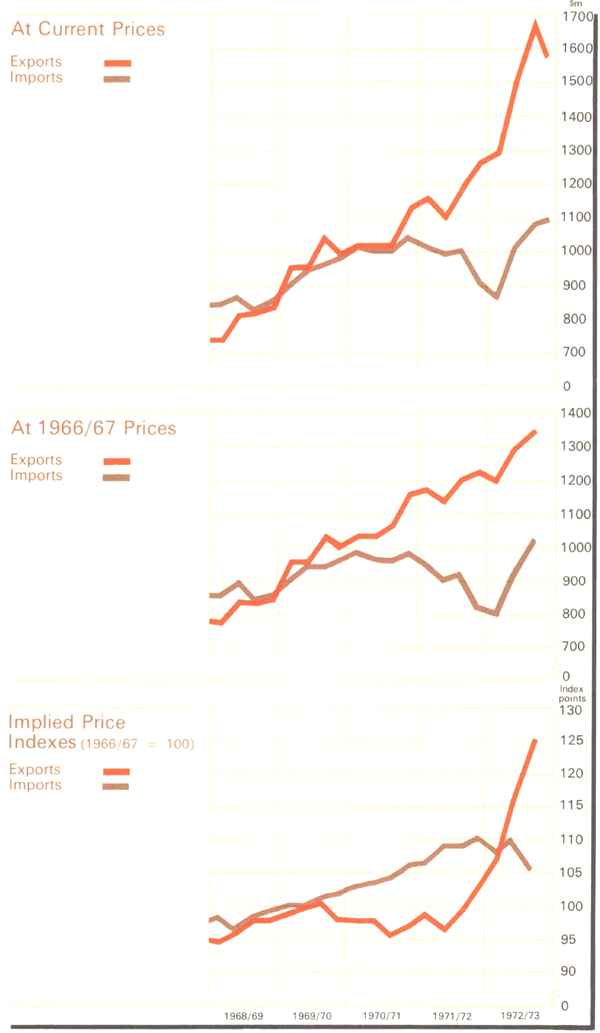
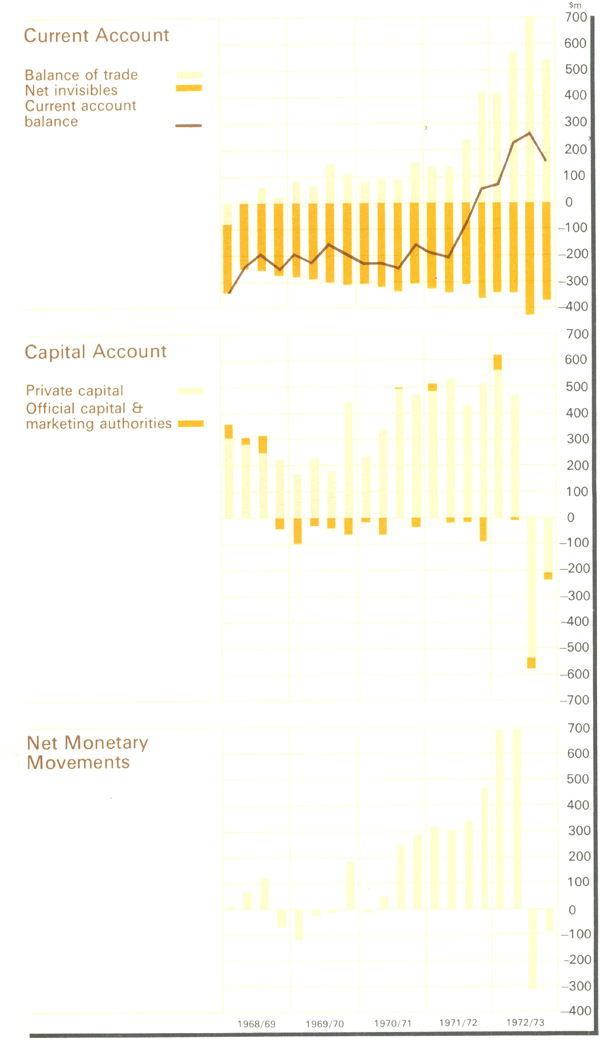
The sharp fluctuations in Australia's balance of payments during 1972/73 are shown in Graphs 10 and 11.
Current Account
Mainly because of the large rise in prices, exports of goods on a balance of payments basis increased in value by 27 per cent to $6,002 million in 1972/73. The value of wool exports, which doubled, accounted for half of this increase; beef, which benefited from both higher quantities and prices, also made a very large contribution; of the other major categories of exports only cereals, for which a decline in shipments easily outweighed a gain in unit returns, failed to show a substantial rise. Within the year, growth in total exports was particularly strong until the final few months. Thus, after allowing for seasonal influences, there was an increase of 30 per cent between the June quarter 1972 and the March quarter 1973 but a fall of 5 per cent in the following three months.
The rising trend in the volume of importing during 1972/73 was offset to some extent by declines in import prices but there was nevertheless strong growth within the year in the value of goods imported. Because of a low starting level, however, full-year figures show virtually no change in the cost of visible imports from their 1971/72 level of $3,791 million (on a balance of payments basis).
The above figures indicate a visible overseas trade surplus in 1972/73 of just over $2,200 million, more than double the previous year's surplus which, at $938 million, had been easily a record up to that time; the latest figure, in fact, was about equal to the cumulated surplus over the previous fifteen years. The surplus reached a seasonally adjusted annual rate of about $2,800 million in the March quarter but fell to $2,150 million in the following quarter.
Australia's trade in services in 1972/73 showed a deficit of about $650 million, compared with $550 million in the previous year; there was a large rise in payments for travel while, among the credits, transportation did best. Additionally, there was an increase of about $40 million to $860 million in net property and other transfer payments; rises in earnings on international reserves and private investments abroad failed to match a broadly-based rise on the debit side. The overall deficit on invisible transactions came to about $1,500 million.
10 Overseas Trade — Merchandise
SEASONALLY ADJUSTED
Combining the above elements, there was a surplus of just over $700 million on overseas current account in 1972/73. There had been a deficit of $416 million in 1971/72 and deficits had averaged about $700 million per annum in the decade ending in that year. The previous surplus occurred in 1956/57.
Capital Account
The year just ended was remarkable for the variety of major influences on capital flows into and out of Australia and for their dramatic turn-around.
Net private capital inflow into Australia came to about $1,960 million in 1971/72; this compares with the previous year's $1,550 million which itself greatly exceeded any previous figure. As mentioned in last year's Report, policy towards capital flows had been put under review by the Government during 1971/72.
During the period of high and rising capital inflow, cyclical factors had contributed importantly to the strengthening of our balance of payments. As time went by, however, it seemed that measures which changed the value of the Australian dollar or imposed restrictions on capital flows would be needed; such views added to the problems posed for monetary management by stimulating capital inflow even further. Statistics of exchange control approvals indicated that much of the inflow was in forms that did not increase overseas ownership or control, was short-term and was at the initiative of Australian-controlled companies.
In the face of an unabated flow of capital during the early months of 1972/73 and rapidly rising international reserves, a number of changes were announced on 26 September in policy concerning overseas investment in Australia and investment overseas by Australian residents. The changes were as follows:
11 Balance of Payments
SEASONALLY ADJUSTED
- from 27 September, Australian residents, including foreign companies resident in Australia, were refused exchange control approval for all overseas borrowings which would be repayable, or carry options to repay, in two years or less. Loan agreements which had already received exchange control approval, whether drawn upon or not, were not affected. In conjunction with this measure, the sterling area exemption was revoked; under this provision, certain types of transactions between persons and companies in Australia and residents of overseas sterling area countries had been exempted from the application of exchange control regulations.
- guidelines relating to borrowing in Australia by overseas-owned companies were abolished. From May 1965, the Government had laid down certain guidelines which limited the freedom of overseas-owned companies to borrow in Australia. One effect of the guidelines was to encourage overseas-owned companies to bring in funds from overseas in place of funds which they had not been permitted to borrow locally.
- the policy under which portfolio investment abroad by Australian residents was not permitted was eased. However, exchange control approval of such transactions is still required; by 30 June 1973, approvals for this form of capital outflow amounted to about $30 million.
- measures were brought into immediate effect on an interim basis from 26 September to control foreign takeovers considered by the Government to be contrary to the national interest. The foreign takeover measures apply to acquisitions of shares or other assets by overseas interests which might reasonably be expected to result in control of an Australian business passing to overseas interests. The measures also apply to the transfer of a significant part of the ownership or rights over a valuable or potentially valuable mineral area. The Companies (Foreign Take-overs) Act 1972 which came into operation on 9 November 1972 provided legal backing to these measures insofar as they related to foreign takeovers of companies through the acquisition of shares.
These measures seemed to have an immediate impact in that there was a sharp reduction in exchange control approvals for inward capital movements in October; in respect of loan capital, these approvals measure large flows at the time at which they occur and hence the falling-off was also apparent in indicators of movements of funds during the month. However, approvals began to increase again in November; this was due, in part, to inflows of previously approved borrowings but also reflected new borrowers' rearranging their loan terms to periods beyond two years and eliminating from their loan agreements options for early repayment. This trend not only continued into December but intensified; it was clear that many felt further measures were in the offing and were seeking to forestall them. Both exchange control approvals and actual inflow began to approach the record rates of the previous September and international reserves, reflecting also a rapidly growing surplus on current account transactions, were bounding upwards.
One other aspect of the developing situation concerned the provision of forward exchange cover to Australian traders by the banks and the banks' covering of their own net forward positions with the Reserve Bank. There had been heavy recourse to these facilities in June 1972 and the Bank's over-purchased forward position more than doubled during that month to the equivalent of $900 million. Facilities were suspended temporarily following the floating of sterling. On 10 July 1972, a new system of forward exchange arrangements was introduced, based on a discount (or premium) for the United States dollar. Initially a forward discount for the United States dollar of 1 per cent per annum was set; it was increased to 2 per cent per annum on 17 July 1972. The Bank imposed limits on the amount of cover it would automatically provide for banks on any one day.
The Bank's outstanding risk on forward exchange contracts remained fairly close to the end-June figure till late in November 1972. There was then a strong upward surge in the outstanding risk to over $1,300 million on 22 December, notwithstanding further increases in the forward discount to 2.5 per cent per annum on 1 December and to 4 per cent per annum on 7 December.
While the September exchange control measures and the subsequent depletion of approvals for short-term borrowings outstanding at the time of these measures were likely to begin to be reflected in reduced rates of capital inflow, it was becoming increasingly clear that additional measures would be required to restore some balance to our external accounts. On 23 December, therefore, the Government formed after the elections on the second of that month announced a revaluation of the Australian dollar and a strengthening of existing measures to control the volume of capital inflow.
The parity of the Australian dollar, expressed in terms of the United States dollar, was changed from US $1.2160 = $A1 to US $1.2750 = $A1, representing an appreciation of 4.85 per cent. At the same time the market rate was fixed at the new parity, giving an overall appreciation of 7.05 per cent over the previous market rate of US $1.1910 = $A1. The forward discount for the United States dollar reverted to 1 per cent per annum.
It was also announced that the existing embargo on overseas borrowings repayable, or carrying options to repay, in two years or less would be retained and its coverage broadened. This measure was supplemented by the introduction of a variable deposit requirement scheme in respect of overseas borrowings with a maturity in excess of two years. Under this scheme, borrowers are required to lodge a non-interest-bearing deposit with the Reserve Bank as drawings take place. Deposits are to be held for the period of the loan and to be refunded proportionately as loan repayments are made. The deposit percentage, which can be varied from time to time, was set initially and remains at 25 per cent. No deposit is required in respect of borrowings specifically to finance trade transactions on normal trade credit terms or on borrowings not exceeding $100,000 in the aggregate over any period of 12 months. Since 1 February, restrictions on capital flows have encompassed indirect forms of borrowing and transactions having a similar effect on capital inflow.
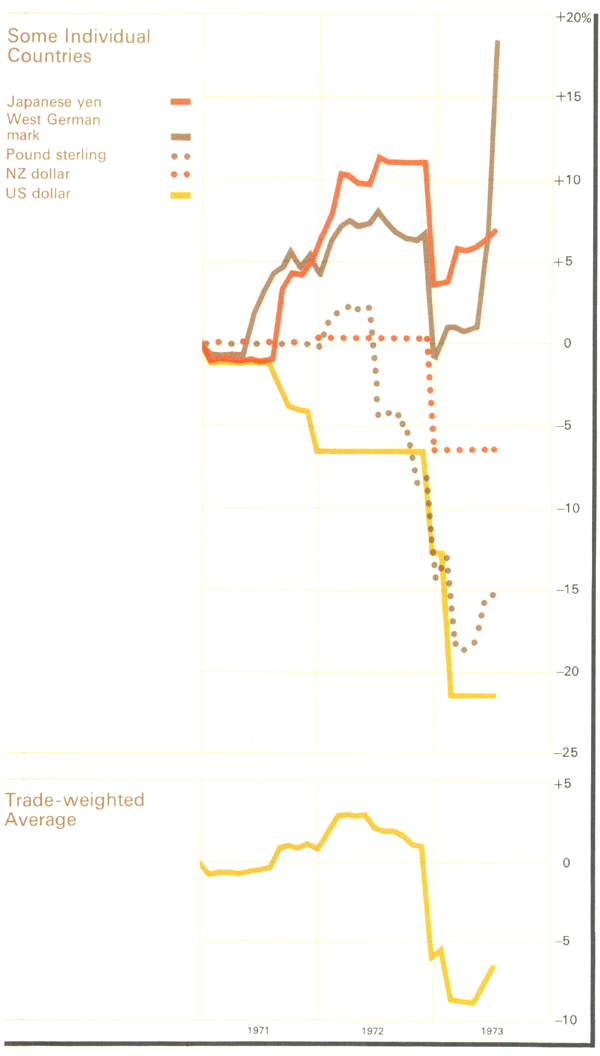
12 Exchange Rates
CURRENCIES OF AUSTRALIA'S MAIN TRADING PARTNERS—
APPRECIATION(+)/DEPRECIATION(−) AGAINST $A
SINCE END 1970 (BASED ON END-MONTH MARKET RATES)
After 23 December, the various measures taken were clearly reflected in statistics of exchange control approvals and capital flows; January 1973 was the first month for many years in which there was an apparent net capital outflow on private account. Net new forward purchases of foreign exchange by the Bank fell away immediately following revaluation though they rose strongly after mid January in response to renewed speculation against the United States dollar; the forward discount was raised to 2 per cent per annum on 30 January. By 9 February, just prior to the closing of world foreign exchange markets (see page 9), the outstanding net risk greatly exceeded the level at 22 December. All dealings in foreign exchange by Australian banks were suspended on 12 February.
Between its December revaluation and mid February, the Australian dollar effectively appreciated by a few percentage points against other currencies as a net result of the United States devaluation (which moved the rate of exchange between the Australian and United States dollars from US $1.2750 = $A1 to US $1.4167 = $A1) and the floating of some other major currencies. When foreign exchange dealings were resumed here on 14 February, following an indication from the Australian Treasurer that the par value of the Australian dollar had not been changed by the United States decision, approvals for the repatriation of capital jumped immediately to very high levels. Actual outflow showed an even greater upsurge, aided probably by a reversal of previous trends in leads and lags in respect of payments for trade, and came to over $300 million in February, concentrated in the second half of the month; for a while, the Bank was a net forward seller of foreign currencies.
Being tied to the United States dollar, the Australian dollar tended to depreciate, in effect, over the remaining months of 1972/73 as the floating of other currencies for the most part substantially appreciated their exchange rates against the United States and Australian dollars (Graph 12). During this period, exchange control approvals for inflow remained at rates less than half those during 1972 but approvals for repatriation of capital returned quickly to their pre-February rates and inflow of private capital was about balancing outflow in the closing part of the year. In June, the performance of the United States dollar in overseas currency markets stimulated demand for forward exchange cover in Australia and the Bank's outstanding net risk exceeded $1,700 million at the end of the year; the forward discount on United States dollars was raised to 4 per cent per annum on 29 June.
Net private capital outflow in the second half of the year exceeded $650 million and was a little less than $300 million short of the net inflow in the first half of the year. After allowing for a small net outflow of capital on account of official and marketing authorities' transactions, overall net capital inflow in 1972/73 came to $270 million, the smallest figure since 1961/62.
Monetary Movements and Reserves
The overall surplus in the balance of payments in 1972/73 was $980 million; the surplus in the first half of the year was $1,269 million (not seasonally adjusted) but total net capital outflow exceeded the surplus on current account by $289 million in the second half.
Australian dollar equivalents of our holdings of official reserve assets are shown in the table below; when converted on the basis of official parities, they increased by $567 million over 1972/73. It used to be a simple matter to gauge from such figures the extent to which transactions with the rest of the world had added to domestic liquidity. More recently, with exchange rates varying widely from time to time, this is no longer so. For instance, the appreciation of the Australian dollar in December and the devaluation of the United States dollar in February each reduced the Australian dollar equivalent of official reserve assets by a little over $230 million.
| Converted on basis of official parity relationships | Valued at market rates* | |||||
|---|---|---|---|---|---|---|
| 1971 | 1972 | 1973 | 1971 | 1972 | 1973 | |
| Gold | 227 | 233 | 220 | 227 | 233 | 220 |
| Special Drawing Rights with IMF | 146 | 209 | 200 | 146 | 209 | 200 |
| IMF Gold Tranche | 186 | 149 | 143 | 186 | 149 | 143 |
| U.S. Dollars | 696 | 1,345 | 2,028 | 696 | 1,373 | 2,064 |
| Sterling | 947 | 1,657 | 1,484 | 969 | 1,594 | 1,334 |
| Other Foreign Exchange | 77 | 171 | 255 | 77 | 179 | 286 |
| Total | 2,280 | 3,764 | 4,331 | 2,301 | 3,737 | 4,248 |
| * Gold, SDR's and IMF gold tranche converted to Australian dollars on the basis of Australia's official parity with the IMF. Figures for 1973 have been affected by the change in accounting procedure whereby the foreign currency value of overseas securities in the Bank's balance sheet now reflects current market values. Previously these securities were generally included at the lower of cost or face value. | ||||||
Exchange Guarantees
In common with most other members of the O.E.C.D., Australia has taken part, from 1 January 1973, in an agreement whereby working balances (defined within narrow limits and involving relatively minor amounts) held by central banks in the currencies of other members are guaranteed against exchange loss due to devaluation.
The Sterling Guarantee Agreements between the United Kingdom and other members of the sterling area continued to operate during 1972/73; Australia had agreed to maintain the proportion of sterling in its reserves (as defined in the Agreement) at or above 36 per cent. In January 1973, the Bank received from the Bank of England an amount of £12,851,419 (equivalent to $A26.3 million at official parity relationships or $A23.7 million at market rates then prevailing) due under the Agreement, which provided for compensation if sterling remained more than 1 per cent below US $2.40 for 30 consecutive days; the rate fell below US $2.3760 on 24 October 1972 and on 23 November was US $2.3506. The present agreement expires in September 1973; arrangements after that date are still to be determined.
Financing
Financial conditions were very easy in the early months of 1972/73. Since then, the increase in activity, exchange control measures, exchange rate movements and some policy actions have all tended to cause a tightening in conditions and interest rates have risen.
Financial Trends
As 1972/73 opened, private incomes were expanding strongly but a high propensity for saving limited the growth in expenditure. Possible explanations of the high rate of saving could include a lingering pessimism on the part of both consumers and producers about future prospects and attempts to restore the purchasing power of previous savings. But the sheer pace of expansion of incomes was also a factor.
Interest rates on financial assets at the start of 1972/73 were still fairly high by past standards though somewhat lower than a year or so previously and still under downward pressure. Moreover, in view of the rapid rate of growth in prices that had occurred, the attractiveness of these rates, at least to domestic asset-holders, had probably declined by more than was suggested by changes in their nominal values. At the same time, the attractiveness of real assets was probably beginning to rise (given inflation and expected higher levels of activity) and, all in all, it seemed likely that spending would be increasingly financed through running down financial assets or borrowing. It was notable that much of the growth in holdings of financial assets was occurring at the liquid end of the spectrum; as far as borrowing was concerned, there was a common expectation that the future burden of liabilities denominated in some foreign currencies would decline. The low level of resource use at the start of the year provided some room for manoeuvre but the situation was obviously volatile.
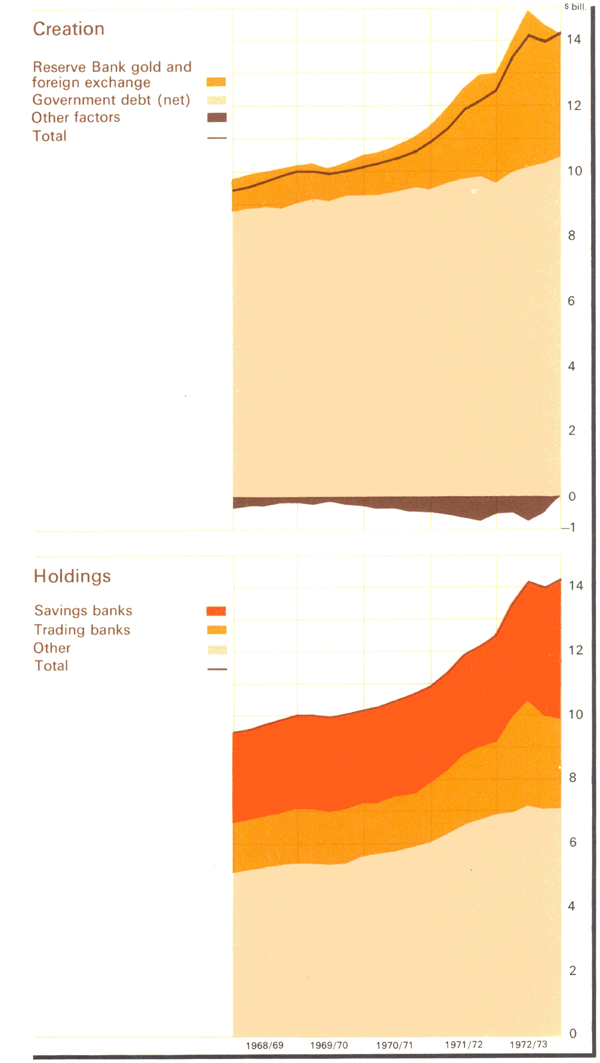
Demand for government securities was extremely strong during the first seven months of 1972/73. Loan raisings were buoyant and the Bank made heavy sales of bonds; subscriptions to Treasury notes were even stronger and the amount on issue easily bettered previous peaks. The heavy demand arose because of factors such as the size of the private sector's financial surplus (which reflected strong desires for saving and a sharp improvement in our terms of trade) and the gains expected by foreigners from having assets denominated in Australian dollars and by Australians from having liabilities denominated in some other currencies. Each of these factors was tending to increase private holdings of LGS assets (cash, cash with the Reserve Bank and Australian Government securities). At their peak in mid February 1973, these holdings were about $3,000 million above their level at the start of the financial year; this rise was about half as much again as the rise in the corresponding period of the previous year, which itself had been easily a record.
13 LGS Assets
AT END OF QUARTER,
SEASONALLY ADJUSTED
The heavy demand for government securities put considerable downward pressure on yields but, in view of the outlook for domestic activity and prices, the authorities did not let this pressure reflect fully in the prices of these securities. The Government cash loan in August 1972 embodied rates which had been established in trading immediately beforehand. Compared with those offered in the May 1972 loan, rates were down 0.4 of a percentage point for short maturities, were only very slightly reduced for medium maturities and unchanged for long-term issues. Issue yields on Treasury notes, which had already been trimmed in June 1972, were reduced again in July, September, October and December.
Financial conditions were clearly very easy in the first half of the year. The end-September measures aimed at bringing the external situation closer to balance had little effect on desires to incur liabilities overseas and probably even increased them. Partly because of exchange control approvals for short-term borrowing granted before the measures came into effect, there was not much reduction before the end of 1972 in the rate at which funds were arriving from overseas. However, the appreciation of the Australian dollar and the further exchange control measures in December were followed by an immediate reduction in the volume of overseas borrowings and demands on the domestic market began to increase.
These processes were reinforced after mid February when the United States dollar was devalued and the parity of the Australian dollar was not changed. At that stage, it may have seemed to many that, in terms of overseas currencies, the value of assets held here could fall and that, in terms of Australian currency, the cost of repaying liabilities incurred in foreign currencies could rise. The sudden tightening in financial conditions induced by the capital outflow resulting from these beliefs was manifest in some discomfort in markets for short-term funds in particular and in increases in a wide range of interest rates on private assets and liabilities. This, in turn, encouraged some who were concerned about the future cost and availability of funds to approach the market at that time.
For a while, the private sector met liquidity demands by making heavy sales of government securities to the Bank and by rediscounting Treasury notes. During March, however, increasing reluctance on the part of the Bank to purchase government securities was evidenced in some rises in yields. Initially, pressures were concentrated on prices of shorter maturities but, by end April, yields had risen over the entire maturity spectrum; during that month the Bank also raised the Statutory Reserve Deposit ratio for the major trading banks by 1 percentage point to 7.6 per cent. Following a period of stability around the May loan, yields rose further in the final part of the year in the face of continued reluctance by the Bank to buy securities.
In the later part of the financial year, private incomes were still running well ahead of private spending but desires to reduce overseas liabilities caused a much larger than usual decline in private holdings of LGS assets from their seasonal peak. Even so, these holdings finished 1972/73 about $1,700 million above their starting level. In the previous year holdings had increased by $1,460 million. Taken together, the last two years have seen private holdings of LGS assets increase by almost 30 per cent (Graph 13).
There was still plenty of scope at year's end for spending to be boosted by running down financial assets or borrowing. The cost of doing so had increased somewhat, at least in nominal terms. As far as government securities were concerned, the rates offered in the July 1973 loan were up on those offered in February by amounts ranging from 1.4 percentage points for short-term securities to about 1 percentage point for longer-term securities. Over the same period, issue yields on Treasury notes rose by about 1.2 percentage points. However, with bank lending continuing to run very strongly and expenditure pressing more heavily upon available resources, the Bank considered, early in July, that further tightening in monetary conditions was warranted. Accordingly, it announced that the Statutory Reserve Deposit ratio for major trading banks would be increased by a further two percentage points during August.
Public Finance
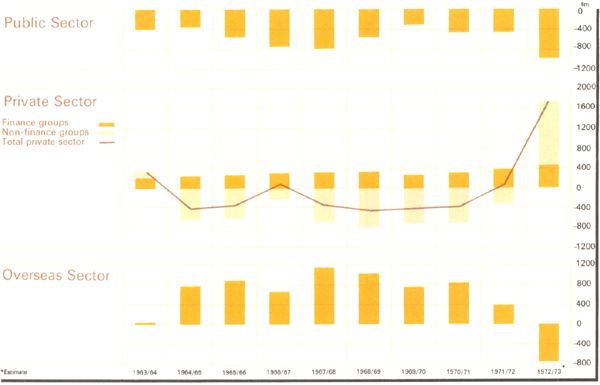
As already indicated, private incomes in 1972/73 greatly exceeded private outlays and the surplus, in fact, seems to have been of the order of $1,750 million; this result represents a substantial quickening of a trend which, in 1971/72, saw private incomes and outlays in approximate balance following four years of large deficits. The counterparts to this latest result were large financial deficits in the accounts of public authorities and the rest of the world (the latter as reflected in the balance of payments on current account). These results represent a marked departure from the more usual pattern of borrowing and lending between the private sector, the public sector and the rest of the world (Graph 14).
Within the public sector, on a national accounts basis, the Australian Government's receipts in 1972/73 rose by about 6 per cent; expenditures (total outlays less net advances) rose by about 14 per cent. Receipts therefore exceeded expenditures by considerably less than they had in 1971/72. The smaller excess was the major factor behind the sharp rise in the overall deficit of public authorities in 1972/73.
In budgetary presentations of the Government's financial position, an overall surplus or deficit is struck after taking account not only of the difference between expenditures and receipts but also of net advances to state governments, Commonwealth authorities (the Post Office, Qantas, the Australian Wheat Board, etc.) and the private sector. Allowing for these, total outlays from the Budget in 1972/73 exceeded receipts by $709 million; both this deficit and the Government's need for finance within the year were much higher than in other recent years. The composition of the Government's borrowing during the year reflected current and expected interest rates, the balance of payments and the fortunes of various intermediaries.
14 Sector Financing
NET LENDING (+)/BORROWING(−)
In the first part of the financial year, as previously indicated, the private sector chose to increase greatly its holdings of claims on the authorities. Some of the increase in holdings of LGS assets over this period was in the form of currency and deposits with the Bank but there was an exceptionally large rise in holdings of government securities.
By the end of January 1973, when the deficit in the Government's accounts had reached its seasonal peak (at $1,682 million compared with $1,539 million in the previous corresponding period), private holdings of government securities had increased by over $2,200 million, having risen by a little less than $1,600 million in the seven months to January 1972. Between these two periods the size of the increase in banks' holdings of government securities almost doubled to about $1,750 million but the aggregate rise in non-bank holdings was down by $210 million; within the banking group, movements in each year were very largely in holdings by trading banks.
A much larger proportion of the deficit was financed by Treasury notes in the later period; net issues between end June 1972 and end January 1973 came to $1,176 million, compared with $546 million in the previous corresponding period. This, no doubt, reflected a precautionary attitude on the part of holders in the face of greater than usual uncertainty (particularly about the size and direction of international capital flows) and a widespread view that the next movement in the general level of interest rates would be upward. In contrast, net new issues of other securities by the Government declined slightly between the two periods; there was one less loan floated in the later period. Notwithstanding this decline, total net issues of securities by the Government over the first seven months of the year were so large that it substantially increased its cash balances with the Bank over this period, in contrast with the usual pattern of heavy short-term borrowing from the Bank prior to the main tax-gathering season.
The heavier-than-usual surrender by private groups of claims on the authorities after mid February was reflected in the holdings of government securities by trading banks in particular. But the holdings of these banks nevertheless showed a large increase over the full year; the rise was about $460 million compared with about $380 million in 1971/72. Savings banks' holdings of government securities also showed a sizeable increase for the year as a whole. On the other hand, private non-bank holdings of government securities, which had risen by $700 million in 1971/72, declined by about $50 million over the latest year; this mainly reflected a marked change in the activities of short-term money market dealers.
In total, private holdings of government securities increased by about $800 million over 1972/73; this exceeded the Government's domestic borrowing requirement by about $70 million, implying an increase of this order in its net claims on the Bank. Thus, an increase of $111 million in holdings of securities by the Bank was accompanied by an increase of approximately $175 million in Government balances with the Bank.
It is tentatively estimated that state and local government authorities incurred a deficit in excess of $1,000 million in 1972/73. Besides the net advances from the Australian Government mentioned above, the other main sources of loan funds for this group were the issues by local and semi-governmental authorities.
Gross raisings by these bodies came to approximately $640 million, of which private loans yielded about $610 million; corresponding figures in 1971/72 were $550 million and $501 million. The rates of interest offered on these issues reflect yields on Australian Government securities.
Private Finance
Among private groups, home buyers in particular and persons in general maintained a strong demand for loans throughout the year. Demand by businesses for finance was not especially strong but, in the second half of the year, a far greater proportion of it was met from domestic sources, mainly bank loans. The watershed in financial conditions associated with the turn-around in overseas capital movements is reflected in the indicators of interest rate trends shown in Graph 15.
Direct financing by borrowers in domestic money markets did not attain particularly high levels during 1972/73. This mainly reflected the reluctance of businesses to replace or expand capacity. Raisings of new money through share capital issues were at low levels in the nine months to March 1973. Share prices dropped sharply when the sterling float began late in June 1972 and drifted further downwards in the early months of 1972/73; the ground lost over this period was regained by mid January but a preponderance of sellers caused prices to drop by almost 20 per cent over the next few months. Some recovery in the closing months left prices at end June 8 per cent below their level at the beginning of the year. Fixed interest issues by non-finance companies showed a surge around March/April 1973 but were otherwise at low levels; interest rates offered on issues after February were higher than those on issues made earlier in the financial year. The volume of business being done in the intercompany market and through commercial bills in the early part of the financial year was not very great and interest rates declined to low levels. Later, the demands on these markets reflected the general tightening which occurred after mid February and interest rates in this area rose significantly over the remaining months of the year.
15 Interest Rates
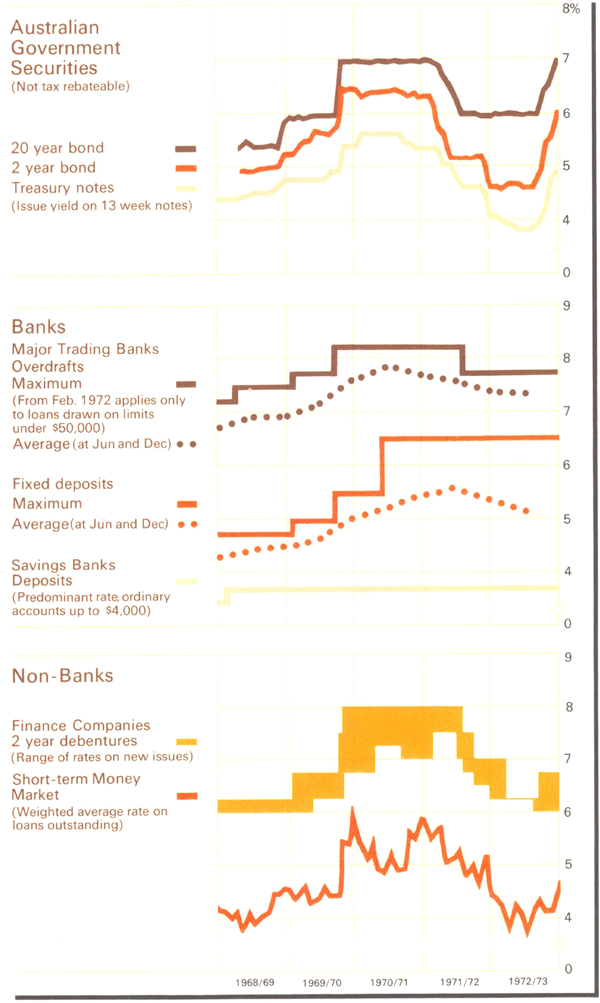
Deposits with banks grew exceptionally rapidly during 1972/73 (Graphs 16 and 17). Private non-bank deposits with trading banks rose by 32 per cent over the year; they had grown at an annual rate of 42 per cent in the seven months to January. Deposits with savings banks grew at an annual rate of around 20 per cent in both halves of the year. Taking into account an increase of 16 per cent in holdings of notes and coin, the aggregate rise in the volume of money over 1972/73 came to 26 per cent, compared with 10 per cent in 1971/72 and no more than 9 per cent in any of the previous seven years; at annual rates, growth ran at 30 per cent in the first seven months of the year and 20 per cent over the remainder.
The experience of other financial intermediaries in 1972/73 was diverse. Some features were the sharp reversal suffered by permanent building societies within the year, a large run-down in portfolios of short-term money market dealers and further strong growth in the balance sheets of finance companies. At the close of the financial year, the Reserve Bank and the Treasury had under consideration the question of regulation by the Australian Government of non-bank financial intermediaries. Trends in financial intermediation during 1972/73 are examined in more detail below.
Trading banks
Reflecting their relative attractiveness, fixed-term liabilities of trading banks captured a large proportion of accruing funds over the first eight months of the financial year and grew at an annual rate approaching 60 per cent. Thereafter, however, there was no further growth despite a lift in interest rates offered by the banks on larger deposits. Nevertheless, at the end of 1972/73, private non-bank holdings of trading bank fixed deposits and certificates of deposit stood 35 per cent above their level twelve months previously.
Current deposits also held attractions for trading bank customers during 1972/73 and holdings by private non-bank groups increased by 30 per cent. Growth was not as spectacular in the early part of the year as that in other deposits but was better maintained through the events of the final few months; over the later period, expectations of rising interest rates and of reduced availability of funds would have stimulated preferences for liquidity.
16 Major Trading Banks
SEASONALLY ADJUSTED
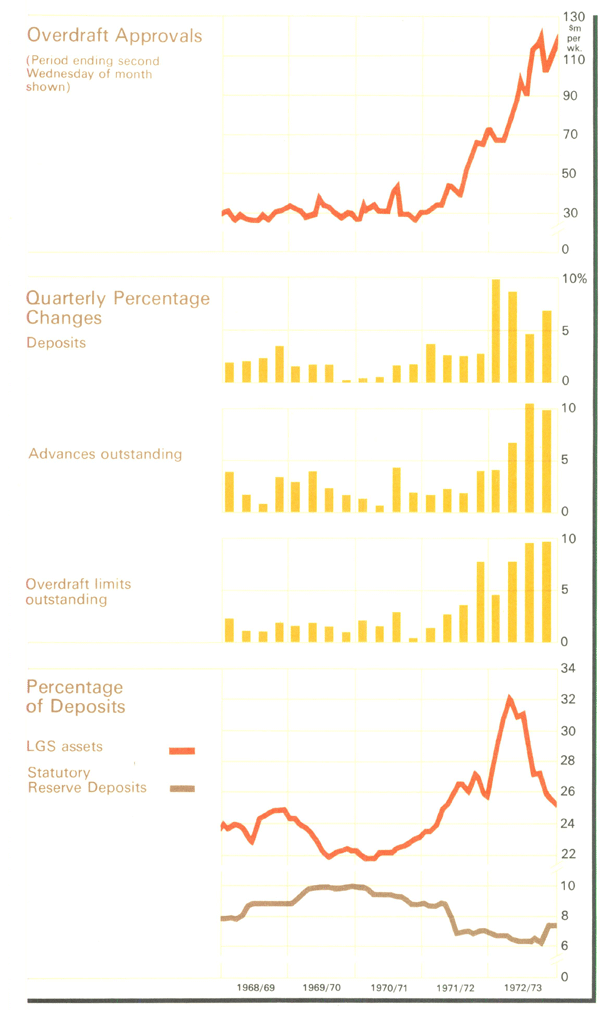
The major trading banks found themselves extremely well placed to meet demand for loans from the private sector at the beginning of 1972/73. No official restraints on lending existed and banks had in fact been encouraged to step up their rate of lending to assist the emerging recovery in spending; their inflow of funds had been quite strong and an acceleration was in prospect; holdings of government securities were relatively high and yields on them were falling.
In the event, new lending approvals by the major trading banks continued their previously-established steep upward trend until late in 1972/73 (Graph 16). Total new approvals for the year were more than 80 per cent above those in 1971/72. The bulk of the increase in total lending was, of course, in overdrafts but personal instalment and farm development loan approvals each made a significant contribution. Early in November 1972, new arrangements were established for lending from banks' Farm Development Loan Funds, widening the purposes of, and removing the maximum limit on the term of, such loans. Where loans are for developmental purposes, preferential rates of interest continue to apply. Major trading banks' term loan approvals during 1972/73 were not as buoyant as other components of lending.
Following the changes in arrangements for farm development lending in November, the banks' Farm Development Loan Funds with the Bank were replenished by about $65 million (of which two-thirds came from their Statutory Reserve Deposits and the remainder from their other assets) to assist them to meet an expected increase in this type of lending. Just after the close of the financial year the Bank announced that, in order that banks could continue lending from their Term and Farm Development Loan Funds at levels consistent with the requirements of overall policy, these funds would be replenished before the end of September 1973 by about $62 million and $41 million respectively; once again, about two-thirds of the replenishment would be provided from banks' Statutory Reserve Deposit Accounts. To this end, the banks' Statutory Reserve Deposit ratio would be reduced by 0.6 of a percentage point in early August, thereby reducing to 1.4 percentage points the net increase in the ratio during the month.
17 Savings Banks
SEASONALLY ADJUSTED
For the major trading banks, lags between the approval and drawing of loans meant that outstandings had been slow to respond to the upsurge in new lending in the second half of 1971/72. However, growth in overdraft advances outstanding more or less kept pace with the rise in limits outstanding in the early part of 1972/73 and moved ahead towards the end of the year when limits were being drawn upon to finance repayments of overseas loans and taxes. Once again, the early part of 1973 was a watershed; growth in advances was at an annual rate of 22 per cent between June and January, quickened markedly to 54 per cent over the rest of the financial year and came to 35 per cent for the year as a whole. Lending by other trading banks also grew buoyantly and their advances expanded by 24 per cent over the year.
The major trading banks' holdings of LGS assets averaged 23.1 per cent of deposits in June 1973, compared with a minimum conventional level of 18 per cent and a ratio of 23.7 per cent in June 1972. On a seasonally adjusted basis, the LGS ratio climbed to a peak of 32 per cent in October/November but, with the subsequent surge in lending and the call to the banks' Statutory Reserve Deposits in April, it fell by 7 percentage points over the next seven months.
During the year, the number of trading banks operating in Australia was reduced when the International Commercial Bank of China informed the Government in December that it had ceased to carry on banking business in Australia. Its banking authority was then revoked in accordance with the provisions of the Banking Act.
Savings banks
Depositors' balances with savings banks grew rapidly throughout 1972/73 to record an increase of 22 per cent for the year as a whole. Growth in other recent years had come nowhere near this. Some reasons for the high level of household savings during 1972/73 have already been suggested. The ability of savings banks to attract such a large volume of these savings may have been enhanced by the reduced interest rates available on competing investments. The rates offered by savings banks generally on ordinary accounts and investment accounts were not changed during the year. The interest-bearing limit on their investment accounts was raised from $20,000 to $50,000 on 19 April 1973.
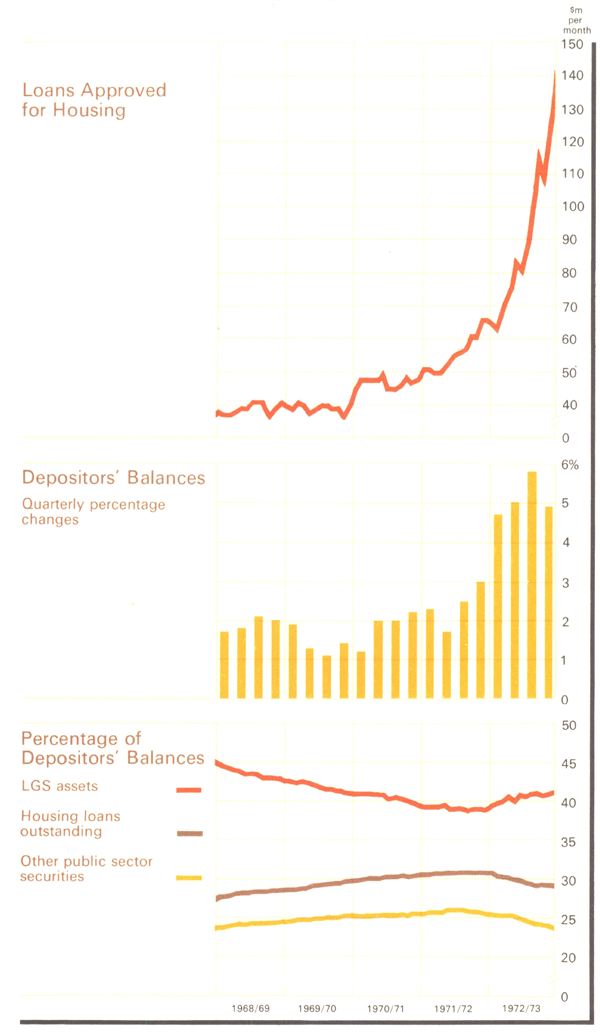
Savings banks found themselves in a good position to meet a large part of a very strong demand for housing finance in 1972/73. All told, the banks approved loans for housing in 1972/73 totalling 64 per cent more than in the previous year; the number of loans approved rose by about 35 per cent and their average value rose by about 20 per cent.
Despite the much higher rate of new approvals during 1972/73, growth in savings banks' housing loans outstanding was outstripped by that in depositors' balances and the ratio of housing loans outstanding to deposits showed its first full-year fall on record; largely reflecting normal lags, there was a substantial build-up of undrawn housing loan commitments over the year. The counterpart of the fall in the ratio of loans outstanding to deposits was a reversal of the previous downward trend in the ratio to deposits of savings banks' “60 per cent” tranche of liquid assets and public sector securities (Graph 17).
Among the latter group of assets, holdings of local and semi-governmental securities increased by $290 million, compared with $189 million in 1971/72. Additions to savings banks' LGS assets over the year represented 30 per cent of their starting level; this rise included an increase of 65 per cent in the banks' deposits with the Reserve Bank.
Other banks
Reflecting mainly the depressed levels of capital formation in the mining industry, new loan approvals by the Australian Resources Development Bank in 1972/73 were much lower than in any previous financial year. Some loan drawings were made during the year against earlier approvals but the Resources Bank nevertheless experienced a net reduction in loans outstanding. A corresponding reduction in liabilities was concentrated in overseas borrowings, most of which were repaid during the year.
There was no expansion in the balance sheet of the Commonwealth Development Bank during 1972/73. Late in the financial year the Government announced that it wished to see rural lending by the Development Bank extended to cover a wider range of purposes, in order to improve the facilities available to farmers for long-term borrowing. This lending will, however, be subject to the current proviso that finance is not otherwise available on reasonable and suitable terms and conditions. It was also announced that an advance of $20 million will be provided in the 1973/74 Budget to facilitate the additional types of lending by the Development Bank.
Other intermediaries
Following very strong growth in previous periods, the liabilities of permanent building societies grew even faster in the first seven months of 1972/73. An increase of more than 30 per cent over this period was partly due to seasonal factors but, basically, was a further reflection of the strong demand for financial assets. In the face of such buoyant inflow societies in New South Wales and Tasmania reduced, in February, the returns offered on their liabilities.
Like most other groups, the societies found the competition for funds much keener later in the year. On top of this, the societies came in for a certain amount of discussion in the first half of 1973 which may have affected the attitude of some investors. The liabilities of societies grew much less rapidly after January; the slowing was most pronounced in New South Wales. From 1 July, interest rates on societies' liabilities were restored to their pre-February levels in New South Wales and Tasmania. Societies in Victoria have decided to increase, from 1 August, the returns offered on funds lodged with them.
Confronted with substantial reductions in their net intake of withdrawable funds, societies turned to other sources. They also cut back their new approvals sharply in the final three months of the year. Even so, the rate of new lending in the June quarter remained a little above that in the previous corresponding period; in the preceding nine months, new approvals had been running at levels about double those in the first three quarters of 1971/72.
The average interest rate on loans outstanding to authorised dealers in the short-term money market, which had been close to 6 per cent per annum in the middle quarters of 1971 and around 5 per cent per annum for the rest of 1971/72, averaged a little over 4 per cent per annum during 1972/73. In the face of a large increase in portfolios which had occurred during 1971/72 and expectations of rising interest rates, dealers did not resist strongly reductions in portfolios during 1972/73 and moved to shorten their average maturity. Both these factors were tending to hold down the interest rates they were prepared to offer to clients. In the outcome, dealers' liabilities during the year were not above their starting level (about $1,000 million) for long and finished the year $172 million below it; there had been a rise of almost $300 million during 1971/72. This turn-around was the main factor behind the marked change between 1971/72 and 1972/73 in movements in private non-bank holdings of government securities.
For finance companies, 1972/73 was a year of further strong expansion. Balances outstanding to these companies rose by about 18 per cent, which was close to the rates achieved in each of the previous four years. As in 1971/72, growth in the companies' instalment credit business was relatively modest and it again fell to other forms of lending to provide an outlet for funds. Such funds were raised at interest rates which were declining early in the year but which reflected the general tightening in the closing months. An innovation during the latter part of the year was the issue of liabilities repayable at call after three months and attracting interest on a daily basis.
The sharp change during 1972/73 in the willingness and ability of domestic borrowers to seek funds from overseas was noticed in particular by merchant and investment banking groups through which many such deals had previously been arranged. But these intermediaries had also been very active in raising funds domestically and increased their efforts in this direction in the latter part of the year. During the year the Bank continued to build up information available to it on the activities of these groups.
Rural advances of pastoral finance companies at the start of 1972/73 were about 20 per cent below their end-1970 peak; they continued to decline well into 1972/73 before rising a little over the final few months. The liabilities of this group have continued to expand quite strongly over recent years, however, and assets other than rural advances have greatly increased their share of the total. There has been a degree of diversification of the business done by some of these companies.
Available information suggests that the growth in assets of life insurance companies was maintained in 1972/73. These companies have continued to increase the proportion of equities and fixed assets in their portfolios, mainly at the expense of loans.