
Payments System Board Annual Report – 2026 2. Payments System Regulation and Policy Issues
The RBA undertakes regulatory and policy work on payment systems and on the infrastructure that supports the safety, efficiency and competitiveness of the Australian payments system. During 2025/26, the Payments System Board focused on strengthening the resilience of systemically important and prominent payment systems, progressing reforms in the card payments market, overseeing industry efforts to modernise account-to-account payments, supporting work to reinforce access to cash, and examining how innovation in digital money could support the future evolution of the payments system.
Oversight of safety and resilience of payment systems
Individuals, businesses and governments rely on electronic payment systems to make a wide range of critical payments. Disruptions to payment services can impose significant costs on end users, have broad economic consequences and undermine public confidence in the financial system. Effective governance, risk management and operational resilience are therefore essential to the safe and reliable operations of payment systems. The Payments System Board considers it vital that participants continue to invest in resilient and secure infrastructure, systems and customer services to safeguard trust in the payments system.
The RBA oversees systemically important payment systems, which have the potential to trigger or transmit systemic disruptions, and prominent payment systems, where outages could cause significant economic disruption and damage confidence in the financial system. To support this, it conducts an annual review of developments in the payments landscape. The 2026 review confirmed that:
- the Reserve Bank Information and Transfer System (RITS) and CLS Bank International (CLS) are systemically important payment systems operating in Australia
- the New Payments Platform (NPP), eftpos, Mastercard, Visa and the Bulk Electronic Clearing System (BECS) continue to be prominent payment systems.
The Australian payments system functions as an interconnected network, with participants often relying on common infrastructure and service providers. As such, disruptions at a single point can affect multiple participants in the system and have broader consequences for the ecosystem and public confidence. In August 2025, the Payments System Board endorsed a program of work examining interoperability, third-party and concentration risks and vulnerabilities arising from disruption to utilities. The RBA has also engaged with payments industry participants and regulatory agencies on the development of industry-wide responses to support the continuity of payments under a range of disruption scenarios.
The focus on resilience also extends to emerging technology risks, such as potential threats arising from advances in computing capabilities. Consistent with this, the Issues Paper on the Review of Payments System Regulation published in June 2026 included strengthening cryptographic practices across the Australian payments system as an issue for consultation. The RBA reaffirmed that industry should maintain momentum towards their December 2030 target for mitigating quantum-related risks.
Reserve Bank Information and Transfer System
RITS is Australia’s high-value payments system. It is owned and operated by the RBA and used by banks and other approved institutions to settle their payment obligations on a real-time gross settlement basis. Following the establishment of the Governance Board in April 2025, RITS operations now fall under the general responsibility of the Governance Board, which governs the management and organisational affairs of the RBA. Arrangements for the Payments System Board to have ongoing oversight of RITS as a financial market infrastructure have been detailed through an MOU between the RBA’s boards.
In June 2026, the Payments System Board endorsed the most recent assessment of RITS against the relevant Principles for Financial Market Infrastructures (PFMI). The assessment concluded that RITS observed all relevant PFMIs except for Principle 2 (Governance), Principle 3 (Framework for the comprehensive management of risks) and Principle 17 (Operational risk), which were partly observed.
The assessment acknowledged that while meaningful progress had been made on the program of work established following the RBA’s 2022 technology outage, it had progressed at a slower pace than was anticipated. The Board also endorsed a new recommendation focused on improving RITS governance.
New Payments Platform
The NPP is Australia’s fast payments system, developed to enable households, businesses and government agencies to make payments with near real-time funds availability to the recipient on a 24/7 basis. In 2025, the RBA conducted an assessment of the NPP under the MOU established between Australian Payments Plus (AP+), NPP Australia Limited and the RBA.1 At the November 2025 meeting, the Board reviewed the assessment and highlighted that efforts to promote effective governance and risk management remain a priority in light of industry’s intended migration of account-to-account payments to the NPP in the medium term.
International payments infrastructure
The RBA participates in cooperative oversight arrangements for two international payments infrastructures – CLS and Swift – to promote the stability of the Australian financial system.
CLS Bank International
CLS operates a payment-versus-payment settlement system (CLS Settlement) for foreign exchange transactions in 18 currencies, including the Australian dollar. CLS is chartered in the United States and is regulated and supervised by the Federal Reserve and the Federal Reserve Bank of New York (FRBNY). The RBA participates in a cooperative oversight arrangement for CLS, facilitated by the FRBNY.
Swift
Swift provides critical messaging and connectivity services to both RITS and CLS, as well as other market infrastructures and participants in Australia and overseas. Oversight of Swift is based on the expectations applicable to critical service providers set out in the PFMI, anchored in a statutory framework in Belgium. The G10 central banks oversee Swift through the Swift Oversight Group. The RBA is a member of the Swift Oversight Forum, which affords a broader set of central banks the opportunity to discuss oversight matters and provide input into the Oversight Group’s priorities and policies.
Card payments policy issues
Card payments remain the most common method for Australians to make consumer payments, with cash and cheques used much less frequently than in the past. This was confirmed by the RBA’s three-yearly Consumer Payments Survey, which was conducted in late 2025.2
New technologies and new participants in the payments system are also providing more payment options to consumers and businesses. This gives rise to new and emerging policy issues in card payments.
Review of Merchant Card Payment Costs and Surcharging
On 31 March 2026, the RBA published a Conclusions Paper which set out the final decisions of the Payments System Board on the Review of Merchant Card Payment Costs and Surcharging.3 The Board concluded that a package of reforms that includes removing surcharging, reducing interchange fees and increasing transparency would be in the public interest and promote competition and efficiency in the payments system. This followed an extensive public consultation process since the release of a Consultation Paper in July 2025, which sought stakeholder feedback on the Board’s preliminary policy proposals.4
The Board’s key decisions included:
- removing surcharging on debit, prepaid and credit cards on the designated eftpos, Mastercard and Visa card networks. The surcharging framework, introduced more than two decades ago, is no longer achieving its intended purpose of steering consumers towards making more efficient payment choices. The increased prevalence of businesses surcharging all cards at the same rate, challenges with enforcing the current surcharging framework, and consumers using less cash have reduced the effectiveness of the surcharging regime. Removing surcharging makes card payments simpler and more transparent, and increases competition among payment service providers. Removing surcharging also aligns with the preference of most consumers for payment costs to be incorporated into advertised prices.
- lowering the caps on interchange fees paid by Australian businesses. These changes are expected to lower businesses’ costs when they accept domestic or overseas card payments. Small businesses should benefit the most because they tend to pay fees closer to the existing caps.
- increasing transparency over the fees charged by card networks and payment service providers to strengthen competition. Improving transparency enhances competition between players within the payments chain, puts downward pressure on card payment costs and makes it easier for businesses to shop around for a better deal.
Most of these changes come into effect on 1 October 2026, including the removal of surcharging and reductions in the interchange caps for domestic card transactions. The introduction of an interchange fee cap on foreign cards and some changes to payment cost transparency come into effect on 1 April 2027 to ensure the payments industry has sufficient time to implement these more complex changes.
Following publication of the Conclusions Paper on 31 March 2026, the RBA lodged variations to its Standards No. 1, 2 and 3 to implement the review’s conclusions, with the variation instrument registered on the Federal Register of Legislation on 14 April 2026. The RBA has engaged with designated card networks on their plans to remove surcharging by imposing no-surcharge rules. eftpos, Mastercard and Visa each indicated an intention to introduce ‘no-surcharge’ rules from 1 October 2026. American Express and UnionPay International, which are non-designated networks and not subject to formal RBA regulation, announced their intention to introduce ‘no-surcharge’ rules from the same date.
Review of payments system regulation
Following the conclusion of the Review of Merchant Card Payment Costs and Surcharging and amendments to the Payment Systems (Regulation) Act 1998, the RBA commenced a Review of Payments System Regulation with the publication of an Issues Paper in June 2026.5 This review comes at a time of significant innovation and change in the payments landscape, which is reshaping how Australian consumers and businesses make and receive payments. These developments have the potential to make payments more convenient and safer, facilitate the entry of new players, and lower costs for end users. At the same time, they could give rise to potential concerns for competition, efficiency or financial safety in the payments system. The Issues Paper invited stakeholder views and evidence on which payments policy issues should be prioritised by the RBA. The Issues Paper set out potential questions about:
- merchant choice of payment methods and providers
- account-to-account payments and competition with card payments
- mobile wallets, non-designated card networks and buy now pay later services
- cryptography and fraud prevention.
The evidence gathered through this process will inform the RBA’s prioritisation of issues and consideration of whether regulatory action may be warranted and, if so, what form that could take. The RBA intends to publish a list of regulatory priorities by the end of 2026 and commence further consultation on prioritised issues by mid-2027.
Compliance with card payments regulation
There was a high level of compliance with the RBA’s card payments regulations. The large majority of card schemes, issuers and acquirers certified their compliance with relevant aspects of the regulations, including the RBA’s interchange fee regulations, net compensation provisions and access regimes. A limited number of non-compliant instances were identified for individual institutions, and remediation activities are underway to address these. Ongoing monitoring of the surcharging framework suggests that issuers, acquirers, payment facilitators and card schemes are adequately discharging their obligations to provide relevant disclosures to help merchants surcharge appropriately, ahead of changes coming into force in October 2026 as part of the Conclusions of the Review of Merchant Card Payment Costs and Surcharging.
Policy issues in account-to-account payments
Risk assessment of the proposed decommissioning of the Bulk Electronic Clearing System
Following publication of the RBA Risk Assessment on the decommissioning of the Bulk Electronic Clearing System (BECS) in March 2025, the RBA put in place a program of oversight of the intended decommissioning of BECS, Australia’s primary account-to-account (A2A) system.6 In March 2026, the RBA provided an update on the evolving risk profile and progress made since March 2025 by industry against the recommendations in the RBA Risk Assessment.7
Overall, the RBA welcomed industry’s efforts to implement the recommendations, especially by increasing coordination within industry and undertaking more direct engagement with end users. In December 2025, the Australian Payments Network (AusPayNet) announced that until further progress has been made and a clear roadmap has been developed for the future of A2A payments in Australia, it was removing the target end date of June 2030. The RBA Risk Assessment identified risks that a disorderly transition posed to end users in the A2A payments system. These risks have diminished in the near term with the revised approach to transitioning A2A payments away from BECS.
Nonetheless, the update on the RBA Risk Assessment highlighted that several areas of risk persist, and others have emerged to be more prominent. Key stakeholders across the A2A ecosystem have highlighted insufficient consensus within industry about the A2A payments modernisation agenda, particularly on how to best process bulk payments in the future. This is impeding the effective decision-making and analysis needed to establish a path forward for A2A payments. As a result, industry risks losing the necessary momentum to modernise A2A payments. If industry participants are unable to make coordinated progress on modernising A2A payments, the RBA indicated that it would take further action to achieve outcomes in the public interest.
Developing a vision and roadmap for the future of account-to-account payments
Since late 2025, the RBA has participated in an A2A Payments Roundtable together with the Treasury, AusPayNet and AP+. The roundtable’s main purpose is to develop a common vision for the future of the A2A payments system and a plan to achieve that vision.
The A2A Payments Roundtable released its vision for the future of A2A payments in Australia on 8 July 2026, incorporating feedback from a public consultation and ongoing engagements with various stakeholders. The vision report is centred on a vision statement, supported by five end-user objectives – outcomes that consumers, businesses and government agencies expect when sending or receiving A2A payments – and six system characteristics as shown in Figure 2.1.8
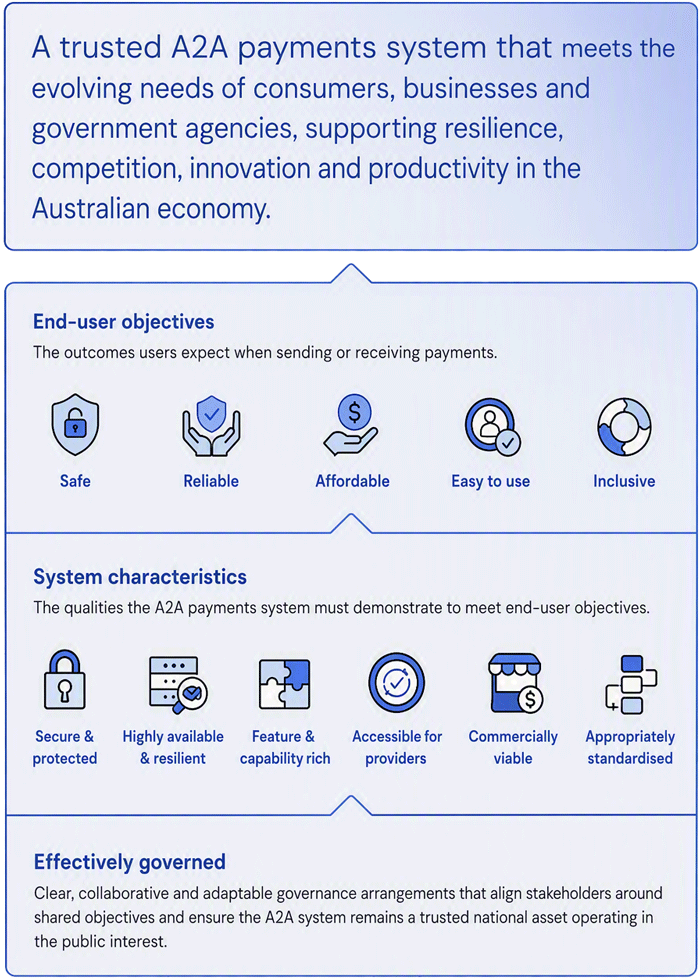
Source: A2A Payments Roundtable.
Over the second half of 2026, the A2A Payments Roundtable and industry participants will focus on developing a roadmap for achieving the A2A payments vision. The A2A payments roadmap will involve determining priorities for A2A payments infrastructure, capabilities and standards, the sequencing and timing of specific deliverables and the appropriate governance arrangements to deliver these.
Development of New Payments Platform capabilities
Usage of the NPP continued to increase over 2025/26. The Payments System Board has monitored the industry’s progress in rolling out NPP payment capabilities such as PayTo, the International Payments Service and planned enhancements to the NPP’s messaging based on the harmonised ISO 20022 standards. The RBA continues to engage with a broad range of industry participants to understand the opportunities for, and barriers to, the further development and adoption of NPP functionality.
AP+, the operator of the NPP, launched the industry-wide Confirmation of Payee (CoP) service in July 2025 to help prevent mistaken payments and combat scams. The service complements the NPP PayID addressing service by verifying the entered account details for payments addressed to a BSB and account number, and displaying a match outcome. By the end of June, 99 financial institutions offered CoP lookup capability to their payer customers, while 125 financial institutions were able to respond to a CoP verification request. Nearly all personal bank accounts in Australia are now CoP enabled.
Policy issues in cash
The Board continued to consider the future of cash distribution arrangements and the policy measures needed to support access to cash across the community. In August 2025, members discussed the ongoing challenges in the cash distribution system and the need for industry cooperation to work towards a more durable framework that supports the availability of cash, including in regional and remote Australia. The Board reiterated that cash remains an important means of payment for many Australians and can also serve as a valuable back-up to electronic payment methods in a resilient and inclusive payments ecosystem.
In March 2026, the Board again considered these issues and expressed support for a proposed regulatory framework for providers of cash distribution services. Members noted that such a framework, including crisis powers for the public sector, could assist in managing risks to the continuity of cash distribution services across Australia and support the long-term sustainability of the system. The Cash Distribution Framework Act 2026 (CDF Act) was passed by Parliament, commencing on 27 August 2026. Under the CDF Act, the RBA has new powers to designate and supervise significant providers of cash distribution services. The CDF Act also provides the RBA with cash distribution crisis management powers.
Cross-border payments
Efficient, competitive and safe cross-border payments are central to economic activity, trade and financial inclusion. However, outcomes for end users of cross-border payments continue to lag domestic payments. In response, the G20 countries (including Australia) have endorsed a roadmap to enhance cross-border payments, including a set of quantitative targets for cost, speed, transparency and access.9
The RBA continues to track Australia’s progress against these targets and to work with other regulatory agencies, industry participants and global standard-setting bodies on key initiatives that can help deliver better cross-border payment outcomes for end users. The available data suggest Australia has made gradual progress against the roadmap targets. While costs to transfer money internationally have fallen in recent years, they remain above G20 cost targets for payments to both advanced and developing countries. Bank-intermediated retail payments and remittances also remain slower, on average, than the G20 speed target. A more detailed assessment of Australia’s progress against the roadmap targets was provided in the RBA Bulletin in February 2026.10
Adopting the Committee on Payments and Market Infrastructures’ (CPMI) harmonised ISO 20022 data requirements for cross-border payments is a major initiative that will support further progress globally. More consistent use of richer, structured messaging based on the ISO 20022 messaging standard is expected to support faster, lower-cost payments by reducing the need for manual intervention and improving regulatory compliance (including with financial crime and sanctions screening requirements).
The RBA expects Australia’s High Value Clearing System (HVCS) and the NPP to adopt the harmonised messaging requirements by the end-2027 global timeframe. The Board is receiving regular reporting on the industry’s progress towards this goal. Industry planning remains broadly consistent with achieving timely alignment with the harmonised messaging requirements.
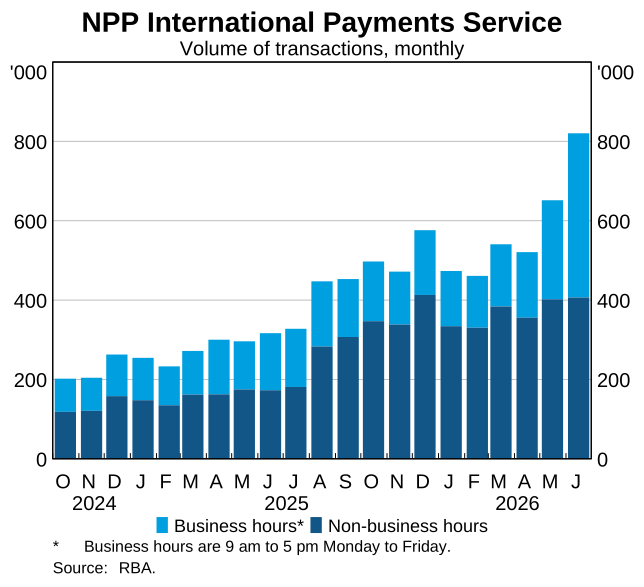
Making use of the NPP’s International Payments Service (IPS) for incoming cross-border payments is another key initiative underway in Australia. The IPS allows participants to process the final Australian dollar leg of inbound cross-border payments via the NPP on a near real-time, 24/7 basis. The IPS also supports safer incoming payments by enabling the transmission of more complete payer data for financial crime screening purposes. Growing use of the IPS is contributing to an uplift in the speed of incoming cross-border payments, with many of these payments being sent outside standard business hours (Graph 2.1). There remains scope for further adoption of the IPS by the Australian payments industry, with the volume of inbound cross-border payments processed through the HVCS still several times larger than those processed through the IPS.
The RBA is participating in the second phase of Project Mandala, in collaboration with the Bank for International Settlements and other central banks.11 The project is exploring opportunities to streamline cross-border compliance for payments made on both existing and new distributed ledger technology-based infrastructure. These efforts reinforce the importance of international collaboration to improve the speed and efficiency of cross-border payments, including through joint research on the potential for automated and interoperable compliance procedures and the use of privacy-enhancing technologies to address existing frictions.
Regulation of purchased payment facilities
Purchased payment facilities (PPFs) are facilities that enable funds to be stored for the purpose of making future payments. Consumers rely on the holder of the stored value backing such a facility to subsequently redeem that value on demand. The existing regulatory regime for PPFs is complex, with APRA, the RBA and ASIC each having regulatory responsibilities depending on the nature and size of the facility. The government’s proposed payments service provider licensing reforms will simplify and modernise the regulatory framework for stored value facilities, a term that encompasses PPFs.
In 2025, the RBA committed to reviewing the limited-value threshold below which the Payment Systems (Regulation) Act does not apply to PPFs. This was one of several payments-related initiatives aimed at supporting efficiency and reducing regulatory burden; the limited-value threshold has stood at $10 million since 2006.12 The RBA subsequently considered this proposal, in consultation with other Council of Financial Regulators agencies, and has decided not to proceed with any change to the existing exemption. The RBA was not satisfied that changes to the current exemption were necessary ahead of the payments service provider licensing reforms, having weighed the expected benefits against the time and expense for the stakeholders concerned.
Research on innovations in digital money
The RBA continued work to examine how innovations in digital money could support the future evolution of Australia’s payments system. This work is part of a broader program to assess the potential role of new forms of digital money – including central bank digital currency (CBDC), tokenised bank deposits and stablecoins – in promoting efficiency, resilience and competition in payments.
A major focus over 2025/26 was the completion of Project Acacia, a joint initiative between the RBA and the Digital Finance Cooperative Research Centre to explore how digital money and associated settlement infrastructure could enhance the functioning of Australia’s wholesale asset markets through the development of tokenised finance. Overall, the project found strong potential for the tokenisation of assets, alongside digital money and/or enhanced settlement infrastructure, to improve the efficiency, and functionality of financial markets. However, generating these benefits will require ongoing coordinated effort across industry and the public sector.
The Payments System Board supported the establishment of a new multi-stream program of work. A central aim of this program is to better support the ability of industry to safely explore and scale new ideas that could enhance the functioning of wholesale markets. Initiatives include enhanced industry–regulator cooperation, a possible sandbox to support the development of tokenisation-based business models, exploration of the opportunities and challenges associated with tokenised government bonds, and continued industry-led work on interoperable commercial bank deposit tokens.
In addition, the RBA is pursuing several complementary initiatives. These include consulting with industry on how the RBA’s settlement services could support the development and growth of tokenised asset markets and tokenised private money; further assessing the potential role of tokenised reserves; and examining how tokenised central bank and private money, alongside enhanced settlement infrastructure, could improve wholesale cross-border payments.
The RBA also continued its work on unmet payment needs through public engagement. Findings from focus groups suggested that while Australia’s existing electronic payment systems generally meet the needs of most users, opportunities remain to further strengthen areas, such as payment security. Participants also emphasised their strong reliance on cash as a back-up payment method. There was limited public demand for a retail CBDC as a direct substitute for existing payment methods, with many participants expressing satisfaction with current options. Subsequently, the RBA and Treasury concluded that there is currently no clear public interest case for a retail CBDC in Australia, reaffirming the assessment reached in the 2024 RBA–Treasury White Paper.13
Endnotes
1 RBA (2024), ‘Memorandum of Understanding – Cooperation Arrangements between Australian Payments Plus Limited, NPP Australia Limited and the Reserve Bank of Australia regarding Observance of the Principles for Financial Market Infrastructures over 2024-2027’.
2 For an overview of the results of the latest Consumer Payments Survey, see RBA (2026), ‘Consumer Payment Behaviour in Australia’, RBA Bulletin, May.
3 RBA (2026), ‘Review of Merchant Card Payment Costs and Surcharging – Conclusions Paper’, March.
4 RBA (2025), ‘Review of Merchant Card Payment Costs and Surcharging – Consultation Paper’, July.
5 RBA (2026), ‘Review of Payments System Regulation – Issues Paper’, June.
6 RBA (2025), ‘Decommissioning of the Bulk Electronic Clearing System: RBA Risk Assessment’, March.
7 RBA (2026), ‘Decommissioning of the Bulk Electronic Clearing System: RBA Risk Assessment Update’, March.
8 A2A Payments Roundtable (2026), ‘The Vision for Account-to-account Payments in Australia’, July.
9 For details about the global cross-border payment targets, see the ‘G20 Targets for Enhancing Cross-border Payments’ webpage on the Financial Stability Board website.
10 RBA (2026), ‘On the Road to Better Cross-border Payments: How is Australia Travelling?’, RBA Bulletin, February.
11 For more detail about the second phase of Project Mandala, see the ‘Project Mandala: Shaping the Future of Cross-border Payments Compliance’ webpage on the Bank for International Settlements website.
12 The RBA has previously granted class exemptions for certain low-value and limited purpose PPFs under section 9(3) of the Payment Systems (Regulation) Act. RBA (undated), ‘Declarations and Exemptions for Purchased Payment Facilities’. See also Council of Financial Regulators (2025), ‘Better Regulation Roadmap – Implementation Plan’, December.
13 RBA and Treasury (2024), ‘Central Bank Digital Currency and the Future of Digital Money in Australia’, White Paper, September.