
Payments System Board Annual Report – 2026 1. About the Payments System Board
The Payments System Board (the Board) has responsibility for the RBA’s payments system policy, including policy on clearing and settlement facilities.
Role of the Board and the RBA
The Reserve Bank of Australia (RBA) is responsible for promoting the stability, efficiency and competitiveness of the payments system through the Payments System Board. The Board has a duty under the Reserve Bank Act 1959 to ensure that the RBA’s payments system policy is directed to the greatest advantage of the people of Australia, and that the powers of the RBA under the Payment Systems (Regulation) Act 1998 and the Payment Systems and Netting Act 1998 are exercised in a way that, in the Board’s opinion, will best contribute to:
- controlling risk in the financial system
- promoting the efficiency of the payments system
- promoting competition in the market for payment services, consistent with the overall stability of the financial system.
Under the Payment Systems (Regulation) Act, the RBA has the power to designate payment systems and to set standards and access regimes for designated systems. The Payment Systems and Netting Act provides the RBA with the power to give legal certainty to certain settlement arrangements to minimise the risks of systemic disruptions from payment systems.
The Board also has a duty to ensure that the powers and functions of the RBA under Parts 7.3 and 7.3B of the Corporations Act 2001 are performed and exercised in a way that, in the Board’s opinion, will best contribute to the overall stability of the financial system. These powers and functions relate to the supervision and crisis resolution of central counterparties and securities settlement facilities, which are key infrastructure supporting the clearing and settlement of transactions in financial markets. The RBA’s Payments Policy Department also acts as overseer of Australia’s high-value payments system – the Reserve Bank Information and Transfer System (RITS).
In addition, the Board has a duty to ensure that the RBA’s functions and powers under the cash distribution framework (dealing with events that may threaten the continuity of critical cash distribution services) are performed and exercised in a way that, in the Board’s opinion, best contributes to the availability of cash in Australia.
RBA Payments Policy Strategy 2025–2027
In August 2025, the Payments System Board endorsed an RBA payments policy strategy focused on three strategic objectives, supported by 10 priority initiatives, over 2025–2027. This strategy helps prioritise the RBA’s efforts to support the Australian payments system to evolve in line with the public interest over coming years. The Board regularly reviews the RBA’s progress on delivering the priority initiatives.
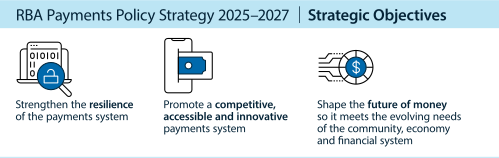
RBA payments policy strategic objectives
Strengthen the resilience of the payments system
Payments and market infrastructures play a crucial role in facilitating payments and managing financial risk in the financial system. The reliance of the community, economy and financial system on these services means that disruptions can have wide-reaching effects. The RBA is strongly focused on ensuring risks to payments and market infrastructures are managed appropriately.
Promote a competitive, accessible and innovative payments system
Consumers and businesses rely on the payments system every day. Competition and innovation are important to ensuring payment services remain efficient, cost-effective and responsive to the evolving needs of users. The RBA has an important role to play in promoting a payments system that delivers competitive, accessible and innovative payments for consumers and businesses.
Shape the future of money so it meets the evolving needs of the community, economy and financial system
Australians need safe, efficient and cost-effective payment options, both now and in the future. As the payments landscape changes, the RBA is helping to shape the future of money by exploring the case for new digital forms of money, and by ensuring cash remains a viable means of payment for those who need or want it.
RBA payments policy priority initiatives
To achieve its payments policy strategic objectives, the RBA is pursuing 10 priority initiatives over 2025–2027 to:
- identify system-wide risks to Australia’s payments system that require attention
- press payments and market infrastructures to strengthen their governance, risk management and operational resilience to meet regulator and community expectations
- deliver a framework for clearing and settlement (CS) facility and cash distribution crisis management and operationalise new powers for supervision
- oversee the industry’s efforts to modernise account-to-account payments in a manner consistent with the public interest
- assist payments regulatory reform
- work with the government and industry to reinforce reasonable access to cash across the community
- review the regulatory settings for retail payment systems and support the implementation of adjustments if required
- enhance cross-border payments
- assess how innovations in digital money and existing infrastructure could enhance wholesale payments and settlements
- deepen analysis into the issues associated with new forms of retail digital money, including central bank digital currencies (CBDCs).
Board members as at September 2026
Membership of the Payments System Board is specified in section 25A of the Reserve Bank Act, and comprises up to eight members:
- the Governor of the RBA (Chair of the Payments System Board)
- one representative of the RBA who is appointed by the Governor and who must be either a member of one of the RBA’s other boards or a member of the RBA service (Deputy Chair of the Payments System Board)
- one representative of the Australian Prudential Regulation Authority (APRA) who is appointed by APRA and who must be either an APRA member or an APRA staff member
- up to five other members who are appointed by the Treasurer for a term of up to five years.
Members of the Board as at September 2026 and details of their qualifications and experience are provided below.
Michele Bullock
BEc (Hons) (UNE), MSc Economics (LSE)

Chair and RBA Governor
Governor since 18 September 2023
Present term ends 17 September 2030
Michele Bullock commenced as RBA Governor on 18 September 2023. She is Chair of the Governance Board, Monetary Policy Board, Payments System Board and Council of Financial Regulators.
Prior to her current role, Ms Bullock was the RBA Deputy Governor. She has also held a variety of senior management positions at the RBA. She was Assistant Governor (Financial System), Assistant Governor (Business Services), Assistant Governor (Currency), Adviser for the Currency Group and, before that, Head of Payments Policy Department.
Ms Bullock is a Member of Chief Executive Women and a signatory to the Banking and Finance Oath.
Other roles
Chair – Governance Board
Chair – Monetary Policy Board
Chair – Council of Financial Regulators
Chair – Financial Markets Foundation for Children
Co-chair – Financial Stability Board Regional Consultative Group for Asia; Financial Stability Board Cross-border Payments Coordination Group
Chair – BIS Irving Fisher Committee on Central Bank Statistics
Chair – BIS Asian Consultative Council
Member – Financial Stability Board
Member – Melbourne Institute Advisory Board
Member – Trans-Tasman Council on Banking Supervision
Director – The Anika Foundation
Brad Jones
PhD (Macquarie)

Deputy Chair and RBA Assistant Governor (Financial System)
Deputy Chair since 16 January 2024
Brad Jones joined the RBA in 2018 and was appointed RBA Assistant Governor (Financial System) in 2022. He oversees the RBA’s work on financial stability and payments policy, including the future of money and geopolitical risk.
Prior to his current role, Dr Jones was the Head of International Department and then the Head of Economic Analysis Department.
Before joining the RBA, Dr Jones held roles at the International Monetary Fund in Washington DC, Deutsche Bank in London and Hong Kong, and the University of Cambridge Judge Business School.
Dr Jones is a graduate member of the Australian Institute of Company Directors and a signatory to the Banking and Finance Oath.
Other roles
Member – Basel Committee on Banking Supervision
Member – Financial Stability Board Regional Consultative Group for Asia
Member – Council of Financial Regulators
Member – Trans-Tasman Council on Banking Supervision
Member – Institute of Global Finance Advisory Board
Member – Financial Stability Board Standing Committee on Assessment of Vulnerabilities
Chair – RBA Financial Market Infrastructure Review Committee
Ross Buckley
BEcon, LLB (Hons) (UQ), PhD (UNSW), LLD (Melbourne)

Non-executive member
Member since 1 August 2023
Present term ends 31 July 2028
Ross Buckley is a Scientia Professor, School of Private and Commercial Law, at the University of New South Wales and an Australian Research Council Laureate Fellow. His key research areas include the regulation of fintech and tokenised currencies and assets. He has written seven books and over 200 journal articles, book chapters and major reports. He has twice been a Fulbright Scholar, at Yale and Duke universities.
Professor Buckley has consulted to government departments and regulators in many nations and advised and written reports for some 40 international institutions, including the Alliance for Financial Inclusion, Asian Development Bank, Bank for International Settlements, European Commission and United Nations Capital Development Fund.
Other roles
Strategic Research Advisor – Digital Finance Cooperative Research Centre
Chair – Digital Finance Advisory Panel, Australian Securities and Investments Commission
Member – Consultative Panel, Australian Securities and Investments Commission
Member – Public and Private Markets Advisory Group Network, Australian Securities and Investments Commission
Member – Simplification Consultative Group, Australian Securities and Investments Commission
Fellow and Academic Board Member – European Banking Institute, Frankfurt
Gina Cass-Gottlieb
BEc (Hons), LLB (Hons) (Sydney), LLM (Berkeley)

Non-executive member
Member from 15 July 2013 to 14 July 2018
Reappointed from 1 August 2018
Present term ends 31 July 2028
Gina Cass-Gottlieb has extensive expertise in competition law and economic regulatory advice and in the regulation of payments in Australia. She was appointed Chair of the Australian Competition and Consumer Commission on 21 March 2022.
Prior to this, Ms Cass-Gottlieb was a senior partner in Gilbert + Tobin’s competition and regulation practice, advising and representing corporations, industry associations, government and non-government agencies. She has over 25 years’ experience, including advising in relation to access arrangements in a range of sectors across the economy.
Ms Cass-Gottlieb attended the University of California, Berkeley, as a Fulbright Scholar.
Michelle Deaker
BSc (Hons), MSc (Sydney), PhD (UC)

Non-executive member
Member since 1 August 2023
Present term ends 31 July 2028
Michelle Deaker is a founding partner and the current Managing Partner of OneVentures, a venture capital firm with over $1 billion in funds under management that specialises in technology and healthcare investment. Dr Deaker has over 20 years’ experience in the development of high-growth technology companies in Australia and the United States. She has served on the boards of large and small listed and unlisted companies and has a background in Australian research and development as well as expertise in global business expansion.
Prior to establishing OneVentures in late 2006, Dr Deaker established IT enterprise business Networks Beyond 2000 and later E Com Industries, a leading prepaid card and electronic voucher provider in several countries.
Dr Deaker is a member of the Australian Institute of Company Directors and of Chief Executive Women.
Other roles
Managing Partner – 1V Partnership
Director – Buildkite
Director – Vaxxas Pty Ltd
Director – WinVC Limited
Board Observer – Employment Hero
Scott Farrell
BEc (Sydney), LLB (Hons) (Sydney), PhD (UNSW)

Non-executive member
Member since 23 March 2022
Present term ends 22 March 2027
Scott Farrell has more than 25 years’ experience in financial markets and financial systems law. In 2016, he was appointed to the Australian Government’s FinTech Advisory Group at its formation and in 2018 was appointed its co-Chair.
Dr Farrell has led a number of reviews for the Australian Government, including the Review into Open Banking in Australia in 2017, the Inquiry into Future Directions for the Consumer Data Right in 2020 and the Review of the Australian Payments System in 2021.
Other roles
Strategic Counsel – Mallesons
Adjunct Professor – School of Private and Commercial Law, University of New South Wales
Chair – International Organisation for Standardization TC 307 Blockchain and Distributed Ledger Technologies
Data Standards Chair – Consumer Data Right and Digital ID
John Lonsdale

APRA-appointed member
Chair – Australian Prudential Regulation Authority
Member since 1 November 2022
John Lonsdale was appointed as Chair of the Australian Prudential Regulation Authority (APRA) on 31 October 2022 after joining APRA as Deputy Chair on 8 October 2018. In his Deputy Chair role, Mr Lonsdale was responsible for oversight of Australia’s banking sector, as well as oversight of APRA’s work on culture and remuneration, building APRA’s crisis-resolution capability and strengthening APRA’s collaboration with peer regulators.
Prior to joining APRA, Mr Lonsdale worked for the Australian Treasury for over 30 years. He was a member of the Treasury’s Executive and, in his role as Deputy Secretary for the Markets Group, he had responsibility for financial system, consumer and foreign investment policy. In 2014, he led the Secretariat for the Financial System Inquiry.
Other roles
Member – Council of Financial Regulators
Member – Financial Stability Board Standing Committee on Supervisory and Regulatory Cooperation
Member – Trans-Tasman Council on Banking Supervision
Deborah Ralston
BEc, Dip Fin Mgt, MEc (UNE), PhD (Bond)

Non-executive member
Member since 15 December 2016
Present term ends 14 December 2026
Deborah Ralston has more than 25 years of board-level experience in education, banking, superannuation and fintech sectors. Her current appointments include Guardian of the Future Fund, non-executive director of the Digital Finance Cooperative Research Centre, and Chair of the Household Capital Advisory Board.
She has held senior leadership and research roles in Australian universities, most recently as the Executive Director of the Australian Centre for Financial Studies.
Dr Ralston’s expertise in public policy has been reflected in appointments to the Australian Government’s Retirement Income Review Panel, the Comprehensive Income Products for Retirement Framework Advisory Committee and as inaugural Chair of the Australian Securities and Investments Commission’s Digital Finance Advisory Board.
Dr Ralston is currently a Professorial Fellow at Monash University Business School, with research interests in financial regulation and superannuation. She is a Fellow of both CPA Australia and the Australian Institute of Company Directors.
Other roles
Professorial Fellow – Monash University
Chair – Advisory Board, Household Capital
Non-executive Director – Digital Finance Cooperative Research Centre
Member – Advisory Board, Connexus Institute
Member – Future Fund Board of Guardians
Member – Expert Panel – Mortgage Stress Victoria
Meetings of the Board
The Payments System Board met five times in 2025/26, including an ad hoc meeting in January 2026.
Five members form a quorum for a meeting of the Payments System Board. Consistent with the Reserve Bank Act, the Board makes decisions by a majority of the members present, with the Chair having a casting vote, if necessary. Attendance by members is shown in Table 1.1.
| Member | Role | Term | Meetings attended | Meetings eligible to attend(a) |
|---|---|---|---|---|
| Michele Bullock | Chair; Governor | Sep 2023 – Sep 2030 | 5 | 5 |
| Brad Jones | Deputy Chair; RBA representative | Jan 2024 – | 5 | 5 |
| John Lonsdale | APRA representative | Nov 2022 – | 5 | 5 |
| Ross Buckley | Non-executive member | Aug 2023 – Jul 2028 | 5 | 5 |
| Gina Cass-Gottlieb(b) | Non-executive member | Jul 2013 – Jul 2028 | 3 | 5 |
| Michelle Deaker | Non-executive member | Aug 2023 – Jul 2028 | 5 | 5 |
| Scott Farrell | Non-executive member | Mar 2022 – Mar 2027 | 5 | 5 |
| Deborah Ralston(c) | Non-executive member | Dec 2016 – Dec 2026 | 5 | 5 |
|
(a) Eligible meetings during the year include one ad hoc meeting.
Source: RBA |
||||

Source: RBA.
Code of conduct
A code of conduct for Payments System Board members supplements statutory requirements and imposes obligations on members to ensure the highest possible standards of ethical conduct. The code received minor updates in 2024/25 and is published on the RBA website.1
Conflicts of interest
The RBA has several distinct areas of responsibility in the Australian payments system. It:
- owns, operates and participates in Australia’s real-time gross settlement system – RITS
- provides transactional banking services to the Australian Government and its agencies
- is principal regulator of the payments system through the Payments System Board.
This combination of functions is conventional internationally, but their existence in the one institution may give rise to concerns about conflicts of interest. In view of this, the Board has adopted a policy on managing actual or perceived conflicts of interests, which focuses on the interactions between the RBA’s Payments Policy and Banking departments. The policy is published on the RBA website.2
Details of the steps taken to achieve compliance with the policy, including the minutes of informal meetings between departments, are audited every three years by the RBA’s Audit Department, with the results presented to the Board. The most recent audit was conducted in June 2025.
The Board also has a governance role in managing conflicts of interest relating to the RBA’s oversight of RITS. While an internal Financial Market Infrastructure Review Committee has the formal responsibility to review and approve assessments of other payments and market infrastructures, the Board retains primary responsibility for approving the staff’s periodic assessments of RITS.
Accountability and communication
The Payments System Board seeks to ensure a high degree of transparency and accountability around its actions through regular reporting to the Australian Government and through the RBA’s communication program.
Accountability
The RBA has a range of reporting obligations that serve to ensure the accountability of the Payments System Board. Under the Reserve Bank Act 1959, the Board is required to:
- inform the government, from time to time, about the performance of its functions and the exercise of its powers, including the determination of any payments system policy (section 11A(2))
- prepare and give to the Treasurer a report that covers certain matters relating to the standards that the RBA determines under section 827D of the Corporations Act 2001 and developments in the clearing and settlement industry that are relevant to Australia’s financial stability (section 25M(1)).
This annual report addresses these requirements and is the primary accountability vehicle for the RBA’s payments system responsibilities. The House of Representatives Standing Committee on Economics holds twice-yearly public hearings at which the RBA presents an opening statement on the economy, financial markets and other matters – including payments system matters – related to the RBA’s operations, and responds to questions from Committee members. These hearings may include discussion of developments in the payments system and the RBA’s payments system policy.
The broader accountability of the RBA includes its obligations under the Public Governance, Performance and Accountability Act 2013. The RBA’s annual report, including the annual performance statement, covers the RBA’s role in the payments system.
Communications
The RBA regularly communicates on payments system issues and its regulatory and oversight work through media releases, speeches, research publications, the RBA website, and community and industry liaison. The RBA also engages in various international forums relating to payments and market infrastructures.
The RBA publishes a media release in the afternoon immediately following each quarterly Payments System Board meeting, outlining matters that were discussed by the Board and foreshadowing any forthcoming documents to be released by the RBA. Media releases also accompany any major announcements following decisions taken by the Board.
During 2025/26, senior RBA staff gave a number of public speeches and participated in discussion panels on various payments system-related topics, including:
- resilience, innovation and the future of the payments system
- the future of account-to-account payments in Australia
- uplifting the functioning of Australia’s wholesale markets through the tokenisation of assets and money
- geopolitics and the financial system
- the evolving global payments landscape and challenges and opportunities for the Asia-Pacific region
- stablecoins and the future of money.
Audio files and transcripts of speeches are published on the RBA website.
Submissions and parliamentary appearances
Where appropriate, the RBA makes submissions to parliamentary and government committees, inquiries and regulatory processes on payments and market infrastructure-related topics. During 2025/26, the RBA made a submission to, and appeared before, the House of Representatives Economics Committee Inquiry into Schemes, Digital Wallets and Innovation in the Payments Sector. Copies of the RBA’s submissions can be found on the RBA website. The RBA also made submissions to the Treasury Consultation on Mandating Cash Acceptance, and the Australian Competition and Consumer Commission in relation to the commencement of a Regional ATM Trial.
Research and statistics
To support the RBA’s research and policy work, the RBA collects monthly statistics on retail payments from financial institutions, card companies and other payments system participants. Data on debit and credit cards, mobile wallets, ATM transactions, merchant fees, bulk electronic transfers, New Payments Platform (NPP) transactions and cheques provide insights on how individuals and businesses make and receive payments. These aggregated data are published as part of the statistical tables on the RBA website.
In addition, the RBA completed the next three-yearly Consumer Payments Survey, with results published in the RBA Bulletin in May 2026.
Liaison activity
The RBA engages with a wide range of stakeholders in Australia and overseas.
During 2025/26, the RBA engaged with a range of participants in the payments industry to discuss policy issues and market developments. Key focuses of stakeholder engagement were on the Review of Merchant Card Payment Costs and Surcharging and the future of account-to-account payments.
The RBA’s meetings with stakeholders on retail payments issues over the past year focused on various issues, including competition in the debit card market, merchant card payment costs and surcharging, improving security, efficiency and competition for online card payments, the development of the NPP, the future of the account-to-account payments system, enhancing cross-border payments, and the future of cash. RBA staff continued to engage with stakeholders about their obligations under the RBA’s card payments regulations. The RBA also engaged with payments industry participants on technology and innovation, especially on digital money and the role of new players in the payments ecosystem. There was significant engagement with industry participants as part of a research project, Project Acacia, which explored the role that innovations in wholesale digital money could play in supporting settlement of tokenised assets.
RBA staff meet regularly with senior staff of the Australian Payments Network (AusPayNet), the main industry body for the payments system, to discuss industry initiatives and developments. These meetings take place consistent with a Memorandum of Understanding (MOU) on liaison arrangements between the two organisations, which is published on the RBA website.
RBA staff also meet periodically with counterparts from government agencies, including the Australian Competition and Consumer Commission (ACCC), Australian Prudential Regulation Authority (APRA), Australian Securities and Investments Commission (ASIC), the Australian Transaction Reports and Analysis Centre (AUSTRAC), the Treasury, the Attorney-General’s Department and the Department of Home Affairs as part of the cross-agency forum on payments. An MOU between the ACCC and the RBA sets out an agreed basis for policy coordination, information sharing and liaison between the two agencies.
There was significant engagement with the Treasury and other Commonwealth agencies during the past year on issues relating to implementing the government’s reforms to the regulation of the payments system.
The NPP is operated by NPP Australia Ltd, a wholly owned subsidiary of Australian Payments Plus (AP+). Staff from the RBA’s Payments Policy Department meet regularly with senior staff from AP+ to discuss developments in relation to the NPP as well as the other domestic payments infrastructure operated by AP+ (eftpos and BPAY).
The RBA meets regularly with each clearing and settlement facility (CS facility) it supervises. These meetings cover a wide range of topics, including developments in financial and operational risk management. As ASIC and the RBA have complementary regulatory responsibilities for the supervision of CS facilities, the two agencies coordinate their liaison with these facilities. ASIC and the RBA also liaise with market participants on a range of topics related to clearing and settlement.
The RBA continues to work closely with other agencies of the Council of Financial Regulators (and, where relevant, the ACCC) on several policy issues. These include the Australian Government’s reforms to the regulatory regime for financial market infrastructures and the introduction of a crisis management regime for CS facilities, competition in clearing and settlement of equities, electronic conveyancing and cybersecurity.
The RBA works closely with the Department of Home Affairs in the performance of each agency’s respective regulatory responsibilities under the Security of Critical Infrastructure Act 2018. This engagement takes place consistent with an MOU between the Department of Home Affairs and the RBA, which is published on the RBA website.
RBA staff also attend various conferences and seminars on issues related to payments and market infrastructures, in some cases as speakers or panellists.
International engagement
The RBA is a member of the Bank for International Settlements (BIS) Committee on Payments and Market Infrastructures (CPMI), which serves as a forum for central banks to monitor and analyse developments in payment, clearing and settlement infrastructures, and the development of relevant international standards. It has members from 28 central banks.
Joint working groups of the CPMI and the International Organization of Securities Commissions (IOSCO) bring together members of these two bodies to coordinate policy work on the regulation of payments and market infrastructures. RBA staff are members of several CPMI working groups, including those involved in the international roadmap for enhancing cross-border payments and the future of payments.
The RBA participates in the BIS Committee on the Global Financial System working group on implications of stablecoins for monetary policy effectiveness and a Financial Stability Board (FSB) working group on central counterparty (CCP) resolution.
The RBA participates in the Executives’ Meeting of East Asia-Pacific Central Banks (EMEAP) Working Group on Payments and Market Infrastructures. This is a regional forum for sharing information and experiences relating to the development, oversight and regulation of payments and market infrastructures.
In addition, the RBA participates in several multilateral and bilateral arrangements to support its oversight of overseas-based payments and market infrastructures.
Table 1.2 provides details of the RBA’s participation in the standing international forums relevant to the mandate of the Payments System Board.
| Name of the forum | Organiser/secretariat | Mandate | Membership |
|---|---|---|---|
| Policy-focused forums | |||
| CPMI | BIS | Monitoring and analysing developments in payment, clearing and settlement infrastructures, standard setting | Central banks |
| CPMI–IOSCO Steering Group | BIS/IOSCO | Providing operational guidance on joint CPMI–IOSCO work | CPMI and IOSCO members |
| CPMI–IOSCO Policy Standing Group | BIS/IOSCO | Developing supervisory policies and guidance | CPMI and IOSCO members |
| CPMI–IOSCO Implementation Monitoring Standing Group | BIS/IOSCO | Monitoring of Principles for Financial Market Infrastructures implementation in 28 CPMI–IOSCO jurisdictions | CPMI and IOSCO members |
| CPMI–IOSCO Operational Resilience Group | BIS/IOSCO | Strengthening the cyber and operational resilience of financial market infrastructures | CPMI and IOSCO members |
| Financial Market Infrastructure Cross Border Crisis Management Group | FSB | Development of resolution strategies and operational resolution plans for CCPs | Representatives from jurisdictions, major international financial institutions and standard-setting bodies |
| FSB Cross-border Payments Coordination Group | FSB | Coordination of work under the G20 Roadmap for enhancing cross-border payments | Representatives from jurisdictions and relevant international bodies |
| EMEAP Working Group on Payments and Market Infrastructures | Rotating chair | Information and experience-sharing on the regulation and oversight of payments and market infrastructures | East Asia-Pacific central banks |
| Cooperative oversight forums | |||
| CLS Oversight Committee | Federal Reserve Bank of New York | Cooperative oversight of CLS Bank International (CLS) | Central banks representing CLS settlement-eligible currencies |
| Swift Oversight Forum | National Bank of Belgium | Providing input to cooperative oversight of Swift exercised by the Swift Oversight Group | G10 central banks and additional central banks |
| LCH Ltd Supervisory College and Crisis Management Group | Bank of England | Cooperative oversight of LCH Ltd | Central banks and securities regulatory authorities from jurisdictions where LCH Ltd operates |
| Multilateral Oversight Group for the Euroclear Bank | National Bank of Belgium | Cooperative oversight of Euroclear Bank | Central banks from jurisdictions where Euroclear Bank operates |
|
Source: RBA. |
|||
Endnotes
1 RBA (2025), ‘Code of Conduct for Payments System Board Members’, March.
2 RBA (2025), ‘Managing Potential Conflicts of Interest Arising from the Bank’s Commercial Activities’, June.