
Review of Merchant Card Payment Costs and Surcharging – Phase 3 2. Surcharging
Conclusions Paper
March 2026
Download the complete Document 3.1MB
Summary of the PSB’s decision
The PSB has concluded that it is in the public interest to remove surcharging by lifting the prohibition on ‘no-surcharge’ rules for all designated card networks (eftpos, Mastercard and Visa).
Consumers will benefit from greater price transparency – they will no longer be faced with unexpected payment surcharges that obscure the total amount they are paying. The simplicity of this policy will make it easier for merchants and consumers to understand the applicable regulatory regime, significantly reduce current enforcement issues with surcharging, and have lower implementation costs than removing surcharging on debit (and prepaid) cards only. The removal of surcharging on all designated card networks is expected to incentivise merchants to shop around for lower cost payment services, supporting competition in card acquiring services.
The PSB does not expect the removal of surcharging on designated card networks to result in a significant increase in consumers’ use of (higher cost) credit cards given that there is currently limited evidence of there being a price-signalling effect from surcharging regulated credit cards; this will be further supported by the PSB’s decision to significantly lower the interchange cap on consumer credit cards.
2.1 Issues for the Review
The RBA’s surcharging framework was first introduced in 2003. The framework prohibits card networks from imposing ‘no-surcharge’ rules, thereby allowing merchants to apply a surcharge to card transactions.12 Prior to the introduction of the framework, these card network rules generally prevented Australian merchants from applying a surcharge to card transactions. The framework was intended to promote the efficiency of the payments system by encouraging consumers to use lower cost payment methods at a time of strong growth in higher cost credit card transactions, and to increase the competitive pressure on card networks.
The framework has been amended over time reflecting changes in the payments landscape, including in 2013 and 2016 to define the costs that merchants are permitted to recover through a surcharge. The ACCC was also given powers in 2016 under the Competition and Consumer Act 2010 to take action against merchant surcharging that exceeds the merchant’s cost of card acceptance. Using multiple sources, the RBA estimates that 16 per cent of Australian merchants surcharged designated network card payments in the 2024/25 financial year, charging around $1.8 billion in surcharges.13
The surcharging framework is no longer fit for purpose given the significant changes in the payments landscape since its introduction, including the increasing prevalence of single-rate payment plans among merchants, the difficulty of enforcing surcharging rules and a decline in consumers’ use of cash for payments:
- Merchants, especially small merchants, are increasingly taking up single-rate merchant payment plans that charge the same percentage fee for all card types. Some of these merchants also impose a surcharge on consumers at the same rate for all card transactions. This is despite different card types having different underlying costs, such as debit cards being lower cost than credit cards or charge cards.
- Inadequate upfront disclosure of surcharges by some merchants reduces the ability of consumers to understand the relative costs of card payments and make informed choices about which payment method to use.
- Consumers are less able to avoid surcharges at point-of-sale. Cash use has declined and it is no longer clearly cheaper for merchants to accept than debit or credit cards due to higher back-office, handling and labour costs.14
2.2 Options presented in consultation
Option 1: Retain the current surcharging framework and narrow the definition of a permitted surcharge to include only wholesale fees
Merchants would continue to be allowed to surcharge costs related to providing payment services, but the definition of the costs that can be included in the permitted surcharge would be narrowed.
This option would allow merchants to pass on only the wholesale fees (interchange and scheme fees) of each designated network to consumers via payment surcharges. This approach could require merchants either to surcharge each of the networks separately, or to surcharge the lowest blended rate of the networks.15
The ACCC would continue to enforce the excessive surcharging laws, but under the narrowed definition of a permitted surcharge. To facilitate this, the RBA would require PSPs to report wholesale fees separately from other fees in merchant reports.
Option 2: Remove surcharging on designated debit (and prepaid) card networks16
The RBA would lift its prohibition of ‘no-surcharge’ rules for the designated debit card networks. One addition to this option could be a cap on credit card surcharge rates alongside a removal of debit card surcharging. For credit card transactions, the permitted surcharge definition would be retained, and merchants would be allowed to only surcharge at the lower of their cost of acceptance or the cap. This would mitigate the risk of PSPs lowering their fees on debit transactions, and increasing their fees on credit transactions, to help merchants recoup more of their total card payment costs through credit card surcharges.
Option 3: Remove surcharging on all designated card networks
The RBA would lift the prohibition on ‘no-surcharge’ rules for all currently designated card networks (eftpos, Mastercard and Visa). Based on historical experience and arrangements in other jurisdictions, the RBA considers that this would likely be followed by the designated card networks imposing ‘no-surcharge’ rules.
In the event surcharging continued after the prohibition on ‘no-surcharge’ rules was lifted, which would be counter to the spirit of the proposed policy reform, the RBA could recommend that the Government legislate a ban on the surcharging of cards of the designated card networks.
2.3 Stakeholder views17
This section summarises stakeholder feedback on the options proposed in the Consultation Paper.
Option 1: Retain the current surcharging framework and narrow the definition of a permitted surcharge to include only wholesale fees
There was little support for narrowing the definition of a permitted surcharge.
However, many merchants and some PSPs and consumers supported retaining the current surcharging framework on all designated card networks, arguing the framework:
- allows merchants to recover their card payment costs and supports the ‘user pays’ principle. These stakeholders argued that merchants should be allowed to pass on payment costs to consumers when those consumers choose to use expensive payment methods such as credit cards.
- can steer consumers towards cheaper payment methods, which supports efficiency in the card payments system. Some merchants provided evidence that differential surcharging affects their cost of acceptance (see Box B: Evidence of the price-signalling effect of surcharging).
- provides downward pressure on merchant fees, including for merchants that do not surcharge. Several merchants argued card networks are incentivised to keep wholesale fees on credit cards lower to reduce surcharges and encourage use of their credit cards. According to those merchants, this is particularly important for credit cards because least-cost routing (LCR) is not available to place downward pressure on wholesale fees at the transaction level. Several large merchants that do not surcharge considered the threat of surcharging to be an important negotiating tool to exert downward pressure on merchant fees.
- supports innovation and competition in card acquiring services, according to a group representing the technology industry. This group considered that surcharging allows new entrants to gain revenue and market share at no cost to merchants (as these merchants are able to pass on the costs through card surcharges). The group nevertheless noted that surcharging is not the only lever for innovation.
These stakeholders argued that removing surcharging would result in:
- an increase in the price of goods and services for all consumers, regardless of how they pay, because merchants will need to incorporate the cost of accepting card payments into their advertised prices rather than passing them on as a surcharge. Some merchants argued that it was not practicable for them to provide discounts to steer consumers to their preferred payment methods.
- threats to the viability of some merchants, particularly those operating on low margins and those with regulated pricing (such as lotteries and pharmacies), if merchants have to absorb payment costs into their margin.
- more use of high-cost credit cards, which would reduce efficiency. They argued that consumers would be incentivised to use higher cost cards such as premium credit cards or American Express cards to earn rewards without being surcharged.
- some merchants reconsidering whether to accept card payments if the cost of accepting cards remains substantially higher than alternatives.
- less incentive to adopt lower cost payment technologies because consumers would have no financial incentive to switch payment methods in the absence of surcharging. This could entrench cards as the dominant payment method. Some submissions noted the relatively low uptake in retail settings of lower cost payment methods such as account-to-account solutions (e.g. the New Payments Platform), even at a time when surcharging is allowed on cards.
- little-to-no merchant switching as the costs of switching acquirers are high.
Option 2: Remove surcharging on designated debit (and prepaid) cards
Some large merchants, issuers and PSPs that already offer differential surcharging supported removing surcharging on debit cards only, arguing that this option would:
- strengthen the price signal of surcharging and encourage consumers to use lower cost debit cards, which would improve efficiency. Some merchants provided evidence that differential surcharging has lowered their cost of acceptance by encouraging greater use of lower cost payment methods (see Box B: Evidence of the price-signalling effect of surcharging).
- reduce the cross-subsidisation of higher cost payment methods by debit card users. Currently, consumers are typically charged the same overall price regardless of whether they pay with a debit or credit card (most of the merchants that surcharge apply the same surcharge rate to debit and credit cards even though credit cards tend to be more expensive to accept). If surcharging was retained on credit cards only, debit cardholders would no longer face surcharges that cross-subsidise the rewards and other benefits accruing to credit cardholders. This would better align how much cardholders pay with actual card payment costs.
- generate greater downward price pressure on credit card wholesale fees than a full removal of surcharging because merchants would retain the ability to use surcharging as a negotiating tool. This negotiating tool was particularly valued by larger merchants that do not surcharge.
- reduce the costs merchants would be required to absorb or pass on through higher prices by allowing merchants to pass on the cost of accepting credit cards to consumers as a surcharge.
- likely disrupt single-rate pricing models, which some stakeholders argued could be more efficient by enhancing the price signal both to merchants and consumers.
However, other stakeholders including issuers, PSPs and card networks raised concerns about the implementation and enforcement costs of this option because removing surcharging on debit cards only would:
- increase the complexity and costs of enforcement relative to the other options, particularly as some merchants may find it difficult to understand and comply with the regulations
- be expensive and require significant time to implement, in part because many merchants may require new or upgraded terminals. Some merchants also described difficulties in upgrading terminals in the past.
The RBA also received evidence of the practical challenges for businesses in distinguishing debit cards from credit cards, particularly when consumers pay using contactless or online payment methods:
- Some bank identification numbers (BINs) are incorrectly set up such that some debit cards are incorrectly identified as credit cards by card terminals.18 This issue appears to mainly affect cards held within the same digital wallet and combination cards.19 This would increase the risk that debit card users are incorrectly surcharged.
- It would be inefficient for businesses to train their staff to find out from customers whether they are using a debit or credit card, as this would slow down transactions and introduce frictions at the point of payment for businesses and customers.
- Complexities in the arrangements between merchants, PSPs and other types of integrated service providers can make it difficult to determine who is responsible for levying the card payment surcharge and whether the relevant surcharge is excessive.
- There are instances of consumers not being refunded card payment surcharges when receiving refunds for returned products. This is an increasing problem with the growth in online commerce.
- Some PSPs that offer differential surcharging challenged these concerns. They argued that implementation, compliance and enforcement costs were overestimated since differential surcharging is fairly common, and that high implementation costs for some PSPs reflect a historical lack of investment in flexible systems by those PSPs.
Option 3: Remove surcharging on all designated card networks
A majority of stakeholders (including most consumers who made submissions, card networks and issuers, and some acquirers) supported removing surcharging on all designated card networks. They argued that the surcharging framework was no longer effective and that removing surcharging on all cards would:
- simplify payments, make pricing more transparent and reduce drip pricing. An RBA survey of consumers indicated most would prefer to pay an all-inclusive price with no separate card payment surcharge (see Box A: Consumer experiences with the surcharging framework).
- increase payment system efficiency by incentivising the use of cards. Cash is no longer clearly cheaper for merchants to accept than card payments.
- increase competition among providers of card acquiring services by incentivising merchants to shop around for a better payment plan.
- be less disruptive than removing surcharging only on debit cards for most participants in the payments industry. Groups representing the payments industry generally reported that most of their members supported a full removal over a removal on debit only. One PSP industry group stated that removing surcharges would hurt PSPs whose business models rely on the surcharging capabilities they offer merchants and could result in some exits or fewer entrants. However, one PSP provided evidence that following the introduction of a surcharge ban in Europe, the number of acquirers did not change and that new non-bank and fintech acquirers began to offer their services in the United Kingdom following the surcharge ban.
- eliminate some practices that are counter to the policy intent of the surcharging regulations, such as excessive surcharging and inadequate signage.
- reduce the system-wide compliance and enforcement burden. Under the current framework, it is difficult for consumers to know whether merchants are excessively surcharging because they cannot see merchants’ true costs of acceptance. This lack of visibility has also made enforcement of the existing surcharging framework difficult. The removal of all surcharges would also mean that merchants have less need to calculate and monitor their cost of acceptance to ensure they are not excessively surcharging.
- bring payments in line with other cost items by incorporating card acceptance costs into the base price.
Most merchants, groups representing merchants and some PSPs opposed the full removal of surcharging. Their arguments are outlined above under Option 1.
Alternative options raised in submissions
Stakeholders raised alternative options that were not covered in the Consultation Paper including:
- differential surcharging rules for card-present (CP) and card-not-present (CNP) transactions. Some stakeholders proposed allowing surcharging on CNP (online) transactions only. They noted that the challenges related to surcharging, such as inconsistent merchant disclosure and a weak price-signalling effect, are less of a concern in the online environment.
- exemptions from any removal of surcharging for certain sectors or payments. Overall, the RBA received over a dozen requests for carveouts from any change in surcharging policy.20
Other feedback
- Some card networks indicated that they would impose no-surcharge rules if the RBA removed its prohibition on such rules across all networks. The application of these rules could differ across networks, resulting in inconsistent scope or implementation for different card networks.
- Several submissions stated that the Government should legislate a ban on surcharging to ensure consistency across all card networks and merchants and give the ACCC powers to enforce the legislated ban.
- A banking industry group and some card networks stated that removing surcharging should not be conditioned on reductions in interchange.
Box A: Consumer experiences with the surcharging framework
The RBA undertook research to examine consumer experiences and preferences within the current surcharging framework. To inform this analysis, JWS Research conducted a survey in September 2025 of a representative sample of 3,000 respondents, reflecting the Australian population across age, gender and location.
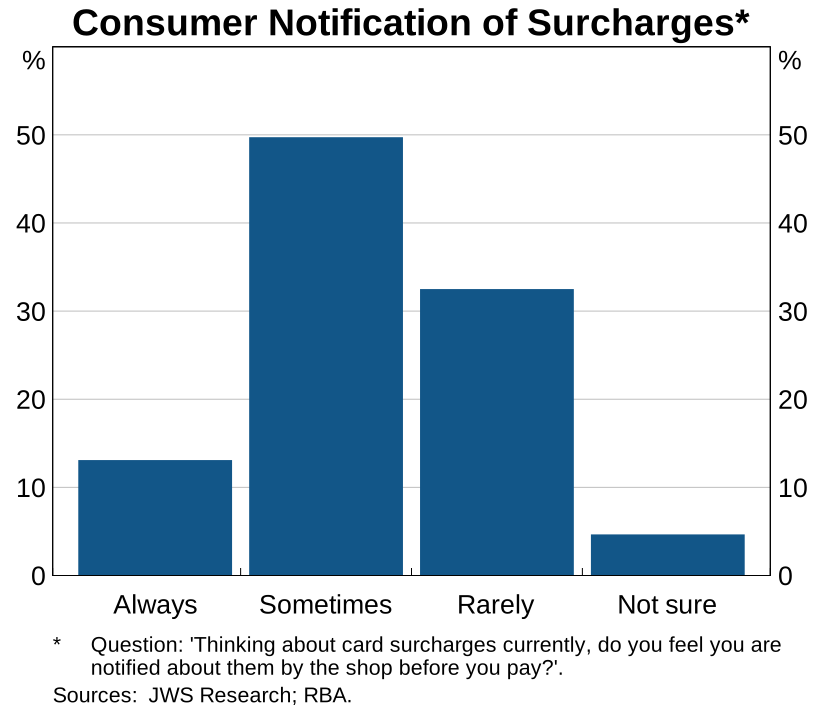
Consumers are not consistently notified of payment surcharges
A large majority of consumers indicated that they are notified of surcharges before making payments only sometimes or rarely (Graph 1). This is consistent with feedback the RBA has received over the consultation period, with acquirers, industry groups and other stakeholders identifying poor compliance with disclosure requirements as a key challenge of the existing surcharge framework. This suggests surcharges are not being used effectively by merchants to direct consumers towards cheaper payment methods.
Consumers prefer an all-in price when shopping
Consumers have a strong preference for removing card surcharging. Around three-quarters of respondents thought surcharging was unnecessary and should stop (Table 1). When deciding to purchase products or services, most respondents prefer advertised prices be the all-inclusive checkout price, without a surcharge for card payments.
| Per cent of respondents (%) | |
|---|---|
| Consumers’ views on surcharging. ‘Some shops apply a surcharge (or fee) on card transactions. How do you feel about this practice?’ | |
| – Necessary for business to cover costs | 19 |
| – Surcharging is unnecessary and should stop | 76 |
| – Do not understand or no preference | 5 |
| Consumers’ preferred surcharging policy. ‘When deciding whether to purchase products or services, would you prefer to see …’ | |
| – All-inclusive price which does not change depending on method of payment | 60 |
| – Price exclusive of card-payment cost, with surcharge if paying by card | 27 |
| – Do not understand or no preference | 13 |
|
Sources: JWS Research; RBA. |
|
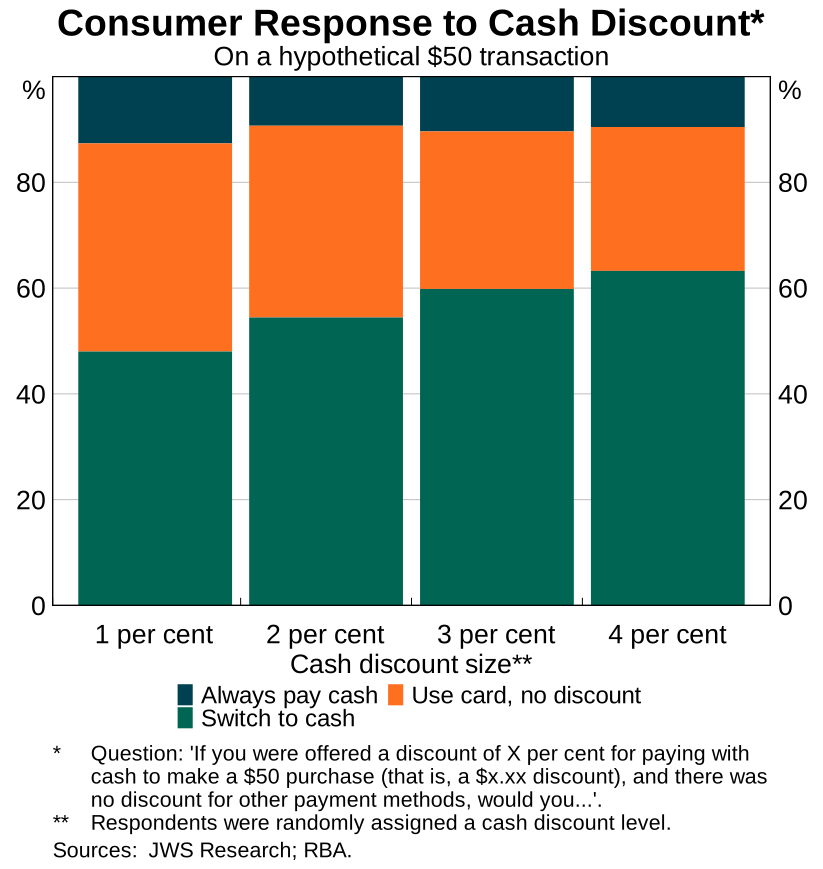
Consumers report strong responsiveness to discounts
Consumers indicated that relatively modest discounts can incentivise them to adopt alternative payment methods (Graph 2). Over half of card users indicated they would switch to cash if offered a 1 per cent discount on a $50 transaction. This increased to over two-thirds for a 4 per cent discount.
2.4 The PSB’s assessment and conclusions
The PSB has concluded that fully removing surcharging on designated card networks (Option 3), when implemented alongside the proposed reduction in interchange fees and increased transparency initiatives in this paper, would best promote the public interest by enhancing competition and efficiency in the card payments system. This assessment reflects the significant changes in the Australian payments landscape since the introduction of the surcharging framework in the early 2000s.
The RBA will lift its prohibition of ‘no-surcharge’ rules for all designated card networks. If surcharging continues after the prohibition of ‘no-surcharge’ rules is lifted, the Government could legislate a ban on surcharging cards of the designated card networks.
The surcharging framework is no longer effective
The PSB has concluded that the significant changes in the Australian payment system since the introduction of the surcharging framework mean the framework is no longer effectively supporting competition and efficiency in the card payments system. The PSB has reached this conclusion based on evidence that surcharging is no longer effectively steering consumers towards making efficient payment choices as:
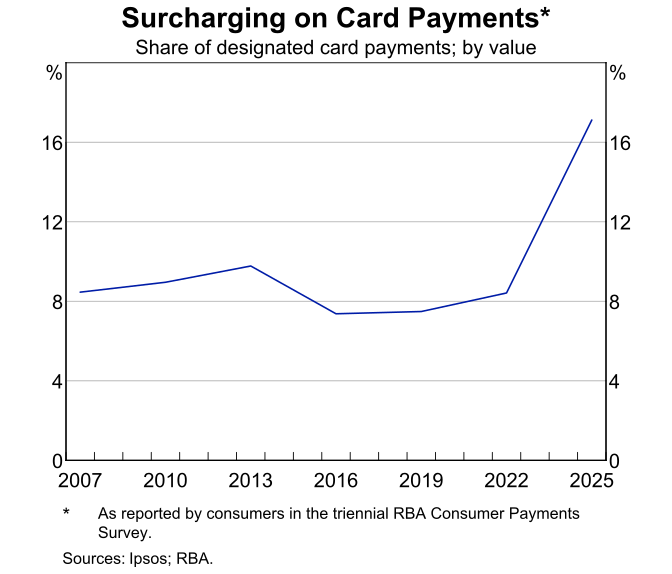
- consumers are less able to avoid surcharges. According to the RBA’s 2025 Consumer Payments Survey, merchant surcharging on card payments doubled in prevalence since 2022 (Graph 3). Cash, which is often the surcharge-free payment method, declined to around 15 per cent of in-person transactions in 2025 from 69 per cent in 2007. Evidence suggests that cash is no longer clearly cheaper for merchants to accept than debit or credit cards, with the cost of each cash transaction having risen as consumer use has declined.21
- merchants on single-rate payment plans usually impose the same surcharge for all card transactions when they choose to surcharge, despite different card types having different underlying costs. Consumers at these merchants are therefore not incentivised to switch to a lower cost payment method, such as a debit card over a credit card. Only around 5 per cent of merchants differentially surcharge debit and credit cards.
- inadequate disclosure of surcharges by some merchants reduces the ability of consumers to make an informed choice about which payment method to use. In the 18 months to June 2024, the ACCC received around 2,500 reports about payment surcharging and disclosure of add-on costs, which included consumer complaints and queries, as well as merchants seeking to better understand their obligations. A survey found consumers are frequently surprised about surcharges when making a payment (see Box A: Consumer experiences with the surcharging framework).
- some merchants may be surcharging above their cost of acceptance, which distorts the price signal and reduces the efficiency of the payments system as consumers are unable to make informed decisions about the cost of their chosen method of payment.
- it is challenging for the ACCC to enforce compliance. The enforcement challenges
generally arise from:
- the large number of merchants that surcharge across the economy (even though the share of merchants that surcharge is estimated to be around 16 per cent)
- the substantial number of these being smaller merchants, which presents challenges for proportionate enforcement action
- the complexities of calculating the cost of acceptance for each merchant.
- some PSPs have gone beyond the policy intention of surcharging regulations. Examples
include PSPs:
- bundling non-payments services into the cost of acceptance (such as business data or inventory management services), which some merchants pass through to consumers via payments surcharges. These services are designed to support the general business operations of the merchant and are not related to the merchant’s cost of acceptance for a given payment method.
- marketing their payment services as ‘free’ for merchants, with the full cost of payments being ‘automatically’ passed on to the consumer as a surcharge. This can reduce the incentive for merchants to shop around and seek lower cost payments services.
- offering merchants incentives, such as frequent flyer points, for their customers’ card transactions, with a higher cost of acceptance that the merchant can pass on to the consumer via a surcharge.
The above evidence has reaffirmed the PSB‘s view that the current surcharging framework is no longer operating effectively. The PSB has assessed that the relatively minor changes to the surcharging framework proposed under Option 1 would not sufficiently address the issues with the framework. The PSB assessed that Option 1 would therefore not be in the public interest.
Removing surcharging on all designated card networks is in the public interest
The PSB has assessed that removing surcharging by lifting the prohibition on ‘no-surcharge rules’ for all designated card networks would best promote the public interest (Option 3). This policy will more strongly advance the public interest than removing surcharging on debit cards only (Option 2). Removing surcharging on all designated cards is in the public interest as it will:
- reduce the inefficiencies for consumers and merchants associated with the complexity
of surcharging rules and poor disclosure of surcharges.
- An RBA survey of consumers indicated that most consumers would prefer to pay an all-inclusive price with no card payment surcharges and that they are often not notified of card surcharges. These consumer responses are consistent with surcharging being viewed as a form of drip pricing that makes it difficult for consumers to make efficient choices by obscuring final prices – contrary to the intent of the surcharging framework. An example of drip pricing is adding a payment surcharge after a consumer has decided to purchase a product at the advertised price.
- Removing card surcharging on designated cards would mean that consumers are able to more easily compare the advertised prices across merchants and not be surprised by additional card surcharges towards the end of the payment process. This benefit would be realised across all cardholders (rather than only for debit cardholders) by removing surcharging on all designated card networks.
- The checkout experience would be more efficient for users of designated cards. By contrast, if surcharging is removed on debit cards only, merchants may need to find out from customers at the point of sale whether they are using a debit or credit card to ensure they are applying the correct surcharge. This would generate inefficiencies for businesses and customers by slowing down transactions and introducing frictions and potential mistakes into the payment process.
- The aggregate impact on measured consumer prices from a removal of surcharging is estimated to be small (around 0.1 per cent) as only around 16 per cent of merchants currently impose payments surcharges. In any case, this would only be a small, one-off impact on measured inflation; consumers are already paying these costs via payment surcharges – which are not included in the Consumer Price Index.22
- simplify enforcement, reduce regulatory complexity and lessen the cost of compliance for
merchants.
- Removing surcharging for all designated card payments would be easier for consumers and merchants to understand and implement than removing surcharges on debit cards only or retaining the current surcharging framework. It is much easier for consumers and regulators to identify whether or not a surcharge is being applied than to assess whether the surcharge is excessive relative to a merchant’s cost of acceptance.
- The PSB was particularly concerned about the challenges that merchants and PSPs would face in applying surcharges correctly if surcharging was only removed for debit cards. Some merchants and PSPs have difficulty distinguishing debit cards from credit cards, particularly when consumers make contactless payments. These challenges would be compounded if a combination card is used. There are eight million combination cards in circulation, which are processed either as a credit card or debit card transaction depending on how the customer presents the card at the terminal.
- Enforcing the surcharging framework is challenging and would continue to be so if surcharging was removed on debit cards only. The ACCC highlighted the challenges of enforcing the framework across the large number of merchants that surcharge and difficulties in calculating a merchant’s cost of acceptance. Lowering the compliance and enforcement burden for merchants and regulators will improve regulatory simplicity and enhance the efficiency of the payment system.
- shift the incentive onto merchants to make more efficient choices when choosing their PSP and
which payment methods to accept.
- If merchants are required to directly absorb payment costs or increase their advertised prices, rather than passing these costs on to consumers via a surcharge, they would be more incentivised to seek a cheaper payment plan. Data from large PSPs suggest only a small share of merchants have switched providers over recent years; at least 90 per cent of their merchants did not switch providers in the 2024/25 financial year despite many merchants paying significantly more in payment fees than their peers. While switching PSPs is costly, the removal of surcharging will increase incentives for merchants to switch, which is likely to encourage PSPs to lower prices to retain and attract merchants.
- The PSB views that this increased incentive for merchants to shop around for better value plans can help to increase efficiency and competition in the payments system. To support this, the RBA is also implementing in this Review several measures to give merchants more information to help them shop around for better deals (for more details, see Chapter 6: Competition in Card Acquiring Services).
- Merchants will be more incentivised to explore alternative, potentially cheaper, payment methods and would have the option to use discounting to encourage uptake of these lower cost payment methods. The PSB continues to support merchants’ use of discounting to help direct consumers to lower cost payment methods, in line with consumer preferences (see Box A: Consumer experiences with the surcharging framework). This is also consistent with behavioural economics literature, which suggests that consumers are loss-averse and dislike the perceived loss from surcharges.23 In addition to directly lowering payment costs, this mechanism would contribute indirect pressure on payment networks’ wholesale fees by encouraging competition on cost.
- ensure non-payment-related costs are paid for by merchants that are using the services rather
than being directly passed onto consumers via a surcharge.
- Some PSPs bundle non-payments services into their merchant service fees. This allows merchants with these providers to surcharge the cost of receiving these non-payment services. This is contrary to the intent of the surcharging framework.
- Removing merchants’ ability to surcharge these services will incentivise them to evaluate the value provided by their PSP’s offering, including bundled services. Merchants that wish to continue using PSPs’ non-payment-related services could pay for these services under a ‘user-pays’ approach.
- If surcharging was removed only on debit cards, PSPs could bundle non-payment services into the cost of acceptance for credit cards. Such bundling would allow merchants to continue to pass those costs to credit card users via a surcharge, adversely affecting credit card users and dampening the incentive for merchants to shop around for a better payment plan. Continuing to allow surcharging on credit cards would therefore reduce competition between PSPs (relative to removing surcharging on all cards).
- be less costly to implement and less disruptive to existing business models.
- Acquirers and PSPs estimated it would cost around $25 million to implement a full removal of surcharging, compared with around $45 million for removing surcharging on debit cards only. PSPs and merchants indicated that they would require less time to comply with a full removal. These differences are due to a full removal of surcharging involving less substantial infrastructure upgrades and more straightforward communication to merchants than removing surcharging on debit cards only.
- PSPs will be able to continue offering the single-rate plans that many merchants value due to their simplicity and certainty of pricing. These PSPs can continue to provide competition in card acquiring services. A debit-only surcharge removal may lead to PSPs ceasing to provide card acquiring services, fewer entrants or the disruption of business models that meet the needs of smaller merchants.
- likely increase some consumers’ use of cards to make payments relative to cash.
Recent research suggests that cash is no longer clearly cheaper for merchants to accept than debit or
credit cards.24 Consumers use cash for a range of reasons,
including sometimes to avoid payment surcharges. They would no longer need to expend effort to avoid
card payment surcharges, including by paying in cash. Since evidence suggests the costs for merchants
to accept cash have risen as cash use has declined, paying in cash is generally no longer more
efficient than paying by card.25
- The RBA’s 2025 Consumer Payments Survey showed that around 20 per cent of consumers avoided surcharges on in-person transactions by switching payment methods. These consumers were 12.5 percentage points more likely to use cash than other consumers. If these consumers were to switch away from cash to card payments, around 2½ percentage points of in-person consumer payments would shift from cash to card.
- enable four-party card networks to compete on a more level playing field with higher cost payment methods that are not subject to price regulation and do not allow surcharging, such as some BNPL products.
The PSB also assessed the potential negative impacts of removing surcharging on all designated card networks and considers that actions can be taken to mitigate these effects or that they are unlikely to materialise:
- The removal of surcharging reduces the ability of merchants to provide a price signal to consumers. However, merchants would retain the ability to steer consumers towards paying with cheaper payment methods by offering discounts. Removing the RBA’s prohibition on ‘no-surcharge’ rules is not intended to prevent discounts being offered to consumers for using certain payment methods. The PSB was not convinced by arguments raised by some stakeholders that discounting is not practical given the widespread use of discounting in retail settings more generally, both in-person and online. An RBA survey indicated that consumers may be responsive to even modest discounts (See Box A: Consumer experiences with the surcharging framework).
- While a full removal of surcharging could facilitate some cross-subsidisation of credit card costs by debit card users, this will be largely offset by reducing the differential in credit and debit interchange fees (see Chapter 3: Interchange Fees). In addition, the cost differential between debit and credit has already decreased partly due to the increased merchant preferences for single-rate plans. Under these plans, merchants are charged the same rate for all card payments and therefore surcharge their customers the same amount regardless of the type of card used.
- Merchants that currently surcharge will face the costs of accepting card payments. Merchants can reduce this impact by switching to a cheaper PSP or plan and incorporating their payment costs in the price of their goods and services. The reduction in interchange fees would likely mean that merchants would need to increase their prices by less than the amount they currently surcharge.
- Removing surcharging may incentivise more consumers to use cards, but would be unlikely to result in
a significant increase in credit card use. Evidence suggests that the price-signalling effect of
surcharging is modest (see Box B: Evidence of the price-signalling effect of surcharging).
Evidence provided by large merchants suggested that surcharging cards at different rates was only
sometimes effective at steering consumers towards cheaper payment methods. In addition, the RBA found
little evidence of an effective surcharging price signal in the aggregate data for Australia.
Evidence from the European Economic Area (EEA) and the United Kingdom shows that credit card usage
did not increase significantly after the removal of surcharging.26 Based on this evidence, the
PSB has concluded that any shift towards credit cards following a removal of surcharging is likely to
be modest.
- Some merchants were particularly concerned about losing the ability to surcharge American Express cards. The PSB is aware of these concerns and intends to consider the appropriate regulatory settings for American Express as part of the next Review planned for mid-2026 under the broader scope of the amended PSRA (see Box C: Surcharging and payment systems not subject to price regulation).
- While surcharging would no longer be a competitive constraint on scheme fees, RBA analysis has not found any evidence that scheme fees are lower in jurisdictions that allow surcharging. Other initiatives that directly target scheme fees are likely to be more effective at constraining networks from raising their fees (see Chapter 4: Scheme Fees; Chapter 5: Transparency of Wholesale Fees).
Box B: Evidence of the price-signalling effect of surcharging
One of the key objectives of surcharging was to provide a price signal to consumers regarding the costs of payments and incentivise them to choose lower cost payment methods.
There is evidence of a weak price signal at the merchant level …
Several large merchants provided evidence of the impact of surcharging on their payment mix:
- A merchant that processes payments across several separate businesses provided evidence that usage of more expensive cards rose a little at some businesses after surcharging was removed. However, this did not occur at all of its businesses that changed their surcharging practices.
- A merchant saw a substantial increase in debit card volumes after adopting differential surcharging for debit and credit cards in place of surcharging all cards at the same rate.
- Another merchant’s card mix did not change materially following changes in surcharging practices, including adding and subsequently removing debit surcharging.
- Data shared by several merchants suggest that the price signal provided by surcharging may be stronger for American Express cards than for designated network cards.
This mixed evidence at the merchant level might overstate the strength of the price signal given it was provided by a small number of merchants that predominantly accept payments online, where the price signal is likely strongest. When paying online, consumers may have more time to decide on a payment method and typically benefit from greater visibility of payment options, surcharges and discounts.
… and the aggregate price-signalling effect of surcharging is small.
Analysis of a merchant-level dataset with a sample of over one million merchants (collected by the RBA from eight large Australian PSPs including major banks and specialist providers) suggests that the price-signalling effect of surcharging is small in aggregate:27
- The median merchant that started surcharging between the 2023/24 and 2024/25 financial years did not experience a meaningful change in its credit card share of payments or merchant payment costs, and nor did the median merchant that removed surcharging.
- Merchants that did not surcharge processed on average 66.1 per cent of card payments through debit cards, while merchants that did surcharge had only a modestly higher 67.8 per cent debit share of card payments. Merchants that applied a higher surcharge on credit payments than on debit payments processed an average of 67.0 per cent of their payments through debit cards.
- Regression analysis of the 2023/24 financial year sample showed that merchants that surcharged card payments had a 0.9 percentage point lower credit card share of payments, after controlling for merchant-level variables such as acquirer, industry and merchant size. This suggests surcharging has minimal impact on merchant card payment costs; a merchant accepting $1 million in card payments would save $36 in lower card payment costs as a result of surcharging.28
The 2025 Consumer Payments Survey data suggest that removing surcharging would not result in an economically significant increase in credit card use. In the survey, around 20 per cent of credit-card owning consumers avoided a surcharge by switching payment methods. This group was around 12 percentage points less likely to use a credit card and 13 percentage points more likely to pay with cash than other consumers when making in-person payments (with no statistically significant impact on debit card use). If surcharging were removed and these consumers ceased switching payment method to avoid surcharges, these estimates indicate that there could be a one-off increase in credit card use of 1½ per cent of in-person transactions. The additional cost of these transactions would largely be offset by lower cash-handling costs and lower interchange on credit card payments (see Chapter 3: Interchange Fees).
The evidence collected over the consultation period suggests the price-signalling impact of surcharging in Australia has diminished since the introduction of the surcharging framework and is now modest. This is consistent with the experience in both the EEA and the United Kingdom, where credit card payments did not increase as a share of total card payments following the removal of surcharging.
The alternative of retaining surcharging on credit cards only
The PSB considered the case for removing surcharging on debit cards only as less compelling than removing surcharging on all designated card networks. As outlined above, many benefits of removing surcharging would be less effective (or not realised at all) if surcharging was removed on debit cards only. Compared with fully removing surcharging, removing surcharging on debit cards only would be more complex for merchants and consumers to understand, retain existing enforcement challenges and have higher implementation costs.
The PSB recognises that retaining surcharging on credit cards may have some competition and efficiency benefits relative to removing surcharging on all designated cards, including:
- steering more consumers towards using cheaper debit card payments and away from credit cards or cash, which are generally more expensive for merchants to accept. Consumers would be incentivised to use debit cards as these cards would never be surcharged.
- putting greater downward pressure on wholesale fees (scheme and interchange fees) on credit cards. Some merchants have argued that card networks are incentivised to keep wholesale fees on credit cards lower to reduce surcharges and encourage use of their credit cards. According to those merchants, this is particularly important in the credit card context because LCR is not available to place downward pressure on wholesale fees at the transaction level. Large merchants that do not surcharge reported that the threat of surcharging is an important negotiating tool to exert downward pressure on merchant fees.
However, the PSB has not received compelling evidence that these benefits would be significant. The share of card payments made on credit cards would need to increase markedly for the lower merchant costs resulting from the RBA’s interchange reforms to be offset by increased credit card use. The PSB views this as unlikely (see Box B: Evidence of the price-signalling effect of surcharging). The RBA has not found any evidence that scheme fees are lower in jurisdictions that allow surcharging, and the PSB views the interchange reforms as more effective at lowering wholesale fees than indirect pressure through surcharging.
If the RBA were to remove the surcharging framework for debit cards only, there may be a policy case for imposing a cap on credit card surcharges to make enforcement easier and limit the bundling of non-payment services into credit card merchant fees such that they could be passed on as a surcharge. However, doing so could reduce efficiency. Merchants may be incentivised to impose surcharges at the cap, even if their merchant fee is below the cap, resulting in credit card surcharging being above efficient levels. While this could be mitigated by defining a permitted surcharge as the lower of the cap or cost of acceptance, this would greatly increase regulatory complexity and make compliance and enforcement more difficult and costly. Determining the appropriate level of the cap would be difficult given the wide divergence in merchant service fees and would require regular review. In addition, legislation may be required to effectively implement and enforce any cap on credit card surcharging.
Other policy options and considerations
The PSB considered the public interest cases of alternative policy options raised by stakeholders and has concluded that these options are not in the public interest at this time:
- Differential surcharging rules for CP and CNP transactions. Some merchants suggested the challenges the PSB has identified in the surcharging framework such as poor disclosure or differential surcharging are less prevalent in the online environment, though the evidence supporting this case is weak. The PSB considers that differential surcharging between CP and CNP transactions is not in the public interest because it would result in additional complexity in the surcharging framework, continue to enable drip pricing and create perverse incentives for merchants’ billing practices. The PSB is particularly concerned that merchants and PSPs would be incentivised to encourage CNP transactions and could stop offering or restrict the useability of in-person payment options in retail settings. For example, consumers ordering at a restaurant could be required to pay through an app without the option to pay in person to force them to pay with a payment method that can be surcharged. The PSB notes that online merchants retain the options of providing discounts or designing the online checkout to encourage consumers to use lower cost payment methods.
- Exemptions from the removal of surcharging. The PSB received many requests for
carve-outs from the removal of surcharging.29 The PSB acknowledges that removing surcharging
will affect some business models more significantly than others. The PSB anticipates merchants
– particularly smaller merchants – will raise their headline prices to incorporate
payment costs. This is in line with consumer preferences for sticker prices to be all-inclusive (see
Box A: Consumer experiences with the surcharging framework). The PSB considers that exemptions
from the removal of surcharging would significantly raise the complexity of the surcharging
framework. The simplicity and ease of enforcement for consumers, merchants, PSPs and the ACCC will
support efficiency and competition in the payments system and outweigh the potential benefits of
exceptions to removing surcharging.
- The PSB recognises that some merchants (such as pharmacies and lottery agencies) sell goods which are subject to regulated pricing and so will not be able to adjust the prices of these products following the removal of surcharging. To address this concern, the RBA is engaging with the federal, state and territory governments to inform them of its decision to remove surcharging so that price regulators can take this change into account in their future decisions.
- Surcharging of taxi fares is subject to regulation by relevant state and territory regulators. The RBA’s surcharging framework currently provides a carve-out in respect of payments for taxi fares using a designated network card. This carve-out is being removed from the relevant RBA Standard and the transparency requirements under that Standard will apply to payments for taxi fares that are made using a designated network card (see section C.3 Transparency requirements for merchant statements). To the extent that surcharging continues in respect of payments for taxi fares, these surcharges will continue to be subject to any applicable relevant state and territory legislation.
Box C: Surcharging and payment systems not subject to price regulation
Many stakeholders expressed concerns that the removal of surcharging alongside reductions in interchange fees on designated card networks may provide a competitive advantage to payment methods that are not subject to the RBA’s interchange regulation. These alternative payment networks include three-party card networks and BNPL providers, and concerns were particularly acute in relation to American Express.
Many submissions suggested that American Express would prevent the surcharging of its cards if surcharging was removed on four-party credit cards. Stakeholders argued this could adversely impact competition and efficiency in the payment system in two ways:
- American Express cards would be able to offer more generous rewards than four-party issuers, given American Express is not subject to the RBA’s interchange regulation. Consumers would therefore be incentivised to switch to American Express and would be able to use these cards without being surcharged. This could raise costs in the payments system because American Express cards are generally more expensive for merchants to accept.
- Losing the ability to surcharge American Express cards could reduce the downward pressure on these fees. Some large merchants argued that surcharging (or the threat to surcharge) is their only credible bargaining tool in negotiations with American Express given they consider American Express cards to be ‘must take’. Nonetheless, the lower rate of merchant acceptance of American Express relative to designated card networks suggests merchants opting out of the American Express network exerts some measure of competitive pressure on its merchant fees.
The 2025 amendments to the PSRA brought three-party card networks and BNPL services clearly within the RBA’s regulatory perimeter. The RBA plans to commence another consultation in mid-2026 under the broader scope of the amended PSRA powers. The PSB considers that competition and efficiency issues related to three-party card networks and BNPL services would be best considered as part of this next review.
Endnotes
12 The current surcharging regulations prohibit designated card networks from imposing ‘no-surcharge’ rules; however, American Express (a non-designated network) entered into a voluntary agreement with the RBA to not impose ‘no-surcharge’ rules. Designated card networks are also subject to the RBA’s interchange fee regulation.
13 Independent estimates calculated using the RBA’s 2025 Consumer Payment Survey and separately using data provided from large Australian PSPs both indicated that around 16 per cent of merchants surcharged designated network card payments. An estimated $1.6 billion of these surcharges were paid by consumers, with the remaining $0.2 billion paid by businesses.
14 See Mastercard (2025).
15 Blended plans have some transaction types ‘blended together’ at one price, such as one rate for all debit card transactions (including eftpos, Mastercard and Visa debit). Merchants on such plans would be able to set a surcharge using the combined rate – in this example for eftpos, Mastercard and Visa debit – even if the wholesale fees for accepting debit card transactions from one network were cheaper than the average rate for debit transactions across all the card networks.
16 In this chapter, references to debit cards and networks include prepaid cards and networks.
17 For further details, see RBA (2025g).
18 BINs are the component of a card number that identify the issuing bank, card type and region.
19 Combination cards allow the cardholder to access both debit card and credit card functionality. There are eight million combination cards in circulation.
20 For further details, see RBA (2025g), p 8.
21 See Mastercard (2025).
22 This estimate was constructed using 2024/25 financial year merchant-level surcharging data to determine the share of merchants that applied payment surcharges and the typical surcharge applied to designated card payments. These estimates were scaled to estimate the total value of card surcharges paid on designated personal cards in Australia in the 2024/25 financial year ($1.6 billion). These surcharges – if fully incorporated into sticker prices on household consumption goods– would result in a 0.1 per cent increase in the Consumer Price Index (proxied by the ABS National Accounts measure of household final consumption expenditure).
23 Kahneman and Tversky (2000).
24 See Mastercard (2025).
25 The RBA is committed to supporting the Australian Government’s policy objective of ensuring cash remains a viable means of payment for as long as Australians want or need to use it as cash is a critical part of an inclusive and resilient payments system. See Bullock (2026).
26 See European Commission: Directorate-General for Competition, Copenhagen Economics and EY (2020), p 44. See also UK Finance and Accenture (2024), p 8.
27 This dataset includes merchant-level data on total card payments made at each merchant on each designated card network, the surcharge on each payment method (if applicable), merchant fees on each payment method and merchant characteristics such as industry. It does not include cash payments.
28 Surcharging would result in 0.9 percentage points of total card payments – $9,000 – shifting from being paid by debit cards to being paid by credit cards. On average, debit cards are 0.40 percentage points cheaper for merchants to accept than credit cards, and so the merchant would save $36 in merchant fees.
29 See RBA (2025g), p 8.