
Backgrounder on Payment Surcharges in Australia
What is a payment surcharge?
A payment surcharge is a fee paid by customers, in addition to the price of a good or service, allowing merchants to pass on the cost of the customer’s chosen payment method.
This Backgrounder describes the current surcharging framework that applies to payment surcharges in Australia, the impact of surcharges on consumers and the approach taken to surcharges in other jurisdictions.
What are the rules about surcharging in Australia?
Currently, merchants have the right to apply a surcharge on card payments, but this surcharge is limited to the amount it costs the merchant to accept that type of card for that transaction. There are three key elements to the surcharging framework, which are broadly as follows:
- Card acceptance costs are limited to fees paid to the merchant’s payment service provider (acquirer or payments facilitator) and other observable costs paid to third parties for services directly related to accepting particular types of cards.
- Payment service providers must provide merchants with an annual statement that clearly sets out their average cost of acceptance for each of the card payment systems regulated by the RBA. Acceptance costs must be expressed as a percentage of transactions.[1] Merchants need to calculate for themselves any other observable costs paid to third parties and that are directly relatable to accepting particular cards.
- The Competition and Consumer Act 2010 (Cth) prohibits merchants from applying excessive card payment surcharges – this is defined as charging a higher amount than what it costs the merchant to use any particular card payment type. The Australian Competition and Consumer Commission (ACCC) has powers to investigate and take enforcement action in the case of possible excessive surcharging.
The Australian Consumer Law (ACL), enforced by the ACCC along with state and territory consumer protection agencies, includes requirements which mean that merchants need to provide clear pricing to customers. The merchant must not mislead customers about their prices and must display the minimum total cost of a product or service, inclusive of any unavoidable or preselected fees.
The ACL also requires:
- merchants to display any surcharges prominently so that consumers are aware of any potential additional costs before payment
- merchants to include the minimum surcharge in the total single figure price displayed for any product or service if they do not provide a surcharge-free payment method.
Why did the RBA implement a surcharging framework?
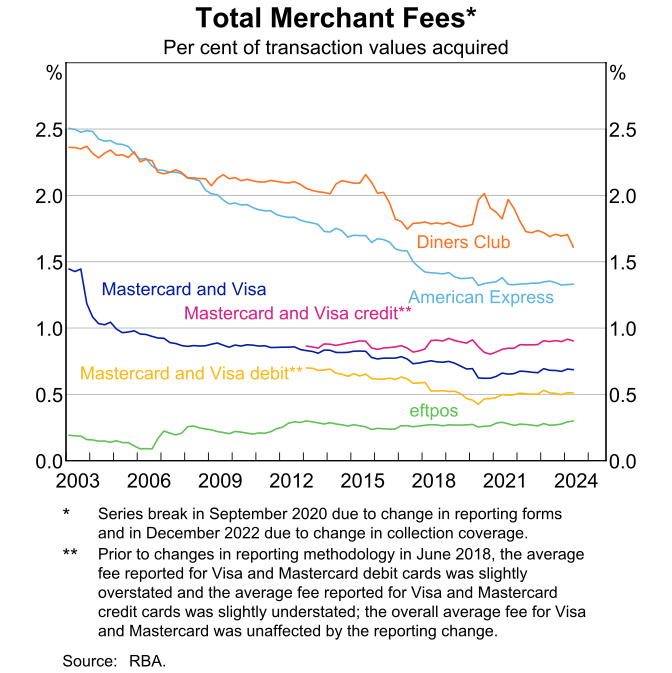
RBA’s surcharging framework aims to lower payment costs for merchants, which, in turn, flows through to lower prices for consumers. Merchants incur costs when they accept a payment from a customer. Different payment methods can have different costs. For example, in 2023, the average cost of a debit-card transaction was around 0.4 per cent, a credit card transaction was around 0.8 per cent, and a charge card transaction was around 1.3 per cent. Unlike other costs that merchants face, such as rent or electricity, a customer’s choice to pay with one method over another affects the costs faced by the merchant.
When customers can see the costs associated with their chosen payment method, it puts competitive pressure on payment service providers and payment system operators. If the prices of payment services are set too high, customers may choose a cheaper alternative. This incentivises payment service providers and payment system operators to keep their fees low. However, if customers do not directly see the cost of their chosen payment method, they may gravitate towards higher cost payment methods that include more benefits targeted at customers (e.g. rewards points). For merchants to recover these higher costs, they need to raise overall prices, leading to higher prices for all customers, even those who pay using lower cost payment methods.
How many card payments are surcharged?
Data available to the RBA suggest that surcharging has increased in recent years, but apply only to a minority of total card purchases by consumers. In the 2022 Consumer Payments Survey, respondents reported that 7 per cent of all card payments attracted surcharges, an increase from around 5 per cent in 2019. The low share of transactions that attracted surcharges partly reflects that large, frequently visited merchants such as supermarkets, large online retailers, petrol stations and large fast-food chains typically do not apply surcharges. Data from one payment service provider suggests that there has been an increase in the prevalence of surcharging in recent years, particularly in hospitality, with around half of this provider’s merchants in the hospitality industry surcharging in mid-2023.[2]
How do consumers respond to surcharges?
Many consumers dislike surcharges and some take steps to avoid paying them.[3] In 2022, around 45 per cent of consumers said they would choose a non-surcharged method when faced with a surcharge, and 20 per cent said that they would avoid shopping at a merchant that levies a surcharge.[4] However, 30 per cent of consumers said they would use their preferred payment method and pay the surcharge. This may reflect that some consumers are willing to pay for the convenience of using contactless payments and that less consumers are carrying a non-surcharged payment method such as cash.
What has been the impact of surcharging regulation in Australia?
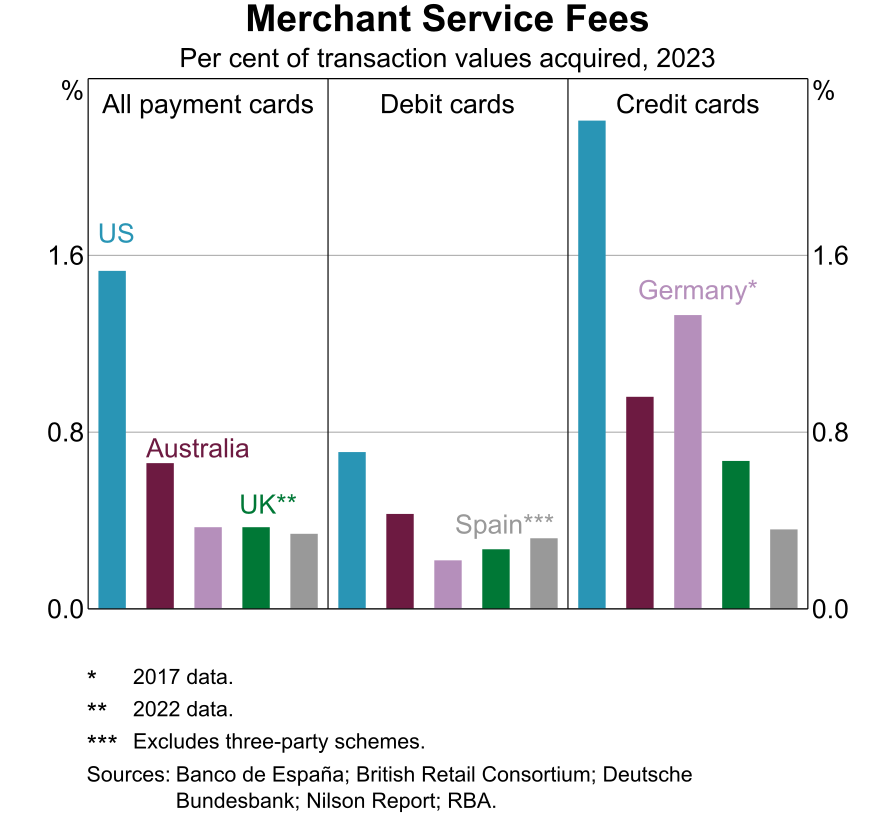
The RBA first implemented surcharging regulation as part of a package of payments reforms in 2003. Card payments have grown strongly in Australia since then and data on merchant service fees indicate that the costs per transaction for merchants to accept card payments have declined. The RBA’s view is that surcharging has helped to put downward pressure on merchant service fees, particularly for charge cards such as American Express, which are not subject to interchange regulation (Graph 1). Surcharging works to lower payment costs for three-party schemes, such as American Express, by giving merchants the option to directly pass on the cost to consumers. This incentivises these payment schemes to lower fees so that either merchants are less likely to surcharge or consumers will still choose their payment option.[5] Comparatively, Australia’s overall card payment costs are lower than those in the United States, yet remain higher than in European countries (Graph 2).
Changes to the surcharging framework were implemented following the Review of Retail Payments Regulation in 2015–2016. The changes preserved the right of merchants to surcharge for more expensive payment methods but required surcharges in designated card systems to be more closely linked to the cost of acceptance.[6] Changes to the Competition and Consumer Act 2010 at the same time provided the ACCC with powers to investigate and take enforcement action when merchants surcharge excessively. These changes have helped reduce excessive surcharging, particularly in the airline industry, with companies adjusting their practices in response to the changes. Some enforcement action has also been taken against companies that engaged in excessive surcharging.[7]
What is the approach to surcharging in other jurisdictions?
Rules on payment surcharging vary significantly across jurisdictions. This section discusses the approach taken to surcharging in some other jurisdictions.
European Union, United Kingdom and Malaysia
Some jurisdictions do not allow surcharging of debit and credit card transactions. For example, the European Union bans surcharging on debit and credit card transactions, but cards issued by three-party schemes (such as American Express or Diners Club) and commercial cards are exempt because they are not covered by interchange fee regulation. Interchange fee regulation caps a portion of the main fees charged by payment service providers to merchants. European Union regulators argue that since these caps keep payment costs at a sufficiently low level, surcharging is not justified as it reduces price transparency and creates additional complexity for consumers. Malaysia also prohibits surcharging of debit or credit cards as part of its interchange regulation. The United Kingdom bans surcharging on all non-commercial debit and credit card transactions to prevent hidden costs for consumers.
United States and Canada
Most of the United States and Canada allow surcharging of credit cards, following lawsuits by merchants against credit card networks and card issuers in those jurisdictions. Credit card surcharges are subject to rules that limit surcharges to the cost of acceptance, up to a maximum allowable surcharge. A few states and provinces, however, have banned surcharging altogether. By contrast, the United States and Canada do not allow debit card surcharging because of ‘no-surcharge’ rules set by the card networks and, in the United States, interchange regulation.
New Zealand
New Zealand has allowed surcharging of credit and contactless debit card transactions since 2009, under agreements that the competition regulator entered with card schemes and banks. The competition regulator issued guidelines in 2023 that surcharges should not be greater than the cost of acceptance. The guidelines also indicate that there is no merchant service fee for the domestic eftpos scheme or where a debit card is inserted or swiped through the merchant’s terminal, so a surcharge should not be applied to these transactions.
Endnotes
Twelve payment systems are subject to the surcharging framework. The RBA has designated eight card schemes and they are covered by surcharging standards: Visa (credit, debit, prepaid), Mastercard (credit, debit, prepaid) and eftpos (debit, prepaid). The RBA also has undertakings from American Express, Diners Club and UnionPay that permit merchants to apply surcharges. PayPal revised its User Agreements in 2016 to allow merchants to surcharge PayPal transactions. [1]
Tyro (2023), ‘Tyro Report: The Surcharging Landscape of Australian Businesses’, 13 June. [2]
Choice (undated), ‘Credit Card Surcharging in Australia’, Report; McMullen S (2018), ‘Avoid Card Surcharges for Good with Fee-Free Shops’, Finder, 19 September. [3]
Livermore T, J Mulqueeney, T Nguyen and B Watson (2023), ‘The Evolution of Consumer Payments in Australia: Results from the 2022 Consumer Payments Survey’, RBA Research Discussion Paper No 2023-08. [4]
Three-party card schemes, like American Express, do not have interchange fees so they cannot be subject to the RBA’s interchange regulation. Interchange fees are wholesale fees set by four-party card schemes such as Mastercard, Visa and eftpos that require payments from the merchant’s payment service provider to the cardholder’s issuer on every transaction. Three-party schemes do not have interchange fees because the merchant’s payment service provider and the cardholder’s issuer are the same institution: the operator of the three-party scheme. [5]
RBA (undated), ‘2015–16 Review of Card Payments Regulation’. [6]
ACCC (2019), ‘Europcar to Pay $350,000 Penalty for Excessive Card Payment Surcharges’, Media Release No 146/19, 14 August; ACCC (2021), ‘Nine Entertainment Pays Penalties for Alleged Excessive Payment Surcharges’, Media Release No 100/21, 2 July. [7]