
Review of Merchant Card Payment Costs and Surcharging – Phase 3 3. Interchange Fees
Conclusions Paper
March 2026
Download the complete Document 3.1MB
Summary of the PSB’s decision
For card transactions acquired in Australia, the PSB has concluded that it is in the public interest to:
- maintain the domestic-issued debit and prepaid card interchange benchmark at 8 cents and lower the cap to 8 cents (or 0.16 per cent on an ad-valorem basis)
- lower the cap on domestic-issued consumer credit card interchange to 0.3 per cent and abolish the benchmark
- maintain the interchange cap for domestic-issued commercial credit cards at 0.8 per cent and abolish the benchmark
- introduce interchange caps for all foreign-issued card transactions at 1.0 per cent
- amend the net compensation requirements to ensure all Australian issuers are subject to the requirements, irrespective of the domicile of any sponsor.
This decision follows the consideration of evidence suggesting current interchange levels are materially above efficient levels. For commercial credit cards, the PSB judges that current competitive dynamics between three- and four-party card networks necessitate retaining an interchange cap above what would be considered efficient.
3.1 The RBA’s approach to interchange regulation
Competition between networks for issuers’ business can lead to higher interchange fees in well-established card networks, which can in turn increase merchant service fees and ultimately consumer costs. This dynamic arises because networks competing for issuers’ business can offer higher interchange revenue to attract issuers. Issuers use this revenue to boost profits and fund generous rewards programs to incentivise card usage. As other networks respond by raising their own interchange fees, the result is an upward spiral in costs as merchants, especially small and medium-sized merchants, have little bargaining power to push down interchange fees and little capacity to refuse card payments. The PSB has long considered that this dynamic warrants regulatory intervention to promote efficiency and competition in the payments system. This remains the case today in Australia’s highly mature and ubiquitous card system.
Setting interchange caps and benchmarks
The PSB has long held the view that efficient interchange settings should reflect costs borne by issuers that provide direct value to merchants in the context of processing or authorising transactions, and fraud prevention (or ‘eligible’ costs). Consistent with this, the PSB recognises that merchants benefit directly from reliable authorisation and transaction processing, a secure payments environment, and an effective dispute resolution framework that protects and supports trust in card payments. Interchange fees that are materially above the level required to achieve these outcomes may be inefficiently high, distorting price signals across payment methods and leading to cross-subsidisation between different merchant and consumer segments. Interchange should not fully compensate issuers for costs arising from broader banking or account-related services that primarily benefit cardholders.
Eligible issuer costs are a reference point and not the sole consideration for setting interchange regulation. The RBA’s concept of ‘eligible costs’ and cost studies are a useful reference point when considering interchange policy settings. The PSB also considers other factors relevant to an efficient and competitive payments system, as well as not increasing risk in the financial system.
To assist in its regulation of interchange, the RBA has conducted several studies of issuer costs. The nature of these cost studies has varied over time according to prevailing system characteristics, policy issues or other practical considerations. In the early 2000s, the RBA required card networks to conduct cost studies each time the RBA sought to review interchange policy settings.30 In 2008, the PSB removed this requirement following feedback from financial institutions that the costs of complying with this requirement were material.31 The RBA then reduced the debit and prepaid interchange benchmark and introduced caps on both credit and debit and prepaid interchange fees in 2016 without conducting additional cost studies. The latter decisions were informed by issuer costs from a broader cost study, alongside data on interchange rates at the time.32
3.2 Interchange fees on domestic-issued card transactions acquired in Australia
Issues for the Review
The RBA Standards No. 1 and No. 2 of 2016 place caps on individual interchange fees on domestic-issued card transactions acquired in Australia and benchmarks for weighted-average interchange fees calculated over a rolling 12-month period (Table 2).33
| Credit (Standard No. 1) | Debit and prepaid (Standard No. 2) | |
|---|---|---|
| Caps | 0.8 per cent | 10 cents (fixed fee) or 0.2 per cent (ad-valorem fee) |
| Benchmarks | 0.5 per cent | 8 cents (all debit cards); 8 cents (single-network debit cards) |
|
Source: RBA. |
||
The RBA regularly reviews its interchange regulations to ensure they support competition and efficiency in the payments system, without increasing risk to the financial system. This Review considered the case for changing interchange settings given:
- consumer credit card interchange fees on domestic issued card transactions acquired in Australia remain higher than in some jurisdictions, notably the EEA and the United Kingdom, where consumer credit card interchange is capped at 0.3 per cent of transaction value.
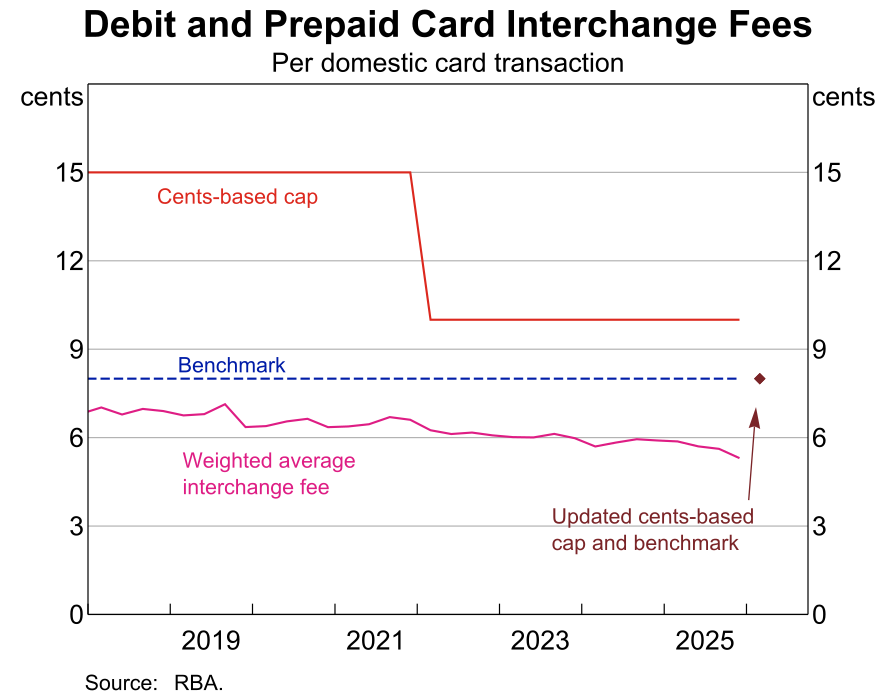
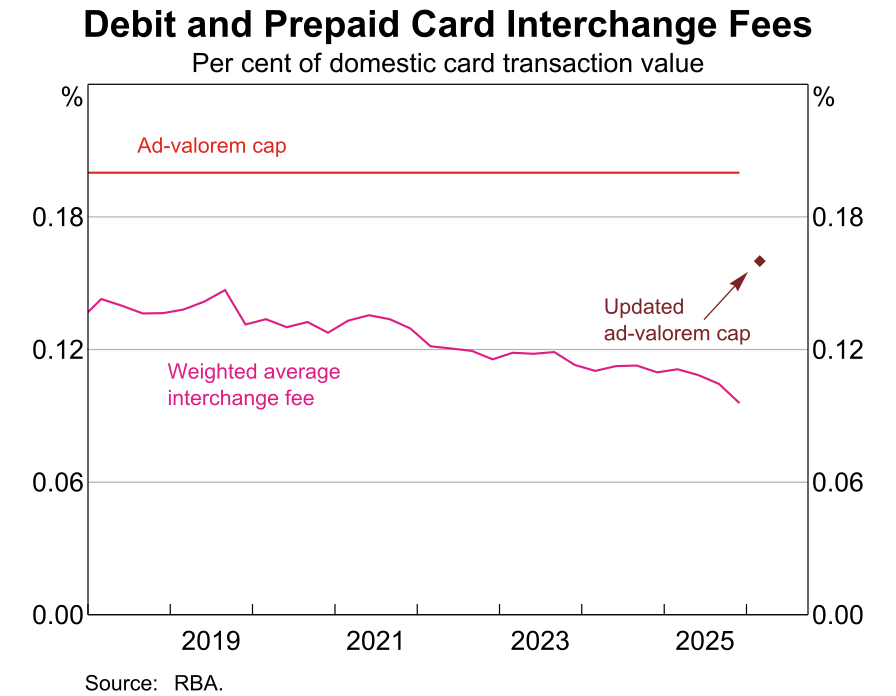
- the weighted-average interchange fee on domestic-issued debit and prepaid card transactions acquired in Australia has fallen to around 6 cents, below the benchmark of 8 cents per transaction and far below the caps of 10 cents per transaction or 0.2 per cent of transaction value. This suggests that current benchmarks and caps are no longer exerting material downward pressure on debit and prepaid card fees.
- there may be a case for regulatory intervention to narrow the gap between ‘strategic’ interchange rates for large merchants and the rates paid by small merchants. While benchmarks have given card networks flexibility to set different rates and encourage adoption of new technologies, this has resulted in small merchants paying significantly higher interchange fees than large merchants. While processing and other costs for small merchants may be higher, these factors do not appear to justify the size of the gap in interchange fees. Lowering interchange caps is one measure that can help to reduce this disparity and promote competitive neutrality across merchants of different size.
- eligible issuer costs have fallen significantly below current benchmarks and caps. Per-transaction costs have declined over time, partly because fixed processing costs are spread across a growing transaction base.
For the purposes of this chapter, references to debit cards includes both consumer and commercial debit cards and prepaid cards. Where relevant, distinctions have been made between DNDCs and single-network debit cards (SNDCs).
Options presented in consultation
Option 1: Retain the current benchmarks and caps on both debit and credit (status quo)
This option maintains the current benchmarks and caps for designated debit card networks (benchmark of 8 cents; cap of 10 cents or 0.2 per cent of transaction value) and credit card networks (benchmark of 0.5 per cent; cap of 0.8 per cent of transaction value).
Option 2: Reduce the credit cap to 0.3 per cent of transaction value and abolish the benchmark
This option simplifies the credit interchange framework to a cap-only regime, with the cap set at 0.3 per cent of transaction value.
Option 3: Reduce the credit benchmark to 0.3 per cent and the cap to 0.5 per cent of transaction value
This option lowers the benchmark for weighted-average credit interchange fees from 0.5 per cent to 0.3 per cent of transaction value, and reduces the cap from 0.8 per cent to 0.5 per cent of transaction value.
Option 4: Reduce the cent-based debit benchmark and the cap to 6 cents, and the ad-valorem cap to 0.12 per cent of transaction value
This option lowers the cent-based debit benchmark for weighted-average interchange fees from 8 cents to 6 cents, and reduces the cap from 10 cents to 6 cents (and the ad-valorem cap from 0.20 per cent to 0.12 per cent of transaction value). The cent-based sub-benchmark for weighted-average interchange fees on SNDCs would also be reduced from 8 cents to 6 cents, in line with the debit benchmark.
Option 5: Apply separate interchange regulation to commercial credit cards
This option applies the reductions in interchange from Options 2 or 3 to consumer cards only, while maintaining the current 0.8 per cent cap for commercial credit card transactions.
3.3 Interchange fees on foreign-issued card transactions acquired in Australia
Issues for the Review
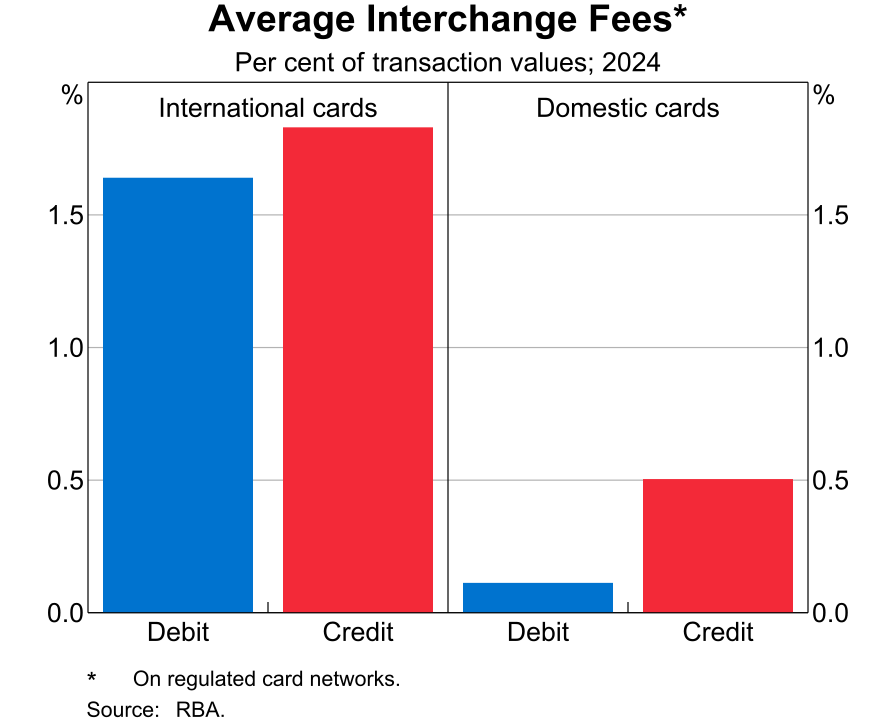
The cost of accepting foreign-issued card transactions acquired in Australia is substantially higher for acquirers and merchants than for equivalent domestic-issued card transactions (Graph 4). Despite foreign-issued cards accounting for around 3 per cent of total card transactions in Australia, they represent approximately 20 per cent of total interchange fees paid by merchants. Current interchange fees on foreign-issued cards acquired in Australia are significantly above the levels agreed to by Mastercard and Visa in the EEA and the United Kingdom. High interchange fees on foreign-issued cards are also raising costs for consumers on domestic-issued card transactions in Australia because of the increasing prevalence of single-rate merchant pricing plans which charge Australian merchants the same fee for domestic and foreign-issued cards.
Options presented in consultation
Option 6: Continue to exclude transactions on foreign-issued cards from the RBA’s interchange regulation (status quo)
Card networks would continue only to be expected to publish international multilateral interchange fee rates or amounts on their websites.
Option 7: Cap interchange on foreign-issued card transactions at 1.15 per cent of value for debit and 1.5 per cent of value for credit
Interchange on foreign-issued card transactions acquired in Australia would be capped at 1.15 per cent of value for debit transactions and 1.5 per cent for credit.
Option 8: Cap interchange on foreign-issued card transactions differentially for CP and CNP transactions
Interchange on foreign-issued card transactions acquired in Australia would be capped at 0.2 per cent of value for debit transactions and 0.4 per cent of value for credit transactions, where card payments are made in person in store (CP, including transactions made in store with a device such as a mobile wallet). Interchange on online (CNP) transactions would be capped at 1.15 per cent of value for debit transactions and 1.5 per cent for credit transactions.
3.4 Stakeholder views34
Consumer interchange fees
Submissions from consumers, merchants, industry groups, PSPs, and government agencies broadly supported lowering interchange caps (Options 2 and 4). These stakeholders argued that:
- high interchange fees are no longer necessary to promote card adoption in a mature payment system with widespread card usage. Stakeholders noted that the cost to issuers of processing transactions has declined over time as fixed costs are spread across a growing transaction base.
- issuers have demonstrated the ability to raise revenue through more allocatively efficient means. For example, most issuers charge higher fees to cardholders for card products that offer more rewards and benefits (which benefit the cardholder).
- reducing interchange would bring Australia closer to peer jurisdictions such as the EEA and the United Kingdom, where consumer credit interchange is capped at 0.3 per cent of transaction value.
- lowering interchange caps would reduce cross-subsidisation within the payments system and improve efficiency. Lower caps would narrow the gap between fees paid by small merchants and those paid by large merchants on strategic rates, reducing the extent to which small businesses subsidise larger ones. Narrowing the gap between credit and debit interchange would reduce the cross-subsidisation of credit cardholders by debit cardholders, particularly given the growing prevalence of single-rate merchant pricing plans.
- current interchange levels allow issuers to ‘double dip’ by receiving compensation for services for which they already charge merchants separately. For example, some merchants reported that they pay for fraud and chargeback protection through interchange fees, while also incurring separate charges from issuers for dispute management services.
- fraud rates in Australia are low by global standards and have been falling, which suggests that Australian issuers require less interchange revenue to compensate them for fraud than global peers or than in the past. A few submissions suggested that higher caps could be maintained for transactions that have higher fraud risks (e.g. CNP and non-tokenised transactions).
These stakeholders generally considered that lowering interchange caps would not have significant negative impacts for the card payment system. They provided evidence that:
- interchange is no longer the primary driver of innovation, as innovations such as tokenisation, click-to-pay and DNDC routing have emerged despite declining interchange fees.
- the level of interchange is not correlated to the incidence of card payment fraud. Stakeholders pointed to evidence from other jurisdictions that interchange reductions did not result in an increase in card fraud rates.
- lowering interchange has not reduced the availability of consumer credit in other jurisdictions.
By contrast, most issuers and networks supported retaining current interchange caps (Option 1) because:
- lower interchange revenue could negatively impact competition in card issuing. They argued that reduced interchange revenue could threaten the viability of smaller issuers, deter new entrants, and entrench the position of larger institutions, particularly as smaller issuers lack alternative revenue streams and may struggle to cover issuing costs under proposed caps. They noted that, unlike larger issuers, their revenue pools lack diversity and scale, and they are less able to recoup revenue losses through higher fees on cardholders.
- a lower interchange benchmark for debit cards was unnecessary. These stakeholders noted that interchange rates for debit transactions are already below the weighted-average benchmarks, reflecting strong competition and the benefits of LCR.
- the proposed reductions in interchange would result in larger falls in interchange revenue
for issuers than the RBA suggested in the Consultation Paper, particularly for debit
cards.
- The debit benchmark represents a weighted average across all debit card interchange categories, which allows some flexibility for card networks to set higher rates for certain categories provided the overall average remains within the benchmark. Reducing the cap to the level of the benchmark, as proposed in the Consultation Paper, would remove this flexibility. This would effectively require all categories to be priced at or below the proposed benchmark. Issuers argued that this would compress interchange revenue more than intended, as the benchmark is an average rather than a ceiling. They argued this could result in revenue falling below sustainable levels.
- These concerns are amplified by debit card issuers lacking alternative revenue levers such as the ability to earn interest income or increase account fees (some of which are restricted under the Banking Code of Practice). Furthermore, cents-based benchmarks mean interchange revenue remains fixed while costs rise with inflation, reducing real revenue over time. These stakeholders viewed this dynamic, combined with a lower cap aligned to the benchmark, as placing additional pressure on issuers’ ability to recover costs associated with debit card issuance.
- existing benchmarks are already low by international standards. Interchange caps on debit cards are already lower in Australia than in the EEA, New Zealand and the United Kingdom. Some stakeholders were also of the view that comparisons to the EEA and the United Kingdom were inappropriate because they claimed Australia has smaller transactions volumes. A banking industry group also opposed comparing the jurisdictions on the basis that Australian issuers incur higher cash distribution costs due to the country’s vast and dispersed geography.
Several large issuers indicated they would consider taking action to maintain the profitability of their card issuing business if interchange revenue was lowered including by:
- increasing card fees or interest rates, or reducing card rewards programs. This would diminish the value of cards for consumers.
- reducing their investment in fraud prevention, which could leave their customers more vulnerable to fraud and malicious actors.
- reducing investments in new technologies such as agentic commerce. Card networks and issuers argued this would be compounded because lower interchange caps would reduce the ability for the card networks to set differential interchange rates to incentivise take-up of new innovations.
- tightening their credit assessments, which could reduce credit access for their customers including lower income households and small businesses.
Issuers considered that their responses could cause cardholders to shift to more expensive payment methods. Higher cardholder fees, increased interest rates, and reduced access to credit could lead some consumers to shift to higher cost alternatives such as payday loans or BNPL products. Similarly, reductions in rewards programs could prompt consumers to switch to products such as American Express, which are not subject to the RBA’s interchange regulations, and typically involve higher acceptance costs for merchants. This could raise system-wide costs if the extent of customer switching was significant.
There was limited support for reducing the credit benchmark to 0.3 per cent and cap to 0.5 per cent (Option 3). A few large merchants stated this option would reduce overall costs but retain sufficient flexibility for strategic rates.
Commercial credit interchange fees
Most stakeholders that supported interchange reductions did not differentiate between consumer and commercial cards. A few submissions specifically supported capping interchange on commercial cards at the same (lower) rate as consumer cards because eligible issuer costs are similar for both products. Some stakeholders also highlighted that issuers often pass on a portion of commercial credit card interchange revenue to cardholders in the form of cash rebates, a practice confirmed by several issuers. Some viewed this as an indication that interchange on commercial cards was too high and questioned whether merchants should be funding this practice through interchange.
Some issuers, card networks, large travel merchants and a group representing payments industry participants advocated for leaving interchange on commercial cards capped at a higher level than consumer cards (Option 5) or entirely uncapped, on the basis that:
- commercial cards provide significant value to cardholders, including:
- through reconciliation information, expense and tax management capabilities
- by providing a source of working capital for small businesses
- by removing the need to raise invoices and allowing merchants to receive payments earlier. However, this view was disputed by some merchants who noted that they issued invoices and offered similar payment terms regardless of payment methods.
- American Express would gain an unfair competitive advantage over four-party commercial card networks. Many submissions stated that American Express would grow its share of commercial card transactions significantly from an already dominant position, which could raise merchant payment costs.
- some issuers could stop issuing commercial card products.
- Some submissions reported that some new issuers rely on commercial cards to cover costs due to their high interchange rates.
- One small issuer stated they would consider withdrawing from this segment.
- issuers are less able to recoup costs via other means because many commercial cards are charge cards that are paid off in full every month and therefore do not incur interest.
- commercial cards have fewer viable substitutes than consumer cards. An issuer stated that cash is less available for business-to-business transactions. However, several submissions noted the higher prevalence of account-to-account payment methods for these transactions.
- commercial cards are more expensive to issue than consumer cards according to a group representing the payments industry. They stated that increasing the number of small issuers surveyed in the issuer cost study could have resulted in higher aggregate costs. An issuer also stated that their costs of issuing commercial cards are larger than their costs of issuing consumer cards.
- peer jurisdictions do not regulate interchange on commercial cards. Interchange on commercial cards is currently uncapped in the EEA, the United Kingdom and New Zealand. Interchange on commercial credit cards generally exceeds 1.5 per cent of transaction value in those jurisdictions.
Applying differential treatment to small issuers
Small issuers, including several smaller fintechs, supported higher interchange caps or exemptions for small issuers. They noted that smaller issuers rely heavily on interchange revenue due to limited alternative income streams and that card networks charge them higher net scheme fees than larger issuers. These stakeholders argued that lower interchange could force small issuers to exit the market or deter new entrants, reducing competition. They also noted that an exemption for small issuers would have minimal impact on overall costs because these issuers account for a small share of transaction volumes.
Conversely, a few issuers and one large merchant argued that all issuers should be subject to the same interchange regulation, with no exemption for smaller issuers. They noted that small issuers already benefit from regulatory relief through exemptions from DNDC requirements and argued that participants should not subsidise inefficient issuers with high cost bases. These submissions warned that exemptions could distort competition or create opportunities for regulatory arbitrage, and suggested that uniform caps would incentivise smaller issuers to invest in lower cost payment methods, thereby improving system efficiency.
Several stakeholders suggested that interchange reforms could come into effect at a later date for small issuers to give these institutions more time to prepare for the changes.
Other issues
Many issuers raised concerns about the design of the Issuer Cost Study.
- Several issuers stated that they were not given sufficient time to provide their cost data to the RBA and as a result, the data submitted was not representative of actual issuer costs. These same submissions acknowledged that the time provided for this study was broadly in line with the timeframe for the system-wide Payment Costs Study in 2013–2014, which required more granular data across a wider range of payment services than this Review’s Issuer Cost Study.35
- Some issuers noted that some definitions in the study were unclear, which led to resubmissions of cost data after the publication of the Consultation Paper. One issuer stated that knowing which cost categories would count as eligible costs influenced how they reported costs in the study.
- Smaller issuers expressed concern that the results of the study did not adequately reflect costs for small and emerging issuers, which have higher fixed costs spread across lower transaction volumes. They argued that their costs were much higher than the estimates presented in the Consultation Paper. Some argued that interchange caps and benchmarks should cover the costs of all issuers rather average costs across the industry.
- Several issuers raised concerns that the Issuer Cost Study underestimated the fees paid to mobile wallet providers. They noted that, while these fees were included as eligible costs, because they are spread across an issuer’s entire transaction base in the calculations rather than only mobile wallet transactions, it implied mobile wallet costs are small. These issuers also expected the share of mobile wallet transactions to increase over time, which they argued would raise the per-transaction cost for issuers.
- Many issuers and some networks opposed the Consultation Paper proposal to exclude the cost of providing interest-free periods from eligible issuer costs. They argued that merchants derived benefits from interest-free periods, such as increased sales and improved customer purchasing power, and therefore merchants should bear most or all of the associated costs. A few issuers also argued that it was not appropriate to use the cash rate in the calculation of the cost of interest-free periods because market funding costs were higher.
Several stakeholders argued that the definition of eligible costs should be expanded to include:
- exchange rate risk
- disputes and chargeback costs; however, some merchants stated they are already being charged by issuers for chargebacks and that compensating issuers via interchange for those costs amounted to double counting
- system and IT costs
- product development costs
- costs that could arise in coming years
- a portion of the cost of account overheads, set-up and maintenance, card production and delivery, and cost of capital.
A network and an issuer proposed using a merchant indifference test36 to calibrate interchange caps. This approach compares merchant payment costs of alternative methods to determine efficient interchange levels that balance benefits across merchants, consumers, issuers and acquirers. The network argued that this method would also account for the risk of consumers switching to American Express or BNPL products.
Some submissions proposed alternative policy options beyond those outlined in the Consultation paper. These options included:
- lowering interchange on debit and credit cards close to zero.
- banning strategic rates or volume-based discounts.
- imposing a cap on strategic rates at a fixed discount of 30 per cent to the rate available to small merchants (as opposed to the current practice of 60–80 per cent).
- reducing interchange fees for small businesses only. Stakeholders suggested this could be achieved by the RBA introducing a separate (lower) cap for small businesses in its standards. Alternatively, card networks could work with the payments industry themselves to design and implement programs that offer lower interchange rates to small businesses. These suggestions were put forward conditional on interchange caps for other businesses not being lowered and overall revenue for issuers remaining little changed from current levels.
- introducing a floor on interchange to reduce the disparity between the interchange rates faced by small and large merchants on strategic rates.
- applying different caps for CP and CNP transactions to reflect higher fraud risk in CNP transactions, as well as costs linked to future product developments that are more prominent in CNP transactions (such as agentic commerce).
Interchange on foreign-issued card transactions acquired in Australia
Most submissions that addressed this issue suggested that interchange on foreign-issued card transactions in Australia should remain higher than on domestic-issued card transactions, reflecting the greater complexity and fraud risk associated with cross-border payments.
Some networks, foreign issuers, and groups representing the payments industry opposed the introduction of caps on foreign-issued card transactions in favour of the status quo (Option 6). They argued that:
- cross-border transactions represent a small share of total card payments in Australia, so caps would only have a marginal effect on overall merchant costs.
- higher interchange fees are necessary to compensate issuers for the higher complexity and risk involved in cross-border transactions relative to domestic-issued card transactions acquired in Australia.
- the proposal to cap interchange on foreign-issued cards is not informed by foreign issuer costs on transactions in Australia because the RBA has not collected these data. Several stakeholders including foreign issuers and card networks stated that using Australian issuer costs on foreign transactions is not an adequate proxy because issuing costs could differ across jurisdictions and institutions.
- the RBA should conduct a merchant indifference test to calibrate potential interchange caps rather than be informed by a cost study. A foreign issuer stated that a merchant indifference test would capture the full benefits derived by merchants from accepting foreign-issued cards.
These stakeholders argued that reducing interchange fees on foreign-issued cards could have adverse impacts:
- Some foreign issuers might respond by blocking or restricting card usage in Australia or imposing prohibitive fees on cardholders travelling to Australia.
- This could discourage foreign tourist spending in Australia, harming sectors such as tourism and retail.
- Lower interchange revenue could disrupt challenger fintech business models, entrench incumbent banks, and give a competitive advantage to payment methods that are not subject to interchange regulation such as American Express.
In addition, some stakeholders argued that the EEA and the United Kingdom are not appropriate benchmarks when considering caps on cross-border interchange. They argued that:
- Australia has a smaller population and lower payment volumes than the EEA and the United Kingdom.
- the equivalent caps in the EEA were originally based on average issuing costs calculated across the 10 largest payment services markets and applied uniformly across all EEA member states. As a result, the framework did not account for cost variations between countries or for structural differences between larger jurisdictions and smaller payment markets. This approach reflected broader policy objectives, principally the development of a single European market, rather than a focus solely on underlying economic cost differentials.
- The EEA benchmarks are not appropriate even in the EEA context because of deficiencies in the original methodology. For example, a card network stated that online transactions were inadequately captured and that the sample size was too small in the merchant indifference test conducted by the European Commission. The card network noted that its preferred methodology suggests cross-border interchange in the EEA should be above 2 per cent for both debit and credit.
By contrast, some merchants, merchant groups and PSPs stated that current levels of interchange on foreign-issued cards were not justified and supported measures to reduce them (Options 7 or 8) on the basis that:
- while fraud rates on cross-border transactions are higher than those for domestic transactions, cross-border fraud rates on foreign-issued card transactions acquired in Australia remain low by global standards and do not warrant interchange fees that are 1–1.5 percentage points above equivalent domestic-issued card transactions acquired in Australia.
- current fees impose significant costs on merchants and consumers without commensurate benefits.
- lowering fees on cross-border payments could facilitate international commerce through reducing acceptance costs for in-person card payments by international visitors and online purchases made from overseas customers using foreign-issued cards. The RBA received evidence that the volume of cross-border transactions rose after the introduction of interchange caps on those transactions in the EEA.
- it would align with G20 objectives to reduce cross-border payment costs.37
The majority of stakeholders that favoured introducing a cap on interchange fees for foreign-issued cards did not specify which option was preferred. A small number of merchants and PSPs specifically supported splitting the caps by CP and CNP (Option 8). There was little direct support for caps that were differentiated only by credit and debit transactions (Option 7).
Several submissions raised concerns regarding the possible circumvention of interchange caps on domestic-issued card transactions acquired in Australia using foreign-issued virtual cards under the status quo (Option 6). A typical example involves an online platform for hotel bookings accepting a domestic-issued card transaction from the booking customer in Australia for an Australian hotel and then paying the Australian hotel using a foreign-issued virtual card, instead of making a domestic payment. This results in the Australian hotel paying much higher interchange and scheme fees than intended by the RBA’s regulations. Regulation of interchange on foreign-issued cards would reduce the detrimental effect on Australian merchants from this practice.
3.5 The PSB’s assessment and conclusions
In forming its conclusions on appropriate interchange settings, the PSB has drawn on a wide range of evidence. This includes analysis of issuer costs, competitive dynamics across card networks and merchant segments, evidence on price-signal distortions and cross-subsidisation, stakeholder submissions, and where relevant, international experience with interchange regulation. The PSB has considered these factors in the context of its public interest mandate.
Issuer Cost Study
The RBA re-ran the Issuer Cost Study following stakeholder feedback on the initial Issuer Cost Study process. The subsequent study featured the following changes:
- The RBA collected data for 2024/25 and 2023/24 reporting years, in response to feedback that there had been structural changes affecting issuer costs since 2023/24, such as growth in the use of mobile wallets.38 The Cost Study confirmed that mobile wallet-related costs remained very small, and the share of mobile wallet transactions did not change materially between studies.
- The RBA clarified the definitions of some cost categories following consultation with participants to assist institutions with reporting and improve consistency across submissions.
- The scope of the study was slightly broadened to include: issuer costs related to commercial debit cards; a cost breakdown for the net costs of disputes, chargebacks, collections and write-offs; and a disaggregation of costs by CP and CNP for transactions acquired in other countries on Australian-issued cards.
- In response to feedback that small issuers had not been adequately captured in the initial cost study, a much broader range of institutions were given the opportunity to voluntarily participate, including members of the Customer Owned Banking Association and Fintech Australia.
- In response to feedback that the RBA should seek to collect issuer cost information from foreign issuers, the RBA contacted 30 foreign issuers to give them the opportunity to voluntarily provide information on their issuer costs for cross-border card transactions.
Following consultation with stakeholders on the design of the Cost Study, the process of collecting data from institutions and resolving data queries took place over a total of 11 weeks. The RBA considered this timeframe appropriate given that:
- the timeframe was consistent with previous, broader cost studies. The 2014–2015 system-wide cost study allowed participating institutions nine weeks for data completion and query resolution, despite requiring significantly more data inputs than this Cost Study.
- the Cost Study was substantially similar to the study conducted for the Consultation Paper, so institutions were familiar with the template and process.
- two rounds of consultations were held with participating institutions to ensure clarity on updated definitions and accurate cost reporting ahead of the Cost Study being issued.
- most institutions indicated that the timeframe was sufficient to complete the study accurately. Extensions and guidance were offered where requested and necessary.
- reporting was staggered between card issuing costs for transactions acquired in Australia and internationally to allow for adequate time for accurate compilation of costs for each transaction type.
The PSB’s longstanding position is that, in a mature card network, interchange fees should be efficiently set such that they compensate issuers only for the costs of services that directly benefit merchants, because these services support merchants’ ability to accept card payments safely, reliably and at scale. Costs that primarily benefit cardholders, or relate to broader banking services, are not considered eligible because passing these costs through to merchants via interchange would undermine efficiency.
Consistent with this, the RBA considers the following issuer costs as eligible, because they represent services that clearly and directly benefit merchants in the context of processing and authorising transactions, and fraud prevention:39
- authorisation and transaction processing – these functions allow merchants to accept card payments with confidence that the transaction will be validated, routed and settled reliably.
- fees and other costs associated with mobile wallet providers – these costs relate to enabling acceptance of card-based payments through digital wallets, a channel increasingly used by consumers; merchants benefit directly from being able to accept these transactions given they are made in the same fashion as ‘tap and go’ card payments.
- fraud, including net fraud losses and fraud prevention – merchants benefit from issuers’ fraud-mitigation activities through reduced fraudulent transactions, fewer disputed payments and a safer payments environment.
- net scheme fees – these fund card network services that underpin acceptance and network integrity (such as interoperability, risk controls, dispute frameworks and technology upgrades) and therefore support merchants’ ability to accept card transactions. Net scheme fees appropriately take into account the rebates provided to issuers by the card networks, such that merchants are not charged twice for the same service (once through acquirer scheme fees, and a second time through interchange to cover gross issuer scheme fees that have been offset by rebates from the card networks).
- net costs of disputes and chargebacks, including chargeback write-offs – merchants benefit from fair and efficient dispute resolution that protects revenue, reduces uncertainty and supports trust in the card network. While this cost category was excluded in the definition of eligible costs in the Consultation Paper, its exclusion was not consistent with prior cost studies, and it has therefore been reinstated following stakeholder feedback.
The PSB has determined that costs associated with interest-free periods on credit cards are no longer eligible. While these costs were included when setting the credit benchmark in 2002, it was indicated at the time that this inclusion was temporary. The treatment of the costs of the interest-free period was subsequently reviewed as part of this Consultation process. The PSB did not receive compelling evidence that merchants derive most of the benefit from interest-free periods; instead, the PSB considers the primary benefit accrues to cardholders, through deferred payment, and issuers, through higher interchange revenue from more credit card purchases and customer retention. As such, to promote efficiency in the payment system through a user-pays approach, the PSB determined that the cost of funding interest-free periods should be excluded as an eligible cost so that merchants would not bear these costs through higher interchange fees.
Stakeholders proposed including a range of broader business and product costs within eligible costs, many of which have never been considered by the RBA to be appropriate for merchants to fund through interchange. The PSB did not treat the following as eligible because they do not relate to costs incurred in processing or authorising transactions, or costs related to fraud or fraud prevention:
- general institutional costs, such as the cost of capital, resilience and risk-management investments outside of fraud prevention, and compliance with prudential or anti-money laundering and counter-terrorism financing obligations. Such costs reflect an issuer’s overall risk profile and the cost of internal controls. Costs associated with directly protecting merchant outcomes, such as processing controls or fraud prevention, are already captured within eligible cost categories.
- general system and information technology costs. Operational information technology directly tied to authorisation and transaction processing or fraud systems is included within the relevant eligible categories; broader systems supporting product development, marketing, account management and customer service primarily benefit cardholders and issuers and therefore are not appropriate to include in eligible costs.
- product development and feature costs unrelated to merchant protection, such as channel enablement, user experience enhancements, and loyalty program development costs. While these may be strategically valuable for issuers and cardholders, they are not prerequisites for a merchant to authorise, clear or settle transactions safely via the card network.
- exchange rate costs borne by issuers. To the extent some foreign exchange-related costs are embedded in relevant categories, such as within net scheme fees, they are already captured in eligible costs. Further, many issuers already recoup many transaction-related foreign-exchange costs directly through their customers through additional fees.
- account set-up, overheads and maintenance costs. These costs largely relate to activities that primarily benefit cardholders and issuers rather than directly supporting card acceptance, such as marketing, general customer service, and account management functions, that would be incurred even in the absence of card issuing.
- card production and delivery costs not associated with fraud-related card replacement or security features. Routine card production and delivery costs have never been considered an eligible cost. These costs are more closely associated with account establishment and lifecycle management, which are similarly not considered eligible.
Some issuers proposed adding ‘buffers’ for prospective trends, such as the growth in mobile wallet or tokenised transactions, the increasing share of CNP transactions, scheme fee changes, and evolving resilience and security standards. The Issuer Cost Study is designed as a point-in-time measurement of actual costs incurred, which has, at some points, benefited industry (such as when costs have been abnormally high due to point-in-time migrations or card-related projects at some card issuers). Incorporating forecasts would introduce subjectivity and be arbitrary. The PSB considers the role of the cost study in the interchange regulatory framework to be appropriate.
The PSB also considered suggestions from stakeholders to adopt different methodologies to inform its regulation of interchange but concluded that those were not as appropriate as a targeted study of issuer costs. These suggestions included:
- conducting a merchant indifference test. In Australia, it is not clear which alternative payment method would be the most appropriate for conducting a merchant indifference test with robust results, since cash use has declined from around 70 per cent of consumer payments by number in 2007 to 15 per cent in 2025 and is not typically an alternative payment method for CNP transactions. There are other challenges associated with data collection in this type of study. In particular, a merchant indifference test requires merchants to provide detailed cost information across a range of payment methods. Overseas experience highlights that such a process is highly complex and can result in substantial data quality issues. While these exercises often take considerable time to execute, the principal concern is that, in the Australian context, a merchant indifference test is unlikely to yield results that are more reliable or relevant than an Issuer Cost Study for the purpose of informing interchange regulation.
- a holistic, end-to-end study of the Australian payment system. There can be value in intermittently conducting such holistic reviews, as was last done in 2014, when considering broader changes than those proposed by this Review. However, to avoid delaying the conclusions of this Review through unnecessary data collection and imposing undue burden on the payments industry, it was appropriate to restrict the focus of the Cost Study to card issuing.
Domestic-issued debit and prepaid card interchange
For all domestic-issued debit and prepaid cards acquired in Australia, including SNDCs and commercial debit cards, the PSB has concluded that it is in the public interest for the:
- interchange cap to be reduced to 8 cents (or 0.16 per cent on an ad-valorem basis) because aligning the cap with the current benchmark will narrow the dispersion in interchange fees between large strategic merchants and smaller merchants, thereby reducing cross-subsidisation.
- interchange benchmark to remain at 8 cents because a lower benchmark (in combination with a lower cap) would risk undermining competition in debit card issuing. Updated evidence indicates that eligible issuer costs are higher than originally estimated, and reducing the benchmark below current settings would push interchange levels below these costs. The PSB judges that the impact of any reduction in competition in debit card issuing from current levels would outweigh the marginal efficiency gains from a lower interchange benchmark. The sub-benchmark for weighted-average interchange fees on SNDCs would also remain at 8 cents.
Lowering the debit cap
The PSB had proposed in the Consultation Paper to reduce the interchange debit cap to 6 cents (or 0.12 per cent on an ad-valorem basis). The intention was to reduce the disparity in interchange fees between large strategic merchants and smaller merchants that are not eligible for strategic rates.
The PSB consider there is a compelling case for reducing the interchange debit cap from current levels because:
- there remains a strong case to improve efficiency by lowering the cap to reduce the disparity between lower strategic rates paid by large merchants and higher non-strategic rates paid by small merchants. On average, smaller merchants pay around 0.13 percentage points per transaction more in interchange fees per debit transaction than strategic merchants. This results in a degree of cross-subsidisation from small to large merchants. Lowering the cap will reduce the upper bound on fees faced by merchants.
- the capacity for international card networks to maintain differentiated interchange categories is preserved. The networks retain the flexibility to promote certain behaviour or technologies through differential rates.
- the PSB has not received compelling evidence that current interchange fee levels have constrained the adoption of security or innovation initiatives in the domestic debit card system. The proposed reduction to debit interchange is not expected to materially change these outcomes or increase risk in the payments system.
However, the PSB has concluded that it is in the public interest to lower the cap from 10 cents to 8 cents (or 0.16 per cent on an ad valorem basis) per transaction, instead of 6 cents (or 0.12 per cent on an ad valorem basis) as proposed, because:
- eligible issuer costs are higher than originally reported. Estimated costs are around 7 cents per debit transaction according to the revised Issuer Cost Study (Table 3).
- issuers have limited ability to offset reductions in interchange revenue for debit cards, relative to credit cards. For example, debit cards do not generate interest revenue as credit cards do.
| Eligible cost category | %(b) | Cents |
|---|---|---|
| Authorisation and transaction processing | 0.06 | 3 |
| Fees and other costs associated with mobile wallet providers | 0.01 | 1 |
| Fraud | 0.02 | 1 |
| Net scheme fees | 0.03 | 1 |
| Net disputes, chargebacks, and chargeback write-offs | 0.01 | 0 |
| Total eligible costs(c) | 0.13 | 7 |
|
(a) Most issuers provided data for the Australian 2024/25 financial year. Others
provided data based on their internal reporting periods. Source: RBA. |
||
Maintaining the debit benchmark
The PSB has determined that it would be in the public interest to maintain the current benchmark of 8 cents for debit interchange. The PSB has concluded that lowering the interchange benchmark on debit transactions to 6 cents, as proposed in the Consultation Paper, could harm competition in debit card issuing for similar reasons as given for the debit interchange cap.
It would also offer only limited efficiency gains, given that the weighted average interchange fee on domestic-issued debit card transactions is already close to 6 cents, driven by competition between issuers for merchants’ transactions on DNDCs (Graph 5; Graph 6).
The PSB considers it appropriate to maintain the debit benchmark rather than remove it in order to retain the efficiency gains from the existence of the benchmark. For debit card transactions, eftpos predominantly prices interchange in cents-based terms, while the international networks typically set ad-valorem interchange rates. Where there are separate cents-based and ad-valorem interchange rates on debit card transactions, retaining the benchmark constrains upward drift in weighted-average interchange rates as prices rise over time, and ensures that card networks cannot circumvent the intent of cents-based caps by shifting towards ad-valorem interchange rates for higher transaction values. This issue arises only for debit cards, as credit card interchange fees are all priced in ad-valorem terms.
Domestic-issued consumer credit card interchange
The PSB has determined that it is in the public interest to:
- reduce the consumer credit interchange cap on domestic-issued card transactions acquired in Australia to 0.3 per cent of transaction value; and
- remove the credit benchmark.
The PSB has determined it is in the public interest to reduce the consumer credit interchange cap. For clarity, this also applies to consumer charge cards. This assessment is based on evidence that:
- there is a large disparity between lower strategic rates paid by large merchants and higher non-strategic rates paid by small merchants. The average interchange rate on consumer credit card transactions is 0.47 per cent of transaction value, with small merchants facing interchange rates of up to 0.8 per cent while the largest merchants receive strategic rates as low as 0.18 per cent. An interchange cap of 0.3 per cent will significantly reduce the extent to which small merchants cross-subsidise large merchants by paying higher interchange rates.
- the Issuer Cost Study demonstrated that the current cap of 0.8 per cent materially exceeds estimated eligible issuer costs on consumer credit cards. The Issuer Cost Study indicates that average eligible costs to issuers on consumer credit cards are approximately 0.2 per cent of transaction value (Table 4).40 An interchange cap of 0.3 per cent of transaction value on consumer credit transactions would, on average, provide revenue sufficient to cover eligible costs for issuers in Australia’s mature card payment systems.
- evidence shows consumer credit interchange is being used to fund cardholder rewards programs by multiple issuers. Reducing the consumer credit card cap to a level where issuers would not be in a position to use interchange fees to fund rewards programs would result in a more efficient payment system. The PSB continues to hold the view that credit card frequent flyer or other reward programs reduce the efficiency of the payment system by encouraging consumers to use higher cost payment methods. If issuers wish to attract customers by offering them frequent flyer or other rewards points, it would be more efficient for those issuers to bear the cost rather than those rewards programs being funded by merchants through higher interchange fees.
- the large differential between debit and credit interchange settings facilitates inefficient cross-subsidisation between debit and credit cardholders. Reducing the consumer credit interchange cap will narrow the difference in wholesale merchant costs between debit and credit transactions and reduce the extent of the cross-subsidisation that occurs when merchants include their payment costs in retail prices. The case for lowering consumer credit card interchange rates to promote efficiency is stronger given that surcharging is expected to be removed. This would eliminate the ability of merchants to pass the costs of these transactions onto cardholders and incentivise them to use lower cost payment methods through differential surcharging.
The PSB considers that a consumer credit cap of 0.3 per cent of transaction value achieves an appropriate balance between maintaining competition and efficiency in the consumer credit card market.
The PSB has determined removing the consumer credit benchmark will simplify the interchange framework and reduce the regulatory burden. As has been seen in other jurisdictions, it is likely that interchange fee schedules would become simpler under a cap-only framework and require less frequent revision than has been occurring with the benchmark. This would reduce compliance costs for the card networks and the complexity of interchange fee schedules for issuers, acquirers and merchants. Where all rates are already ad-valorem, a single cap can constrain the weighted average at efficiently low levels of interchange, so a benchmark would add complexity without materially improving efficiency.
| Eligible cost category | %(b) |
|---|---|
| Authorisation and transaction processing | 0.09 |
| Fees and other costs associated with mobile wallet providers | 0.02 |
| Fraud | 0.03 |
| Net scheme fees | 0.05 |
| Net disputes, chargebacks, and chargeback write-offs | 0.01 |
| Total eligible costs(c) | 0.20 |
|
(a) Most issuers provided data for the Australian 2024/25 financial year. Others
provided data based on their internal reporting periods. Source: RBA. |
|
The PSB considered arguments from stakeholders opposing reducing the consumer credit interchange cap to 0.3 per cent of transaction value. The PSB did not find the following arguments persuasive and judged that some had limited relevance to PSB’s mandate to act in the public interest by promoting efficiency and competition in payment systems, without increasing risk to the financial system. In particular, the PSB does not consider that a reduction to the consumer credit interchange cap would:
- undermine fraud protection, payments system safety and innovation. The new cap is set above eligible costs, which include fraud-related costs (fraud losses and fraud mitigation) and net issuer scheme fees that are used, in part, to fund security and innovation features. Issuers also have some regulatory obligations to maintain fraud prevention measures related to scams and financial crime independent of interchange rates. The PSB also did not receive compelling evidence that lower interchange caps were associated with increases in fraud overseas. Australian issuers have been able to fund innovation and fraud protection measures for debit transactions, despite much lower interchange levels than those for the consumer credit transactions.
- increase merchant costs because consumers would shift to higher cost providers of credit in
the absence of attractive credit card offers, which would offset merchant savings from
lower consumer credit interchange fees.
- Many stakeholders argued that American Express, which does not have interchange fees, could continue to offer substantial consumer reward programs unencumbered by revenue reductions. The PSB reiterates its longstanding position that interchange should not be used to fund consumer reward programs. American Express’ consumer card offering primarily targets affluent consumers, making it a less close substitute to four-party network credit cards for most consumers.
- The consumer shift to higher cost payment methods, such as American Express and BNPL, would need to be significant and broad-based to erode the anticipated benefit of lower interchange for merchants. The PSB has not received evidence suggesting a shift to this extent is likely to occur, given the size of both the American Express consumer card business and BNPL, which tend to target particular segments of consumers. Merchants would maintain the right to not accept these more expensive payment methods and instead encourage their customers to use lower cost payment methods such as debit cards. The PSB also considers that competition and efficiency issues related to American Express and BNPL would be best addressed in the upcoming review under the amended PSRA.
- reduce access to credit, particularly for low-income households.
- The PSB has not received evidence that access to mainstream credit has been curtailed in jurisdictions that reduced interchange caps, including to the levels proposed.
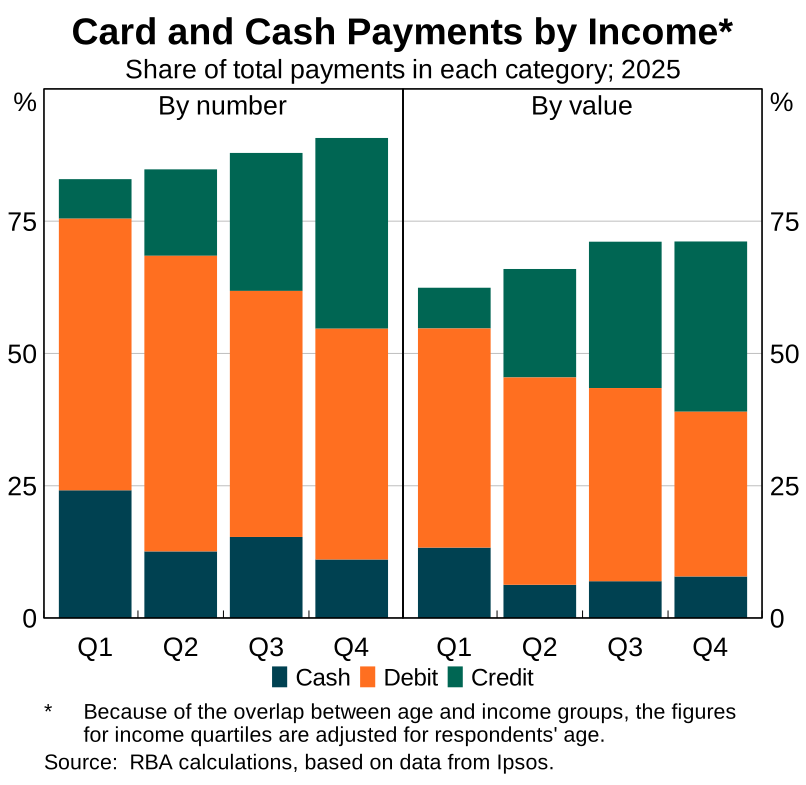
- The lowest income quarter of households in Australia is much less likely to use credit cards than the highest income quarter (Graph 7). The small share of lower income households that use credit cards are more likely to hold basic low-fee cards that already attract relatively low interchange fees (Graph 8). The cap would primarily reduce interchange on premium, high-interchange credit cards that are predominantly held by higher income households. Therefore, the cap would reduce the inefficient cross-subsidisation of high-income credit cardholders by other users of the payment system.
- Issuers will retain flexibility to design their credit card offering in a way that responds to customer preferences, including those of lower income customers.
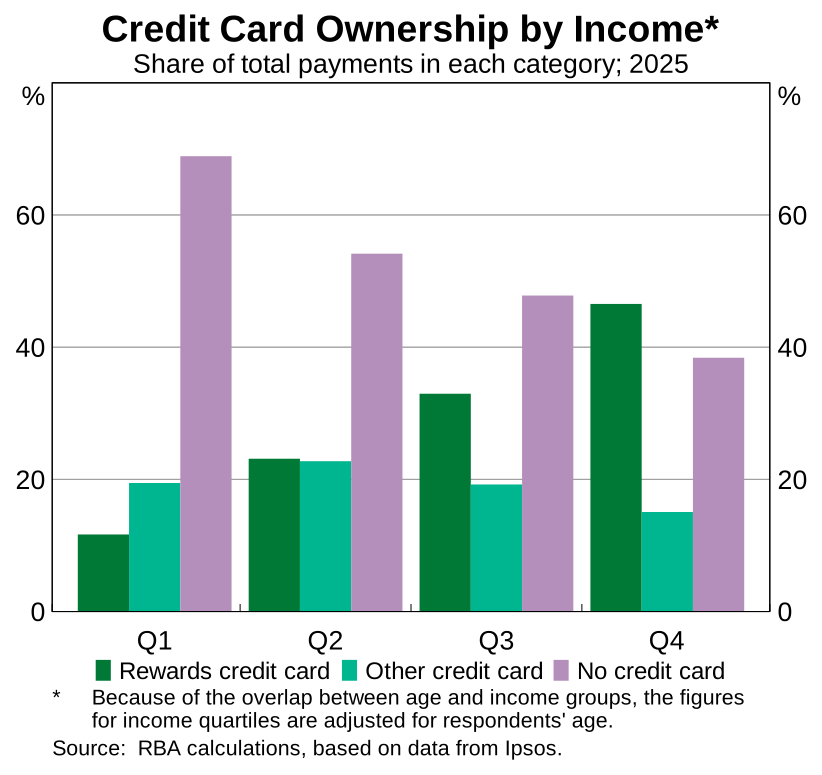
- be inappropriate given Australia’s smaller population, when compared with similar interchange levels in peer jurisdictions such as the EEA or the United Kingdom. Large Australian issuers are comparable to leading issuers in the EEA and the United Kingdom by transaction volumes, despite Australia’s smaller population. Higher volumes enable economies of scale, allowing costs to be spread over a larger transaction base.
The PSB notes that issuers indicated in consultation that they are likely to review their product offerings in response to amended consumer credit interchange settings, including by adjusting rewards programs, account and transaction fees or other features across their product portfolio. To the extent these changes mean the costs of discretionary benefits are borne by the cardholders who choose to access them rather than being borne by merchants, they would be consistent with the PSB’s public interest objectives by promoting efficiency in the payments system.
Domestic-issued commercial credit card interchange
The PSB has concluded that it is in the public interest to retain a cap for interchange fees on commercial credit card transactions acquired in Australia at 0.8 per cent (without a benchmark). For clarity, this also applies to commercial charge cards. The PSB has formed the view that, even though interchange fees on commercial credit cards are above efficient levels, significant cuts to interchange on these cards could have adverse impacts on competition between issuers subject to interchange regulation and American Express that is not subject to interchange regulation.
The PSB did not receive compelling evidence that setting a separate higher cap on commercial credit cards than on consumer credit cards would improve efficiency within the system.
- Commercial credit cards are similar products to consumer credit cards. Both products serve similar purposes of facilitating payments and smoothing consumption, and are generally ‘must-take’ for merchants in the case of four-party networks. Evidence from the Issuer Cost Study suggests that the eligible costs of issuing commercial credit card products are slightly lower than the costs of issuing consumer credit cards on a percentage basis, reflecting that commercial credit card transaction values are significantly higher on average (Table 5).
- Additional benefits of commercial credit cards accrue to the cardholder, not the merchant. Many commercial credit card issuers pointed to the existence of benefits such as spending management tools as justifications for higher interchange on commercial credit cards. The RBA has not received evidence that these features provided additional benefit to merchants accepting commercial credit cards. It would be more efficient for there to be a user-pays approach, where cardholders (rather than merchants) pay for the benefits they derive from commercial credit cards.
- Several issuers use commercial credit card interchange revenue to provide cash rebates or rewards to cardholders. This practice was confirmed by multiple issuers and is an indication that the level of interchange on commercial credit cards is above efficient levels. The PSB reiterates its longstanding position that interchange should not be used to fund reward programs for cardholders.
- The PSB does not consider there is a compelling efficiency case to retain high levels of interchange on commercial credit cards so as to fund any working capital benefits. Card networks and issuers argued that commercial credit cards allow payees to receive the funds immediately rather than issuing an invoice and waiting for settlement, while the cardholder is not required to repay the funds until their statement is due. However, evidence suggests that these benefits primarily accrue to the cardholders rather than the merchant receiving the funds. It is common practice for merchants to offer similar payment terms for commercial credit cards and account-to-account payments, and some merchants noted that the relatively high acceptance costs of commercial credit cards outweigh the value of any working capital benefit they would otherwise obtain from earlier receipt of funds.
| Eligible cost category | %(b) |
|---|---|
| Authorisation and transaction processing | 0.08 |
| Fees and other costs associated with mobile wallet providers | 0.01 |
| Fraud | 0.02 |
| Net scheme fees | 0.06 |
| Net disputes, chargebacks, and chargeback write-offs | 0.03 |
| Total eligible costs(c) | 0.19 |
|
(a) Most issuers provided data for the Australian 2024/25 financial year. Others
provided data based on their internal reporting periods. Source: RBA. |
|
However, the PSB has concluded that reducing interchange on commercial credit cards at this time would harm competition for commercial credit cards, which would likely offset any efficiency benefits of lower interchange fees. The PSB considers that there is a substantial risk that such reductions could materially advantage three-party networks that are not subject to interchange regulation, given the current competitive dynamics, where American Express is by far the largest issuer of commercial credit cards. This would likely raise payment costs for merchants.
The PSB assessed that American Express would likely grow its share of commercial credit cards from an already dominant position if interchange on commercial credit cards was reduced significantly. Submissions from commercial credit card issuers cited the role of rewards and expense management services to cardholders in their arguments for maintaining high commercial credit interchange caps so they can compete with American Express. While these programs are considered outside the scope of the RBA’s eligible costs framework when assessing interchange settings in the public interest, they nonetheless play a role in influencing competitive outcomes and many issuers use interchange revenue to fund them. It is therefore possible that businesses could switch to American Express commercial credit cards if issuers of four-party commercial credit cards elect to reduce their cardholder benefits programs. This could raise payment costs because domestic-issued American Express cards are on average more expensive for Australian merchants to accept than equivalent four-party network cards.
The risk of cardholders switching to American Express is higher for commercial credit cards than consumer credit cards because:
- American Express has a much stronger presence in the commercial credit card segment than in the consumer credit card segment. Its commercial products and marketing target business customers of all sizes, from small businesses through to large corporations. By contrast, American Express’ consumer card offering is more niche and primarily targets affluent consumers, making it a less close substitute for most consumers.
- the proposed interchange reduction would result in a larger percentage fall in revenue for commercial credit cards. The average interchange fee for four-party commercial credit cards is 0.78 per cent of transaction value, so a reduction in the cap to 0.3 per cent would represent a much larger percentage reduction in interchange fees for commercial credit cards compared with consumer credit cards, which have an average interchange fee of 0.47 per cent of transaction value.
- commercial credit card issuers may have fewer revenue sources to fund issuance. Issuers indicated that commercial credit cards are typically paid off in full each month and therefore generate less interest income.
The PSB judges that the efficiency losses of leaving the commercial credit card interchange cap at 0.8 per cent of transaction value are relatively limited. Commercial credit cards account for around 13 per cent of domestic-issued Visa and Mastercard credit card transactions. The majority of efficiency gains from lowering credit card interchange therefore come from reductions in consumer credit card interchange, rather than commercial credit cards.
The PSB does not consider that there are material risks of issuers migrating cardholders onto higher cost commercial products to circumvent the intent of this policy. There is very little evidence that such migration has occurred in jurisdictions such as the EEA and the United Kingdom where commercial credit card interchange is not subject to interchange caps and the difference between commercial and consumer credit card interchange is much larger than proposed in Australia.
While differential treatment of commercial and consumer credit cards will add some complexity to the RBA’s interchange framework, card networks already set differential interchange fees across those cards. Removing the credit benchmark will help offset some of this increased complexity.
The PSB will monitor the effects of differential interchange caps across consumer and commercial credit cards and could reconsider this issue in future reviews of retail payments regulation. The PSB will consider competition and efficiency issues related to three-party networks in the review commencing in mid-2026 under the broader scope of the amended PSRA powers.
Small issuers
The RBA received widespread feedback from the payments industry about the potential detrimental effects of lower interchange caps on small issuers. The PSB is aware that card issuing in Australia is more concentrated than those in other advanced economies and less competitive than acquiring services. There are higher barriers to card issuance compared with providing acquiring services, as issuing activity is closely linked to other banking services. Major banks benefit from economies of scale, while smaller institutions face higher per-customer costs, limiting their ability to compete on price or product features.
A number of the broader interchange adjustments adopted in this Review will provide support to small issuers relative to those options taken to Consultation:
- Many small domestic issuers are primarily active in the issuance of debit cards, and earn greater than 6 cents per debit transaction on average because they can issue SNDCs. In comparison, large issuers typically earn less than 6 cents per transaction, as the RBA expects large domestic issuers to issue DNDCs, and the networks compete for merchants to route transactions to them by offering lower interchange rates. Small issuers will benefit from the decision to retain the debit interchange benchmark at 8 cents per transaction and to reduce the cap only to 8 cents per transaction, rather than the 6 cent per transaction cap proposed in the Consultation Paper.
- Because networks have strong incentives to price SNDC interchange rates at the cap to compete for
issuing contracts, the revised settings are expected to maintain current interchange revenue for
small issuers that issue SNDCs. Maintaining the benchmark at 8 cents reduces the revenue risk
for smaller debit issuers while small merchants still benefit from the reduction in the cap to
8 cents.
- The PSB also notes that the continuation of the SNDC framework provides an additional source of support for small issuers. The ability of smaller institutions to issue SNDCs avoids the additional costs associated with issuing DNDCs.
- The average estimated eligible costs of non-major bank issuers of credit cards are approximately 0.27 per cent of transaction value (Table 6). An interchange cap of 0.3 per cent of transaction value on consumer credit transactions would, on average, provide revenue sufficient to cover eligible costs for smaller issuers in Australia’s mature card payments system.
| Eligible cost category | Debit | Credit(b) | |
|---|---|---|---|
| Cents | %(c) | %(c) | |
| Authorisation and transaction processing | 4 | 0.08 | 0.12 |
| Fees and other costs associated with mobile wallet providers | 1 | 0.01 | 0.02 |
| Fraud | 1 | 0.03 | 0.04 |
| Net scheme fees | 4 | 0.08 | 0.08 |
| Net disputes, chargebacks, and chargeback write-offs | 0 | 0.01 | 0.02 |
| Total eligible costs(d) | 10 | 0.20 | 0.27 |
|
(a) Most issuers provided data for the Australian 2024/25 reporting year. Others
provided data based on their internal reporting periods. Source: RBA. |
|||
- The PSB notes that several issuers of commercial cards are small or non-bank issuers. The decision to retain the commercial credit interchange cap separately at 0.8 per cent of transaction value will assist these issuers in continuing to compete with larger issuers and American Express.
While the eligible costs of small debit issuers are slightly higher than the proposed debit benchmark and cap, the PSB concluded that increasing the interchange benchmark on debit transactions to the level of small issuers’ eligible costs would not be in the public interest. Doing so would raise the interchange fees paid by merchants, reducing efficiency in the payment system.
The PSB considered additional potential policy options to support small issuers, beyond the adjustments to the debit benchmark and cap and commercial credit card interchange cap relative to the Consultation Paper proposals. The PSB concluded there were limited possibilities within the scope of its mandate to address these challenges further. There are efficiency costs to the payments system of offering direct support to small issuers through specific interchange exemptions or net compensation rule modifications, including the introduction of regulatory complexity, opportunities for regulatory arbitrage and evasion, higher end-user costs to merchants and consumers, and the risk that such support promotes inefficient business models without an offsetting increase in long-term competitive dynamics.
The PSB’s view based on the evidence available is that the costs of providing favourable regulatory treatment or subsidies specifically for small issuers are unlikely to be in the public interest and would outweigh the benefits to the card payments system overall. The PSB also judges that the risk of unintended consequences from pursuing any targeted support in this manner is high.
Other options
The PSB considered that proposals in submissions from some issuer-acquirers and card networks to voluntarily introduce small business interchange programs would not deliver the same efficiency improvements as direct regulatory intervention. Several issuer-acquirers indicated support for programs that would provide small businesses with lower interchange rates to help address disparities in fees paid by small and large merchants. However, many of these issuer-acquirers proposed implementing such programs only if interchange caps and benchmarks remained unchanged. It was suggested the RBA may act as convener or facilitator in the design and application of these programs.
- There is a strong likelihood that these programs would fail to deliver the same efficiency gains as holistic interchange cap reductions, given they would only be applied selectively by issuer-acquirers and card networks, and would not address inefficiencies associated with the cross-subsidisation of credit cardholders by debit cardholders, inappropriate funding of rewards programs through interchange, and maintaining interchange rates above eligible issuer costs. Further, the voluntary nature of the programs risks any efficiency gains being small and temporary. The card networks already have small business programs in place for debit cards and they have not seen commercial benefit in developing these programs for credit cards independent of the current Review.
- The PSB also holds concerns that any coordination or facilitation role of the RBA in developing these voluntary programs would not be consistent with Australian competition law.
The PSB has concluded that introducing a floor on interchange rates or setting a cap on strategic discounts for the purpose of narrowing the disparity in interchange fees paid by small and large merchants would not promote efficiency in the payments system. In particular:
- there is no clear basis for calibrating an appropriate floor or discount cap. Setting a floor above the current average strategic interchange rate would increase payment acceptance costs for some merchants, while setting it below the rates currently applied to most strategic merchants would render the floor ineffective.
- some interchange categories, such as those for charities, are currently set at zero. Establishing a floor or restricting the discount would either require these interchange rates to be raised and materially raise the payment costs for these merchants, or necessitate a more complex regulatory framework to allow for exemptions for certain merchant types.
The PSB has concluded that establishing differential interchange caps for CP and CNP transactions on domestic cards acquired in Australia would not promote efficiency in the payments system:
- there is no compelling evidence of material cost differences between CP and CNP transactions on domestic cards. Issuers that provided disaggregated data in the Issuer Cost Study reported only immaterial differences between CP and CNP costs, even though CNP transactions incur slightly higher fraud-related costs.
- costs for both CP and CNP domestic consumer credit transactions appear to remain below the current interchange caps and benchmarks. Many stakeholders proposing differential caps suggested reducing CP rates while maintaining existing CNP rates, partly on the basis that smaller merchants typically accept only CP transactions. However, available evidence indicates that CP and CNP costs are similar and below current interchange settings. The RBA’s data collections also indicate that around 30 per cent of small merchants accept CNP transactions.
- introducing differential caps would add unnecessary complexity to the regulatory framework and increase compliance burdens. Interchange schedules would become more complex across issuers, acquirers and merchants, and card networks would face higher compliance costs.
Interchange on foreign-issued cards acquired in Australia
The PSB has concluded that it is in the public interest to introduce a single cap of 1.0 per cent of transaction value on interchange fees for all transactions on foreign-issued cards acquired in Australia. This cap will apply uniformly across debit, prepaid and credit cards of the designated card networks, and across CP and CNP transactions. Interchange on foreign-issued card transactions is judged to be inefficiently high, significantly increasing merchants’ card payment costs; foreign-issued card transactions account for 20 per cent of interchange paid by acquirers in Australia even though they are only 3 per cent of total card transactions.
The PSB acknowledges feedback during consultation that relying on domestic-issuer costs on transactions acquired outside Australia as a proxy for foreign-issuer costs on transactions acquired in Australia may not fully reflect foreign-issuer cost structures. To address this, the RBA contacted over 30 of the largest foreign issuers whose cards are used in Australia, across multiple jurisdictions. However, only two issuers agreed to participate, which the RBA did not consider to be a sufficient number of foreign issuers for estimating eligible costs. The international card networks were asked to, but were unable to, provide additional information at the level of detail required to support a more robust estimation of the costs of foreign issuers. This included the costs of issuer net scheme fees on transactions acquired outside Australia, that were a key element cited by issuers as differing from those on transactions acquired in Australia. Given the lack of data provided by foreign issuers and the international card networks, the PSB has concluded that domestic-issuer costs on transactions acquired outside Australia are the most appropriate available data for informing interchange caps on foreign-issuer transactions acquired in Australia. As a cross-check, the cost data from the two foreign issuers did not indicate that domestic-issuer costs related to fraud and authorisation and transaction processing on transactions acquired outside Australia were significantly different from foreign-issuer costs.
The PSB considers that interchange fees on foreign-issued card transactions acquired in Australia should be regulated to support efficiency in the Australian payments system, based on evidence that:
- these fees are more than three times higher than domestic interchange rates, and the PSB has not received convincing evidence that these high rates are justified on efficiency or competition grounds.
- eligible issuer costs are likely well below current interchange rates. Evidence from the Issuer Cost Study suggests that eligible issuer costs on domestic-issued card transactions acquired outside Australia are materially below prevailing interchange rates on foreign-issued card transactions acquired in Australia (Table 7). The weighted-average interchange fee on foreign-issued debit and credit cards acquired in Australia is estimated to be around 1.75 per cent of transaction value. By contrast, average estimated eligible issuer costs on domestic-issued card transactions acquired outside Australia range between 0.31 and 0.57 per cent of transaction value, depending on transaction type. The two largest contributors to the higher eligible issuer costs for domestic-issued card transactions acquired outside Australia are fraud costs and net scheme fees.
| Eligible cost category | Credit (%)(b) | Debit and prepaid (%)(b) | ||
|---|---|---|---|---|
| Card present | Card not present | Card present | Card not present | |
| Authorisation and transaction processing | 0.08 | 0.07 | 0.06 | 0.05 |
| Fees and other costs associated with mobile wallet providers | 0.03 | 0.01 | 0.02 | 0.02 |
| Fraud | 0.10 | 0.24 | 0.12 | 0.24 |
| Net scheme fees | 0.29 | 0.22 | 0.10 | 0.12 |
| Net disputes, chargebacks, and chargeback write-offs | 0.02 | 0.03 | 0.01 | 0.03 |
| Total eligible costs(c) | 0.51 | 0.57 | 0.31 | 0.46 |
|
(a) Most issuers provided data for the Australian 2024/25 financial year. Others
provided data based on their internal reporting periods. Source: RBA. |
||||
- fraud differentials between domestic-issued and foreign-issued card transactions acquired in
Australia are not large enough to justify the extent to which interchange is higher on
foreign-issued cards. While fraud rates for transactions acquired in Australia are
higher for foreign-issued than domestic-issued cards for both CP and CNP transactions (by up to
0.29 percentage points on average; Table 8), these differentials are much smaller than the
disparity in interchange fees between domestic-issued and foreign-issued cards of around
1.25 percentage points. It is also important to note that the cost of fraud is not all borne by
issuers, with these costs also borne by acquirers and merchants.
- The net fraud and fraud-prevention costs in the issuer cost study are likely an upper bound estimate of these costs for foreign issuers. The Issuer Cost Study found that net fraud and fraud-prevention costs for issuers are on average 24 basis points for CNP transactions on domestic-issued cards acquired outside Australia. Evidence received from foreign issuers suggests their net fraud costs are similar, if not lower, for foreign-issued card transactions acquired in Australia.
- Fraud rates on CNP domestic-issued card transactions acquired outside Australia are almost three times higher than on foreign-issued cards acquired in Australia, according to the Australian Payments Network’s fraud statistics. This indicates that there is a relatively low fraud rate in Australia for international card transactions, which raises doubt about the appropriateness of the high interchange rates being paid by Australian acquirers and merchants on foreign-issued card transactions.
| Card present transactions (%)(a) | Card not present transactions (%)(a) | ||
|---|---|---|---|
| Domestic-issued cards | Foreign-issued cards | Domestic-issued cards | Foreign-issued cards |
| 0.01 | 0.10 | 0.07 | 0.36 |
|
(a) Per cent of transaction value. Sources: Australian Payments Network; RBA. |
|||
- net scheme fees for domestic-issued card transactions acquired overseas are unlikely to be substantially higher for foreign-card issuers. Issuer scheme fees on international transactions are often set at a regional level and are likely to be common across issuers outside of Australia. Therefore, the 19 basis point difference in net scheme fees could explain less than one-fifth of the 125 basis point difference between domestic and foreign-issued card interchange rates paid by Australian acquirers and merchants on foreign-issued cards.
- high interchange fees on foreign-issued cards acquired in Australia disproportionately inflate payment costs for Australian merchants and cardholders. Given the prevalence of single-rate merchant pricing plans that charge merchants the same fee for all cards, high interchange on foreign cards is being cross-subsidised by higher payment costs on domestic-issued card transactions, reducing the efficiency of the payment system. Imposing a cap on interchange on foreign-issued card transactions acquired in Australia reduces this cross-subsidisation of foreign issuers and cardholders by Australian merchants and cardholders.
- regulating interchange fees on foreign-issued cards reduces the efficiency losses for
Australian acquirers and merchants from intermediaries in the payments chain substituting
domestic-issued card transactions with foreign-issued virtual card transactions that incur much
higher interchange fees. In the RBA’s 2015–2016
Review of Retail Payments Regulation, the PSB considered imposing a cap on interchange for
foreign-issued cards acquired in Australia due to concerns about circumvention of domestic-issued
card interchange caps using foreign-issued virtual cards.41 The international card networks provided
commitments to the RBA that their network rules were sufficient to prevent circumvention. However,
the RBA has received evidence in several submissions that this practice is still ongoing and adding
to costs for Australian acquirers and merchants, against the spirit of the RBA’s interchange
regulation. The PSB is aware of several settings where this practice is occurring or could arise in
future:
- Online travel booking platforms: The RBA received evidence in submissions that online platforms for hotel bookings in Australia are paid via domestic-issued card transactions from Australian customers and then pay Australian hotels using foreign-issued virtual cards, instead of making domestic payments, resulting in Australian hotels paying much higher interchange fees.
- Agentic commerce: if artificial intelligence (AI) agents located outside Australia start acting as intermediaries in card transactions between Australian consumers and merchants, this could replace domestic-card transactions with foreign-card transactions, increasing the amount of interchange paid by Australian merchants and their acquirers.
- Wallet-as-issuer functionality: some card networks are starting to enable digital wallets to issue virtual cards for their consumers. If Australian consumers start using this functionality to pay Australian merchants instead of using a domestic-issued card, and the virtual cards are issued outside Australia, then a domestic card transaction would be substituted by a foreign-card transaction, increasing the amount of interchange paid by Australian merchants and their acquirers.
Introducing a cap materially reduces the profit motive for intermediaries to adopt these practices that circumvent the RBA’s interchange regulations, now and in possible future scenarios. Given measures employed by card networks have been insufficient in preventing or discouraging this practice to-date, the PSB judges that a cap on foreign-issued card interchange is now warranted.
The PSB judges that a single cap of 1.0 per cent of transaction value is appropriate to enhance efficiency in the payment system, because:
- a uniform cap limits opportunities for circumvention of the RBA’s interchange regulations and simplifies compliance. Multiple different interchange caps on foreign-issued card transactions could have incentivised issuers and acquirers to encourage or discourage particular types of transactions, reducing efficiency and adding complexity for cardholders and merchants.
- the differences in eligible costs in the Issuer Cost Study between CP and CNP, or debit and credit, transactions are not large enough to justify different interchange caps. The cost study shows that cost components for foreign outbound transactions vary only marginally across cost categories and are well within the 1.0 per cent cap. Foreign issuers that voluntarily responded to the Study provided no evidence that the differentials would be materially different from those observed for Australian-issued cards.
- a cap of 1.0 per cent of transaction value roughly aligns on a weighted-average basis with the proposed caps in the Consultation Paper. The effective average interchange rate implied by the Consultation Paper’s category-specific caps is 0.99 per cent. A single 1.0 per cent cap therefore achieves a similar overall calibration while ensuring that all transaction types are treated consistently, reflecting that estimated eligible issuer costs are broadly similar across categories.
Introducing caps on interchange for foreign-issued cards acquired in Australia is consistent with regulations in comparable jurisdictions. Caps on foreign-issued transactions acquired in the EEA have been in place since 2019 and were recently extended by mutual agreement between the card networks and the European Commission.42 Mastercard and Visa also voluntarily set interchange rates at the same level in the United Kingdom.43 The New Zealand Commerce Commission has similarly introduced interchange caps on foreign-issued card transactions, taking effect on 1 May 2026.44
The PSB is not persuaded by arguments that reducing interchange on foreign-issued cards would disrupt cross-border transactions or harm sectors such as tourism or exports:
- The 1 per cent cap is well above both the estimates of eligible costs in the Issuer Cost Study and the interchange caps on domestic-issued card transactions. The PSB considers that this higher interchange appropriately compensates foreign issuers for the greater complexity and risk involved in cross-border transactions, particularly to lower risk jurisdictions such as Australia.
- The PSB considers it unlikely that foreign-card issuers would seek to block or restrict use of their cards in Australia as a result of lower interchange revenue. It is common for issuers globally to charge ad-valorem foreign transaction fees to cardholders of up to 3 per cent of transaction value. Some issuers also offer cards that do not charge cardholders additional fees for international transactions but carry higher annual fees. Reallocating some of the costs of foreign card transactions towards the users of those cards, who receive significant benefits from making cross-border transactions, would enhance efficiency in the Australian card payments system.
- In the EEA, cross-border payments increased following the introduction of the European Commission’s interchange regulations. The European Commission also found no evidence of higher card transaction decline rates as a result of introducing foreign interchange caps. Similarly, claims of higher decline rates resulting from cross-border interchange caps in the EEA could not be substantiated by the New Zealand Commerce Commission during consultation with issuers. No further evidence was provided to the RBA to support a causal relationship of this nature. Therefore, the PSB has concluded that it is unlikely that decline rates on transactions acquired in Australia would increase.
- The interchange cap on foreign-issued card transactions is not expected to give a competitive advantage to American Express. The cost for merchants to accept foreign-issued American Express cards in Australia is generally much lower than the merchant service fees for foreign-issued Visa and Mastercard transactions.45 This is the opposite of the situation for domestic-issued card transactions, where American Express transactions are typically more expensive for merchants than four-party card network transactions. By lowering the cost of foreign-issued four-party card network transactions, the interchange cap is expected to increase the cost-competitiveness of these cards relative to American Express.
The PSB has therefore concluded that introducing a uniform cap of 1.0 per cent of transaction value on foreign-issued cards acquired in Australia is in the public interest. This cap will strengthen efficiency in the payment system by more effectively constraining excessive interchange fees on transactions on foreign-issued cards acquired in Australia, and reduce the scope for regulatory circumvention of domestic interchange regulations.
The PSB has considered the potential for circumvention of any new caps on foreign interchange through the international card networks increasing scheme fees and using those to compensate foreign issuers, or by increasing the margins on the foreign exchange rates they set. The relevant RBA Standards will require card networks to publish their scheme fees on foreign card transactions. The RBA will monitor these scheme fees and would consider further regulatory action if required.
Net compensation
The PSB has decided to amend the net compensation provisions to ensure all Australian issuers are clearly subject to the requirements under the relevant RBA Standards, irrespective of the domicile of any sponsor. This will also include amendments to capture transactions on domestic-issued cards acquired overseas to reflect the RBA’s intent, consistent with existing practice. The PSB received very little feedback on this; however, among those who did comment, the large majority supported the amendments. The RBA has become aware of entities with Australian-issuing activities that may be operating against the spirit and intent of this regulation, which indicates that clarifying regulatory policy through the proposed amendments to the relevant RBA Standards will provide regulatory certainty to payments system participants.
Non-designated card networks
The PSB may consider whether the designation and application of interchange caps or other regulation to other card networks would be in the public interest. The PSB notes that interchange regulation only applies to four-party card networks that are currently designated in Australia. The RBA will continue to monitor developments in the card payments system, including the share of domestic- and foreign-issued card transactions acquired in Australia for networks that are not currently designated, along with the interchange rates of those networks. The next review, planned for mid-2026, will also consider the public interest case to designate and regulate three-party card networks.
Endnotes
30 Initial credit benchmarks were set differentially according to the costs to each network by an independent expert appointment by the relevant network. The RBA moved away from differential interchange caps in 2005 with the introduction of the ‘Common Benchmark’ for credit interchange.
31 See RBA (2015b).
32 See Stewart et al (2014).
33 References to interchange fee caps relate to the requirement that card networks must not set interchange fee rates for any transaction above the prescribed cap. This effectively limits the rate applicable to each individual fee category. References to benchmarks relate to the requirement that, over a specified period, the total interchange fees charged by a card network must not exceed the level implied by the weighted-average benchmark on a per-transaction basis.
34 For further details, see RBA (2025g).
35 See Stewart et al (2014).
36 The merchant indifference test is considered appropriate in some jurisdictions on the basis that it theoretically ensures cost neutrality for merchants, supports economic efficiency and promotes fair competition between alternative payment methods where cash is typically used as the primary alternative payment method.
37 The G20 Roadmap for Enhancing Cross-border Payments, established in 2020, includes a target for average ‘retail’ cross-border payment costs of 1 per cent.
38 Data for the 2023/24 reporting period is available in Appendix B: Issuer Cost Study.
39 See Appendix B: Issuer Cost Study for more detail on the Issuer Cost Study and eligible costs.
40 As explained earlier in this chapter, the PSB has determined that costs associated with interest-free periods on credit cards are not eligible. The difference in eligible costs since the publication of the Consultation Paper is driven by a large increase in the estimated costs of authorisation and transaction processing. This was driven by two large institutions that identified significant errors in their previous submissions and substantially revised their reported costs.
41 See RBA (2015a), p 18.
42 See European Commission (2019); European Commission (2024).
43 See PSR (2024b).
44 See NZCC (2025).
45 The cost for merchants to accept foreign-issued American Express card transactions in Australia is around 1.65 per cent; the merchant service fees for foreign-issued Visa and Mastercard credit transactions in Australia has been between 2.6 and 2.75 per cent. So, a merchant on an unblended plan would be paying substantially more to accept a foreign-issued Visa or Mastercard credit card than an American Express card.