
Review of Merchant Card Payment Costs and Surcharging – Phase 3 4. Scheme Fees
Conclusions Paper
March 2026
Download the complete Document 3.1MB
Summary of the PSB’s decision
To promote the efficiency of the retail payments system, the RBA expects the designated card networks to improve scheme fee billing procedures by making their price-setting practices more transparent and better supporting scheme fee reconciliation processes for participants.
To help deliver this, designated card networks will be expected to work with the payments industry to design Scheme Fee Roadmaps in accordance with the principles and measures set out in Box D. The PSB expects card networks to publish these Roadmaps and make them available to the RBA for publication on its website by 1 April 2027.
The RBA will monitor progress by the card networks on improving scheme fee management and transparency. The RBA will consider further regulatory action if it considers that progress is insufficient.
4.1 Issues for the Review
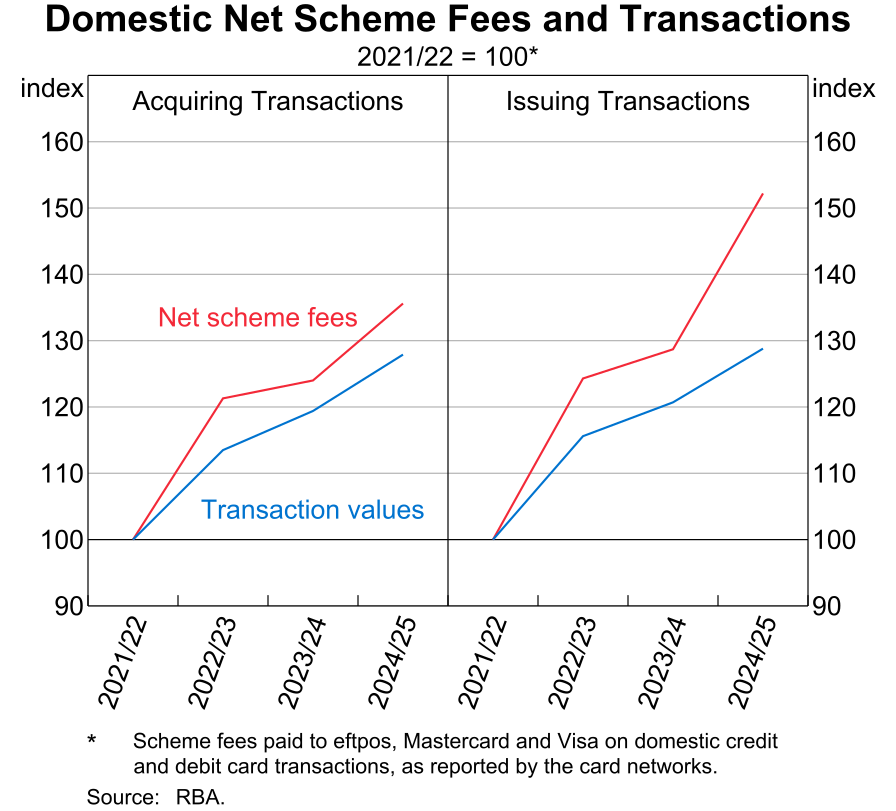
Scheme fees have grown faster than transaction values in recent years, putting upward pressure on card payment costs for card network participants and merchants (Graph 9). Card acquirers and issuers pay scheme fees to card networks such as Visa, Mastercard and eftpos for using their services. These costs are typically passed on to merchants as part of the service fees charged by PSPs (acquirer scheme fees can be directly passed on to merchants while issuer scheme fees can be indirectly recouped from merchants through interchange fees). Scheme fees paid by acquirers tend to account for around one-sixth of Australian merchants’ domestic-issued card transaction costs, with fees being higher for credit than for debit card transactions (Table 9).
Scheme fees set by the international card networks are opaque and complex. This inhibits competition by restricting the ability of merchants and PSPs to accurately understand and compare pricing. It also gives rise to concerns that prices are set inefficiently high in the absence of meaningful competitive pressures.
The RBA sought more information on the extent to which the level and complexity of scheme fees may be the result of a lack of competitive pressure, rather than differences in the cost or quality of services provided by the networks. Unlike interchange fees, scheme fees are not currently subject to regulatory caps.
| Net scheme fees ($, millions) | Net scheme fees (basis points of transaction value) | Net scheme fees (Proportion of MSFs; per cent)(b) | |
|---|---|---|---|
| Domestic-issued card transactions acquired in Australia | |||
| Acquirers | 992.1 | 10.5 | 17.8 |
|
612.9 | 9.8 | 21.5 |
|
379.2 | 11.9 | 14.8 |
| Issuers | 310.7 | 3.3 | ‒ |
|
163.6 | 2.6 | ‒ |
|
147.1 | 4.6 | ‒ |
| Cross-border card transactions | |||
| Australian Acquirers | 514.2 | 158.2 | 58.0 |
| Australian Issuers | 207.5 | 34.5 | ‒ |
|
(a) Includes scheme fees paid to eftpos, Mastercard and Visa in financial year
2024/25. Source: RBA. |
|||
4.2 Options presented in consultation
Option 1: Maintain the status quo
The RBA would continue to use its information-gathering powers under section 26 of the PSRA to monitor scheme fees.
Option 2: Set an expectation that any further increases in scheme fees require adequate explanation by networks
The RBA would set an expectation that average scheme fees per transaction should not increase without clear explanation, based on the specific cost or quality of services provided.
Option 3: Set a cap on scheme fees
Under this option, the RBA would set a cap on the level of scheme fees. The cap would be informed by a targeted study on scheme fees, prior to consulting with stakeholders on any proposed regulation.
Option 4: Set an expectation that card networks work with the industry to reduce the complexity and improve the transparency of their scheme fee schedules46
The RBA would set an expectation that the card networks work with PSPs to address the issues that have been identified regarding the complexity and large number of scheme fees, without seeking to be prescriptive on how this is achieved. Card networks would be expected to work with PSPs to:
- reduce the complexity of scheme fee schedules where possible
- identify what information gaps exist for PSPs in understanding existing fees, and work to fill those gaps
- assess what information is necessary for PSPs to understand new fees or changes in existing fees.
Additional accessible information could include items such as:
- classification of fees, such as whether the fee is mandatory, optional or behavioural
- clear and detailed information regarding when the fee will apply
- the history of changes to the level of a fee including where the fee was renamed or split.
The RBA would expect the card networks to submit, by September 2026, a clear and actionable plan outlining how they will meet this expectation. The plan should show how they have engaged with PSPs and explain how the proposed improvements will enhance transparency and support better outcomes for stakeholders. It should also include anticipated timelines and a strategy for measuring and evaluating progress.
4.3 Stakeholder views47
Most stakeholders expressed the view that the PSB’s preferred policy option, which would expect card networks to provide explanations for increases in scheme fees (Option 2), was inadequate. They considered that scheme fees should not rise relative to transaction values without clear explanation and noted concerns over existing practices whereby fees can be changed without consultation or sufficient notice to network participants. These stakeholders argued that the RBA’s proposed expectation would not meaningfully constrain undue fee growth because of a lack of enforceability, ambiguity in terms, and insufficient disclosure expectations.
Many stakeholders who expressed views on scheme fees supported direct regulation through the use of price caps (Option 3). Those that supported price caps often argued that Visa and Mastercard held too much market power to be meaningfully influenced by the RBA’s proposed expectation. Several stakeholders that supported Option 2 also supported price caps as an escalation measure if desired policy outcomes were not achieved.
Some card networks opposed the RBA’s proposed expectation that they explain scheme fee changes, advocating instead for the status quo (Option 1). These submissions stated that designated card networks already face competitive pressure, in part from alternative payments options (such as three-party card networks, real-time payments, BNPL, and digital wallets), and stated the PSB’s proposals would lead to unfair competitive advantages for these alternative services. They also warned that the proposed measures could limit pricing flexibility in a manner that would negatively affect innovation and resilience.
One card network stated that transparency measures should be focused on end-user prices that merchants ultimately pay rather than on wholesale fees. That card network supported the RBA maintaining its current approach to transparency through the RBA’s publication of merchant service fees data. They noted that these data show stable or declining average merchant service fees, and cited this as evidence that competition is functioning effectively.
A card network also stated that the RBA’s proposed expectation regarding pricing justifications was too unclear and required clarification.
Stakeholders provided near-unanimous support for the simplification of scheme fee schedules, but were also sceptical that the RBA’s proposed simplification expectation (Option 4) was sufficient to achieve the intended policy outcomes. Many PSPs and issuers reported significant difficulties estimating and reconciling scheme fees. They often stated that these difficulties create additional operational costs in trying to understand, manage and ensure accurate billing of fees. Some PSPs indicated they have elected not to invest resources in ensuring they are consistently billed correctly, instead only investigating their fees when they exceed their expectation by a pre-determined threshold; they indicated that because scheme fees are opaque, complex and frequently revised, it is more cost-effective to absorb any resulting fee inaccuracies.
Several issuers and PSPs supported directly simplifying scheme fees by capping the total number of fees in card networks’ schedules or by capping the total number of fees that can be charged per transaction.
Some stakeholders confidentially argued that the complexity of scheme fees is a deliberate feature of card network pricing designed to obfuscate the true cost of services to extract more fees. Examples cited included:
- behavioural fees with limited ability for issuers or acquirers to adjust behaviour to avoid the fee48
- involuntary product trial periods incurring fees
- difficult opt-out processes for voluntary services incurring fees
- bills for fees provided in unstructured and inconsistent formats
- difficult remediation procedures for fee billing errors
- frequent changes to the same fee type within a short period, and the persistence of redundant fees in schedules.
Most submissions received by the RBA noted exceptionally strict confidentiality terms and information restrictions in their contractual arrangements with the card networks, which effectively prevents them from comparing pricing, or in some cases, understanding their own billing accounts. Stakeholders that provided these submissions cited concerns over potential negative commercial repercussions from the international card networks if they were overtly critical of these practices in public forums.
While Visa recognised the importance of transparency and offered to work with the RBA to ensure that the scheme fees framework remained robust, both international card networks argued against the RBA’s proposed simplification expectation, and in favour of the status quo. One argument made in defence of the status quo was that the large number of fees in schedules reflects the variety of products and services available to participants and end-users. Another argument made by a card network was that the RBA’s expectation did not take into account recent work to improve communications with participants, including through online platforms. One card network also stated that the expectation was too vague to be implemented.
4.4 The PSB’s assessment and conclusions
The PSB considers that scheme fees, particularly for credit cards, are not subject to effective competitive constraints. The complexity of scheme fees is likely to be adding inefficiencies to the retail payments system, including through inaccurate downstream billing to merchants. Four-party card networks process 70 per cent of consumer-to-business transactions in Australia, with cash being the next largest payment method accounting for 15 per cent of these transactions. Although alternative payment products (including BNPL, account-to-account payments and three-party networks) offer some competition in the payments system, they do not meaningfully constrain scheme fees because they are not ubiquitously accepted and are therefore not direct substitutes to card products issued by designated networks.
While the presence of a third debit card network and the RBA’s LCR policy has improved competition for debit card transactions and put downward pressure on scheme fees, there is no equivalent mechanism to encourage competition between the international card networks for credit card transactions. The RBA continues to observe considerable variation in scheme fees between different card networks without clearly commensurate differences in the cost and quality of services, suggesting a notable degree of price-setting power. Evidence provided by stakeholders indicates that card networks raise prices and adopt concerning commercial practices in the absence of the disciplining effects of robust competition. The PSB therefore considers that there is a strong risk that card networks may increase scheme fees if competitive pressures were to lessen following a removal of card surcharging, which currently provides some price signal to customers of the cost of their card usage.
To promote the efficiency of the retail payments system, the RBA is setting an expectation that designated card networks improve scheme fee billing procedures by making price-setting practices more transparent and better supporting scheme fee reconciliation processes for participants. The RBA will strengthen its expectations related to scheme fees by combining elements of Options 2 and 4 into a single expectation, and providing greater detail as to how this expectation should be achieved. As part of this expectation, card networks should publish a ‘Scheme Fee Roadmap’ (Roadmap) detailing how they will meet these objectives.49
Consistent with the PSB’s longstanding preference for industry-led solutions, Roadmaps should be developed in consultation with network participants, including issuers, acquirers and other PSPs. The Roadmaps should have clearly scheduled milestones, and detail how card networks intend to fulfil the principles listed in Box D. The PSB considers that implementing changes in line with these principles will benefit the efficiency of the payments system, through issuers and PSPs being better able to assess and understand their scheme fees and make more informed decisions. The RBA expects card networks to consult with the full range of network participants when developing the Roadmaps, including small PSPs and issuers.
The PSB acknowledges the role that scheme fees play in enhancing security and fraud prevention and supporting resilience in a well-functioning card network. However, the complexity and level of scheme fees more broadly suggests that additional measures to address complexity and promote transparency are necessary to improve competition and efficiency in the payments system.
Box D: Principles and measures for the PSB’s expectation to improve card networks’ scheme fee management and transparency
Principle 1: Card networks should manage scheme fee changes with due consideration to impacts on stakeholders. To support this, the RBA expects that Roadmaps will set out plans to:
- circulate at no additional cost structured reports, or bulletin-style notices, to all network participants to provide greater contextual justification for fee changes (such as links to service quality improvements or the provision of new services) and expected outcomes for participants50
- implement six-month minimum notice periods for fee changes
- following changes to a fee, seek to avoid further changes to that particular fee for at least an additional six months to offer greater certainty to network participants over a period of 12 months from the initial announcement of a fee change.
Principle 2: Card networks should provide scheme fee schedules that are concise, clearly presented, and allow for network participants to develop a practical understanding of the applicable fees. To support this, the RBA expects that Roadmaps will set out plans to:
- remove superseded fees in a timely manner
- in consultation with participants, provide information in fee schedules about the nature and purpose
of each fee in a manner that facilitates participants’ understanding. The RBA considers, at a
minimum, that schedules should include the following types of information:
- classification of fees as either mandatory, optional or behavioural51
- unit of charge (e.g. per transaction, per cent of value, per account) and, for future changes, the effective date
- rate of billing (actual price)
- justification for the fees, which provides a non-technical explanation of the cost area/s that each fee contributes to (e.g. authorisation, processing, fraud prevention, network development or network maintenance).
Principle 3: Card networks should invoice and provide billing reports in a manner that allows participants to efficiently reconcile fees. To support this, the RBA expects that Roadmaps will set out plans to:
- clearly identify whether a listed fee is mandatory, optional or behavioural
- facilitate automation of scheme fee reconciliation processes for participants by making invoices available in machine-readable formats at no additional cost
- in consultation with participants and as a standard service at no additional cost, provide on-demand
billing reports enabling participants to:
- understand the scheme fees that have been charged against each transaction
- provide timely and accurate pricing of fees that have been incurred by each merchant.
Principle 4: Card networks should establish and implement transparent billing practices. To support this, the RBA expects that Roadmaps will set out plans to:
- provide actionable information at no additional cost on how participants can avoid optional fees, supported by clear and simple opt-out procedures
- establish robust procedures for the comprehensive remediation of errors, ensuring that:
- all potentially impacted card network participants are notified in a timely manner where the card network becomes aware that a fee has been charged incorrectly
- incorrect charging is remediated for all potentially impacted participants, not just those participants that have identified the error
- consistent with Principle 1, ensure that behavioural fees are only charged to parties that have
been provided with a reasonable opportunity to adapt their behaviour, including by:
- ensuring that behavioural fees are charged to parties that are able to avoid those fees
- charging for behavioural fees in a transparent and timely manner such that parties can easily identify behaviours that trigger the extra fees.
The RBA expects Roadmaps to be available on the RBA website and card network websites by 1 April 2027. The PSB considers that publicly available Roadmaps will increase the likelihood of meaningful improvement by providing transparency to all stakeholders, who can then scrutinise card networks’ actual practices against their stated intentions. Once the plans to address the RBA’s expectations have been published, the RBA expects card networks to consult with the payments industry regularly to monitor whether outcomes meet the RBA’s expectations. The RBA will also monitor progress by the card networks on improving scheme fee management and transparency, and the PSB may consider further regulatory action if there is unsatisfactory progress.
While several stakeholders suggested directly simplifying card network billing practices by limiting the total number of scheme fees charged to participants, the PSB does not consider that such measures would deliver significant net benefits for the efficiency of the payments system. The PSB judges that mandating a reduction in the total number of fees in fee schedules, or fees charged per transaction, would likely lead to card networks bundling a wider range of services together. While this would make schedules simpler to understand, it would reduce flexibility for the card networks in delivering tailored services to participants and likely result in inefficient cross-subsidisation of some services. It could mean that participants would have less opportunity to choose the services that best suits their needs, reducing the allocative efficiency of the payments system.
The PSB does not consider that the RBA has sufficient evidence to pursue scheme fee price caps at this time (Option 3). In order to estimate appropriate price caps or benchmarks, the RBA would need more information about the costs involved in servicing and developing card network services. Determining these costs would require more time, resourcing and cooperation from the card networks and participants. Further consideration would need to be given to designing the appropriate regulatory mechanism to ensure that policy objectives are met without generating unintended consequences for the payments system. There would also be ongoing system costs associated with the regulatory burden of complying with new mandates. By contrast, an industry-led approach may be able to achieve some of the same benefits without incurring these costs.
The RBA will continue to monitor developments in scheme fees and seek to gather additional evidence to determine whether further intervention is necessary. While retaining its preference for an industry-led approach, the PSB does not rule out additional formal or targeted policy measures on scheme fees should its expectations not be met. Further options to improve competition and efficiency in the payments system through action targeting scheme fees may include drafting and consulting on a standard regarding scheme fee practices, scheme fee price caps or the introduction of dual network credit cards and the extension of LCR initiatives to credit card transactions, given the effectiveness of these initiatives in supporting competition between debit card networks.
Endnotes
46 In the Consultation Paper, Option 4 was presented in Chapter 4: Transparency of Wholesale Fees.
47 For further details, see RBA (2025g).
48 Behavioural scheme fees are designed to incentivise PSPs or merchants to behave in certain ways. The RBA received evidence that behavioural fees are not always avoidable for the issuer, PSP or merchant. One example is when a customer attempting to purchase a good or service seeks to retry a card payment multiple times but the merchant is charged additional fees for repeatedly attempting the payment, even if it is ultimately successful.
49 It is expected that two versions of the Roadmap may be necessary to protect commercially sensitive information while supporting public accountability: one for public viewing, with the other to be provided to the RBA so the RBA may gain confidence in the degree of detailed consideration and intended action by the card networks.
50 Expected outcomes refer to the expected benefits and costs that participants are expected to incur as a result of the fee change and any associated adjustments to services.
51 The RBA understands these terms to have the following definitions: Mandatory fees are charged for services that participants must pay for as a condition for participating in the card network or processing transactions through the card network. Optional fees are charged for services that are available to participants, but do not need to be paid for as a condition of participation in a card network and are not a condition for processing transactions through the network. Behavioural fees are charged to disincentivise specific behaviours by participants, or to incentivise them to adopt specific technical solutions.