
Review of Merchant Card Payment Costs and Surcharging – Phase 3 6. Competition in Card Acquiring Services
Conclusions Paper
March 2026
Download the complete Document 3.1MB
Summary of the PSB’s decision
The PSB has concluded that it is in the public interest to:
- require large acquirers (processing above $10 billion in card transactions annually) to publish their merchant service fees on a quarterly basis. This will enable merchants to better compare the average fees charged by acquirers.
- publish information on acquirers’ merchant service fees on the RBA’s website. This will promote competition among acquirers and incentivise them to pass through reductions in interchange to merchants.
- require acquirers to provide merchants with additional information on their statements about the relative costs of accepting domestic-issued and foreign-issued card transactions, and payments made in store (CP) or online (CNP). This information will provide merchants with visibility over their payment costs and enable them to obtain quotes from other providers.
- require large acquirers to publish a measure of interchange pass-through for four quarters following changes in interchange regulations on domestic-issued cards, which will be republished on the RBA’s website. This will provide public accountability for acquirers to pass on savings to merchants.
- require acquirers to provide the RBA with a breakdown of their merchant service fees by interchange fees, scheme fees and margins. This will enable the RBA to monitor whether interchange savings are being passed through to merchants.
6.1 Issues for the Review
There is a strong degree of non-price competition for card acquiring services. There are many providers of acquiring services and traditional providers such as major banks have a substantially lower share of transactions in card acquiring compared to issuing. Lower market concentration in acquiring service provision reflects the growth of newer specialist acquirers in recent years and the increased use of payment facilitators, especially among smaller merchants. The shift towards new entrants reflects the increasing popularity of simplified pricing models such as single-rate or blended plans.55 There is also a substantial degree of product differentiation across acquiring services; specialist acquirers tend to tailor their offerings to target certain merchant segments and often provide additional convenience to merchants by allowing their payment terminals to be purchased at major retailers. Specialist acquirers and payment facilitators may also offer value-added services not typically provided by traditional banks such as industry-specific software solutions.
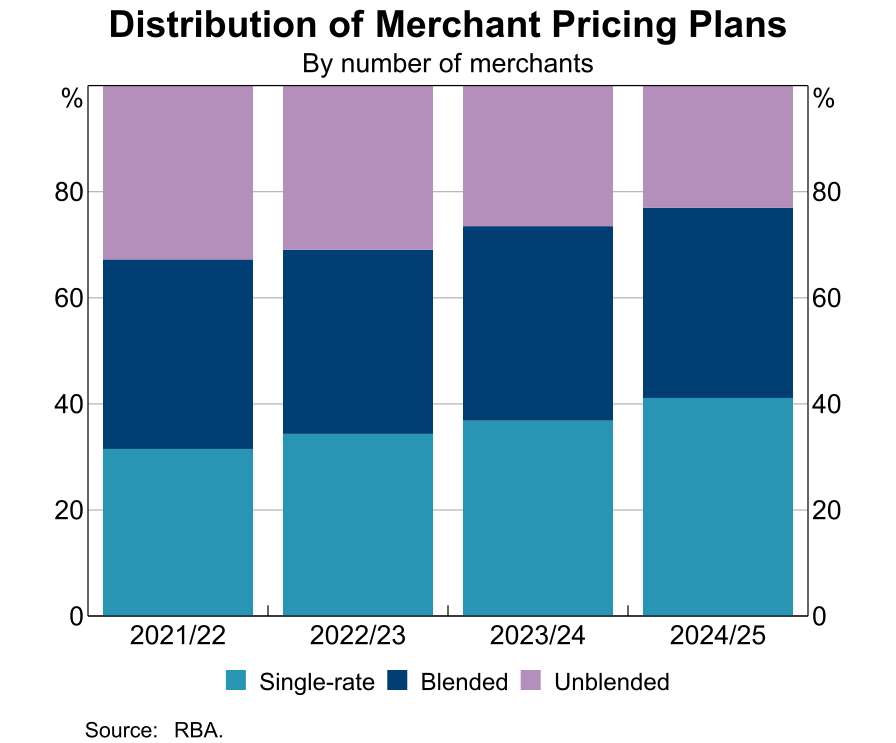
Many merchants have been moving onto single-rate or blended pricing plans that tend to charge higher merchant service fees than unblended plans (Graph 10). In particular, single-rate plans are common among specialist acquirers and payment facilitators and have also been introduced in recent years by traditional acquirers. Single-rate plans have become increasingly popular with small merchants partly due to the certainty they provide merchants over the fees they would be charged and the reduced need for merchants to understand complex payment concepts under an unblended pricing model. While the pricing of single-rate plans is transparent and often coincides with the advertised rate on PSPs’ websites, the trade-off is that these fees are often more expensive than those of unblended plans, which are not typically advertised. Merchants on unblended plans are charged fees that differ based on the wholesale cost of the transaction; therefore, merchants can benefit from lower fees than may be offered on single-rate plans for low-cost transactions. Due to the complex and opaque nature of unblended pricing, many merchants may not be aware that they can obtain more competitive pricing by switching plans.
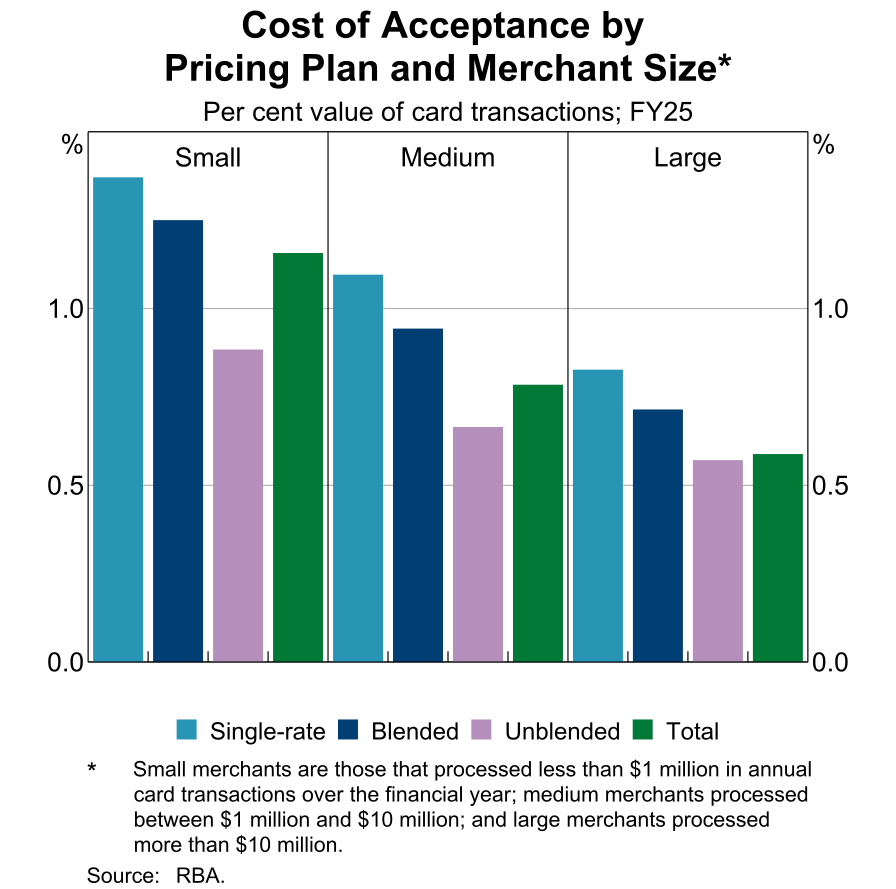
As a result, card payment costs can vary widely even among small merchants, as well as between small and large merchants. Merchants on single-rate or blended plans tend to pay higher rates than similar sized merchants on unblended plans (Graph 11). On average, it costs a small merchant on a single-rate plan 1.4 per cent of their transaction value to accept card payments, while a small merchant on an unblended plan would be charged a lower fee on average at 0.9 per cent. Despite the differences in fees, only 19 per cent of small merchants are on unblended plans. On average, large merchants tend to be charged lower fees (0.6 per cent of transaction value) as they tend to have greater resources to manage their payment costs. Large merchants on unblended plans also tend to be charged lower fees than those on single-rate or blended plans.
Complex pricing models and the lack of consistent publicly available information on the fees charged by acquirers makes it more difficult for merchants to compare pricing across providers and for providers to assess their competitors’ offerings. Pricing plans can be complex and competitive offerings are typically negotiated confidentially at levels below advertised rates. It can be difficult for merchants to know whether the prices they are receiving are comparable to similar merchants using their provider or other providers. Search costs can be high because merchants need to approach various acquirers and PSPs to obtain personalised quotes, there are many types of payment plans offered by providers and many payment plans include other bundled services.
Merchants also do not receive consistent information from their PSPs on their merchant statements, making it difficult for some to compare providers. While large merchants tend to receive highly detailed information on their card transactions and choose unblended plans, small merchants have been moving onto single-rate or blended pricing plans partly in order to receive certainty on their payment costs. Some merchants on single-rate plans receive minimal information about their card mix, which is important information required for merchants to receive accurate quotes from other PSPs. Merchants that tend to accept lower cost transactions may not be aware that they can negotiate a lower price with their PSP or use this information to seek a more competitive quote from another PSP.
Transparency issues tend to be greater for small merchants, which tend to pay higher merchant service fees than larger merchants. Small merchants:
- have less bargaining power to negotiate better fees with acquirers and networks due to their size
- are more likely to be on single-rate or blended pricing plans; merchants on these types of plans tend to pay higher rates than similar sized merchants on unblended plans
- are less likely to get the information on their merchant statements that they need to shop around
- have less resources to manage and reduce their payment costs.
While some of these issues may be beyond the RBA’s remit, the PSB considers that greater transparency of acquirers’ pricing can promote competition between acquirers, including by empowering merchants to seek a better deal with their current provider or to switch to another acquirer. Increasing both public transparency and the information merchants receive should put downward pressure on merchants’ payment costs and result in lower costs for consumers.
6.2 Options presented in consultation
The RBA consulted on Options 1–4 in the Consultation Paper released in July and had proposed to proceed with Options 2 and 3.
Option 1: Status quo
Acquirers would not be required to publish any of their fees or provide further information on merchant statements beyond current requirements. Merchants would continue to observe acquirers’ advertised rates but would need to approach acquirers individually for bespoke quotes. Merchants would continue to receive information about their card payment costs directly through the statements provided by their acquirer or payment facilitator.
Option 2: Require large acquirers to publish their average cost of acceptance by card type and merchant size
The RBA would set a standard that requires acquirers that process more than $10 billion in card payments annually (equivalent to approximately 1 per cent share of designated card transactions acquired) to publish their average cost of acceptance rate on their website on a quarterly basis.56 These acquirers would be required to publish their fees across card types (debit and prepaid vs credit), card origin (domestic vs foreign) and merchant size (small, medium, all). While the PSB would encourage all acquirers and other PSPs to publish these data, the acquirer size threshold would provide new entrants or small acquirers with the option to opt out if they find these reporting requirements unduly burdensome. Acquirers would also be required to provide the RBA with a copy of the data so that the RBA could republish the information on its website.
Option 3: More information provided by acquirers on merchant statements
The RBA would amend its current standard on merchant cost of acceptance reporting to also include further breakdowns for the cost of accepting card payments. These breakdowns would include foreign-issued cards (which tend to be the most expensive cards to accept), such that the cost of accepting domestic- and foreign-issued cards would be separately identifiable. This would be in addition to the current requirements to report merchants’ cost of acceptance by card network on merchant statements. Acquirers that process transactions on behalf of merchants indirectly via a payment facilitator would continue to be able to meet their obligations via their payment facilitator(s).
Option 4: Create an online quotation or comparison tool for merchants to compare pricing across acquirers
The RBA would require acquirers to provide their pricing information to a centralised comparison website so that merchants could gather quotes and compare pricing across acquirers in one location by entering their merchant characteristics (e.g. average transaction size, turnover, card transaction mix and industry). The comparison website would then produce indicative quotes based on all plans offered by participating acquirers as well as outline the services included in the quote. Merchants could then use this information to decide whether to switch to another provider or plan. This information would need to be updated whenever acquirers changed their pricing or service offerings.
An alternative approach would be for the RBA to set a standard that requires acquirers to provide an online quotation tool on their own website similar to the policy recently introduced by the Payments System Regulator in the United Kingdom.57 Through this tool, acquirers would be required to provide tailored pricing that accounts for merchant characteristics such as the size and composition of their cards transactions and their industry. Acquirers would be responsible for keeping their online quotation tool updated.
6.2 Stakeholder views58
There was widespread support for proposals to increase the transparency of the fees that merchants are charged, both in aggregate (Option 2) and on merchant statements (Option 3), on the basis that:
- the information would help merchants better understand and manage their payment costs. Most merchants currently have little visibility over the costs they incur for accepting foreign-issued card payments, which tend to be the most expensive to accept. Some merchants noted that greater transparency would help them determine whether the fees they are charged are competitive.
- the information would help merchants compare fees across providers. Many submissions noted that comparing pricing was difficult because the fees charged by acquirers were not always public and, when they were, not always representative of the fees charged to merchants. Merchants also indicated that inconsistent reporting made it difficult to compare pricing across acquirers, particularly when a merchant used multiple acquirers.
- the proposed data categories, frequency of publication and acquirer size thresholds were appropriate and would enable more accurate price comparisons for acquiring services.
Some stakeholders suggested adjustments to the proposed transparency measures including:
- further breakdowns of fees, including for CP and CNP transactions, or by reporting merchant services fees split by interchange fees, scheme fees and acquirer margins.
- changing the scope of reporting requirements, including to exclude large merchants and include three-party networks.
- requiring greater consistency in reporting across PSPs to help merchants (and in particular large merchants) reconcile the fees they are charged with interchange and scheme fee schedules. While acquirers generally supported consistency across participants, many argued they should retain the ability to provide additional information on merchant statements if they chose to.
Some submissions opposed these proposals because:
- the new information would not be used by merchants or help them switch providers. Some acquirers and PSPs questioned the value of providing further information given many merchants are now on single-rate plans, which have a pricing structure that is easy to understand and compare.
- aggregate fee information could be misleading given merchant card payment costs are driven by a range of factors not included in the proposals such as merchant industry and risk profile.
The estimated time and cost to implement these measures varied significantly across providers:
- For Option 2, most acquirers would require six months and up to a few hundred thousand dollars to publish their fees. A few expected it would take 12 or more months and cost them over $1 million.
- For Option 3, acquirers and PSPs expect implementation costs and timelines would increase if the RBA chose to be more prescriptive in the format of the data needed to be provided to merchants. Acquirers and PSPs estimated the costs of providing this information would be higher than Option 2; median responses indicated this would cost at least a few hundred thousand dollars and take six to eight months; a few expected the costs and time for implementation to be minimal, while a few expected implementation to take up to 18 months and costs to exceed $1 million. Some payment facilitators also noted they may not be able to provide additional breakdowns (e.g. foreign-issued card transactions) because they do not receive this information from their acquirer.
There was limited support for the RBA establishing a comparison tool or website for merchants to compare pricing plans across acquirers (Option 4). A small number of submissions argued that a centralised location for small and medium-sized merchants to search for pricing plans could reduce the searching and switching costs for merchants and help them to find a better payment plan.
Pass-through of interchange reductions
Many stakeholders agreed that the transparency measures proposed in the Consultation Paper would support the pass-through of interchange reductions to merchants. There was broad agreement that there would be greater competitive pressure on acquirers to pass on savings if their fees are in the public domain and can be easily compared across providers. This transparency may be particularly valuable for the large share of (mainly smaller) merchants on single-rate or blended pricing who do not receive automatic pass-through of interchange reductions – unlike merchants on an unblended plan.
However, many submissions raised concerns that merchants would not receive the full benefits of any interchange reductions without further regulatory intervention.
- Several pointed to evidence that acquirers and card networks raised their fees following interchange reductions in other jurisdictions, resulting in merchants sometimes only receiving a portion of the savings from lower interchange (see Box E: International comparison of interchange pass-through).
- Concerns were most acute for small merchants because pass-through in other jurisdictions generally was lowest for the single-rate or blended plans that small merchants tend to favour. In Australia, around three-quarters of merchants are on single-rate or blended plans, including the majority of small merchants.
By contrast, some acquirers argued that the strong competition for the supply of card acquiring services would create pressure for acquirers to pass through savings from interchange reductions without regulatory intervention.
Box E: International comparison of interchange pass-through
United Kingdom
The Payment Systems Regulator found that small and medium-sized merchants experienced little-to-no pass-through of interchange savings from the 2015–2016 Interchange Fee Regulation because acquirers and card networks increased their fees:59
- Merchants on unblended plans (mostly large merchants) received full pass-through of interchange savings.
- Acquirers passed on savings in full to large merchants (those with over £50 million annual card transactions) that were on single-rate or blended plans; however, the actual saving was small because Visa raised its interchange fees on high-value transactions after the regulations took effect.
New Zealand
The New Zealand Commerce Commission estimated that merchants received around 90 per cent of the savings from the 2022 interchange reductions.60 Pass-through was boosted by some acquirers automatically shifting merchants to unblended pricing.61
European Union
The European Commission found that 45 per cent of the interchange reductions from the 2015–2016 Interchange Fee Regulation were passed onto merchants. The remainder was absorbed by higher acquirer margins (45 per cent) and scheme fees (10 per cent).62
Canada
The Canadian Government secured agreements from Mastercard and Visa to lower the interchange fees charged to small businesses. These changes came into effect in 2024, with only some acquirers stating that they would pass-through the interchange savings to merchants.63
Australia’s initial credit interchange reforms64
The RBA introduced regulation of credit interchange fees in the early 2000s on the Bankcard, Mastercard and Visa credit card systems. In 1999, these credit card networks had an average interchange fee of 0.95 per cent and average merchant service fees were 1.8 per cent of transaction values. Data collected by the RBA showed that competitive pressures ahead of the introduction of credit interchange regulation led merchant service fees to decline to 1.4 per cent of transaction value by March 2003. After the interchange regulations in October 2003 came into effect, merchant service fees declined a further 0.35 percentage points to 1.05 per cent, while the average interchange fee following the reforms had fallen 0.4 percentage points to 0.55 per cent.
To reduce the risk of incomplete pass-through of interchange reductions, the RBA considered and conducted targeted consultation on further options to support full interchange pass-through beyond those in the Consultation Paper.65
Option 5: Require acquirers to provide comparison data on merchant statements
The RBA would set a standard requiring all acquirers to provide additional comparison data on merchant statements. This could include how the merchant’s merchant service fees have changed over time (e.g. compared with the same billing period in the previous year) and/or how the merchant’s fees compare with other merchants of a similar size at the same acquirer.
Option 6: Require acquirers to publish interchange pass-through
The RBA would set a standard that requires acquirers that process more than $10 billion in card payments annually to publish the change in their average merchant service fees charged to their merchants divided by the change in their average interchange fees for the first four quarters following the changes to interchange regulations. This requirement would only apply to transactions acquired for the designated card networks and would be reported relative to the value of those transactions in percentage points.
Acquirers would also be required to provide the RBA with a copy of the data so that the RBA could publish information on interchange pass-through on its website.
Option 7: Require acquirers to provide detailed fees data to RBA
The RBA would use its information gathering powers to obtain quarterly data from acquirers on total merchant service fees, broken down by interchange fees, scheme fees and acquirer margin. The data would also include total transaction volumes and values across multiple card types. The RBA could use these data to monitor whether interchange reductions are being passed through or being eroded by an increase in scheme fees or acquirers’ margins. The RBA would not publish the acquirer-level data but could use these data to publish industry aggregates, undertake further analysis and determine whether further regulatory action is required.
Option 8: Requiring acquirers to offer unblended plans
The RBA would set a standard requiring acquirers to only offer unblended pricing plans. Alternatively, the RBA could require acquirers to offer (but not require) unblended pricing plans to all merchants while preserving the ability for merchants to choose a blended pricing plan.
Option 9: Direct regulation of merchant service fees
The RBA would set a standard, set an expectation or obtain voluntary undertakings from acquirers to ensure that acquirers reduce their merchant service fees by at least the amount of interchange reductions.
Stakeholder views
Stakeholders’ views were mixed on whether further comparison data on merchant statements would be useful (Option 5):
- Most merchants supported receiving additional information on how their cost of acceptance had changed over time and how it compared with other merchants at their provider. They argued it would prompt merchants on higher cost deals to negotiate a lower rate with their existing provider or to switch to a cheaper provider. It would also incentivise acquirers to pass on interchange reductions.
- Acquirers, PSPs and some merchants opposed the proposal. They argued that merchants already have access to this information, prefer simple rather than detailed information and that there were legitimate reasons for pricing to vary over time and across merchants of the same size (e.g. industry, card mix, changes in wholesale costs). PSPs also noted that these changes would be difficult and costly to implement. Some suggested that the RBA could instead publish averages by merchant size, industry and card mix to help merchants benchmark their costs against more representative groups.
Stakeholders expressed mixed views on whether requiring acquirers to publish measures of interchange savings (Option 6) would create competitive pressure among acquirers to pass through these savings:
- Several merchants and merchant groups argued that public accountability would put pressure on acquirers to lower their fees in line with interchange reductions, particularly for acquirers that offer bundled payment plans for which pass-through of reduced interchange rates is not automatic.
- Acquirers generally opposed publishing interchange savings due to the risk of potentially being misleading or confusing for merchants. They noted that aggregate figures would not be applicable to individual merchants’ circumstances. They also raised concerns that card networks could raise their scheme fees, as had occurred in other jurisdictions, which could force acquirers to either reduce their margins or risk being unduly blamed for not lowering their merchant service fees.
There was broad agreement that the RBA should monitor whether savings are being passed on to merchants (Option 7). Stakeholders noted the importance of the RBA monitoring whether acquirers or card networks are responsible for any incomplete pass-through.
There was mixed support for mandating unblended plans (Option 8) or enforcing pass-through of interchange reductions though more direct measures (Option 9):
- A few stakeholders argued that single-rate and blended pricing obscure payment costs for merchants and generally results in higher merchant fees. However, many stakeholders argued that a large share of merchants, and particularly small merchants, preferred certainty in their payment costs and the simplicity of a single-rate or blended plan.
- A few stakeholders supported the RBA requiring audits or imposing pricing restrictions on acquirers in the months that follow changes to interchange regulations.
- Several stakeholders noted that these options would be very interventionist and not warranted given current levels of competition for acquiring services.
6.5 The PSB’s assessment and conclusions
Transparency measures for merchant fees
The PSB’s conclusion is that increasing the transparency on merchant fees would promote competition and efficiency within card acquiring services. This would be best done by:
- requiring large acquirers to publish the fees they charge merchants and provide these data to the RBA for republication (Option 2)
- requiring acquirers to provide more information on merchant statements (Option 3).
The PSB has concluded that the existing public information on merchant service fees is insufficient to promote competition and efficiency in the card payment system. The fees paid by some merchants vary significantly from advertised rates, with the most competitive rates negotiated on a commercial basis between merchants and PSPs. The current lack of publicly available information makes it difficult for merchants to compare pricing across acquirers. This is particularly relevant for merchants on single-rate plans that do not have visibility over other offerings. Comparing providers can also be costly and time-consuming for merchants because there are many acquirers and PSPs, and no easy way for merchants to compare their fees.
Requiring that large acquirers publish the fees they charge merchants and provide these data to the RBA for republication (Option 2) will significantly improve transparency of merchant service fees. The PSB has taken into consideration stakeholder feedback and made the following adjustments to Option 2 from its Consultation Paper proposal to best meet the public interest:
- To best aid comparability of published information across providers, the PSB has decided that acquirers should publish their merchant service fees, which generally reflect the actual per-transaction fees that acquirers charge merchants for acquiring transactions, rather than the ‘cost of acceptance’ that can currently include other costs. Acquirers also already report their merchant service fees to the RBA.
- To reflect the differences in payment costs between CP and CNP transactions, the published data will
have a further breakdown of fees for these two categories for domestic transactions.
- Most stakeholders agreed that the proposal to break down published fees by merchant size, card mix and card origin would be useful in capturing some of the largest differences in card acceptance costs across merchants.
- Stakeholders also provided compelling evidence that whether a transaction occurs in store or online has a significant bearing on the fees charged to the merchant. Adding this additional breakdown would make the transparency measure more useful for merchants at a similar cost to the original proposal, according to feedback from acquirers and PSPs.
The revised categories balance simplicity and usefulness for merchants. The categories are not overly detailed to preserve commercial sensitivity for acquirers, reduce the risk of price coordination, reduce implementation costs and avoid confusion for merchants. Other aspects of the PSB’s original proposal for Option 2 would remain unchanged.
Republishing these data on the RBA website will help merchants more easily compare actual pricing across providers in one centralised location. This direct comparison may incentivise acquirers to lower their fees to ensure they compare favourably with their competitors. The PSB acknowledges that some acquirers’ fees include additional services. Acquirers would be free to list the services included in their fees on their website and it would be up to merchants to determine whether they are receiving additional value commensurate with the cost.
The PSB considers that all merchant statements should separately identify the costs for merchants to accept foreign-issued cards (Option 3), with an additional breakdown for CNP (online) payments. As with Option 2, the PSB has decided to make the following changes to Option 3 from the Consultation Paper proposal to best promote competition and efficiency:
- To best aid comparability of merchant statements with published information, acquirers should provide merchants with their merchant service fees, which generally reflect the actual per-transaction fees that acquirers charge merchants for acquiring transactions, rather than the ‘cost of acceptance’ that can currently include other costs.66
- Stakeholders provided compelling arguments that the cost of CP and CNP payments can vary significantly for merchants. As above in Option 2, the PSB has decided that it would be in the public interest for merchants to have visibility over the differences in CP and CNP costs on their merchant statements.
- In determining the standardised information that merchants should have access to, the PSB considered that the information should enable merchants to obtain quotes from other PSPs and understand their payment costs. The RBA sought feedback from merchants, acquirers and PSPs on information required to provide an accurate quote for a payment plan. Merchants and PSPs indicated that information on expected transaction volumes and values, average transaction size and card mix were required to provide an accurate quote. The main categories of card mix cited by merchants and PSPs were: debit vs credit, CP vs CNP and domestic vs foreign-issued card transactions. Having merchants’ fees broken down this way will enable them to see which types of card payments are relatively expensive to accept, make it easier for them to obtain quotes from other PSPs and would aid their decisions as to the type of payment plan that would best suit their business needs.
The PSB’s view is that providing merchants with information about their payment costs broken down in this way would best promote competition and efficiency in combination with the information to be published under Option 2:
- Many merchants currently do not receive information about the breakdown of domestic and foreign transactions. The PSB considered stakeholder feedback that merchants would value visibility over these costs because foreign-issued card transactions tend to be more expensive for merchants to accept. These merchants are therefore unable to make fully informed decisions about what types of payments they accept, what payments plan suits their circumstances best or which provider offers them the best value.
- The fee categories reported to merchants on their statements would match those published by large acquirers and republished on the RBA’s website. This consistency will make it easier for merchants to accurately compare fees and switch providers, thereby supporting competition.
Appendix C: Transparency Requirements provides further detail on the publication requirements for large acquirers and the information that would be required to be provided on merchant statements.
The PSB’s assessment is that the potential benefits of the proposed transparency requirements would outweigh the costs. The PSB considered the implementation costs of Options 2 and 3 on acquirers and other PSPs. In general, PSPs’ largest costs were predominantly one-off implementation costs of around $18 million for both initiatives with smaller ongoing costs to update data. However, these costs are relatively small compared with the total expected interchange savings that merchants could potentially receive from increased competition among acquirers. Even a small saving on merchant service fees as a result of increased competition between acquirers would be expected to outweigh the costs of implementation, given merchant service fees are around $7 billion per year.
The PSB has determined that it is not in the public interest to create an online comparison tool for merchants to compare payment plans (Option 4). The PSB considered that:
- it would be significantly more costly to design, implement and maintain the comparison tool compared with the other transparency options. Significant resources would be required to build a comparison website and update the data regularly. The burden for acquirers to report pricing changes to the administrator of the tool in real time would also be high.
- any comparison tool would likely need to be independently funded and operated such that providers would be displayed in an impartial manner.67
- a comparison tool would be difficult to design well, given that there are many types of payment plans (single-rate, blended, unblended) and the service offerings included within each plan or provider can differ substantially. Some providers also charge separately for terminal rental fees, making it difficult to compare plans and providers in a standardised way.
- even a well-designed comparison tool may not increase rates of merchants switching providers due to
real or perceived switching costs. Switching costs may arise from:
- the cognitive burden involved in comparing providers through research, obtaining quotes and negotiating fees. More complex pricing structures may also increase the complexity of the research, negotiation or decision process.
- the potential loss of non-payments services also provided by the merchant’s current provider.
- the potential retraining of the merchant’s staff, and the cost of setting up new systems or software and/or purchasing new hardware.
- lock-in contracts from the merchant’s current provider.
- The PSB also considered the Payment System Regulator’s initiative in the United Kingdom that required acquirers to provide a quotation tool on their websites. There was limited stakeholder support for this option, particularly given the additional search costs that merchants would face with a decentralised comparison tool.
Supporting pass-through of interchange reductions
The PSB acknowledges the risk raised by some stakeholders that reductions in interchange fees would not be passed through to merchants. Stakeholders provided persuasive evidence from overseas jurisdictions where card networks and/or acquirers increased their fees to offset the intended savings for merchants. The PSB gave considerable weight to evidence that merchants on single-rate or blended pricing plans tended to receive incomplete or limited pass-through of savings from interchange reductions in other jurisdictions. While there are many participants providing card acquiring services in Australia, the RBA has not received evidence that it is more price competitive than the overseas jurisdictions that only experienced moderate pass-through of interchange savings.
The risk of incomplete pass-through is greatest for merchants on single-rate or blended price plans as they do not automatically receive savings from interchange reductions in the way that occurs for unblended plans. In Australia, around three-quarters of merchants are on single-rate or blended plans, which are the most common types of payment plans among small merchants.
To strengthen the pass-through of interchange reductions to merchants, the PSB has concluded that it is in the public interest to require large acquirers to:
- publish a measure of interchange pass-through (Option 6). Public accountability will put competitive pressure on acquirers to pass on interchange savings to merchants. To promote this competitive pressure, the RBA intends to republish this information to compare acquirers and draw attention to those that do not pass on the savings to merchants. Large acquirers will be required to publish this measure for the first four quarters that follow the change in interchange regulation, in recognition that changes in services or business models may warrant legitimate changes to acquirers’ margins or pricing thereafter. Acquirers estimated that reporting this figure would cost them between a few thousand dollars to slightly over $1 million each. These costs are very small relative to the reductions in interchange that the PSB expects acquirers to pass on to merchants. The RBA will monitor the pass-through of interchange savings closely and engage further with acquirers with less than full pass-through in order to consider whether further regulatory action is required.
- provide the RBA with detailed information about the composition of their merchant service fees (Option 7). To supplement the aggregate publication requirements under Option 2, this data collection will separately identify the components of merchant service fees relating to acquirer margins and scheme fees at the acquirer level. This level of granularity will allow the RBA to determine the extent to which any incomplete pass-through was due to increases in acquirer or scheme fees. The PSB has determined that acquirer-level data on margins, interchange fees and scheme fees should not be published due to commercial sensitivity. These data will assist the PSB in assessing whether to take future regulatory action on acquiring fees or scheme fees.
These measures are in addition to the transparency measures outlined above.
The PSB has considered other options but determined that there is not currently a public interest case to:
- require acquirers to provide comparison data on merchant statements (Option 5). This would be expensive for acquirers and PSPs to implement and the benefits are uncertain. Providing comparisons across merchants of a similar size at the same acquirer would likely be a technically complex project and risks not being useful or accurate because many factors besides the value of transactions can influence a merchant’s average fee. Merchants can also typically access their historical statements. At the merchant level, fees may also change over time for a variety of reasons unrelated to interchange pass-through including changes in card mix.
- prescribe the types of payment plans offered by acquirers (Option 8). Stakeholder feedback and data collected by the RBA indicate that many small merchants prefer single-rate or blended pricing plans due to the certainty they provide about payment costs. It is therefore unclear that requiring acquirers to offer unblended plans would result in actual take-up of these plans by merchants. Many small merchants also use payment facilitators that are not within the scope of this Review, potentially creating concerns of uneven experiences across providers. Given the costs that some providers would incur to comply with this measure, the PSB has decided not to explore this option further at this stage. However, the PSB could revisit this option if pass-through was incomplete for merchants on blended price plans.
- directly regulate the price of acquiring services (Option 9). The PSB continues to
favour market-led outcomes and views this option as highly interventionist and unwarranted given:
- the current level of competition for card acquiring services
- the transparency measures announced in this Review will likely exert downward pressure on merchant service fees
- merchants currently surcharging will be more incentivised to shop around for a cheaper payment plan once surcharging is removed
- it would be challenging to implement price regulation given the diversity of products and services for card acquiring.
The RBA will closely monitor the pass-through of interchange reductions and stands ready to take further regulatory action if competition or efficiency issues arise. This could involve revisiting some of the options that the RBA has chosen not to implement at this time as part of the next review that will consider use of the RBA’s expanded regulatory powers following the 2025 amendments to the PSRA.
Endnotes
55 See the Glossary of Key Terms for further information on single-rate and blended pricing plans.
56 Where an acquirer is also a payment facilitator, the acquirer will be obliged to publish data for merchants that have a direct relationship with the payment facilitator. This requirement is otherwise not intended to apply to transactions that are indirectly acquired via a payment facilitator or transactions that are self-acquired.
57 See PSR (2024b) for further detail on the Payment System Regulator’s initiatives in the United Kingdom.
58 For further details, see RBA (2025g).
59 See PSR (2021), pp 69–73.
60 See NZCC (2025), p 23.
61 See NZCC (2023).
62 See European Commission: Directorate-General for Competition, Copenhagen Economics and EY (2020), p 15.
63 See Canadian Federation of Independent Business (undated).
64 See RBA (2004) for more information.
65 The targeted consultation consisted of a list of survey questions requesting feedback from stakeholders on the topics of scheme fees, commercial cards, the transparency of merchant fees and interchange pass-through. Questions were sent to merchants, merchant groups representing small businesses, acquirers and other PSPs that had made written submissions to the Consultation Paper. Participation was voluntary and the RBA received 26 responses to this survey.
66 The concept of ‘cost of acceptance’ is more relevant for the purposes of calculating the maximum permitted surcharge a merchant can apply. It allows merchants to include the cost of renting payment terminals as well as other costs that may not be incurred on a per-transaction basis.
67 See ACCC (2015) for potential issues surrounding comparison websites.