
Reserve Bank of Australia Annual Report – 1964 Other Activities of The Bank
Apart from its role in the field of monetary policy, the Bank undertakes many other activities of importance to the financial system and to the community at large, including note issue, financing of marketing authorities and conduct of Inscribed Stock Registries. During the year under review the Bank also carried forward its planning for the introduction of decimal currency, the installation of computer equipment and the development of banking in the Territory of Papua and New Guinea. The following sections of the Report deal with the more important services provided by the Bank, some of the special activities with which it is associated and some internal matters.
Note Issue Department
In contrast with the general pattern of change under conditions of rising economic activity, the value of notes in circulation decreased by £2 million in 1963/64, an increase in the circulation of notes of small denomination being more than offset by a fall in the “£10 and over” category. In 1962/63, circulation rose by £6 million.
| End of June | Total | Denominations | |||
|---|---|---|---|---|---|
| 10/- | £1 | £5 | £10 and over |
||
| 1962 | 424 | 12 | 68 | 190 | 154 |
| 1963 | 430 | 13 | 69 | 193 | 155 |
| 1964 | 428 | 14 | 70 | 193 | 151 |
The following statistics indicate the wide range of security printing produced at the Bank's Note Printing Branch.
| Year ended June | Australian Notes | Postage Stamps | Postal Notes | Other postal material | Cheques | |||||||||||||||||||||||||||||||||||||||||||||||||||||||||||||||
|---|---|---|---|---|---|---|---|---|---|---|---|---|---|---|---|---|---|---|---|---|---|---|---|---|---|---|---|---|---|---|---|---|---|---|---|---|---|---|---|---|---|---|---|---|---|---|---|---|---|---|---|---|---|---|---|---|---|---|---|---|---|---|---|---|---|---|---|---|
| (millions of pieces) | ||||||||||||||||||||||||||||||||||||||||||||||||||||||||||||||||||||
| 1962 | 197 | 1,023 | 15 | 55 | 82 | |||||||||||||||||||||||||||||||||||||||||||||||||||||||||||||||
| 1963 | 189 | 949 | 16 | 56 | 86 | |||||||||||||||||||||||||||||||||||||||||||||||||||||||||||||||
| 1964 | 207 | 1,036 | 16 | 70 | 83 | |||||||||||||||||||||||||||||||||||||||||||||||||||||||||||||||
Work continued during the year on preparations for the introduction of Australian decimal currency notes in February, 1966. It is proposed initially to issue notes in denominations of $1, $2, $10 and $20 basically in the colours brown, green, blue and red as in the present 10/-, £1, £5 and £10 Australian notes. New equipment is being installed to enable new notes to be produced in designs which will incorporate the most up-to-date features of bank-note printing. If it is not possible to produce notes of new design in time, notes of current designs but denominated in dollars, will be used from the conversion date.
RURAL CREDITS DEPARTMENT
During the year, Rural Credits Department made advances for the processing and marketing of a wide range of primary produce including wheat—the commodity requiring the highest seasonal advances—dairy products, canned and dried fruits, sugar, barley, oats and cotton. Despite a larger wheat harvest, the seasonal peak of advances of £127 million in March was £11 million less than in 1962/63; over the year, advances outstanding declined by £40 million to £65 million at 30th June. This decline in advances and the lower seasonal peak reflected the increase in wheat shipments and early receipt of export proceeds.
Cotton production attracted wider interest in 1963/64. In past years the bulk of Australian cotton has been grown in Queensland, but more recently production has been expanding in New South Wales and Western Australia. Although the amount involved was not large in relation to total advances, the Department financed the processing and marketing of almost the whole of Australia's cotton production in 1963/64.
One-half of the net profits of the Department are placed annually to the credit of the Rural Credits Development Fund, from which grants are made to organisations engaged in agricultural research and extension activities such as universities and other research institutions, agricultural societies and the Junior Farmer movement. Grants totalling £223,875 were made in 1963/64 to bring the total since the establishment of the Fund in 1925 to over £2.1 million. Major grants this year included the purchase of an electron microscope as an aid in basic research being undertaken in entomology and plant mechanisms and diseases; assistance for a survey of the role of the streptomyces group of bacteria in breaking down organic material in soils; and support for research into the use of locally available products for poultry feeding in the Territory of Papua and New Guinea. Use of these products would constitute a significant departure from standard-type feeding. During the year, the Bank published a booklet “Funds for Research” containing a general description of the Fund and a record of the projects supported over the last seven years.
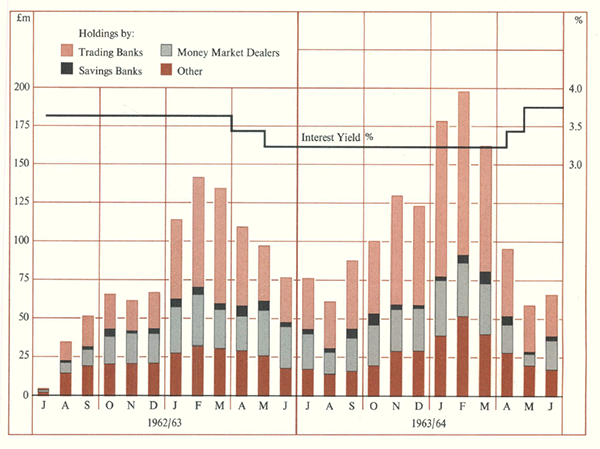
Treasury Notes (Average of Weekly Figures)
BONDS AND STOCK
Inscribed Stock Registries handled a substantial volume of business in 1963/64, both in connection with new issues and in registration of transactions on existing loans. There were four Commonwealth cash loans, the largest number in any post-war financial year. Three loans were combined with conversion offers to holders of maturing securities. A departure from former practice was a reduction in the flotation period for cash loans from two to three weeks to six working days. In addition to these flotations, Registries continued to issue Special Bonds and Treasury notes on tap and to accept advance subscriptions to cash loans. The number of inscribed stock holdings at Registries is expected to rise as a result of legislative changes during the year to permit Special Bonds and Treasury notes to be inscribed as stock. The Bank continued to offer rediscount facilities for Treasury notes but since there is now a substantial market in these securities the facilities tended to be used only in the last resort.
RURAL LIAISON SERVICE
This Service continued to carry out its function of keeping trading banks informed of the latest developments in rural research and in financial and marketing trends relevant to the rural sector, and of providing information specifically requested about the development potential of particular areas, market prospects for commodities and similar topics. Information on rural values for 33 local government areas in New South Wales and 9 in South Australia was assembled and distributed to trading banks. At the end of the year, plans were under way for a new series of regional conferences of representatives from banks, governments and universities, to commence in 1964/65.
SPECIAL ACTIVITIES
Some other activities of the Bank call for special mention.
Economic Liaison: The Bank continued the practice of regular contact in all States with representatives of firms and organisations in industry and commerce, and with government departments and instrumentalities. The information obtained helped the Bank in making its assessment of current and prospective trends in particular industries and the economy as a whole. The Bank appreciates the frank and co-operative response to its enquiries throughout the year.
Centralised Facilities for Distribution of Cash to Banks: Arrangements are well advanced for the Bank to provide a centralised system of currency distribution to banks. At present, each bank draws its requirements of notes and coin from the Reserve Bank and organises distribution to and from its city, suburban and country branches. Under the new system, the Bank will provide facilities which will enable the processing of cash for branches of banks to be carried out at a central point and will also assume responsibility for the transportation of cash in the metropolitan areas. Concentration of operations will enable greater use of mechanical processing and handling equipment. The new service will be available initially to banks in New South Wales probably from about the middle of 1965; the service will be extended later to other States.
Automation in Banking: Following extensive research within the Bank into its likely overall requirements for electronic data processing and the submission of these requirements to locally represented computer organisations, the Bank placed an order in April, 1964 for the installation of a late model computer in the new Head Office building. Functions to be performed by the new equipment include inscribed stock and various accounting and statistical operations, for some of which a punched card installation or service bureau computers are already being used. The equipment will incorporate magnetic ink character recognition (MICR) facilities for servicing cheques drawn on Commonwealth Government accounts. The feasibility of handling cheque clearings generally on a centralised basis and the use of electronic data processing equipment for this purpose is being investigated by the banking system.
Decimal Currency: Because of its key role in the payments mechanism the banking system is faced with the unique task of having to complete the conversion to decimal currency throughout Australia at a single point of time. The greater part of this work will of necessity be concentrated in the few days immediately preceding the day appointed for the changeover. By way of preparation, a committee representative of all banks, including the Reserve Bank, has been formed to advise on the conversion problems to be faced by banks.
Economic and Financial Research Fund: The Bank provided additional support to post-graduate economic and financial research at Australian universities during the year. Assistance continued to be given to a number of projects commenced in earlier years and grants were made for several new projects, including research into investment in education and into output and productivity in Australian manufacturing industry.
TERRITORY OF PAPUA AND NEW GUINEA
As the financial system of the Territory of Papua and New Guinea develops and the need for central banking functions evolves, the Bank's role in the Territory becomes increasingly important. The normal range of central banking services is provided through the branch at Port Moresby. In addition, research activities in relation to the economic and financial development of the Territory have been expanded and, in association with the Administration and the trading banks, the Bank has been actively engaged in encouraging the development of a financial and banking structure suited to the particular needs of the Territory. The selection of local personnel and their training in economics and banking, and the raising of the general level of financial knowledge of the indigenous population form an integral part of this programme. The Bank continued during the year to promote the growth of Savings and Loan Societies. These Societies are, in effect, small scale co-operative banks. Their main functions are to mobilise small savings and to provide credit in small amounts. At the same time, they enable the indigenous people to gain valuable training and practical experience in the running of financial enterprises. At the end of June, 1964 there were twenty three Societies in operation and a further one hundred and twelve groups were in a probationary stage as Savings Clubs.
The Registry of Savings and Loan Societies is conducted by the Bank's staff in Port Moresby, Lae and Rabaul. Trading banks operating in the Territory have agreed to second staff to the Registry of Savings and Loan Societies from time to time and one officer is already engaged on this work.
As part of the combined banks' activities in financial education, a series of three films has been produced for showing to indigenous audiences in the Territory. Two of these are based on and bear titles corresponding to the booklets “Your Money” and “What is Wealth ?” which have already received wide circulation in the Territory. The third, entitled “The Luluai's Dream” illustrates the advantages of keeping savings with banks instead of hoarding currency.
The Bank's staff in the Territory now numbers twenty of whom eight are Papuans and New Guineans being trained to assume duties currently undertaken by Australians. Five Territory students are currently being educated on Bank scholarships at secondary school level in Queensland and in the Australian Capital Territory. Two other students are studying for a degree in economics at the University of Sydney under Bank bursaries; one of these is in the final year of his course; the other commenced at the beginning of 1964.
PREMISES
Construction of the Bank's new Head Office building in Sydney is nearing completion and it is planned that the Bank will move into these premises about the end of 1964. Work commenced in January on construction of the final stage of the building to house the Bank's Melbourne branch. This is scheduled for completion in the latter half of 1965.
The Bank's building programme advanced a stage further during the year with the letting of contracts for the construction of branch buildings in Adelaide and Canberra. The Adelaide branch building is being erected on the corner of Victoria Square and Flinders Street and on completion will have two basements for vaults and bulk cash handling, a ground floor entrance lobby and banking chamber and sixteen upper floors, seven of which are to be leased to the South Australian Government. Construction commenced late last year and completion is expected in 1966. The new Canberra premises, which are located on the corner of London Circuit and the open court leading to the Law Courts, will be available for occupation early in 1965.
The Administration of the Territory of Papua and New Guinea has agreed to lease a site in Port Moresby to the Bank for the erection of a building in which some space will be let to the Administration. The project is expected to be completed during 1966. The Bank proposes to open a branch in Darwin and a site is to be leased from the Northern Territory Administration. Planning for the premises is proceeding.
INTERNATIONAL LIAISON
During the year the Governor, Deputy Governor and a number of senior officers of the Bank visited the main financial centres in Europe, North America and Asia to maintain personal contact with the central banks in those areas and to enquire into latest financial and economic developments. A number of leading central bankers visited Australia and spent some time with the Bank.
The Bank participated in the Fifth SEANZA Course for central bankers held at Karachi early in 1964 and was also represented at the Sixteenth International Banking Summer School held in Vienna.
Arrangements for short period interchanges of staff with central banks in certain Asian countries were completed during the year. There was an exchange of staff with the Central Bank of Malaysia and another member of the Bank's staff obtained experience with the Reserve Bank of India.
Several of the staff continue to serve overseas. Mr. J.M. Garland holds the office of Executive Director for Australia, South Africa, Vietnam and New Zealand with the International Monetary Fund and the International Bank for Reconstruction and Development and other members of the staff are serving with the I.M.F. Mr. J.G. Menzies continues as Deputy Governor of the Central Bank of Malaysia and another officer has also been seconded to that Bank. Another officer is serving for a period as Economist with the South Pacific Commission.
STAFF
The Board gratefully acknowledges the effective contribution made by the staff to the work of the Bank during the year.
Movements among the Bank's senior staff which will take place in the coming months include Mr. H.R. Longmuir to Manager, London, to replace Mr. J.B. Wright who will be returning to Head Office. Mr. W.P. Eskdale Manager, Sydney, retired from the Bank during the year.
It is recorded with regret that Mr. A.W. Elvery, an Adviser, died in December.
The Bank has continued its staff training programme by means of specialised courses at its own Staff Training College at Kirribilli, and by participation in senior executive training courses including the Bankers' Administrative Staff College and the Australian Administrative Staff College. Many officers are undertaking university courses under the Bank's bursary scheme.