
The Role of RITS in Supporting Settlement in a Tokenised Ecosystem 2. Overview of current RITS and FSS functionality
Consultation Paper
September 2026
Download the complete Document 1MB
RITS is Australia’s payments settlements system. It enables financial institutions to settle payment obligations with one another in central bank reserves through ESAs. Institutions hold funds in their ESA to facilitate timely settlement and to meet prudential requirements. Transactions are delivered to RITS via a range of connected systems and services and are processed through either the RITS core settlement engine (the RITS System Queue) or the FSS. Settlement is final and irrevocable, achieved through the simultaneous debiting and crediting of ESAs.7
RITS supports settlement on a real-time gross settlement (RTGS) basis, enabling the immediate and final settlement of interbank obligations. By reducing the build-up of settlement risk between participants, RTGS is a critical mechanism for supporting financial stability and confidence in the payments system. RITS also supports settlement on a net (batch) basis and has functionality to reserve ESA funds in advance of settlement.
This chapter highlights existing RITS and FSS capabilities that may be relevant to the settlement, liquidity, connectivity and operational requirements of tokenised finance arrangements.8 Respondents to this consultation are invited to consider whether the functionality outlined in this chapter can support anticipated tokenised finance use cases, and, where relevant, explain how it does so. Respondents are also invited to consider whether and how enhancements to existing services could improve efficiency, interoperability or scalability for tokenised finance.
2.1 Core settlement services
2.1.1 RTGS settlement on the RITS System Queue
The RITS System Queue supports settlement on an RTGS basis, whereby transactions are settled individually in central bank reserves with immediate finality and irrevocability. It is the primary service used for the settlement of high-value payment obligations such as correspondent banking and customer payments, the Australian dollar legs of foreign exchange (FX) transactions, transactions in debt securities and some money market derivatives, and cash lending flows between financial institutions. The finality of settlement, together with a range of liquidity management and liquidity-saving mechanisms, makes RTGS settlement on the RITS System Queue well suited to these high-value and time-critical transactions.
The key liquidity management tool on the RITS System Queue is a next-down looping mechanism, which sequentially tests transactions for settlement in the order received but may settle transactions in any order to provide for efficient use of liquidity. Transactions submitted to the queue settle when sufficient funds are available and configurable transaction statuses allow. Transactions that cannot settle immediately, due to insufficient funds or a ‘deferred’ transaction status, remain queued and are periodically re-tested.9 The RITS System Queue can also automatically identify bilaterally offsetting payment obligations between participants and settle them simultaneously, with the gross value of each payment posted to the relevant ESAs. This reduces liquidity requirements.
RTGS settlement on the RITS System Queue operates within defined settlement hours aligned to the Australian business day. An evening settlement session, used by only some ESA holders, supports the completion of certain interbank obligations after the completion of settlement of client transactions for the day.
2.2 RTGS settlement on the FSS
The FSS enables immediate and irrevocable settlement of individual transactions on an RTGS basis in central bank reserves and is available 24/7. It is currently used only for account-to-account transfers via the New Payments Platform (NPP). While these are primarily low- to medium-value payments, the FSS is technically capable of supporting higher-value settlements. However, as the FSS prioritises the speed of settlement, it does not have any liquidity-saving features like those available on the RITS System Queue. Payments are either settled immediately if sufficient funds are available or rejected if funds are insufficient.
ESA holders’ balances are split between RITS (to support settlement via the RITS System Queue) and the FSS. RITS provides functionality for an ESA holder to manage their liquidity allocation between core RITS and the FSS, including automated transfers of ESA balances between the two services during the day, and the sweeping of balances into the FSS outside of core RITS operating hours. This helps to ensure participants have sufficient liquidity available for settlements through the FSS.
2.3 Batch settlement on the RITS System Queue
The RITS batch settlement service enables final and irrevocable settlement of interbank obligations that are multilaterally netted outside RITS and subsequently submitted as a batch for settlement. It is only available on the RITS System Queue, not on the FSS. By netting obligations across participants, batches reduce liquidity requirements and improve liquidity efficiency. Settlement will only complete if all payer participants in the batch have sufficient ESA funds, with unsettled batches remaining on the queue for further settlement testing.10
- Settlement-only batches. Settlement-only batches allow for payment obligations to be multilaterally netted outside of RITS and settled on a net deferred basis (e.g. Monday’s obligations are settled on Tuesday). Settlement-only batches are tested for settlement at specified times. They are currently used to settle payment obligations arising from some card schemes and the equities market.
- Reservation batches. Reservation batches allow ESA funds to be locked in participants’ ESAs ahead of settlement, allowing for related processing (e.g. in relation to an asset transfer) to take place between reservation and settlement. Funds can be reserved simultaneously across multiple participants. When a reservation batch request is received, RITS tests if sufficient funds are available in all (net) payer participants’ ESAs, and if so, places a reservation on those funds until a subsequent settlement instruction is received. Funds that have been reserved remain in the payers’ ESAs but cannot be used for settlement of other transactions, guaranteeing that settlement will be able to complete upon receipt of the corresponding settlement instruction.
Once the related processing has been completed, the administrator of the reservation batch will send a settlement instruction, and RITS releases the reserved funds and completes settlement.11 If a settlement instruction is not received by the end of the day, the reserved funds will be released.
Reservation batches are tested on the RITS System Queue continuously throughout the day. They are currently used to facilitate near-DvP settlement of property transactions, where ESA funds are reserved before asset transfer instructions are lodged with land titles offices, and only settled after confirmation of lodgement.12
2.4 Multilateral group settlement on the RITS System Queue
The RITS System Queue supports the final and irrevocable settlement of transactions submitted through the RITS Low Value Settlement Service (LVSS). The service is used for a range of obligations, including those arising from the exchange of direct entry transactions through the Bulk Electronic Clearing System (BECS) and some card schemes.
Settlement instructions are submitted to RITS as bilaterally netted obligations. They may be flagged for settlement immediately as individual transactions or for settlement as part of a multilateral group in one of six daily settlement runs. Multilateral group settlement enables instructions to be settled simultaneously by the RITS System Queue. When testing for settlement, the RITS System Queue calculates a multilaterally netted position for each participant so only the net debit position for an ESA has to be funded.13
2.5 Entering transactions into RITS
Settlement instructions can be entered into RITS via several different channels, including via feeder systems, batches, the LVSS and the RITS User Interface (RITS UI) (Figure 1).
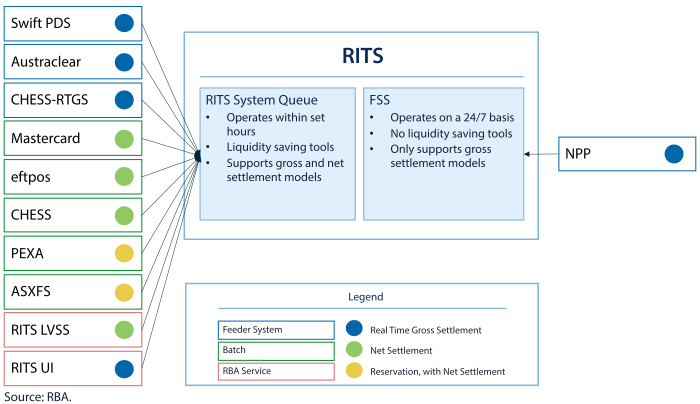
2.5.1 Feeder systems
A feeder system is an external system that is connected to RITS, through which instructions can be sent to RITS for settlement across ESAs. The existing feeder systems are outlined below, with further details in Appendix A.
- Austraclear. Used to settle interbank cash obligations from the Austraclear system, relating to transactions in debt securities, certain derivative products and some central clearing margin payments. Settlement across ESAs is via the RITS System Queue.
- Swift Payment Delivery System (Swift PDS). Used for high-value interbank payments exchanged through the Australian Payments Network’s (AusPayNet) High Value Clearing System (HVCS), including the Australian dollar legs of cross-border transactions. Settlement occurs via the RITS System Queue.
- NPP. Used to settle interbank obligations relating to real-time, primarily retail, payments exchanged via the NPP, which is administered by Australian Payments Plus (AP+). This is currently the only feeder for settlement via the FSS.
In addition, RITS has an RTGS feeder for ASX’s CHESS system (CHESS-RTGS), allowing settlement in RITS of individual transactions arising from the CHESS system. This feeder system is currently not in use. Similar functionality could potentially be used to provide a feeder interface for other external systems requiring settlement on an RTGS basis on the RITS System Queue, although this would require some development effort.
2.5.2 Batches
Batches are used by a range of entities to submit interbank obligations for settlement on a multilaterally netted basis. Settlement-only batches are submitted by ASX Settlements (CHESS) for equity transactions, as well as by Mastercard and eftpos for transactions in their card schemes. Reservation batches are submitted by Property Exchange Australia (PEXA) and ASX Financial Settlements (ASXFS) for property transactions arising from e-conveyancing processes.15 The RITS System Queue supports both settlement-only batches and reservation batches.
2.5.3 LVSS
The RITS LVSS service enables the submission of settlement instructions relating to obligations accruing in various low-value payment systems. This includes obligations arising in BECS (which include wages and salaries, government welfare payments, direct debits and bill payments) and some card schemes (other than Mastercard and eftpos transactions). LVSS transactions settle via the RITS System Queue.
2.5.4 RITS UI
Through the RITS UI, participants can enter RITS Cash Transfers, which are simple settlement instructions that do not contain clearing or remittance information. These transfers are primarily used to move funds between institutions, including for the settlement of interbank overnight cash market transactions and obligations arising where one institution acts as a settlement agent for another (see Section 2.8) in low value clearing systems.
2.6 Messaging types and networks
RITS does not provide a single, common interface across all services. Instead, it supports a range of connectivity channels, with arrangements varying according to the method used to submit transactions and the settlement service involved. At a high level, most feeder systems and settlement-only batches use (or are being upgraded to use) ISO 20022 messages over the Swift network. Reservation batches and LVSS, however, use proprietary XML message formats that are usually submitted as files over the Community of Interest Network (COIN), administered by AusPayNet (and operated by Transaction Network Services). The Austraclear feeder uses a proprietary direct network link. Further details on messaging standards and connectivity arrangements are provided in Appendix A.
2.7 Information and notifications
RITS provides ESA holders with notifications confirming when transactions have settled. For some feeder systems, such as Swift PDS and the NPP, these notifications are generated automatically and delivered through the feeder system. In other cases, ESA holders may elect to receive notifications through the RITS Automated Information Facility (AIF).16 RITS also provides settlement confirmations to batch administrators and, where relevant, feeder system operators (e.g. Austraclear). Batch administrators can also monitor the status of their batches through the RITS user interface. See Appendix A for details.
ESA holders can monitor their transactions and liquidity positions through the RITS UI, including ESA balances, reserved funds and transaction settlement status. ESA balances and statements can also be obtained by querying RITS through the AIF. In addition, RITS provides a range of end-of-day reports.
2.8 Indirect access to RITS
Eligibility to hold an ESA for settlement in RITS is set out in the RBA’s ESA Policy (see Chapter 5). While many institutions are eligible to hold an ESA, not all may choose to settle obligations across their own ESAs, reflecting the operational, technology and liquidity requirements involved in direct settlement in RITS. Instead, some institutions rely on settlement agents to settle obligations on their behalf.17 In these arrangements, where both parties are represented by the same settlement agent, obligations may be settled across the books of the settlement agent. Where a transaction involves a party represented by a different settlement agent or a direct RITS participant, the resulting interbank obligation is submitted to and settled in RITS or the FSS.
Endnotes
7 The point at which transactions settled in RITS and the FSS become final and irrevocable is set out in the RITS Regulations (see RBA (2026), ‘RITS Regulations’, 1 July). Settlement in RITS is also protected under the Payments Systems and Netting Act 1998 (PSNA), under which RITS is an approved RTGS system. Without the protections of the PSNA, if a participant in an RTGS system goes into external administration, a court may date the administration to have occurred at the start (midnight) of the day, such that all transactions executed on that day that involve the participant may be rendered void and can be reversed (commonly referred to as the ‘zero-hour’ rule). Protection from the zero-hour rule supports the stability of the financial system by limiting disruptive reversals of high-value payments and helping to limit spillovers in the case of participant failure.
8 For additional detailed information on existing RITS functionality, see RBA (2025), ‘RITS Overview of Functionality User Guide’, November.
9 Any transactions not settled by the end of the RITS day are removed from the queue.
10 For detailed information on the batch facility, see RBA (2020), ‘Enhanced Batch Processing in RITS – Information Paper’, January.
11 Some reservation batches may include only a single payer bank obligation, and a single receiver bank. Combined with continuous settlement testing, this means that the transaction effectively settles on an RTGS basis.
12 ‘Near-DvP’ refers to the fact that under the existing arrangements the transfer of property titles requires an additional step by the land registry following lodgement of transfer instructions to complete the transfer of ownership.
13 For further information on the LVSS and multilateral group settlement, see RBA (2024), ‘RITS Low Value Settlement Service (LVSS) – User Guide’, November.
14 This figure is illustrative and simplifies many of the scheme, network and other arrangements that enable settlement instructions to be entered into RITS. For example, the RITS UI, which primarily supports the manual entry of transactions for gross settlement, also supports the entry of settlement only and reservation batches in contingency scenarios.
15 ASXFS submits to RITS reservation batches arising from property transactions completed using the electronic conveyancing system managed by Sympli Australia (Sympli).
16 The AIF is a closed user group operating over SwiftNet.
17 See RBA (2025), ‘Exchange Settlement Accounts for ESA Holders Eligible to Use an RTGS Agent – Information Paper’, November.