
Speech Listening to Australians, Interpreting the Data and Setting Monetary Policy
Michele Bullock*
Governor
The Australian Financial Review Business Summit
– Sydney
I would like to begin by acknowledging the Traditional Custodians of the land on which we meet and pay my respects to Elders past and present. I extend that respect to all Aboriginal and Torres Strait Islander people joining us today.
Thank you for having me today. This is an important opportunity to reflect on the forces shaping the Australian economy, how these forces are shifting, and how the Monetary Policy Board is responding.
Since the middle of last year, inflationary pressures have picked up, partly because capacity pressures have been stronger than we previously assessed. With underlying inflation now expected to enter the 2–3 per cent range in mid-2027 and the labour market still somewhat tight, the Board was unanimous in its decision to raise the cash rate in February.
Today I will set out why the Board judged a rate rise to be necessary in February, how it supports our monetary policy strategy, and how we make decisions even when uncertainty is elevated. I also want to explain why listening directly to Australian households and businesses is an essential input to our decision-making.
Inflation is too high and monetary policy needed to respond
In the statement following its decision in February, and in the subsequent minutes of the meeting, the Board noted that inflation is too high and that some of the recent increase in inflation is likely to persist (Graph 1). Staff forecasts did not see inflation coming back into the target band until mid-2027 – that is over a year away. The staff’s view is that the CPI data for January, which was released after the February meeting, broadly supports this assessment. Headline inflation was 3.8 per cent in the year to January and it will continue to be boosted for a time by the unwinding of electricity rebates. But measures of underlying inflation, which strip out some of the large temporary price moves, are also above the top end of our 2–3 per cent target band.
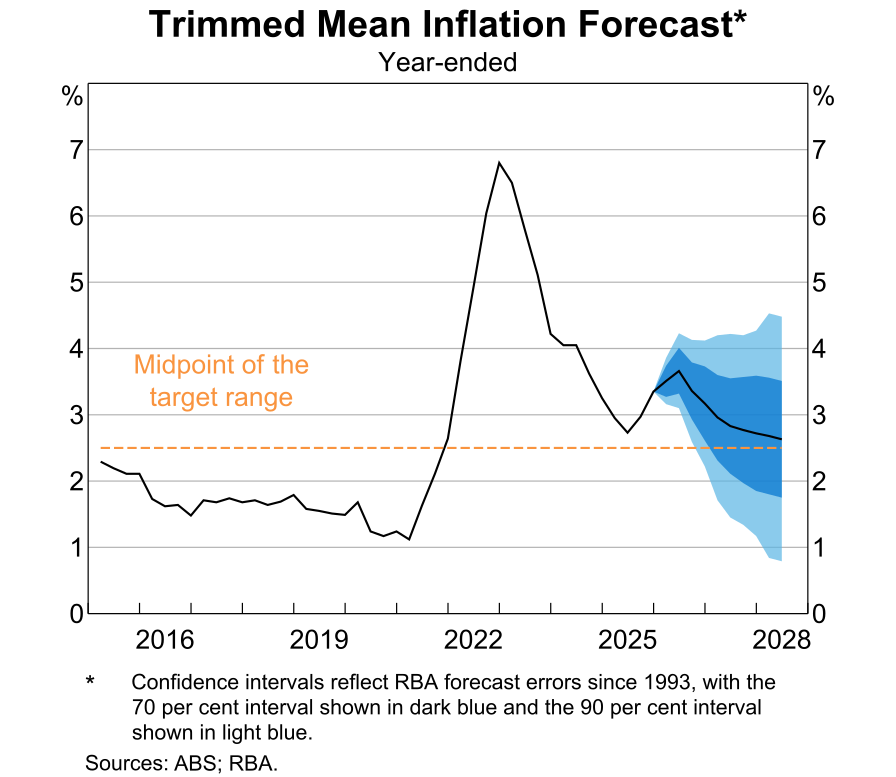
High inflation imposes real costs on people and the economy.1 It puts pressure on household budgets, which means people need to spend more time searching for the lowest prices and working out how to make ends meet. This can be stressful and can force some tough decisions. We don’t want families to have to cut back on after-school activities for their children or delay non-urgent medical care. And we certainly don’t want people to go without essentials. These are just some examples of the real costs of high inflation for all Australians that we are trying to avoid.
High inflation also makes it harder for businesses to plan. When businesses have to spend more time managing rising costs, they have less time to plan how they can grow through investment and productivity improvements. Even when businesses have growth plans, high inflation creates uncertainty, and that can lead them to delay those plans. This is why low and stable inflation matters. It eases the strain on household budgets and creates the conditions businesses need to invest and lift productivity.
We have spent a lot of time thinking about the recent increase in inflation and whether this will continue. Temporary factors have played a part, as my colleague Michael Plumb said in a speech last week.2 But we judge that some of the inflation pressures are because demand exceeds the economy’s supply capacity. Around six months ago we thought that demand and supply would soon be close to balance. But we now think demand was outstripping supply over the second half of last year. There are a few reasons for this.
First, private demand has been stronger than we expected. Global conditions proved more resilient than many feared after the tariff announcements last year, and financial conditions have been more supportive of growth than anticipated.
Second, the economy’s supply potential appears to have been somewhat lower than previously assessed. And with our updated judgement that underlying demand exceeds that supply potential, inflation is likely to remain above target until those pressures ease. That assessment was central to the Board’s decision to increase the cash rate last month.
As you know, the Board looks closely at the labour market when making its decisions. Under our dual mandate, we aim not only to keep inflation low and stable but also to achieve full employment – which is the highest level of employment that is consistent with low and stable inflation.
Last year we were concerned that there was a risk that the labour market could weaken materially. That has not happened – which is very welcome – and the labour market was resilient through 2025. In fact, recent labour market outcomes have come in stronger than we anticipated mid-last year, as my colleague Sarah Hunter highlighted in a speech a few weeks ago.3 Unemployment is still low, the vacancies-to-unemployment ratio is high, and growth in unit labour costs remains elevated (Graph 2).
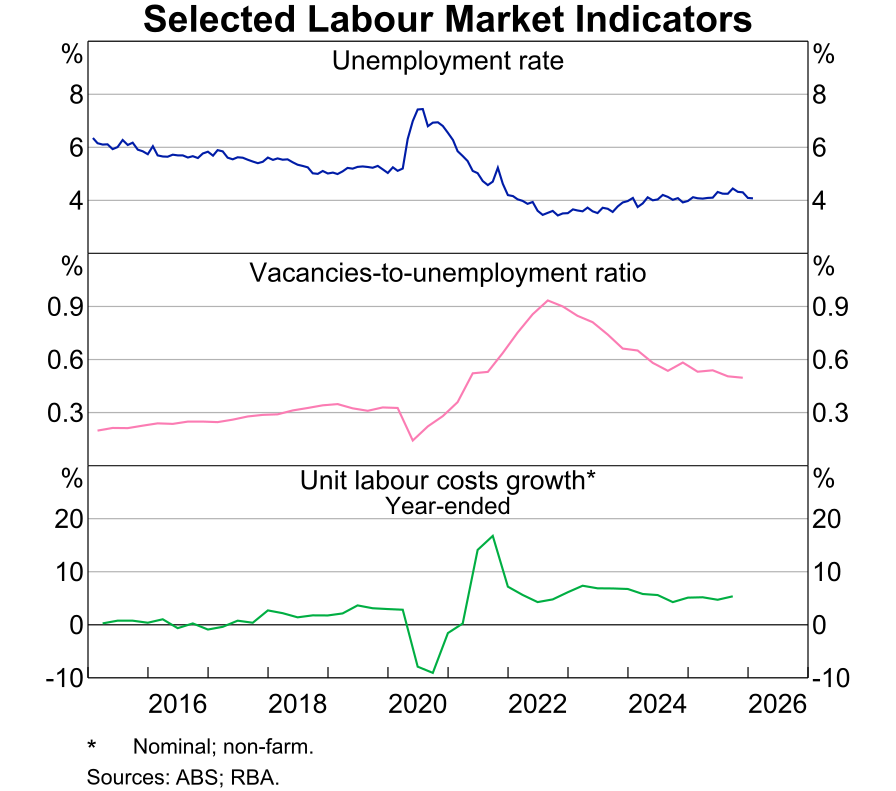
While we expect labour market conditions to ease over time as the economy comes back into balance, we still assess that it is somewhat tight overall. Our judgement in February was that capacity pressures – in the labour market and the economy more broadly – contributed to the recent increase in inflation, and that it was appropriate to tighten policy. The danger we faced was that leaving interest rates unchanged would risk having inflation above target for longer, ultimately requiring a more aggressive tightening later, and a more costly adjustment in the labour market.
Another concern is that the longer inflation stays above target, the greater the risk that people expect inflation to stay high. While measures of longer term inflation expectations remain stable, near-term expectations have increased a little over the past six months. We are alert to this risk, and we closely monitor expectations using surveys, our business and community liaison program, and financial market-based measures.
Dealing with uncertainty
I’m often asked to give more guidance on the direction of monetary policy, and as you know, I’m reluctant to do that.
This is because we set policy in an inherently uncertain environment, from unexpected developments here and overseas, as well as uncertainty around our own assessments, forecasts and models.
That means judging a range of risks and how they might play out. Sometimes the answer is more obvious – when inflation climbed quickly after the pandemic and the cash rate was very low, interest rates clearly had to rise.4
But there are other times when the answer is much less clear.
The past few days have seen a significant escalation in conflict and instability in the Middle East, which is deeply concerning. The human cost is particularly regrettable, and we sincerely hope that conditions improve quickly for all civilians affected.
These events are a timely reminder that in this world of geopolitical uncertainty, things can change quickly. It’s too early to say what the economic impact will be, events are moving rapidly and there are different ways this can play out. We will take some time to make sense of what it could mean for inflation here. A supply shock could, for example, add to inflation pressures. And the potential implications for inflation expectations are something we are very alert to.
But at the same time, a prolonged impact on energy markets could have adverse effects on global economic activity and result in downward pressure on inflation. It is not obvious how this might play out.
So as much as I know the public would like more certainty about the direction of interest rates, it would be wrong for us to pretend to have greater certainty than we do.
But that does not mean the Board throws up its hands and says it’s all too hard.
On the contrary, the staff set out their view of the most likely central case outcome for the major economic variables, which is an important input in the Board’s discussions. And we also look at a range of scenarios to understand how the economic outlook might change and how policy may need to respond in those circumstances.
Most importantly, if it becomes clear that the economy has evolved differently from our earlier expectations, and that difference is likely to endure, then we adjust the stance of policy, as was the case in February.
Our approach to dealing with uncertainty varies depending on the context. For example, global developments can be significant drivers of economic outcomes in small open economies like Australia and are therefore a major source of uncertainty. These developments take many forms. Some stem from shocks to global demand, for example, due to slower economic growth in our key trading partners. For these kinds of shocks, we have history, economic frameworks and models to help us understand the range of possible implications for the Australian economy and inform our decisions. Sometimes, however, as was the case during the pandemic, these events are unique and history is not a great guide for how they will play out. These situations require us to supplement our models with informed judgements about the range of possible outcomes.
There are also more ambiguous sources of uncertainty where it can be difficult to pin down the implications for our economy.5 Over the past few years, we have seen a ratcheting up of geopolitical uncertainty and, as I noted before, the recent events in the Middle East are a manifestation of that. These types of uncertainties are complex because there are many ways that events could unfold and so they can’t be easily captured in our models. To inform our judgement in such cases, we speak and listen to others with a variety of perspectives to work through the plausible range of scenarios. Such conversations, for example, helped staff simulate the effects of trade tensions under different assumptions using scenario analysis in May 2025. This helped the Board think through the issues quantitatively.6 That said, it’s impossible to predict outcomes with any degree of confidence for this type of uncertainty.
Instead, we must ensure we can position monetary policy to respond if needed. With the cash rate currently at 3.85 per cent, and the economy closer to balance than it was a few years ago, we believe we are well positioned for such a response if it were to be required.
But it’s not only future shocks that we need to consider. We also face uncertainty about where the economy stands right now. Our real-time assessment of economic conditions, which underpins our view of the outlook, is always uncertain. The data we rely on can be noisy, incomplete and are usually released with a lag.
Some key concepts – like spare capacity – cannot be directly observed, despite being critical for the medium-term inflation outlook. In such cases, we must form a judgement.7 Sometimes, when the strength of capacity pressures is clear, these judgements are relatively straightforward. By the middle of 2022, for example, inflation had surged to above 7 per cent, unemployment was very low at around 3½ per cent and job vacancies were very high – all strong and consistently indicating that the economy was running hot and that monetary policy needed to be tightened.
But when the economy is closer to balance and demand is near its supply potential, it becomes harder to know whether monetary policy needs to shift to bring inflation back to target.
The data can send mixed signals, so in forming an assessment about spare capacity we also incorporate qualitative information. This is the situation we found ourselves in in August last year when underlying inflation had been steadily declining and was approaching the midpoint of the target band, consistent with the economy returning to balance. But at the same time, several indicators and model estimates pointed to ongoing tightness in the labour market and the economy more broadly. The Board needed to weigh these mixed signals carefully and acknowledge the risk that capacity pressures could be tighter than assessed, which would mean higher inflation than staff had forecast at the time.
As it turned out, inflation did pick up, in part because this risk was realised. And at the margin, recent labour market data point to the risk that conditions may in fact be tightening. This is the environment we are operating in now: the judgements about whether the economy is running a bit too hot are not straightforward, but we still need to make them.
It also underscores why it is so important for monetary policy to be data-driven. Being ‘data-driven’ doesn’t mean we react to every new number or look solely in the rear-view mirror.8 Instead, monetary policy must respond to the outlook for inflation and employment, because interest rates take time to affect the economy. This means drawing on all the available evidence to keep testing and refining our central view, and our view of the risks around it.
The importance of listening directly to households and businesses
I’ve spoken about how traditional economic data and models can tell us a great deal about what is happening in the economy right now and where the economy might be in a year or so. But they cannot always explain what’s driving those developments, or whether they are likely to continue.
That’s why we also draw on what we hear through our business liaison program about what organisations are seeing now, and what they expect next.
Our liaison program has been running since 2001, and in that time our staff have conducted almost 23,000 interviews with businesses and community organisations. We have teams in Adelaide, Brisbane, Melbourne, Perth and Sydney, and we get to other capital cities and regional centres regularly too. I was in Geelong only last week speaking with the business community.
The qualitative information we gather plays an important role in our economic analysis and forecasting process, particularly in times of high uncertainty or of rapid change, where economic data and models may fall short. For example, in early 2022 the Board agreed that timely evidence from liaison and business surveys indicated that labour cost pressures were building, even though this was not yet evident in traditional data. The wage and price outcomes and expectations reported by firms through liaison have historically had a high correlation with the private WPI and the CPI and are therefore a useful input into our assessment of current inflationary pressures (Graph 3).
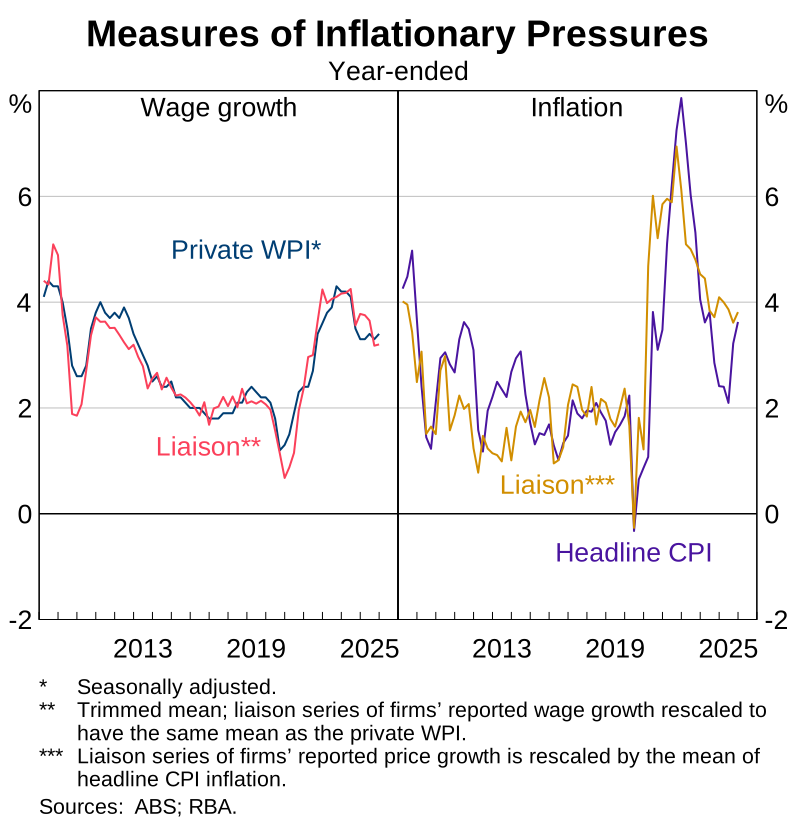
But listening to businesses and the community matters for more than just our forecasts. Our role is to serve the Australian public, and that starts with hearing what people are experiencing.
In early 2025 we expanded these efforts by introducing a new survey of the Australian public, in-step with peer central banks.9 The survey tells us a great deal about the key issues Australians are facing as well as their understanding of monetary policy and the economy. It also gives us direct insights into the public’s level of trust in the RBA. Maintaining public understanding, trust and confidence is critical because it underpins our ability to achieve our policy objectives and to maintain our independence.
In relation to the Australian economy, our survey consistently identified inflation as the public’s top concern in 2025, perhaps unsurprising given inflation has been elevated for some time. At the same time, most surveyed households viewed their own job security as being at or above average, consistent with the labour market remaining a bit tight. (Graph 4).
Importantly, while many households reported that their financial situations were steady or improving, some others told us they were doing it tough – for example, turning to family, friends or community organisations for financial support, or struggling to meet rent or mortgage payments.
This echoes similar concerns that community service providers tell us via our liaison program about cost-of-living pressures and the lack of affordable housing.
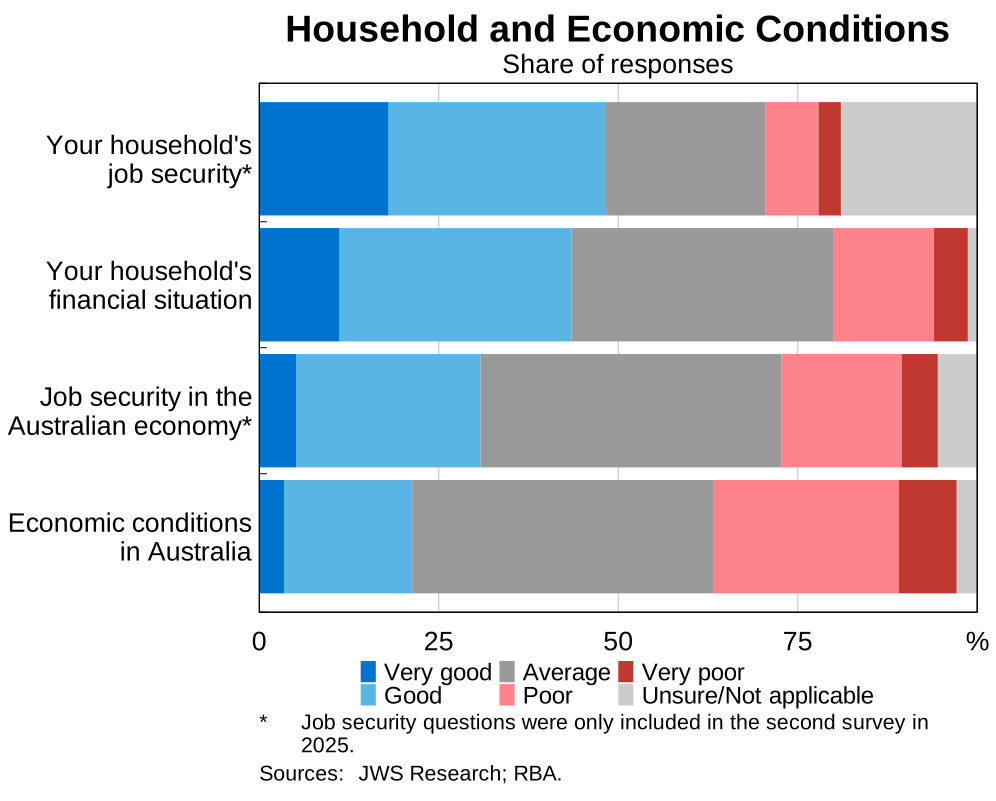
These results are not new to us, but the survey has helped us to better understand how economic conditions are felt across communities. The findings also underscore the real costs of high inflation. Achieving our objectives of low and stable inflation and full employment is the best way for the RBA to contribute to easing these pressures.
Listening to the public is also important for building and maintaining trust. Because the RBA is independent of government, transparency and accountability to the public is critically important. Trust is important for monetary policy transmission, and our survey provides evidence that people with higher levels of trust in the RBA tend to have inflation expectations that are better anchored to the 2–3 per cent target.10
This next graph summarises some of the results from the survey (Graph 5). The survey asks people to provide ‘trust scores’; the higher these are, the higher the reported level of trust in the RBA. One of the key takeaways from the survey is that it suggests that public trust in the RBA in 2025 was around the average of other Council of Financial Regulators (CFR) agencies, as well as peer central banks. You can see this in the left panel of the graph. Importantly, though, the survey also highlights that trust in the RBA varies considerably across segments of our society – this is shown in the right panel of the graph. Trust in the RBA is lower for women and young people, and for people with lower levels of economic literacy and understanding of the RBA’s role and functions. It follows that if we are to build trust, we need to work hard to explain how economic conditions affect everyone and what the RBA is trying to achieve when it sets monetary policy and fulfils its other functions.
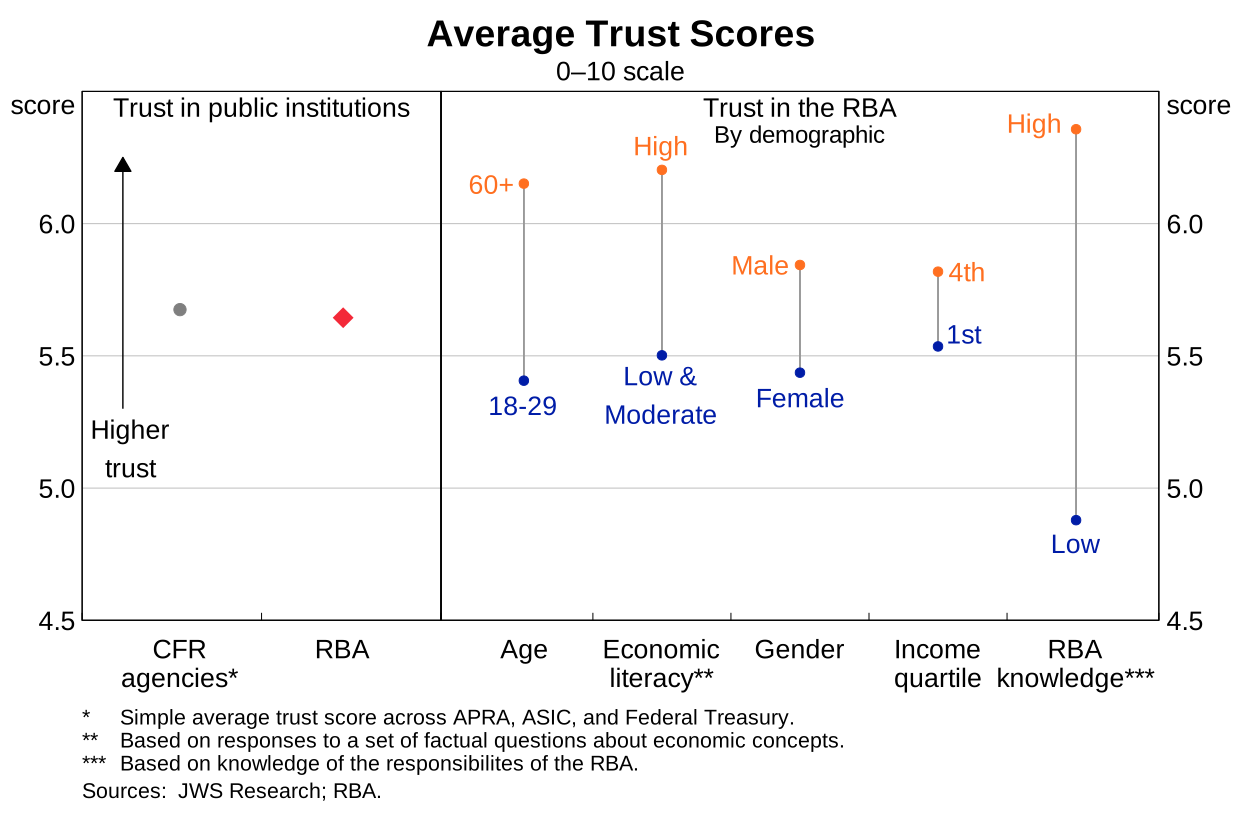
We are developing strategies to better engage with and reach all segments of the community. Encouragingly, our survey suggests that most Australians do value staying informed and want to learn more about the economy and monetary policy. We plan to continue to survey the Australian public to track our progress and identify things we need to focus on. We will also be publishing more insights from this survey later this year.
How are we assessing the current balance of risks?
To conclude by returning to our assessment of the current outlook for the economy; at this juncture we think a large part of the unexpected increase in inflation since the middle of last year was due to sector-specific demand and price pressures that we expect to ease in coming quarters. But economy-wide capacity pressures in the economy are also playing a role and, overall, we think underlying demand in the economy is further from its supply potential than we had assessed six months ago. A range of indicators tell us that labour market conditions are tight. And it is uncertain whether financial conditions are sufficiently restrictive to return inflation to the midpoint of the target in a reasonable timeframe.
Taking all this together, the Board judged that the inflation outlook warranted an increase in the cash rate in February. The staff’s view is that the data we’ve seen since then broadly support their assessment of the outlook at the time of that decision. We remain focused on returning inflation to target. The Board will continue to be driven by what the incoming data tells us about where the economy has been and what this means for the outlook.
Endnotes
* I would like to thank Adam Cagliarini, Peter Rickards, Chris Schwartz, Michelle Wright and Anirudh Yadav for excellent assistance in preparing this speech, and Samuel Evangelinos, Kevin Lane, Kate McLoughlin and Tim Taylor for their valuable input and comments.
1 See Bullock M (2024), ‘The Costs of High Inflation’, Speech at the Anika Foundation Fundraising Lunch, Sydney, 5 September.
2 See Plumb M (2026), ‘Recent Developments in Inflation and the Economic Outlook’, Speech at the ABE Annual Forecasting Conference, Sydney, 24 February.
3 See Hunter S (2026), ‘Defining Full Employment and its Intertwined Relationship with Inflation’, Speech at CEDA: In Conversation series, Perth, 12 February.
4 For more detail on this period, see Bullock M (2025), ‘The RBA’s Dual Mandate – Inflation and Employment’, Speech at the Anika Foundation Fundraising Lunch, Sydney, 24 July.
5 Deputy Governor Andrew Hauser has spoken about the varieties of uncertainty and the challenge of quantifying them. See Hauser A (2025), ‘Monetary Policy in a VUCA World’, Speech to the Australian Financial Review Business Summit, Sydney, 5 March.
6 RBA (2025), ‘Chapter 4: Outlook’, Statement on Monetary Policy, May.
7 The RBA has recently refined its approach to assessing labour market conditions relative to full employment. See RBA (2026a), ‘Box A: Update on the RBA’s Approach to Assessing Full Employment’, Statement on Monetary Policy, February; RBA (2026b), ‘Update on the RBA’s Approach to Assessing Full Employment’, Technical Note, February; Hunter, n 3.
8 See Hunter S (2025), ‘Monetary Policy: Forward Looking and Data Dependent in the Face of Uncertainty’, Speech at The Australian Financial Review Banking Summit, Sydney, 18 March.
9 The survey is conducted by JWS Research on behalf of the RBA and was undertaken in February and September 2025. Each survey has a sample size of 3,000 people, designed to match the representativeness of the Australia population across age, gender and location demographics. Other central bank surveys include: Bank of England (2025), ‘Bank of England/Ipsos Inflation Attitudes Survey – February 2025’, News Release, 14 March, available at<https://www.bankofengland.co.uk/inflation-attitudes-survey/2025/february-2025>; Bank of Canada (2024), ‘Public Awareness Surveys’, available at <https://www.bankofcanada.ca/about/governance-documents/public-awareness-surveys>; Dreher F (2024), ‘Trust in the ECB – Insights from the Consumer Expectations Survey’, ECB Economic Bulletin, Issue 3/2024.
10 This is similar to findings in other countries – see, for example, Dreher, n 9.
Underlying data
This file contains all underlying data that are available for public release.
Some graphs in this speech were generated using Mathematica.