
Speech Recent Developments in Inflation and the Economic Outlook
Michael Plumb*
Head of Economic Analysis Department
2026 ABE Annual Forecasting Conference
– Sydney
Introduction
Good morning. It’s a pleasure to be back at the Australian Business Economists’ annual forecasting conference. While this year’s theme is ‘Macro Meets Machine’, my role today is to set the scene and discuss recent developments in the Australian economy and the economic outlook.1
A key development in the Australian economy has been the unexpected pick-up in inflation since mid last year. Drawing on our analysis and forecasts in the February Statement on Monetary Policy, the questions that I’m going to focus on today are: what were the drivers of the unexpected strength in activity and pick-up in inflation in the second half of 2025, and to what extent are these likely to dissipate in the near term or persist over the forecast period?
In short, we assess that much of the pick-up in inflation was due to some sector-specific price pressures that we expect to dissipate in coming quarters. But overall growth in demand also looks to have been stronger than expected in the second half of last year, adding to existing economy-wide capacity pressures and therefore inflation. Consequently, our forecasts for inflation over the coming year have been revised higher. The February forecasts assume a higher path for the cash rate over the forecast period, consistent with financial market pricing. Alongside the unwinding of some temporary drivers of demand, this is expected to constrain growth in overall demand and bring the economy close to balance by the end of the forecast period – though this is subject to considerable uncertainty and, as always, there are risks around this central forecast.
Inflation was materially higher than expected in the second half of 2025
Let’s start with what we were expecting around six months ago. If we go back to mid-2025, underlying inflation in Australia had been easing gradually from its peak in late 2022, reaching 2.7 per cent in the June quarter 2025. This was consistent with some easing in capacity pressures as the earlier period of restrictive monetary policy helped to bring aggregate demand and potential supply closer to balance. While GDP growth had been picking up (alongside a recovery in real household incomes), it was still below its estimated potential growth rate – so capacity pressures were projected to ease further. Our central forecast in the August 2025 Statement was for the unemployment rate to pick up slightly further and for underlying inflation to ease a little further in the second half of 2025, such that the economy would be close to balance and underlying inflation close to the midpoint of the 2–3 per cent range by the end of 2025.
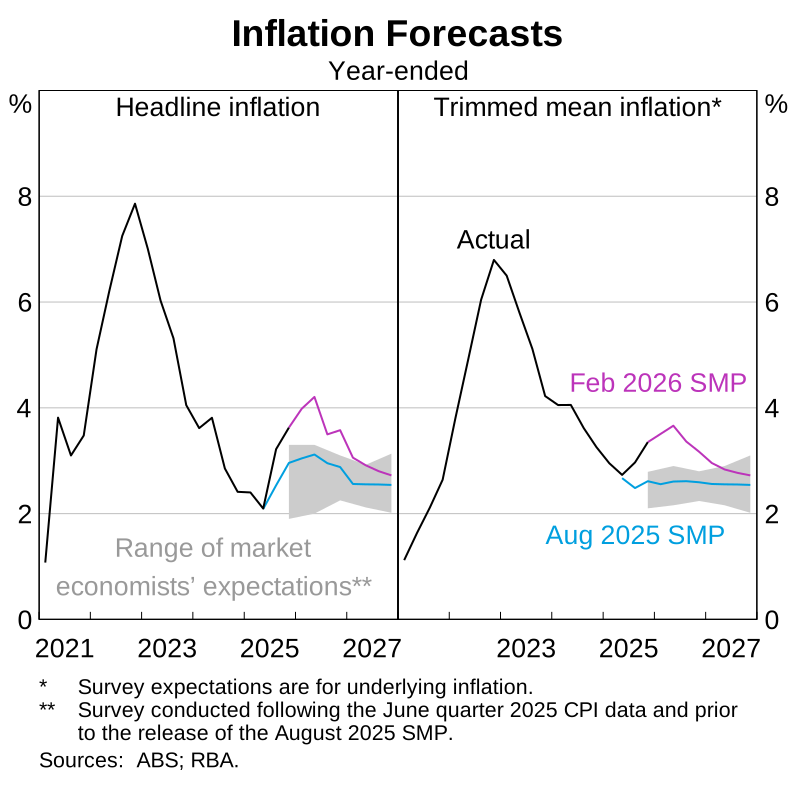
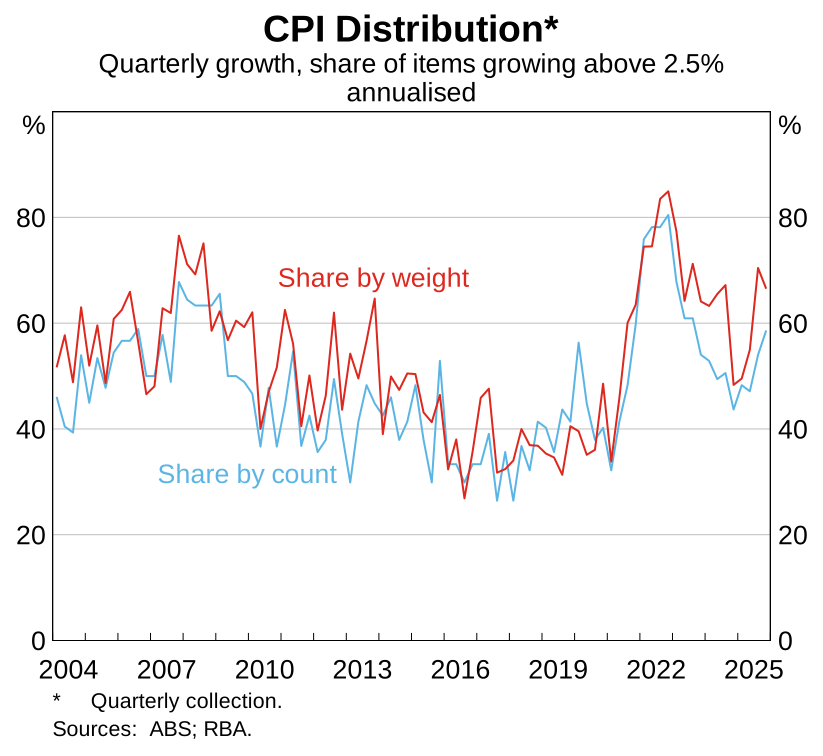
But that is not what we have observed. Instead, there was a material increase in inflation in the second half of 2025. Over the year to the December quarter, headline inflation was 3.6 per cent and underlying (trimmed mean) inflation was 3.4 per cent. While we had expected a sharp rebound in headline inflation as the effects of electricity rebates were unwound, we (and others) were surprised by the extent and breadth of the pick-up in inflationary pressures (Graph 1). The share of items in the CPI with prices rising faster than 2.5 per cent has increased noticeably (Graph 2).
What drove the recent increase in inflation?
So what were the drivers of the unanticipated increase in inflation? Our assessment is that a large part of the unexpected increase was due to sector-specific demand and price pressures, much of which we expect to dissipate in coming quarters. Nevertheless, there also appears to be greater capacity pressures in the broader economy than we had previously expected. I will discuss these in turn, before turning to the risks around this assessment and the broader outlook.
Sector-specific explanations
Some of the pick-up in inflation in the second half of 2025 was driven by increases in the prices of travel and fuel, which tend to be volatile; we expect the prices of these items to ease in early 2026.
In addition, some of the unanticipated pick-up in inflation in the second half of 2025 looks to have been driven by pricing dynamics in the housing and retail sectors (some of which relates to broader demand conditions). Prior to that, in late 2024 and early 2025, liaison contacts in the residential building industry in some states were noting that soft demand growth had led homebuilders to charge lower prices than otherwise, as they increasingly resorted to discounting and promotions to increase sales. As demand for new homes picked up, homebuilders reported they were dialling back on the discounting and promotions. Similarly, in the second half of 2025, fewer liaison contacts in the retail sector reported the need to discount as heavily, noting that demand conditions had improved somewhat alongside efforts to control costs or change their product mix. It is possible that these dynamics were pushing down on aggregate inflation in late 2024 and early 2025, but then subsequently accentuated the pick-up in aggregate inflation in the second half of 2025 as they unwound.
Economy-wide capacity pressures
Greater capacity pressures in the labour market – and the economy more broadly – than we had previously assessed also look to have contributed to the unexpected pick-up in inflation.
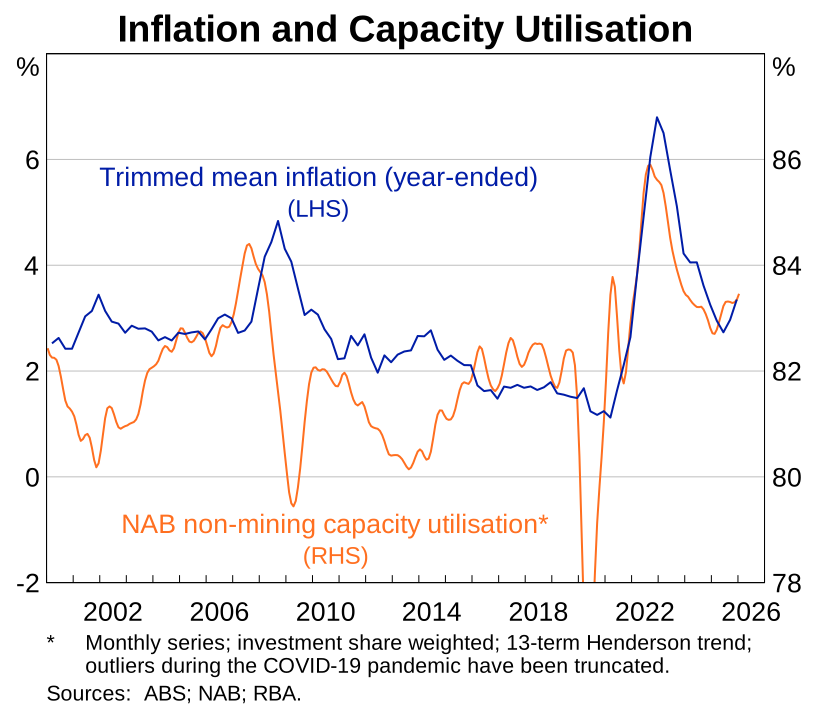
We use a range of models, price and labour market indicators, business surveys and other data to make our assessment about the degree of capacity pressures in the economy. But there is significant uncertainty around this assessment, given the dispersion in what these indicators tell us.2 In addition to the increase in consumer price inflation over the second half of the year, a number of indicators of capacity pressures picked up, such as business survey measures of capacity utilisation and the share of firms reporting labour as a constraint (Graph 3). Other measures of inflationary pressures in the economy, including unit labour costs growth, remained elevated.
How do we explain the change in assessment of capacity pressures? Demand picked up by more than we thought – which I’ll discuss first – but also potential supply looks to have been a little lower than our previous estimates suggested. These were risks that we flagged in the August Statement and have since materialised.
Aggregate demand was higher than we had expected
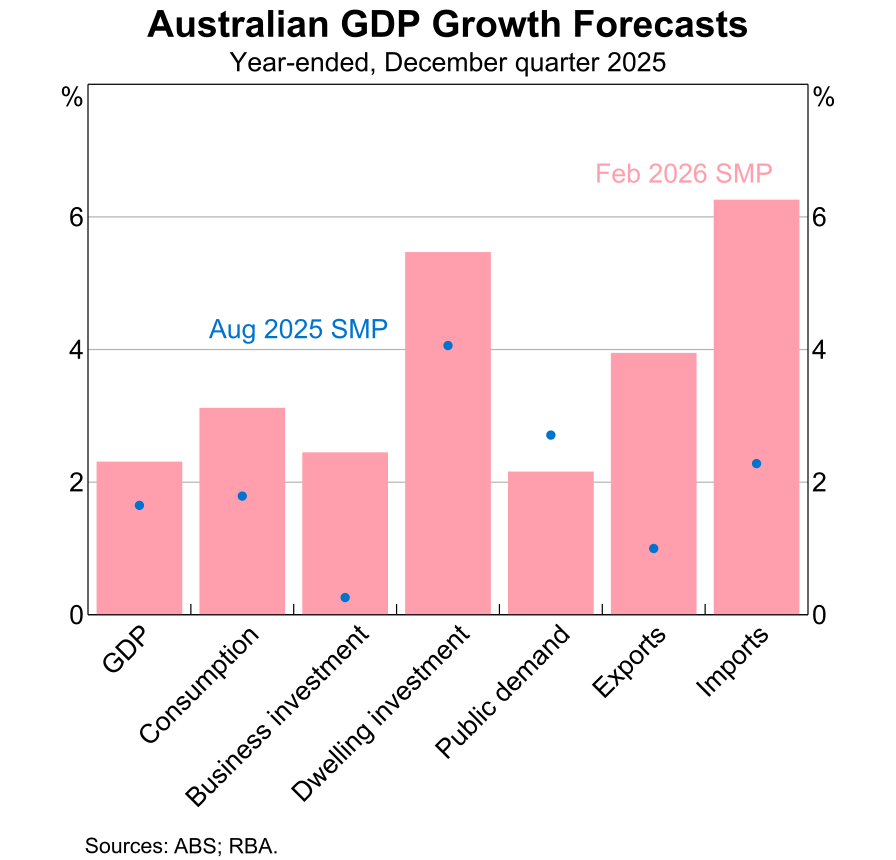
Let’s dig a bit deeper into the surprising strength in demand in the second half of 2025. In mid-2025 we assessed that, while the economy had been growing at a below-potential rate for some time, there were still some capacity pressures in the economy. While we won’t receive the December quarter national accounts until next week, our latest nowcast is that GDP growth over the second half of 2025 was a little above our estimate of potential growth and higher than we had expected in the August forecasts, driven by strength in private demand. Specifically, growth in consumption, dwelling investment, business investment and exports all look to have been stronger than anticipated, with some of this demand met by imported goods and services (Graph 4).
Taking this a step further, what were the drivers of the unanticipated strength in domestic private demand in the second half of 2025? There are several (inter-related) candidates.
First, the global economy has proven more resilient than previously thought. Importantly, the downside risk of a large external shock to the Australian economy did not eventuate. Average US tariff rates have been much lower than was initially projected, as tariff exemptions and the rapid reconfiguration of trade flows and supply chains last year helped to mitigate the negative impacts of the increase in trade barriers. More recently, strong trade flows related to the AI and technology boom have also supported activity among some of our major trading partners. For a small open economy like ours, these better global conditions have supported growth in exports and domestic incomes.
Second, domestic financial conditions might have been less restrictive than we had assessed. Financial conditions are inherently difficult to measure and no one metric provides a definitive picture. In hindsight, the robust credit growth observed over 2025 – and the extent of the pick-up in private demand growth later in the year – raises the possibility that conditions were less restrictive than previously thought, particularly following the monetary policy easing in Australia in 2025. Also, very low risk premia in global funding markets – related to the resilience of the global economy – may have contributed to some additional easing in overall domestic financial conditions.
Third – and in addition to the two factors I just mentioned – stronger-than-expected real household incomes and wealth contributed to the stronger-than-expected pick-up in household consumption growth in the second half of the year. That said, part of the strength is judged to have been a ‘bring forward’ of expenditure in response to sales and promotional activity in the December quarter. Dwelling investment also picked up by more than anticipated. Dwelling investment is relatively sensitive to changes in interest rates, both directly and via higher housing prices (which also increased by more than we expected last year). However, it is worth noting that leading indicators of dwelling investment, such as building approvals, had started increasing prior to the first cash rate reduction in 2025; this may have reflected factors such as expectations of monetary policy easing at that time, earlier strong population growth, and an earlier easing in capacity constraints in the construction sector.
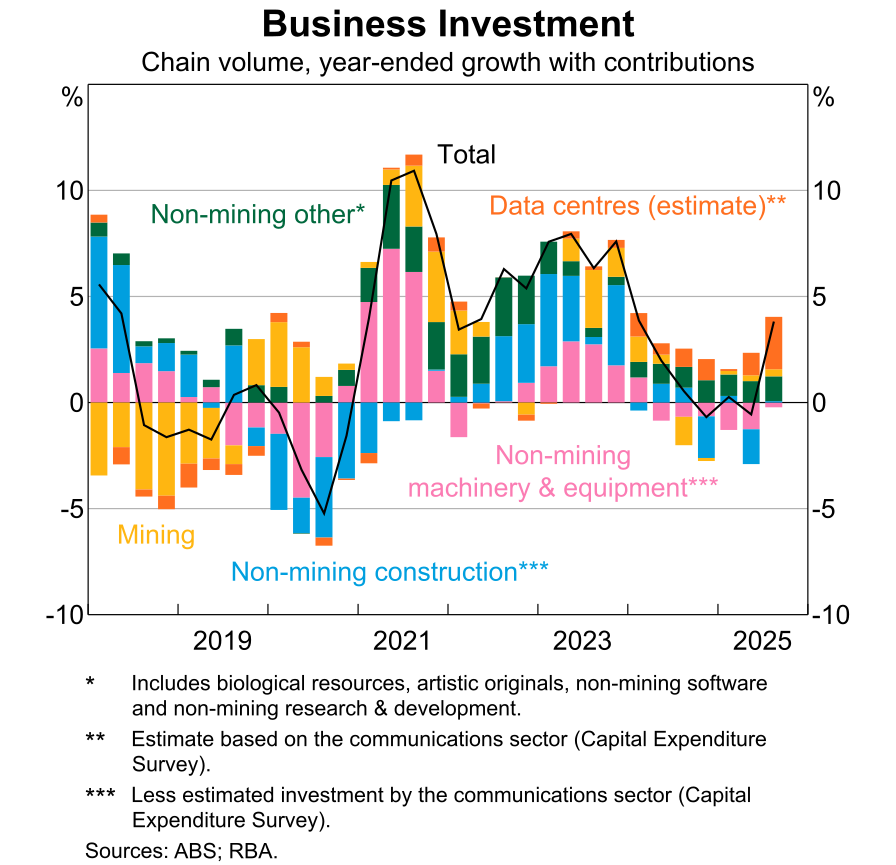
Finally, much of the unanticipated pick-up in business investment in the September quarter was related to data centre fit outs (Graph 5). This type of expenditure is mostly imported and can be lumpy, and we do not expect increases of this magnitude to continue in coming quarters. That said, some of the recent strength in business investment is expected to be maintained in the near term. According to the latest capital expenditure survey and our liaison contacts, firms have recently upgraded their investment plans, especially in areas like utilities, energy, data centres and related technology, and non-residential construction more broadly.
Our estimate of the economy’s supply capacity has been revised a bit lower
Our assessment is that the intensification of capacity constraints in the second half of 2025 was primarily driven by the unanticipated strength in private domestic demand. Nevertheless, recent data also suggest that the supply capacity of the economy is a bit lower than we had assumed in mid-2025.
Specifically, in the August 2025 Statement, our central forecasts for inflation incorporated a modest degree of downward judgement relative to what our models suggested. Underlying inflation data in late 2024 and the first half of 2025 had moderated, and indicators of capacity pressures from business surveys, such as capacity utilisation and the availability of labour, suggested that aggregate demand and potential supply in the economy had been moving back towards balance. At the time, we were attuned to the risk that capacity pressures might be greater than we had incorporated in the inflation forecasts – for example, growth in unit labour costs was elevated.
But inflation picked up from mid-2025, as did the survey measures of capacity pressures, and growth in unit labour costs remained elevated. Consequently, we removed the modest downward judgement to the inflation forecasts in the November Statement, and then made a small downward revision to current supply capacity in the February Statement.
We will continue to refine our estimates of the economy’s supply potential as more data become available. There is a risk that there could be even more labour market tightness than we have assessed; model-based estimates of the economy’s supply potential, as they have for some time, currently point to more capacity pressures than we have accounted for.
Where to from here?
Our outlook for domestic growth, the labour market and inflation was discussed in detail in the February Statement. For the year ahead, the forecasts for activity and inflation are stronger than previously expected, largely reflecting the recent unexpected strength in private demand and inflation. However, it is important to note that the February forecasts assumed a higher path for interest rates, consistent with changes in financial market expectations for the cash rate, and a higher exchange rate. This is forecast to contribute to a slowing in GDP growth from late 2026, to be below its estimates of potential growth, which would help ease capacity pressures. Inflation is now expected to peak in mid-2026 before moderating to a little above the midpoint of the 2–3 per cent range by mid-2028 as the economy returns to balance.
That is the central forecast. It assumes that much of the recent sector-specific inflationary pressures will dissipate in coming quarters (e.g. as the recent and assumed increases in the cash rate constrain demand for new housing), and that broader capacity pressures in the economy will subsequently ease as GDP growth slows later this year. As discussed above, we may be misjudging how quickly some sector-specific inflationary pressures will wane as demand slows. It is also possible we should be taking more signal from the recent strength in inflation and the ongoing weakness in productivity to inform our estimates of supply capacity. And I haven’t even had the time to discuss the global risks, which we continue to assess are tilted to the downside.
Our thinking around the new monthly CPI data
As usual, we will be closely monitoring the incoming data to assess how the economy evolves relative to our forecasts and associated risks. This includes tomorrow’s official CPI data for January. Given today’s audience of fellow forecasters, I thought it was a good time to reiterate our approach to the new monthly CPI data and talk through our plan from here.3
As we have noted, the RBA welcomes the introduction of a complete monthly CPI, as more frequent (and complete) data has material benefits for the timeliness of our read on inflation. The monthly CPI is Australia’s primary measure of headline inflation and the benchmark variable for the inflation target. But, as with anything new, it will take us some time to understand the properties and seasonal patterns of the data. While we learn about the monthly data, for a time we will continue to focus on the quarterly data for forecasting and assessing underlying inflationary pressures. In particular, as you saw in our February forecasts, we continue to forecast the quarterly trimmed mean measure of inflation.
That said, we have also been analysing underlying inflation measures constructed using the monthly data. As more monthly data become available, eventually we aim to assess which underlying inflation measures from the monthly data will be preferred in a post-quarterly CPI world. During this transition period, we will be looking to understand the properties of monthly underlying measures, including any signs of bias, differences in seasonal pattens, responsiveness to changes in economic conditions, and effectiveness as a leading indicator for headline inflation. This will be some way off, but our intention is to engage widely and communicate our thinking ahead of any decisions.
Thank you. I’m happy to take some questions.
Endnotes
* I would like to thank Natasha Cassidy, Matt McCormick and Madeleine McCowage for their help preparing this speech, and also Tim Anderson, Alex Ballantyne, Michele Bullock, Kate Davis, Iris Day, Sarah Hunter, Chris Kent, Kevin Lane, Harrison Nguyen, Harry Stinson, Tim Taylor, Michelle van der Merwe and Michelle Wright for their comments and contributions.
1 Recent RBA work on the role of technology and AI includes: Bullock M (2025), ‘Technology and the Future of Central Banking at the RBA’, Address to the 60th Shann Memorial Lecture, Perth, 3 September; Fernando J, K McLoughlin and R Ratnayake (2025), ‘Technology Investment and AI: What are Firms Telling Us?’, RBA Bulletin, November.
2 For more information on how we use labour market indicators when gauging conditions relative to full employment, see Hunter S (2026), ‘Defining Full Employment and Its Intertwined Relationship with Inflation’, CEDA: In Conversation series, Perth, 12 February; RBA (2026), ‘Box A: Update on the RBA’s Approach to Assessing Full Employment’, Statement on Monetary Policy, February.
3 Our approach was outlined in RBA (2025), ‘Box C: The Transition to a Complete Monthly CPI’, Statement on Monetary Policy, November. Since then, we have been learning and adapting our approaches now that the data are available.
Underlying data
This file contains all underlying data that are available for public release.
Some graphs in this speech were generated using Mathematica.