
Speech Defining Full Employment and Its Intertwined Relationship With Inflation
Sarah Hunter*
Assistant Governor (Economic)
CEDA: In Conversation series
()
– Perth
We meet today on the lands of the Whadjuk peoples of the Noongar nation, who are the traditional owners and custodians of the land on which we are gathered. We are very lucky in Australia to have First Nations people who take care of our land, country and culture, and pass this on to future generations. I pay my respects to Elders past and present and extend that respect to any First Nations people here today.
Today I want to talk about the labour market – a market that almost all Australians will have firsthand experience in during their lives. I dare say all of us are in this room today because we are on the supply side of this market, and most of you as business professionals also have substantial experience on the demand side too. For macroeconomists like me, understanding the labour market is particularly important as it sits at the heart of the economy; given that every good and service we consume requires some human input to produce it, conditions in the labour market are closely linked to conditions across the whole economy.
Indeed, the labour market is so important it forms part of the RBA’s monetary policy objectives. Under the Statement on the Conduct of Monetary Policy, the RBA’s Monetary Policy Board sets policy to over time achieve sustainable full employment, which is defined as the maximum level of employment that is consistent with low and stable inflation.
This means that our full employment objective is closely linked with our inflation objective; while deviations can occur in the short run, over time if the labour market is in balance (i.e. achieving full employment), then inflation will be at our mandated target (i.e. low and stable).1 A bit like a double helix – the twisted ladder shape that encodes our DNA – full employment and price stability are separate, yet entwined. Given this relationship, understanding current and future conditions in the labour market and how they are reflected in underlying inflationary pressures defines the core of the Monetary Policy Board’s policy decisions.
So today, I want to expand on how we think about full employment, how it reflects our inflation objective and how we assess whether the labour market is in balance, before I briefly comment on the outlook from here.
To cut to the punch line, our current assessment is that while there has been some easing in the labour market since the pandemic, it remains somewhat tight. Some in the room today might be experiencing the consequences of a tight labour market. For example, strong construction activity and a long pipeline of work in Western Australia – and other states in the country – mean that it can be hard to hire trades and other construction professionals. Conditions are different in other sectors and parts of the country, but the overall picture of persistent tightness is important because, like the entwined double helix, it is consistent with there still being some inflationary pressure in the economy.
An evolving view of full employment through labour market indicators
Given the centrality of the labour market to the economy and to our dual mandate, understanding where full employment is – and how far away from it we currently are – is critical. But pinning it down to something concrete, so we can get a good read on labour market conditions, requires considerable effort. We have to draw on a broad set of information, including price and wages indicators, models and an array of labour market indicators. I want to start with these labour market indicators as this is where our recent thinking has evolved the most.
Changes in the labour market can happen in many ways, and these adjustments are not always fully captured by one measure such as the unemployment rate. For example, the hours someone wants to work can change over time – parents may want to work part time, students typically move into full-time work when they graduate and so on. And if more people wish to switch jobs, that may encourage businesses to increase wages to retain staff.2
Evidence from a broad range of labour market indicators has long been a core part of informing monetary policy decisions, but our approach has evolved substantially over recent years as part of our response to the RBA Review. The most recent changes build upon previous work and are outlined in the latest Statement on Monetary Policy.3 They refine our approach to be more systematic, comprehensive and transparent – and we will continue improving this over time. There are limitations to any approach and expert judgement is needed in the selection and interpretation of indicators.4 To help to reduce these limitations, we have refined our choice of indicators to ensure that they all contain useful information about future inflation and wages growth. This is important given that the definition of full employment is inextricably tied to the rate of inflation in the economy.
We have also upgraded our benchmarks for judging if a given indicator is tight or loose. Previously, we used a historical range; while this is a reasonable starting point, it doesn’t work well when an indicator trends up or down over time. For example, the proportion of adults with a job or looking for a job has steadily trended up in recent decades, so assessing the current rate against an average from the last 30+ years would be misleading.5 Our new approach tries to account for underlying trends in each indicator using four different simple statistical detrending methods, providing a range for where we think each indicator might be at balance.
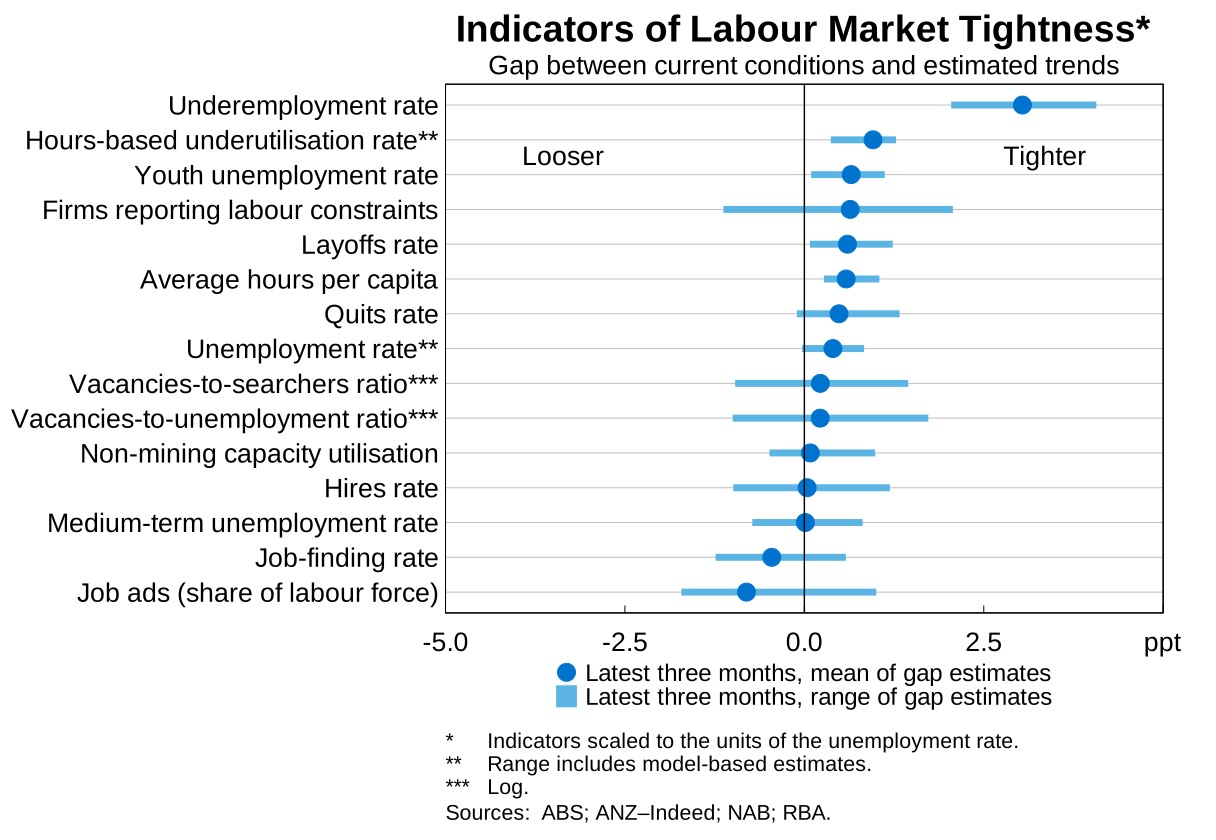
To give us a bird’s eye view of what’s going on, we pull all the indicators and our assessment of whether they’re signalling a loose or tight labour market together into a single chart (Graph 1). The vertical line in the middle, at zero, shows where we think each indicator would be in a balanced labour market. The blue range shows how far the indicator currently is from balance using the four benchmark methods, with the blue dot showing the average of these benchmarks. When the blue bar for an indicator is to the right of the chart it suggests a tight labour market. Currently, most indicators are pointing to a labour market that is at least a little tight, but some series such as job ads and the job-finding rate are suggesting a labour market that is closer to balance or a little loose.
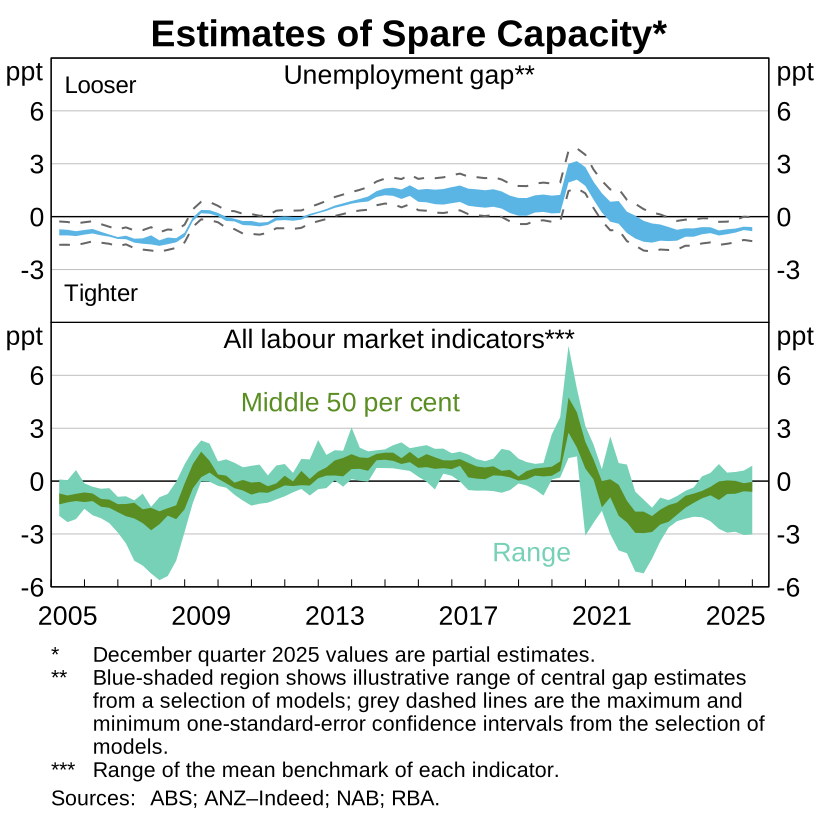
With so many different margins of adjustment, it can be difficult to summarise how labour market conditions are evolving in a single measure. The next graph attempts to do just that (Graph 2).
The bottom panel shows the (normalised) range of indicators that appeared on the earlier abacus graph, and how they have changed over time. Overall, the dark green swathe – which captures the middle 50 per cent of the indicators outlined above – suggests most indicators moved closer to balance over recent years, before stabilising in recent months. The chart also highlights that these indicators don’t always move together, and so the range can widen or narrow over time.
As a point of comparison, the top panel shows our pre-existing estimates, which use the unemployment rate as a single indicator for labour market conditions. These estimates have also gradually moved closer to balance over recent years, but this easing has been less pronounced than the summary indicator. In other words, some of the adjusting in recent years has come through factors like a fall in the vacancy rate, fewer workers looking to change jobs and a slowdown in hiring by firms, rather than by a rise in the unemployment rate.
How have labour market conditions evolved in recent years?
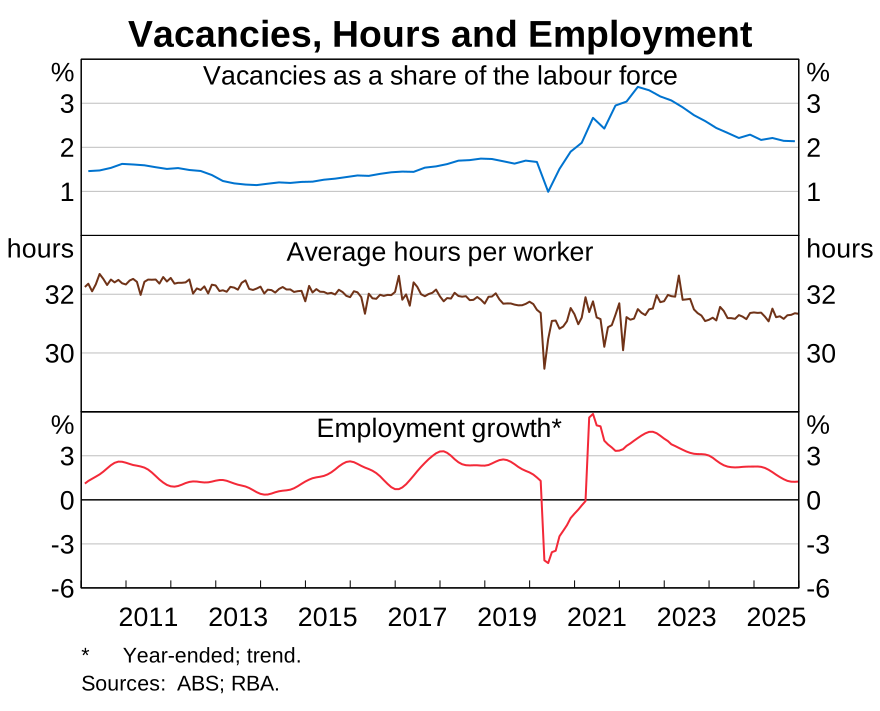
One of the most responsive and rapid forms of adjustment in the post-pandemic years came via job vacancies (Graph 3). When starting from a strong jobs market, the number of vacancies tends to fall quite quickly as demand for labour eases – this is because openings become easier to fill, and some vacancies may be cancelled as hiring plans are put on ice. As the labour market moves closer to balance, this channel of adjustment tends to slow, as we’ve seen in Australia over the last 18 months.
Another important margin of adjustment is changes in the number of hours worked. As the labour market eases, firms also reduce the number of hours worked by their employees, on average, which was particularly apparent through 2023. Indeed, it is common to see the total number hours worked in an economy fluctuate more than the number of people in jobs as economic conditions ebb and flow. In fact, in the current episode, the number of people in jobs has continued to grow (albeit at a slowing) pace, but average hours worked has remained below its pre-pandemic level.
Taken together declining vacancies, slowing growth in the number of people in jobs and relatively low average hours worked confirm that the rise in the unemployment rate has coincided with it becoming a little harder, on average, for those looking for a job to find one.
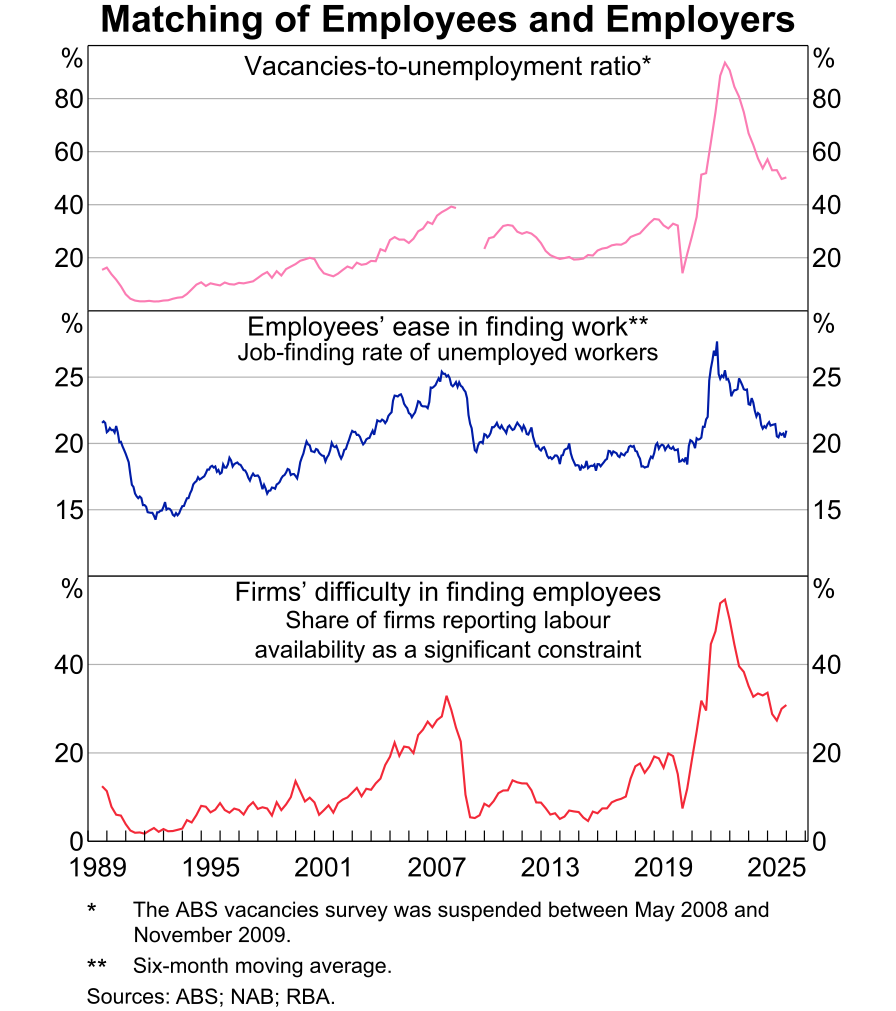
From a firm’s perspective, it has also become much less difficult to find workers (Graph 4). Nonetheless, the share of firms reporting labour availability as a constraint remains well above average, and we regularly hear in our liaison program that firms in some sectors and states still can’t find the staff they need to meet demand.
The easing I’ve just described can be seen on Graph 2 as the move in the blue and green swathes back towards zero. The most recent data from the last 3–6 months suggests that conditions in the labour market have stabilised; in the graph the swathes have flattened off. Looking through the usual volatility in the monthly data, the unemployment rate and average hours have been flat for some time. Some indicators, such as the job finding rate, have continued to ease but some have actually tightened a little; the hiring rate has increased a bit and at the margin more firms are reporting labour constraints.
Overall, our judgement is that the labour market remains a bit tight; on average, it’s still a bit too difficult for firms to find the workers they need to meet demand. It’s now worth exploring how we think full employment is entwined with the other half of our mandate, inflation. What does having a labour market that’s still a bit tight mean for inflation, and do recent inflation outcomes tell us anything about the labour market?
How we think about full employment in relation to inflation
As I’ve outlined, developments in the labour market tell us a lot about how close we are to full employment, and this reflects conditions in the economy more broadly. But what’s the relationship between low and stable inflation and full employment; how are they entwined? To help answer this question we use economic models to put a framework around the relationship. Inherently models simplify reality; we do this to make the models tractable, but we know we’re not capturing all of the nuance in reality and this is why we don’t rely on models alone.
A key framework that links inflation and the labour market is the non-accelerating inflation rate of unemployment, or NAIRU. The NAIRU is a complex idea with a somewhat unhelpful name, so I’d like to unpack it a bit. The RBA, like other central banks, has long used NAIRU models to assess labour market tightness.6 And like all models, our NAIRU estimate is subject to considerable uncertainty and judgement, which means we can’t be definitive about its level at any given point in time. The way the NAIRU is modelled and interpreted has also evolved over time, which is the subject of a recent paper by RBA staff.7
The NAIRU models were developed in the 1970s, at a time when people’s inflation expectations were unanchored and quite responsive to recent inflation outcomes. What that meant is that a temporary increase could lead people to change their views to expect higher inflation going forward, even several years into the future (Graph 5). According to the NAIRU framework, if demand in the economy outstrips supply and the unemployment rate is consistently below the NAIRU, then inflation expectations could rise to a level that is not consistent with low and stable inflation and create a feedback loop between inflation outcomes and expectations, resulting in continually rising, or ‘accelerating’, inflation.8
Conditions are quite different today. The RBA is now mandated to target a specific inflation rate and expectations for inflation in the future are anchored, in our case to around 2.5 per cent (the midpoint of our target).9 In line with this, our interpretation of the NAIRU has evolved and we think of our NAIRU models as estimating the unemployment rate at which current inflation would converge to expected inflation.10
This framework means that when the labour market is sustainably at full employment, inflation is expected to move from its current rate towards 2.5 per cent and then remain stable. This also means that when the labour market is tighter or looser than full employment on an ongoing basis, underlying inflation will hold above or below target but not necessarily accelerate away from it. In other words, we have an anchor, because the feedback loop has been substantially dampened and the old inflation accelerating/decelerating knife-edge doesn’t fit with today’s economy. This means the ‘non-accelerating’ part of the NAIRU name is a bit out of date.11
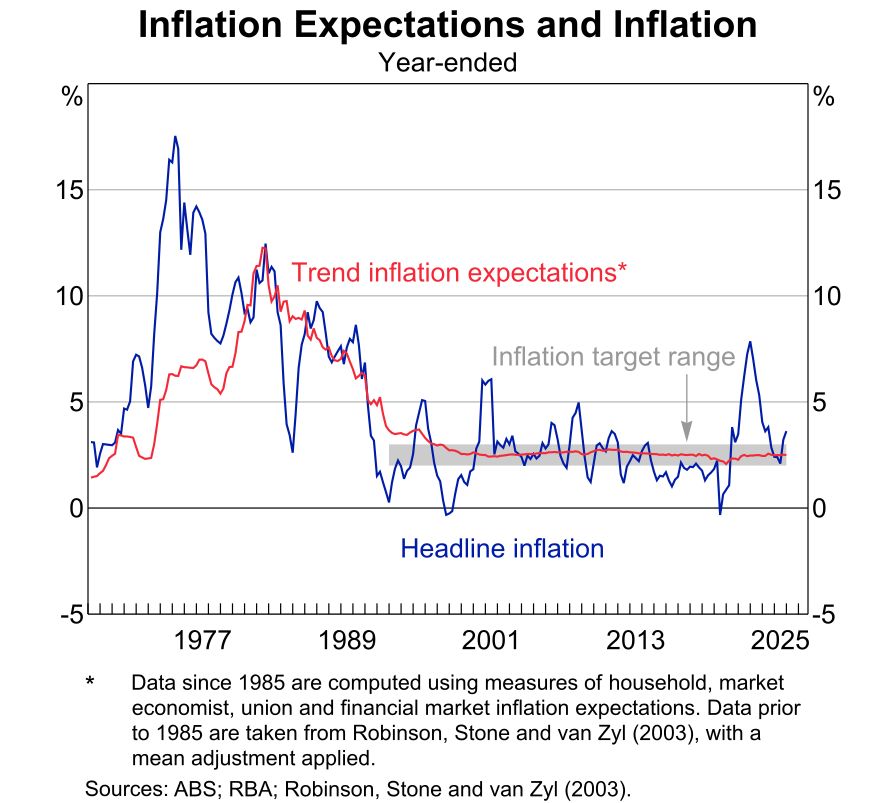
Why is this evolved understanding important? Well, we saw this play out during the pandemic inflation surge. Even with the tightest labour market seen in 50 years, inflation did not create a strong feedback loop with expectations. Long-term inflation expectations remained anchored to the RBA’s target, which meant we did not need to push back against an unhelpful feedback loop between higher expected and realised inflation. This made the disinflation seen in 2022–2025 easier than it otherwise would have been.12 Our evolved understanding also changes how we read and interpret inflation data to gauge full employment. When the labour market is tight and operating beyond full employment, we expect to see inflationary pressures across the economy and an elevated rate of inflation. But the rate of inflation doesn’t have to be continually increasing.
What do the inflation data tell us about current conditions in the labour market relative to full employment?
Earlier on I outlined that our models and analysis of just the labour market data indicate that it’s still a bit tight. Given the intertwined nature of labour market outcomes and inflation outcomes that I’ve discussed, what do the recent inflation and labour costs data tell us about labour market conditions?
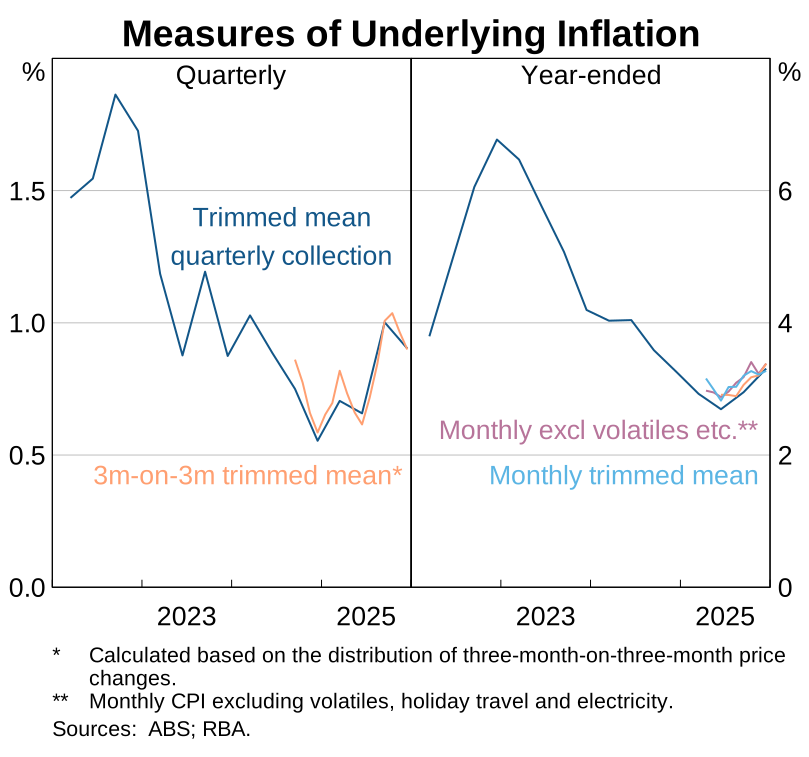
Underlying inflation has picked up recently and is currently around 3¼ per cent (Graph 6). This increase was seen in the quarterly trimmed mean, our preferred measure of underlying inflation, but also for measures of underlying inflation based on the monthly data.13
The increase in consumer price inflation in the second half of 2025 also brought it more into line with other measures of inflationary pressures throughout the economy (Graph 7). Output prices throughout the economy – as distinct from prices faced only by consumers as measured in the CPI – have been increasing by nearly 4 per cent a year for the past couple of years. This suggests businesses along supply chains are increasing prices by more than the CPI, and it may be that these costs are now being passed on to consumers. Similarly, unit labour costs – or the labour cost of producing a unit of output – have been growing by around 5 per cent for several years; before the pandemic, unit labour costs had grown by about the same rate as consumer prices, or 2½ per cent, on average.
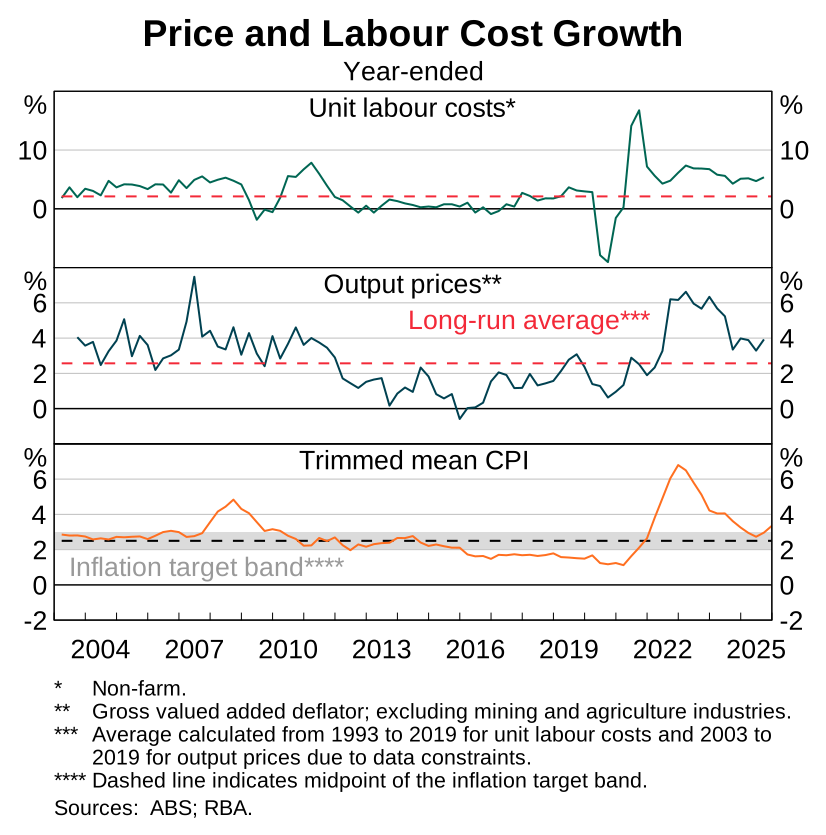
While much of the rise in inflation likely reflects temporary factors that are expected to fade, including the unwinding of discounting by residential builders and durable goods, the data also indicate continued capacity pressures in the economy. Circling back to the labour market, these observations are consistent with and further reinforce the assessment that conditions are still a bit tight; like the DNA double helix, a labour market that has been a bit tight for a period of time is linked to and entwined with above-target inflationary pressure in the economy.
Conclusion
In conclusion, our assessment of full employment, or the maximum level of employment the economy can sustain with low and stable inflation, draws on a broad set of indicators, models and price dynamics. While the unemployment rate is a very important variable to monitor when assessing how tight or loose the labour market is, it does not tell the full story. Labour market conditions evolve across a number of dimensions, including changes in vacancies and average hours worked, and monitoring a range of indicators provides useful information about how easy it is for workers to find jobs and businesses to find workers.
Dynamics in the economy have evolved somewhat in recent months, and our full employment framework and NAIRU framework indicate that the labour market has stabilised recently and remains a bit tight. Recent outcomes for inflation and other labour costs are still sitting above our inflation target, and although we think much of this reflects temporary factors, some of it reflects elevated inflationary pressures in the economy. As we have seen, our full employment and inflation objectives are entwined, and the data is painting a complementary picture with a bit too much pressure on both sides.
The recent acceleration of demand growth beyond our estimate of trend, at a time when the economy is already showing signs of being capacity constrained, means we expect the labour market will remain tight and inflation will remain above target for some time, as outlined in our recent Statement. In response to these developments and to help move the economy and the labour market back towards balance, the Board chose to increase the cash rate at its recent meeting. Moving forward, we’ll be closely assessing capacity pressures in the economy and conditions in the labour market, and this will help us assess the extent to which the recent rise in inflation is temporary; and, in turn, inform our advice to the Monetary Policy Board about the outlook in inflation. The outlook for inflation and the labour market is core to the Monetary Policy Board’s decisions given its commitment to adjust policy settings as needed to achieve both low and stable inflation and full employment.
Endnotes
* I would like to acknowledge and thank Mike Major, Alex Ballantyne, Kevin Lane and Hamish Sullivan who substantially contributed to the drafting of this speech. They have also led the recent work the RBA has done in this area, much of which is discussed here. I would also like to acknowledge Natasha Cassidy, Andrew Hauser, Chris Kent, Brad Jones, Suzanne Houweling and Michelle Wright for their comments on earlier drafts. Any errors and omissions are my own.
1 See Bullock M (2025), ‘The RBA’s Dual Mandate – Inflation and Employment’, Speech to Anika Foundation Fundraising Lunch, Sydney, 24 July.
2 For Australian evidence of job-to-job transitions leading to higher wages growth, see Deutscher N (2019), ‘Job-to-job Transitions and the Wages of Australian Workers’, Treasury Working Paper, December.
3 See RBA (2026a), ‘Box A: Update on the RBA’s Approach to Assessing Full Employment’, Statement on Monetary Policy, February; RBA (2026b), ‘Update on the RBA’s Approach to Assessing Full Employment’, Technical Note, February.
4 These limitations were raised when we first overhauled our approach in early 2024: RBA (2024), ‘Chapter 4: In Depth – Full Employment’, Statement on Monetary Policy, February; Ballantyne A, A Sharma and T Taylor (2024), ‘Assessing Full Employment in Australia’, RBA Bulletin, April. Similar limitations were also raised more recently in a 2025 paper by Borland and Harris of the University of Melbourne: Borland J and D Harris (2025), ‘The RBA’s (Dashboard) Indicator Approach’, Australian Economic Review, 58(3), pp 236–241.
5 See RBA (2026a), n 3; RBA (2026b), n 3.
6 For a history of NAIRU models in Australia, see Gruen D, A Pagan and C Thompson (1999), ‘The Phillips Curve in Australia’, Journal of Monetary Economics, 44(2), pp 223–258.
7 Ballantyne A and T Cusbert (2025), ‘The NAIRU Under Anchored Inflation Expectations’, Australian Economic Review, 58(3), pp 224–235.
8 Whether the 1970s indeed conformed to the ‘accelerationist’ view of inflation was the subject of much debate, as there were many moving parts that I do not cover here. The crucial point is that the evidence supports a view that inflation expectations were unanchored and responsive to inflation outcomes.
9 Hunter S (2024), ‘Inflation Expectations – Why They Matter and How They Are Formed’, Speech to Citi Australia and New Zealand Investment Conference, Sydney, 16 October.
10 See Cusbert T (2017), ‘Estimating the NAIRU and the Unemployment Gap’, RBA Bulletin, June; Ballantyne and Cusbert, n 7.
11 This is the case only so far as inflation expectations remain anchored. Persistent deviations of inflation from target still present a risk that inflation expectations could become de-anchored.
12 See Bullock, n 1, particularly the discussion around Graphs 2–4.
13 For a discussion of how the RBA will initially use the new monthly CPI, see RBA (2025), ‘Box C: The Transition to a Complete Monthly CPI’, Statement on Monetary Policy, November; RBA (2025), ‘The Transition to a Monthly CPI’, Technical Note, November.
Underlying data
You can download the underlying data file for all data that are available for public release.
Some graphs in this article were generated using Mathematica.