
Guidance for the Australian Clearing and Settlement Facility Resolution Regime February 2026
- Download the complete Guidance 608KB
A. About this guidance
Purpose of the guidance
- In September 2024, the Australian Parliament passed the Treasury Laws Amendment (Financial Market Infrastructure and Other Measures) Act 2024 (the Amending Act). This amended the Corporations Act 2001 (the Act), including to provide the Reserve Bank of Australia (RBA) with crisis resolution powers1 (resolution powers) in respect of domestically incorporated clearing and settlement (CS) facilities.2 These powers enable the RBA to manage or respond to a threat posed to the continuity of critical CS facility services or the stability of the financial system in Australia arising in relation to a domestic CS facility licensee (CS facility licensee).3
- This guidance is intended to provide information and transparency about when and how the RBA would generally expect to use these resolution powers. It aims to assist CS facilities, their users, market operators and other stakeholders to understand the RBA’s general approach to resolution and the potential impacts on them if the RBA decides to use a resolution power.
- The guidance does not have the force of law, nor does it pre-commit or otherwise bind the RBA to, or prevent the RBA from taking, a particular course of action. If there is any inconsistency between this guidance and the legislation, the legislation prevails.4
Structure of the guidance
- This guidance is divided into eight sections. The first three sections (Sections A–C) provide introductory background to the CS facility resolution regime and some guiding principles the RBA intends to follow in conducting resolution. These sections are intended to provide an overview of the objectives of resolution, how it fits into the wider regulatory context and how a resolution may progress in practice.
- The remainder of the guidance provides more granular detail on how the RBA expects the various stages
of resolution might occur:
- Entry to resolution (Section D)
- Conducting resolution (Sections E, F and G)
- Exit from resolution (Section H).
B. An introduction to CS facility resolution
About CS facilities
- CS facilities provide post-trade clearing and settlement services for transactions that occur in financial markets. These services are often critical to the functioning of Australia’s financial markets and the Australian financial system.
- Clearing is a post-trade and pre-settlement risk management process that often involves ‘novating’ trades. Under ‘novation’ a CS facility known as a ‘central counterparty’ (CCP) becomes the buyer to every seller in a market transaction and the seller to every buyer. This leads to transaction efficiencies and allows counterparty risk to be managed centrally, enabling investors to act confidently when trading.
- Settlement involves the delivery of financial products, including securities, or cash from one party to another in accordance with the terms of the specific trade. A CS facility known as a ‘securities settlement facility’ facilitates the transfer of ownership of securities and the exchange of payments between parties involved in a transaction.
CS facility regulation in Australia
- In Australia, the Australian Securities and Investments Commission (ASIC) has primary responsibility for licensing CS facilities and for granting exemptions from the requirement to hold a CS facility licence. Holders of Australian CS facility licences are co-regulated by ASIC and the RBA.
- ASIC administers the licensing regime and has regulatory responsibilities in relation to ensuring CS services are provided in a fair and effective way and in relation to ensuring that investors dealing in financial products and users of CS facilities are protected. ASIC is the regulator of domestic financial markets that are cleared and settled by domestic CS facilities.
- The RBA has regulatory responsibilities in relation to financial system stability and supervises CS facility licensees with the goal of ensuring that CS facilities are operated in a way that is consistent with financial stability and, where possible, reduces systemic risk. Among other things, the RBA has powers to set and enforce Financial Stability Standards (FSS)5 and to promote the stability of the Australian financial system.6
- The RBA and ASIC work closely to supervise CS facility licensees and will closely coordinate their actions during incidents or crises. Any crisis response will also involve active coordination of Australia’s Council of Financial Regulators (CFR) members.7
The introduction of resolution powers for Australian CS facilities
- The disorderly failure of a CS facility is likely to cause a significant disruption to Australian financial markets and may also result in substantial operational or financial impacts for market participants. These impacts may have flow-on consequences for the functioning of the broader financial system.
- In 2020, the CFR provided advice to the Government on measures to mitigate and address risks to Australia’s financial market infrastructure, including CS facilities.8 This advice included a recommendation to introduce a resolution regime for licensed CS facilities.9 The introduction of resolution powers was also supported by recommendations of Australia’s Financial System Inquiry10 and of the International Monetary Fund.11
- On 9 September 2024, the Australian Parliament passed the Amending Act, which inserted a new Part 7.3B into the Act containing new resolution powers for the RBA.
- The Amending Act also provided ASIC with the ability to use powers to support the resolution of a CS facility at the RBA’s request.12 ASIC and the RBA intend to work closely together throughout any CS facility resolution to coordinate their actions.
- All domestic licensed CS facilities are within scope of the resolution regime.13
Objectives of resolution
- The stated objective of Part 7.3B (the resolution objective) is to provide for the effective
management and resolution of threats that arise from, or in relation to, CS facility licensees and
which are threats posed to:
- the stability of the financial system in Australia (domestic financial stability); or
- the continuity of clearing and settlement facility services that are critical to the functioning of the financial system in Australia.14
The resolution process
- Figure 1 sets out the broad stages of resolution and the key considerations of each stage. These stages of resolution are also reflected in the structure of this guidance from Section D onwards.
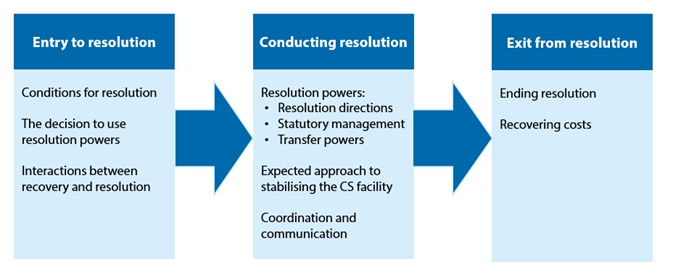
Entry to resolution
- The RBA can use its resolution powers if one or more of the conditions for resolution set out under section 831A of the Act (each a resolution condition) are satisfied in relation to a CS facility licensee. These conditions generally relate to circumstances where there is a threat to domestic financial stability or to the continuity of the CS facility’s services that are critical to the functioning of the financial system in Australia. These conditions are summarised in Figure 2 in Section D.
- Even when a condition for resolution is satisfied in relation to a CS facility licensee, it remains at the RBA’s discretion whether to use a resolution power. The use of resolution powers is expected to be an option of last resort and therefore a relatively rare event. The RBA would generally expect to use its resolution powers only in the unusual event where the CS facility’s own arrangements to manage and recover from a crisis have failed or where the use of those arrangements is likely to threaten the stability of the Australian financial system. Section D provides further information about the conditions for resolution and the decision to use resolution powers.
Conducting resolution
- The resolution powers provided by Parliament are designed to be broad, strong and flexible to allow the RBA to respond effectively to a severe crisis. These powers include directions powers, the ability to appoint a statutory manager to a CS facility, and the ability to transfer ownership of the business of a CS facility or the facility itself. Section E describes the resolution powers in more detail and how they could be used in CS facility resolution.
- In conducting resolution, the RBA’s immediate goal will generally be to stabilise the CS facility and return it to independent viability in a timely manner to ensure the continuity of critical services. In many cases, this may also involve containing, crystalising and allocating financial losses. In doing so, the RBA will generally seek to respect the existing arrangements of the CS facility licensee for the allocation of any such losses. However, crises are unpredictable, and it is not possible for the RBA to set out definitively the steps that it will undertake in its use of resolution powers. Section F contains additional information on the RBA’s expected approach to resolution.
- The use of resolution powers in respect of a CS facility licensee is likely to impact a wide number of stakeholders. The RBA will seek to communicate with stakeholders in an open and timely way to the extent that this is consistent with the resolution objective. Resolution is expected to be done in consultation and coordination with ASIC, and the other CFR agencies. Section G describes the RBA’s expected approach to communication and coordination in conducting resolution.
Exit from resolution
- Once the CS facility is able to operate sustainably without external support and resolution powers are no longer being used, the CS facility’s resolution will end. No formal declaration of the end of the resolution is required under the legislation.15 The exit from resolution is covered in section H.
C. Key principles guiding the use of resolution powers
- Parliament has provided the RBA with broad, strong and flexible powers to use in a CS facility resolution and the RBA takes this responsibility seriously. The RBA has developed a set of key principles that will generally guide the RBA’s use of resolution powers (Box 1).
- The key principles, and all statements in this Guidance, should be taken as a general indication of the RBA’s likely approach to a CS facility resolution. Crises are unpredictable. The RBA may be required to make swift decisions to achieve the resolution objective, sometimes with imperfect information. It is difficult to fully anticipate the actions the RBA might need to take in seeking to protect Australia’s financial system.
Box 1: Key Principles for the RBA’s use of CS Facility Resolution Powers
- The use of resolution powers is expected to be an option of last resort and therefore a relatively rare event. The RBA would generally expect to use its resolution powers only in the unusual event where the CS facility’s recovery plan and arrangements have failed or where the use of those arrangements is likely to threaten the stability of the Australian financial system.
- The RBA must maintain flexibility in the use of resolution powers. It is not possible for the RBA to set out definitively the steps that it will need to take to protect Australia’s financial system in a future crisis. In a crisis, the RBA may need to act quickly and most likely in an environment of great uncertainty.
- The RBA will exercise resolution powers in a way that the RBA considers best contributes to the overall stability of the Australian financial system. Matters the RBA will consider for this purpose necessarily depend on the circumstances. As an example, when considering options to achieve the resolution objective and the potential impact of those options on overall financial stability, the RBA’s position is expected to be informed by, among other things, its assessment of the likely effect of the options on relevant stakeholders.
- The RBA will generally seek to respect the rules and procedures of the CS facility. This includes the CS facility’s own arrangements to manage and recover from a crisis to the extent that this is consistent with the resolution objective.
- If external funding is needed, private sources will be the preferred option. Dedicated Government funding has been established to support CS facility resolution as part of the Amending Act. However, the RBA will generally only consider requesting this funding if it is necessary to achieve the resolution objective and it is not feasible to obtain funding from other sources. Any request for funding is expected to be accompanied with a credible plan to recover the funds.
- The RBA will seek to communicate in an open and timely way. This includes communications with the market, participants and the broader public, to the extent that this is consistent with the resolution objective.
- Resolution is expected to be done in consultation with the CFR members. CFR actions will be coordinated. As co-regulators of CS facilities, ASIC and the RBA will work closely together to coordinate actions throughout a CS facility’s resolution. Other CFR agencies and relevant international agencies will be consulted and informed as appropriate. This may include coordination of regulatory action.
D. Entry into resolution
The interaction between recovery and resolution
- The use of resolution powers is expected to be an option of last resort that would only be used in a rare and severe crisis event.
- CS facilities are designed to be resilient financial institutions. They are required to have dedicated resources and controls, rules and procedures (collectively ‘arrangements’) to enable them to recover from a wide range of distress scenarios. These arrangements include the preparation of an appropriate recovery plan containing effective and comprehensive tools to recover from a threat to its financial viability.16 The CS facility’s arrangements are intended to ensure the CS facility is highly resilient to a wide range of stress events, including the default of one or more clearing participants (in the case of a CCP) or an operational event such as a cyber-attack.
- Resolution powers are not expected to be used while a CS facility can safely and effectively use its own arrangements. Participants are familiar with these recovery tools, have agreed to their use, and should have planned for and be able to manage their effects, including their liquidity implications.
- The RBA also has certain (non-resolution) supervisory powers under Part 7.3 of the Act, which are intended to support the preservation of stability in the Australian financial system and could be used to prevent a crisis from emerging or escalating.17 These can be used by the RBA (subject to certain conditions)18 to, among other things, compel a CS facility to prioritise financial stability over other considerations. For example, by directing the CS facility licensee to do, or refrain from doing, a specified action under its recovery plan.19 The officers of the CS facility licensee would have to comply with the direction regardless of their other duties and responsibilities.20
- ASIC may also choose to exercise its powers over financial market operators and CS facility licensees to support the CS facility licensee’s efforts to recover from a stress event.21 ASIC and the RBA expect to work closely together throughout a crisis.
Conditions for resolution
- The RBA may use a resolution power when one or more resolution conditions are satisfied with respect to a CS facility licensee.22 All resolution powers become available to the RBA when at least one resolution condition is met (resolution conditions are summarised in Figure 2). This flexibility allows the RBA to respond to potentially fast moving and extreme events in a timely manner. The RBA is not obliged to use any resolution power even when one of the conditions for resolution has been met.
- The RBA is not required to make a formal declaration of non-viability prior to using its resolution powers. Resolution is initiated when the RBA uses a resolution power.
- It is difficult to envisage ex-ante the precise scenarios that might not be safely and effectively
managed by the CS facility’s recovery arrangements. However, in line with international best
practice,23 the RBA considers at least two categories of
scenarios in its resolution planning:
- Events that include the default of one or more (likely large) clearing participants at a CCP (participant default scenario).
- Events that do not involve a clearing participant default (non-default scenario). Examples of non-default scenarios may include a severe operational incident such as a cyber-attack, extreme investment losses, or losses arising from legal actions that cannot be addressed through normal recovery tools.
- Before using resolution powers, the RBA generally expects to consider, among other things:
- the ability of the CS facility to use its recovery tools to restore viability
- the financial resources that are still available to the CS facility
- the liquid resources and/or liquidity facilities still available to the CS facility
- the operational capacity of the CS facility.
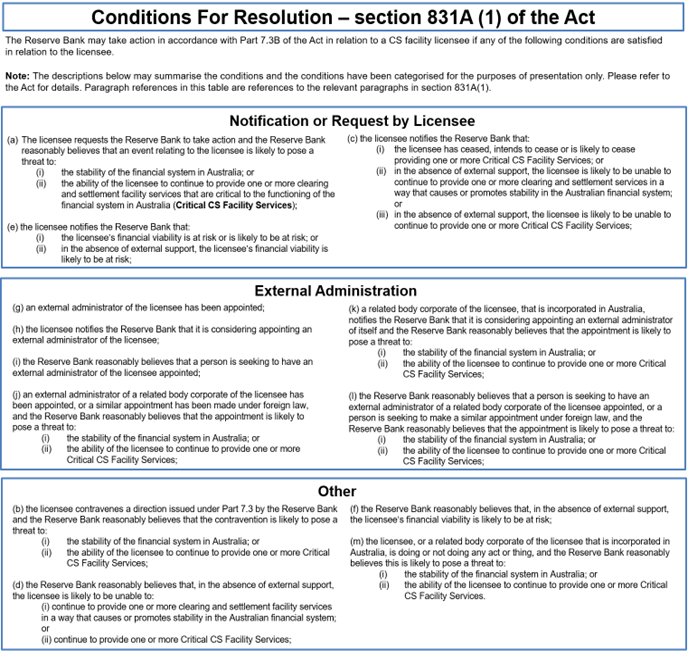
- By way of example, the RBA may consider using a resolution power in respect of a CS facility licensee
for which a resolution condition is satisfied if:
- the RBA reasonably believes the CS facility’s recovery plan and arrangements are not adequate or appropriate to address the threat to the CS facility’s viability
- the CS facility’s recovery plan and arrangements are unlikely to achieve the desired outcome within an appropriate timeframe
- participants have lost confidence in the CS facility’s management, or its ability to recover, and might choose to resign from its service altogether
- the CS facility licensee’s board and management are reluctant to implement the recovery plan due to a perceived legal risk and intend to appoint an external administrator, or decide to resign
- in a default scenario, the CCP’s proposed use of recovery tools is likely to threaten the stability of the Australian financial system. For example, some recovery tools may contribute to additional participant defaults if used in certain ways in highly stressed conditions. Depending on the circumstances, these may include recovery tools such as a cash call, variation margin gains haircutting or a partial tear up.
- Before using a resolution power, the RBA would also generally consider whether other non-resolution options might be appropriate. These would include, for example, private recapitalisation or support from other private sources. The RBA would also weigh the potential benefits of using a resolution power against the possibility that its use could have unintended consequences that create uncertainty and disruption for some stakeholders.
Communicating a decision to use a resolution power
- The RBA considers that timely, clear and transparent communication with participants and other stakeholders throughout the period where resolution powers are being used (resolution period) will be important. Relevant stakeholders may include market operators and users, other CS facilities and supervisory authorities, both foreign and domestic. The RBA appreciates that transparency concerning actions in a crisis scenario reduces uncertainty for participants and other stakeholders and promotes confidence and stability. The RBA intends to prioritise such transparency wherever this is considered consistent with the resolution objective.
- The RBA would generally expect to publicly communicate any decision to use a resolution power as soon as practicable. The RBA would also generally expect to communicate with participants and other stakeholders on an ongoing basis throughout the resolution period. This should assist participants to anticipate and manage their risk exposure throughout the resolution period.
- The RBA is likely to use a combination of communication channels, chosen to facilitate the most effective and timely communication to the target audience. These may include the CS facility’s established communication channels, as well as scheduled press conferences, the RBA website, and dedicated information lines for different stakeholders as deemed appropriate.
E. Conducting resolution: The RBA’s resolution powers
- To allow the RBA to respond effectively to a severe crisis, Parliament has provided powers that are designed to be broad, strong and flexible. They are based on the Financial Stability Board’s ‘Key Attributes of Effective Resolution Regimes for Financial Institutions’ and ‘Appendix II-Annex 1: Resolution of Financial Market Infrastructures’ within the context of Australia’s legal framework.24
- When the RBA decides that the use of a resolution power is appropriate and at least one condition for
resolution has been met, the RBA may choose to exercise those powers, including by:
or the RBA may use a combination of its powers to achieve the resolution objective. High-level descriptions of the powers referred to above are set out below. They are not exhaustive.
- The RBA would generally aim to use its resolution powers to achieve the resolution objective in a manner that as far as possible, would limit any disruption to the CS facility licensee and its corporate group.
Resolution direction powers
- The RBA may give certain directions to a CS facility licensee in respect of which a resolution condition has been satisfied (and certain of its related bodies corporate). Such directions can include requiring the relevant entity to do or refrain from doing specified actions. The RBA must reasonably believe the direction is appropriate to manage or respond to the relevant resolution condition. The legislation enables the CS facility licensee to comply with a direction despite certain other specified obligations and arrangements.28
- A resolution direction has the benefit of being timely and targeted. It is likely to allow the CS facility licensee’s officers to continue to operate the CS facility’s service throughout the resolution period.
Statutory management
- If a resolution condition has been satisfied in relation to a CS facility licensee, the RBA may take control of the business of the facility as statutory manager and/or appoint one or more persons as statutory manager to a CS facility. The RBA may only do this if it reasonably believes the action is appropriate to manage or respond to the resolution condition. In certain circumstances, the RBA may also take this action in relation to a related body corporate of the CS facility licensee.29
- The statutory manager will take control of the body corporate’s business, property and affairs and may, among other things, perform any function and exercise any power that the body corporate and any of its officers could perform.30 The statutory manager has a duty to report to the RBA on request31 and must comply with a direction from the RBA.32
- Upon appointment of a statutory manager, directors of the body must not perform or exercise a function or power of a director (except with the written approval of the statutory manager or the RBA).33 In addition, the appointment will automatically terminate the appointment of an external administrator.34 Directors have the benefit of certain protections when acting under an approval provided by the statutory manager or the RBA.35
- The appointment of a statutory manager is a particularly significant step. Before deciding to appoint a statutory manager, the RBA would consider whether the appointment would be the most appropriate option to achieve the desired financial stability outcome.
- Prior to, or immediately following, the appointment, the RBA (or the statutory manager) would seek to communicate with the CS facility licensee’s existing executives and staff as a matter of priority. The RBA’s expectation would generally be that the CS facility licensee’s executive and staff would continue to operate the facility during statutory management under the direction of the statutory manager.
Transfer powers
- If a resolution condition has been satisfied in relation to a CS facility licensee, the RBA may make a written determination that there is to be a transfer of part or all of the shares or business of a CS facility licensee, to a consenting solvent third party or Government-owned bridge entity. The RBA may only make such a determination if the RBA reasonably believes the transfer is appropriate to manage or respond to the resolution condition. The Minister must also consent to the transfer.36 In some cases, the RBA may also make a transfer determination in respect of certain related bodies corporate of the relevant CS facility licensee (subject to various conditions, including Ministerial consent).37 For example, this may be appropriate where there is an intra-group service provider that supplies the CS facility with operational or financial resources.
- The RBA would generally only expect to exercise transfer powers in an acute resolution scenario. The RBA recognises the disruption that the use of this power could cause to the corporate group. Consultation by the RBA with the ACCC may also be required.38
- By way of example, transfer powers may be an appropriate option if either the CS facility licensee or its corporate group were in serious difficulties and intra-group services and resources could not be reliably provided to the CS facility throughout the resolution period. In these circumstances, the RBA may consider using transfer powers to transfer the shares or business of the CS facility licensee and relevant related bodies corporate to a government-owned bridge entity, subject to the Minister’s approval.
- The transfer powers may apply to all or part of the shares or business of the relevant body. A share transfer is likely to be a timelier option than a business transfer and has the advantage of being less disruptive to existing contracts and arrangements, including the CS facility’s rulebook. Importantly, any licences (such as a market or CS facility licence) would be included in a share transfer.39
Other supporting arrangements
- Information-gathering powers: The RBA has various information-gathering powers under the Act to support the use of its resolution powers. These include the power to direct a person to give the RBA specified information or documents relating to the business of a CS facility licensee or related body corporate.40
- Stays: The Act provides for enforcing stays on certain rights to assist in conducting a resolution.41 Their main purpose is to ensure third-party providers of services such as electricity and communications cannot terminate a contract based solely on the use of a resolution power. Stays are not expected to interfere with the normal function of the CS facility. Critically, the stays on enforcing rights42 do not apply to netting and collateral arrangements protected by the Payments System and Netting Act 1998.43 It is expected that counterparties of a CS facility will continue to be able to close out positions to manage their risk exposures throughout resolution.
- ASIC’s powers to support CS facility resolution: In addition to ASIC’s existing powers, Parliament has provided ASIC with new powers to support a CS facility’s resolution. ASIC may make a market integrity rule44 or a CS facility rule,45 and may give a direction to a financial market operator46 or CS facility licensee if requested by the RBA.47
Using resolution powers on related bodies corporate
- The RBA can exercise certain resolution powers in relation to a related body corporate of the relevant CS facility licensee if the RBA reasonably believes that is appropriate to manage or respond to a resolution condition being satisfied in relation to the CS facility licensee.
- The RBA recognises that exercising a resolution power in relation to a related body corporate could be disruptive to the related body corporate’s operations and potentially to the broader corporate group, particularly in the case of transfer powers. Prior to making such a decision, the RBA would generally give careful consideration to all available options for achieving the resolution objective.
- A key factor in any decision to use resolution powers in respect of a related body corporate is likely to be the need to maintain the supply of intra-group services to the relevant CS facility.
F. Conducting resolution: The RBA’s expected approach
Stabilising the CS facility
- To meet the resolution objective the RBA will generally aim to stabilise the CS facility licensee and return it to independent viability as soon as practicable to ensure the continuity of critical services. In many cases, an important initial priority will be to contain and crystallise the losses of the CS facility licensee.
- The RBA generally expects to manage losses and restore critical CS facility services using a CS facility licensee’s recovery plan and arrangements, to the extent they have not been exhausted and where their use is consistent with the resolution objective.
- The RBA has the power to direct an amendment to a CS facility licensee’s operating rules or procedures.48 By way of example, this power could be used to remove an impediment in the rules that may prevent the successful implementation of a negotiated outcome mutually agreed between the RBA and participants. Such action would likely only be contemplated where other options are unsuitable or are expected to be insufficient to meet the resolution objective. The RBA would generally give careful consideration prior to directing an amendment to the CS facility’s rules because of its potential effect on participants. The RBA appreciates the critical role that participants play in maintaining a CS facility’s functions and operations. If the RBA were minded to take such a step, the RBA may engage with participants, including to understand the likely effects of any actions the RBA may take. In any case, the RBA would generally expect to communicate its intended action to participants before requiring any rule changes. The RBA would seek to make these communications as soon as practicable (and consistent with the resolution objective).
Allocating the CS facility’s losses
- A CS facility may sustain a large financial loss in a resolution scenario. For example, this could be due to several clearing participants defaulting on their obligations to a CCP, or from an operational event.
- Once the CS facility’s losses have been crystalised, the RBA would generally expect, wherever possible, to allocate the loss in the order and manner set out in the CS facility’s rules. Depending on the circumstances, the RBA may delay the deadline for payment if that was necessary to meet the resolution objective.
- If losses remain after the application of the rules, the RBA would expect to use any parental guarantees provided to the CS facility licensee. If a shortfall remains, the RBA may direct the CS facility licensee to recapitalise and, if necessary, also direct the CS facility licensee’s parent to support the CS facility licensee’s recapitalisation. The RBA may also seek private sources of funding with external investors if this is feasible at the time.
- The RBA does not expect to use any loss allocation tools that are not included in the CS facility’s rules (and does not expect to introduce such tools, such as by a change to the rules using the directions power). Such action would likely only be contemplated as a last resort where, for example, other options are unsuitable or are expected to be insufficient to meet the resolution objective. The RBA recognises that imposing unexpected losses on participants could increase liquidity strains at a time when liquidity demands have likely increased and could undermine market confidence. The RBA also recognises that the use of loss allocation tools that are not in the CS facility’s rules could generate risks for financial stability. For instance, the RBA is unlikely to require fundamental changes to loss allocation processes such as the introduction of initial margin haircutting.49
- The RBA is aware that resolution authorities in foreign jurisdictions are considering, or have included, the use of other tools in their resolution regimes.50 These are not currently included in the RBA’s resolution planning. However, the RBA does not rule out considering these tools in future. The introduction of these options would be subject to consultation.
Funding in resolution
- The RBA may request the Government to provide public funding as a last resort where other funding options are infeasible or inconsistent with effective resolution. A standing appropriation of $5 billion has been made to assist the RBA in its actions to support domestic financial stability.51 The Treasurer, with written approval from the Minister for Finance, may decide to activate any or all of this appropriation in a resolution scenario. Use of these funds is limited to actions supporting the RBA’s use of resolution powers, in accordance with the resolution objective.
- Any request for public funding is expected to be accompanied with a credible plan to recover the funds. This will include the appropriate form of funding, and the repayment period. For example, funding may be provided in exchange for equity in the CS facility licensee or its parent, or as a loan, or a hybrid option.
G. Conducting resolution: Coordination and communication
- The resolution of a CS facility may coincide with, or be caused by, broader stress in the financial system. The central role played by CS facilities in Australia’s financial system means they are closely interlinked with other regulated entities such as financial market operators and banks. The RBA also recognises that the use of resolution powers on a domestic CS facility could have implications for a wide range of stakeholders and the broader domestic and international financial systems. Hence multiple regulators and Treasury will have an interest in the RBA’s response to a CS facility in distress.
- The CFR will play an active role in coordinating a joint crisis response between its members. The CFR is the main coordinating body for Australia’s financial regulators – APRA, ASIC, the RBA and the Treasury. The RBA Governor chairs the CFR. The CFR has a central role in crisis management.52
- The RBA is the Chair of the CFR Financial Management Infrastructure Crisis Management Forum and is actively engaged with the CFR Crisis Coordination Group. These groups allow for coordination of a CS crisis response and for coordination of crisis response across different parts of the financial system.
- Treasury will play an active role in communicating the RBA’s response to the Government.
- ASIC works particularly closely with the RBA in the regulation of CS facilities. ASIC is the co-supervisor of CS facilities with the RBA, and the sole supervisor of licensed and over-the-counter markets cleared by CS facilities. ASIC and the RBA will work closely together to coordinate their actions throughout the CS facility’s resolution.
- Some CS facility licensees also operate in other jurisdictions and international regulators will also be informed and consulted as appropriate. For example, ASX Clear (Futures) has been designated as systemically important by New Zealand authorities.53 Accordingly, the RBA intends to inform and consult with the Reserve Bank of New Zealand and the New Zealand Financial Markets Authority on any resolution actions that may affect that facility in accordance with the Memorandum of Understanding between the RBA, ASIC and those New Zealand authorities.54
- CCPs have close financial linkages to their participants. Some of these participants are domestic or foreign authorised deposit-taking institutions (ADIs) supervised and regulated by APRA; some are part of foreign banking groups. The latter have home regulators and resolution authorities. The RBA will communicate closely with APRA and the relevant foreign authorities throughout a CS facility’s resolution where relevant and appropriate.
- The RBA recognises that its resolution actions may significantly affect a CCP’s participants. It is possible that some of those participants may be or become the subject of resolution activity by other relevant authorities. The RBA expects to place a high priority on coordination of regulatory actions and crisis responses with APRA and relevant overseas authorities as appropriate. For the latter, the RBA will look to leverage its membership of international supervisory colleges and crisis management groups where relevant and possible. The RBA also expects to have continuing engagement with APRA and relevant foreign regulators in the context of resolution planning.
- Actions taken by the RBA during a CS facility resolution can also significantly affect the clients of the CS facility’s participants. Many of these clients are domestic institutions, such as superannuation funds, domestic ADIs and insurers, which are regulated by APRA. Other clients include foreign or domestic asset managers, market makers, hedge funds and everyday individual investors. Clear, timely and transparent communication, including market announcements and other appropriate forms of public communication is likely to be critical in managing an effective crisis response. The RBA understands that its financial stability objective will generally be best facilitated by keeping all stakeholders informed about its use of resolution powers.
H. Exit from resolution
- Once the CS facility is sustainably able to operate without external support and resolution powers are no longer being used, the CS facility’s resolution will end. No formal declaration of the end of the resolution is required under the legislation. However, the RBA would generally expect to announce the end of the resolution period via a public statement. This would be in keeping with the RBA’s principle of providing transparency wherever doing so is consistent with the resolution objective.55
- Once any resolution has ended, the RBA expects to develop and publish a resolution report. This will likely capture lessons learned and other information that may help to improve preparedness for any future actions. As part of this process, the RBA may consider engagement with affected parties to discuss outcomes and seek feedback.
Recovery of public funds
- The RBA’s use of resolution powers will incur costs. Any administrative costs associated with the use of a resolution power, such as costs incurred by appointing a statutory manager, will be a debt payable by the CS facility licensee.
- Where public funding is provided, a credible plan will be provided to recover the funds once conditions have stabilised. This is a matter for the Government but is expected to be executed according to the recoupment plan developed alongside the funding strategy.
- For example, if funding was provided in exchange for equity in the CS facility licensee or a related body corporate, the equity is expected to be sold in an orderly fashion within a reasonable timeframe and in a manner consistent with financial stability. If the CS facility licensee and one or more entities in the corporate group have been transferred to a government-owned bridge entity, then the Government is likely to sell the bridge entity. This could take effect by an onward transfer to a third party, or by an initial public offer.
- Any funding provided as a loan would be recouped according to the repayment schedule set out in the loan contract or otherwise agreed. This may include the potential for a loan to be converted to equity.
Endnotes
1 Part 7.3B of the Corporations Act 2001.
2 Licensed under section 824B(1) of the Corporations Act 2001.
3 Action the RBA may take in relation to an overseas CS facility under Division 8 of Part 7.3B of the Corporations Act 2001 is out of scope of this guidance.
4 Also see the qualifications at paragraph 27.
5 See RBA, ‘Financial Stability Standards’. The FSS are based on the CPMI-IOSCO Principles for Financial Market Infrastructure (PFMIs). In 2017, CPMI-IOSCO issued guidance for the PFMI relating to recovery planning in ‘Recovery of Financial Market Infrastructures’.
6 The power to determine FSS is set out in section 827D of the Corporations Act 2001.
7 The members of the CFR are ASIC, the Australian Prudential Regulatory Authority (APRA), Treasury and the RBA.
8 CFR (2020), ‘Financial Market Infrastructure Regulatory Reforms – Advice to Government from the Council of Financial Regulators’, July.
9 CFR (2020), ‘Financial Market Infrastructure Regulatory Reforms – Advice to Government from the Council of Financial Regulators’, July, Recommendation 1.
10 Treasury (2014), ‘Financial System Inquiry – Final Report’, November, Recommendation 5.
11 International Monetary Fund (2019), ‘Australia: Financial System Stability Assessment’, Country Report No 2019/054, Section E under the heading ‘Financial Stability Policy’.
12 Under section 849AB of the Corporations Act 2001, the RBA may request ASIC to make a rule or give a direction to a domestic market operator or a CS facility.
13 Domestic CS facilities are licensed under section 824B(1) of the Corporations Act 2001.
14 Section 830B of the Corporations Act 2001.
15 However, there are some notification requirements specific to certain actions, for example, the termination of the appointment of a statutory manager (see section 832B(2) of the Corporations Act 2001).
16 Required under FSS 3.5 (for both CCPs and securities settlement facilities), which is based on the Bank for International Settlements: CPMI-IOSCO (2014), ‘Recovery of Financial Market Infrastructures’, October.
17 For example, section 823F of the Corporations Act 2001.
18 Section 823F(2) of the Corporations Act 2001.
19 Section 823F(1)(a) of the Corporations Act 2001.
20 This includes duties to creditors and shareholders under the Act and regulatory obligations such as licence conditions, FSS and CS facility rules. The legislation provides immunity from liability to certain directed persons who comply in good faith (see section 823X of the Corporations Act 2001).
21 Parts 7.2 and Part 7.3 of the Corporations Act 2001, respectively.
22 Section 831A of the Corporations Act 2001.
23 Financial Stability Board (2017), ‘Guidance on Central Counterparty Resolution and Resolution Planning’, July, p 14.
24 Financial Stability Board (2024), ‘Key Attributes of Effective Resolution Regimes for Financial Institutions’, April. Treasury and the CFR consulted on these powers, and their Australian context, in 2015 and 2019, respectively.
25 Section 840A of the Corporations Act 2001
26 Section 832A of the Corporations Act 2001.
27 Division 4 Part 7.3B of the Corporations Act 2001.
28 Section 840A of the Corporations Act 2001. The CS facility can comply with a resolution direction despite other parts of the Act, its constitution, any of its operating rules or procedures, any arrangement to which it is party and any listing rules of a financial market on which it may be listed. This is subject to the qualification in section 840A(6).
29 Section 832A of the Corporations Act 2001.
30 Section 833A of the Corporations Act 2001.
31 Section 835A of the Corporations Act 2001.
32 Section 835B of the Corporations Act 2001.
33 Section 834A of the Corporations Act 2001.
34 Section 836A of the Corporations Act 2001.
35 To enable directors, and the CS facility’s officers, to assist the statutory manager, the legislation provides broad immunity for actions taken in good faith under the written approval of the statutory manager. See section 849CD of the Corporations Act 2001.
36 Sections 837A(1) and 837B(1) of the Corporations Act 2001.
37 Sections 837A(2) and 837B(2) of the Corporations Act 2001.
38 Section 837G of the Corporations Act 2001.
39 If the RBA believes that a business transfer is more appropriate in the prevailing circumstances, then the Minister has the power to grant a CS facility licence to the receiving body. Section 824B(3) of the Corporations Act 2001.
40 Section 841A of the Corporations Act 2001. In addition, under section 833E of the Corporations Act 2001, a statutory manager can require current and former officers (of up to three years prior to the statutory manager’s appointment) to provide the statutory manager with information relating to the body corporate’s business, property and affairs. The statutory manager may give this information to the RBA.
41 Division 6 Part 7.3B of the Corporations Act 2001.
42 Section 843A of the Corporations Act 2001.
43 The relevant arrangements are prescribed in Regulation 7.3B.65 of the Corporations Regulations 2001 under section 843B(1)(b)(i) of the Corporations Act 2001.
44 Section 798G(5A) of the Corporations Act 2001.
45 Section 826Q of the Corporations Act 2001.
46 Sections 794AA and 798JB of the Corporations Act 2001.
47 Section 849AB of the Corporations Act 2001.
48 Section 840A(1) of the Corporations Act 2001. Also see section 840A(6) of the Corporations Act 2001 and paragraph 1.229 of the Explanatory Memorandum, Treasury Laws Amendment (Financial Market Infrastructure and Other Measures) Bill 2024, which states ‘the licensee must comply with any processes or procedures for changing the operating rules that are outlined within the operating rules (for example, consulting with participants) following a direction to change the operating rules’.
49 Each participant must pay initial margin to a CCP when a new trade is opened. If a participant subsequently defaults on its obligations under the CCP’s rules, the CCP can use the defaulting participant’s initial margin to cover the costs of closing out the defaulting participant’s positions. The CCP cannot use the initial margin of a non-defaulting participant to cover the costs of a defaulting participant. The latter would be referred to as initial margin haircutting and is currently not included in a domestic CCP’s rules.
50 Some examples of additional tools and resources to support orderly resolution have recently been added to Financial Stability Board (2024), ‘Key Attributes of Effective Resolution Regimes for Financial Institutions’, April, Appendix II, Annex 1 at 4.22.
51 Section 846A of the Corporations Act 2001.
52 The CFR’s Charter sets out the CFR’s role in crisis management.
53 Reserve Bank of New Zealand (2023), ‘Financial Market Infrastructures Act Designation Notice (ASXCF) 2023’, December.
54 See the 2023 Memorandum of Understanding between the Reserve Bank of Australia, Australian Securities and Investments Commission, New Zealand Financial Markets Authority and the Reserve Bank of New Zealand.
55 See general principles set out in Section C.
© Reserve Bank of Australia 2026
For the full copyright and disclaimer provisions that apply to this publication, see https://www.rba.gov.au/copyright.
ISBN 978-1-7637270-8-3 (Online)