
Corporate Plan 2026/27

The Corporate Plan is the RBA’s primary planning document for the period from 2026/27 to 2029/30. It sets out the RBA’s objectives, how we intend to achieve them, and the strategic priorities that we will work towards over the coming four years.
It has been prepared in accordance with section 35(1)(b) of the Public Governance, Performance and Accountability Act 2013. The accountable authority of the Reserve Bank of Australia is its Governance Board.
Foreword

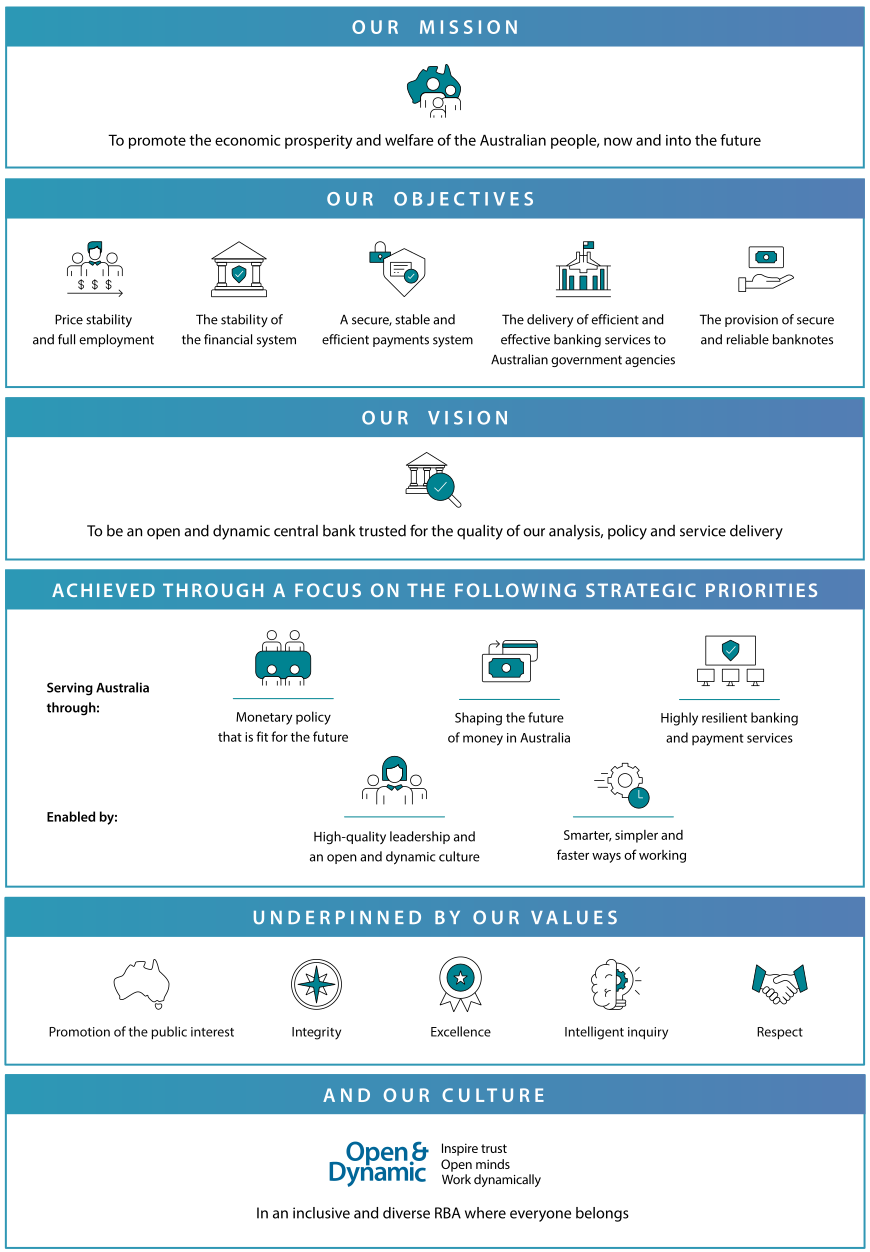
The RBA continues to evolve and change as we work towards our vision of being an open and dynamic central bank that is trusted for the quality of our analysis, policy and service delivery. Achieving that vision is essential for us to fulfil our mission of promoting the economic prosperity and welfare of all Australians, now and into the future.
We have made significant progress towards this vision over the past three years. Our strategic priorities during this period of transformation have been ambitious and yet necessary to give us confidence that we will consistently achieve our core objectives into the future. They have also been consistent with the Australian Government’s Statement of Expectations for the Governance Board. These priorities are currently to:
- establish monetary policy processes that support high quality advice, decision-making and implementation, while communicating that effectively to all Australians
- ensure our payment and banking systems are highly reliable, consistent with their critical importance to the Australian economy
- shape the future of money in Australia, in light of rapidly changing payments technology and consumer preferences
- embed high-quality leadership and an open and dynamic culture, to enable our people to thrive and deliver their best
- create smarter, simpler and faster ways of working that enable us to be efficient, effective and agile enough for the complex, fast-paced and data-rich world in which we operate.
Delivering these strategic priorities is demanding and complex. And we need to deliver them while also successfully achieving the outcomes that the public rightly expects across each of our five core objectives.
The scale and complexity of this work heighten the risks we face while delivering this transformation. This is compounded by the volatile and uncertain world in which we will operate over coming years – a world in which:
- geopolitical risks are prominent and disruptive
- technology is changing rapidly (with implications for the Australian economy and payments system, as well as our internal operations)
- the expectations of the workforce are evolving and competition for talent is strong
- change is an enduring feature.
This backdrop, along with other external and internal developments discussed in this plan, have shaped our priorities for 2026/27.
We have made progress on each of our priority areas but our journey is ongoing. The Governance Board and I are confident that we have the right priorities to materially advance our vision. Delivering on these priorities will significantly enhance our ability to provide quality analysis, policy and service delivery to the people of Australia.
We also recognise that the world is evolving quickly and that much will be required from us over coming years to remain a trusted and successful central bank. To that end, we are well advanced in considering what we must prioritise next, as the horizon for the strategies we set in 2023 draws to a close. The next four years will present many new opportunities and challenges for the Australian economy. We believe that the transformational changes we have delivered over the past three years, together with our plans for the coming four years, leave us well placed to promote the economic prosperity and welfare of the Australian people, both now and into the future.
Michele Bullock
Governor and Chair of the Governance Board
Reserve Bank of Australia
31 August 2026
About the Reserve Bank of Australia
Our mission
Our objectives
To deliver on our mission, we have five core objectives:
Our operating environment
The operating environment we face over the coming years will be shaped by a variety of external and internal challenges and opportunities. This section outlines those that we expect to be most material.
External
- The nature of the shocks buffeting the global economy and financial system has shifted. Non-traditional shocks emanating from outside the economy and financial system (including those discussed below) have become more prominent compared with more traditional risks to the business cycle and credit quality. These shocks are also more likely to occur simultaneously and to intersect than has been true historically.
- Geopolitical division and tensions have become more important in shaping growth and inflation outcomes both globally and domestically. The risk of fragmentation in the global economy and/or financial system has increased. This creates a more uncertain environment. And it requires countries and firms to make challenging trade-offs between efficiency and resilience when organising finance, trade and supply chains. Geopolitical risks also have potential consequences for financial stability.
- Technological change is pervasive and rapid. It is fundamentally altering how people work and interact, and is reshaping a range of industries, firms and jobs. There are immense opportunities to harness technology to improve the livelihood of people and the way we work. But it also creates new risks and amplifies existing ones (including geopolitical and other risks) as they increasingly intersect.
- Artificial intelligence (AI), in particular, is rapidly advancing and being adopted, both in Australia and abroad. AI will have radical implications for the nature of work, productivity and economic structures – as well as for the severity of risks facing the financial system.
- There has been an increase in the frequency, reach and sophistication of cyber-attacks. The development of frontier AI models has materially raised the probability of a successful attack on the financial system. It could be very damaging if the operations of either the RBA or another important financial institution were disrupted for an extended period.
- Climate change and responses to it (both in Australia and abroad) introduce challenges and opportunities for Australia’s economy and financial system, especially over the longer term. These developments pose potential risks to financial stability. And they are likely to increase the variability of inflation and output.
- The supply potential of the economy remains uncertain and supply shocks may become more frequent over coming years. This makes it more difficult to determine the stance of monetary policy that best achieves and balances our two objectives. Persistently weak productivity growth is also currently limiting the ability of the economy to grow without generating inflationary pressures.
- Changes in the nature of financial intermediation internationally, where more financing is occurring outside of prudentially regulated entities, is limiting the ability of authorities to monitor and address potential financial stability risks.
- Rapid innovation and changes in the way that consumers choose to pay are reshaping payment systems. These developments have seen the emergence of new payments technology, services and competitors. They have driven the transition to electronic payments and prompted consideration of the future of account-to-account payments and new forms of money. Changes in payments are, in turn, putting pressure on the cash distribution system. This is necessitating new approaches to ensure that cash remains a widely available and accepted means of payment, as part of an inclusive and resilient payments system.
- Recent legislative changes have major implications for the RBA’s responsibilities and how we operate. These changes include amendments to the Reserve Bank Act 1959 (which created the RBA Governance Board in March 2025), the passage of the Cash Distribution Framework Act 2026 and amendments to the Corporations Act 2001 (which have expanded the scope of the RBA’s responsibilities for crisis management), and amendments to the Payments System Regulation Act 1998 (which broaden the definition of payment systems and the participants within the scope of the RBA’s powers).
Internal
- We face multiple competing priorities as we work to implement a substantial change agenda that spans a wide range of responsibilities and all parts of the RBA. This work will help us achieve our vision, but the scale of what is required to implement this ambitious agenda also creates material risks – both to delivering this change agenda and achieving our core objectives. We are managing these implementation risks actively, including by honing our ability to plan, prioritise and carefully manage the sequence and pace of these changes.
- We are building our capacity to embed the safe and responsible use of AI across the organisation. Our aim is for AI to support improved productivity, stronger operational resilience and more effective use of information when making decisions. This will require AI to be embedded in every line of business, within appropriate guardrails (including humans always being in control – AI will be used to support, not supplant, human judgement).
- We are rebuilding our permanent head office to establish modern infrastructure, comply with current building standards and create a safe workplace free of hazardous material. This also involves establishing an interim banknote storage centre in Sydney and relocating our large and significant archives.
- We are devoting substantially more resources to governance and risk management, following the establishment of our Governance Board in 2025. This will help support effective decision-making, clearer accountability and the delivery of our objectives.
- We are modernising our monetary policy implementation framework by adopting an ‘ample reserves’ system in which we supply as many reserves as banks demand. This system is simple and resilient to changes in the demand for reserves or policies that would increase the size of the RBA’s balance sheet (such as additional monetary policy tools). Implementing this system requires us to evolve our tools and approach to supplying reserves.
- We need ongoing investment to keep our IT systems current, secure and resilient. Technology is essential to our operations, particularly those providing critical national services such as real time gross settlement of payments, government banking services and banknote issuance and wholesale distribution. Our approach to delivering necessary technology change must be fast and efficient, given the criticality of its role in our operations and the rapid pace of change in its capability. This investment must also be done while maintaining 24/7 availability of the systems supporting critical national services.
- Our workforce is changing as we seek to transform and enable a more open and dynamic culture. This includes bringing in more people from outside the RBA, who can provide different experience and perspectives. The associated decline in our average tenure increases the importance of managing corporate knowledge well.
- The broader workforce from which we hire is also changing, with evolving expectations about what motivates employees, how work is delivered and how their careers will develop. We need to be responsive to these ongoing changes if we are to continue to attract quality staff. We also intend for our workforce to reflect the diversity of the community in which we operate. While we are satisfied with our gender balance, we have more work to do to promote cultural and linguistic diversity.
Our strategic priorities
We are entering the final year of our four-year strategic plan, guided by the five strategic priorities first set out in 2023/24. We have made good progress in all areas and expect to achieve most of the aims we set, as outlined in this section.

Measuring our performance
This section outlines the key activities we will undertake to deliver on our objectives, and how we will measure and assess our performance.
| Key objectives | Key activities | Performance measures and targets 2026/27 | Performance measures and targets 2027/28–2029/30 |
|---|---|---|---|
| Price stability and full employment | Conduct monetary policy in a way that best contributes to: – price stability – the maintenance of full employment |
Consumer price inflation is between 2 and 3 per cent, as part of a flexible inflation target. Labour market is close to sustained full employment, which is the current maximum level of employment that is consistent with low and stable inflation. |
As for 2026/27. |
| Operate in money markets to achieve the Monetary Policy Board’s desired monetary policy stance | Cash rate trades close to the target set by the Monetary Policy Board, and other short-term interest rates trade at levels that are broadly consistent with the cash rate. Achieve this while enabling and encouraging private financial markets and keeping associated risks to the RBA no larger than necessary. |
As for 2026/27. |
|
| Contribute to the stability of Australia’s financial system | Assess and communicate risks to financial stability |
Publish financial stability assessments on a regular basis, including in Monetary Policy Board communications and the half-yearly Financial Stability Review. |
As for 2026/27. |
| Work with domestic agencies, the Australian Government and international bodies to identify, monitor and coordinate policies to address risks to financial stability | Cooperate with agencies comprising the Council of Financial Regulators (CFR) to identify, monitor and coordinate policies to address risks to financial stability, and how those risks might interact with monetary policy. Provide advice to the CFR on financial stability and to the Australian Prudential Regulation Authority on macroprudential policy. Coordinate across CFR agencies to build crisis response readiness. |
As for 2026/27. |
|
| Engage with international fora (including the Financial Stability Board, Basel Committee on Banking Supervision and G20) to support regional and global financial stability and promote effective standards and cooperation. | As for 2026/27. |
||
| Be ready to intervene in the financial system if necessary to mitigate the risk of financial instability | Maintain readiness – via clear and well-documented arrangements for when and how to provide liquidity to financial institutions, as is necessary – to support the effective flow of credit and smooth functioning of financial markets. |
As for 2026/27. |
|
Maintain readiness – via clear and well-documented arrangements for when and how to address dysfunction in key financial markets, as is necessary – to preserve financial stability. Foreign reserves portfolio matches the size and liquidity target set by the Monetary Policy Board. |
As for 2026/27. |
||
| A secure, stable and efficient payments system | Strengthen the resilience of the payments system |
Develop operational plans for the use of key crisis management powers for clearing and settlement and cash distribution facilities, including for statutory management, directions and information gathering. |
Conduct simulations involving the use of crisis management powers for clearing and settlement and cash distribution facilities. |
| Promote a competitive, accessible and innovative payments system | Publish regulatory priorities and consult with stakeholders following release of the Review of Payments System Regulation Issues Paper. |
Complete Review of Payments System Regulation. |
|
| Shape the future of money so it meets the evolving needs of the economy, financial system and community |
Consult with stakeholders on how RITS could support tokenised wholesale assets and private money. Publish an assessment of the case for a retail central bank digital currency in Australia, drawing on public engagement, research and experiences of other jurisdictions. |
Deliver initiatives outlined in the Final Report of Project Acacia on exploring the role of digital money in wholesale tokenised asset markets. |
|
| Align the RBA’s regulatory framework for payments and market infrastructures to the Australian Government’s principles of regulator best practice | Conduct research and engagement with stakeholders to understand emerging issues affecting the environment in which regulated entities operate. Regulatory requirements are streamlined, proportionate to risks and coordinated with other regulators. Communicate with regulated entities in a timely, clear and consistent way, including on regulatory priorities. |
As for 2026/27. |
|
| Deliver reliable interbank settlement services | RITS availability is 99.95 per cent during core hours. RITS Fast Settlement Service availability is 99.995 per cent on a 24/7 basis, with most transactions processed in less than one second. |
As for 2026/27. |
|
|
Ensure RITS and related infrastructure are secure, well-maintained and operationally efficient |
Substantially implement improvements to meet the recommendations of the 2023 external review of the RITS operating environment. |
Complete implementation of improvements to meet the recommendations of the 2023 external review of the RITS operating environment. |
|
| Migrate initial batch of critical settlement infrastructure to a third-party-owned co-location data centre without business disruption. | Complete migration of critical settlement infrastructure without business disruption. |
||
Substantially implement planned uplift in cyber resilience, in line with best practice industry frameworks – including ASD Essential Eight and NIST. |
Fully implement planned cyber security uplifts. |
||
Collaborate with industry and government agencies on initiatives to strengthen the resilience of the Australian payments system, such as the Industry Resilience Initiative. |
As for 2026/27. |
||
| Ensure interbank settlement services meet the needs of the payments system and promote the public interest | Contribute to the development of a roadmap to achieve the industry agreed vision for the future of account-to-account payments in Australia. |
Begin to implement changes required to settlement services to support the future of account-to-account payments. |
|
| Begin developing a vision for the strategic modernisation of RITS. | Consult with stakeholders, publish a vision for the strategic modernisation of RITS, and begin the resulting design work. |
||
| The delivery of efficient and effective banking services to Australian government agencies | Provide banking services that are fit for purpose |
Customer satisfaction exceeds 4.5 out of 5.0. |
As for 2026/27. |
Banking’s fast payments system availability is at least 99.995 per cent on a 24/7 basis. Other ‘high availability’ banking systems operate at 99.95 per cent availability during core hours. |
As for 2026/27. |
||
| Satisfy financial performance benchmarks | Minimum return on capital for transactional banking business equivalent to the yield on 10-year Australian Government Securities plus a margin for risk. |
As for 2026/27. |
|
| Progress activities to deliver convenient, secure, reliable and cost-effective banking services to customers | Deploy enhancements to banking services offered to customers, such as new or improved product offerings. |
As for 2026/27. |
|
Support reduced customer usage of legacy payment channels (e.g. cheques) in line with industry timeframes. |
As for 2026/27. |
||
| The provision of secure and reliable banknotes | Maintain public confidence in Australian banknotes as a means of payment and store of value, by: |
||
| – meeting wholesale banknote demand | Fulfil 100 per cent of banknote orders from commercial banks within three business days of requested transaction date. Maintain ability to meet periods of heightened wholesale banknote demand. |
As for 2026/27. |
|
| – maintaining the security of Australian banknotes | Issue secure banknotes, as indicated by counterfeiting rates that are low by historical standards, and effectively respond to counterfeit threats as required. |
As for 2026/27. |
|
| – maintaining high-quality banknotes. | More than 80 per cent of banknotes in circulation are of the highest quality, according to the RBA fitness standard. |
As for 2026/27, subject to a review of quality standards during this period. |
Risk oversight and management
We cannot achieve our objectives without managing risk well. Risk management supports better decisions, stronger resilience and greater accountability. It helps us deliver our mandate safely and effectively in a constantly changing operating environment.
Our risk and compliance management framework
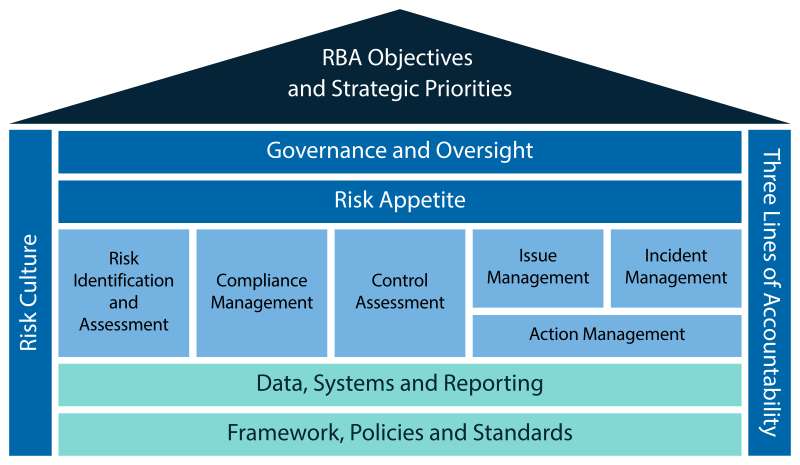
Our risk and compliance management framework sets out how we identify, assess, manage and report on risk and compliance across the RBA. It provides a consistent approach to supporting our objectives and strategic priorities, while helping us respond to change in a disciplined way.
The framework is reinforced by the three lines of accountability model and our risk culture. Management, as the first line, owns and manages risks in day-to-day operations. Risk and Compliance Department, as the second line, provides review, challenge and insight. Audit Department, as the third line, provides independent assurance to the Governance Board (primarily via its Audit and Risk Committee). This model supports clear accountability while helping avoid gaps or duplication.
Governance and oversight of risk are enabled through structured management committees, clearly defined roles and responsibilities, and established escalation pathways. Together, these support informed decision-making.
Our risk appetite is a central element of the framework, defining the types and levels of risk that we are willing to accept when pursuing our objectives and strategic priorities under normal operating conditions.
The framework also describes a structured approach to identifying, assessing and managing the risks, obligations and associated controls. It supports the timely identification and resolution of incidents and issues, contributing to a comprehensive risk profile that helps us operate within our risk appetite. This process is underpinned by reliable data, systems and reporting, as well as a suite of frameworks, policies and standards that provide a foundation for consistent and effective risk and compliance practices.
Governance
The Governance Board oversees the management and organisational affairs of the RBA, including approving the corporate strategy and management of risk and compliance and the determination of our risk appetite. The Audit and Risk Committee supports the Governance Board in this task by overseeing the effectiveness of the risk and compliance management framework and the system of internal control.
The Monetary Policy Board and Payments System Board oversee risks inherent in the decisions they make regarding monetary, financial stability and payments policies. These risks are managed both in the ordinary course of decision-making, and through periodic review of the risks in the framework for policy decision-making.
At the management level, the Executive Committee will provide oversight of the RBA’s overall risk and compliance practices from now on. It will monitor the RBA’s current and emerging risk profile, may request further action where risk exposures or risk management practices are not meeting expectations, and will make enterprise-wide decisions (when required) on how to prioritise and sequence remediation activities. It will be supported in this task by two subordinate risk committees, one focused on managing non-financial risk and another focused on managing financial risk. These committees will delve deeply into how relevant risks are evolving and being managed, drawing on detailed advice from subject matter experts.
We continue to strengthen our risk and compliance capability as part of the RBA’s broader transformation. The focus is now shifting towards embedding stronger risk practices, clearer accountability and better decision-making in day-to-day work.
Risks of heightened focus
We actively manage a broad range of risks across our operations. These risks are influenced by the scale of change currently underway across the RBA and the critical services we provide to the Australian community. Our focus is on strengthening resilience, improving controls and maintaining clear accountability so we can deliver our objectives safely and effectively.
The risks that are of heightened focus currently are:
| Risks | Approach to managing |
|---|---|
| Technology: ability to ensure systems or technology services deliver continuous and reliable services, are not obsolete, manage system outages effectively, ensure timely recovery and meet operational requirements. | We are modernising core infrastructure, strengthening resilience and recovery arrangements and improving key controls across critical services. We are also carefully sequencing major technology change so that essential services remain stable while change is delivered. |
| Cyber security: resilience against cyber-attacks and other potential disruptions to the RBA’s operations. | We continue to strengthen our cyber defences, including via better end-point and server protections, monitoring, identity controls and safeguards for sensitive information. We also regularly test and refine our response arrangements so we can detect, respond to and recover from incidents quickly. |
| Supplier management: effective management of suppliers in line with expected contractual objectives and commercial value. | We are strengthening how we assess, oversee and monitor suppliers, with a focus on critical services and major vendors. This includes clearer accountabilities, stronger due diligence, better monitoring of supplier performance and risk, and continued review of whether controls are working as intended. This will be a particular focus as we move towards signing the major works contract for the rebuild of 65 Martin Place. |
| Strategic implementation: achieving strategic business goals through change programs and day-to-day work. | We are prioritising work more rigorously, improving sequencing across major programs and strengthening governance over delivery risks and key dependencies. This helps us balance ambition with capability and reduce the risk of disruption to day-to-day operations. |
| Integrity and compliance: adhering to rules and legislation. | We are continuing to strengthen the control environment, improve visibility of obligations across the RBA and embed clearer reporting, escalation and accountability. This is supported by more consistent issue and incident management, stronger oversight and ongoing capability uplift. |
| Public policy development: the potential for compromised attainment of charter objectives through inadequate design or operation of public policy and related internal communication processes. | We are supporting monetary policy teams through better prioritisation and planning, stronger use of data, modelling and analytical infrastructure, and better preparedness for plausible shocks. We are also monitoring workload pressures and dependencies that could affect the quality or timeliness of advice. |
In addition to these risks arising from our day-to-day operations, our policy boards face risks when making their decisions. The following risks are expected to be of most importance to our policy boards over coming years:
- monetary and financial stability policy: the potential implications for the economy and/or financial stability of geopolitical developments; structural changes in the economy, most notably those emerging from the rapid adoption of AI; and readiness for a potential financial crisis
- payments policy: the need for greater resilience in critical payments infrastructure; the ability of supporting infrastructure and regulation to keep pace with rapidly evolving technological change; and the challenge of sustaining an efficient and competitive payments system as the payments landscape evolves.