
Speech Recent Refinements to the Dual Mandate and Navigating Back to Target

Sarah Hunter*
Assistant Governor (Economic)
Norges Bank Monetary Policy Mandate Conference
()
– Oslo, Norway
Before I begin, I would like to acknowledge that I have travelled here from the lands of the Gadigal people of the Eora nation. We are very lucky in Australia that our First Nations people protect our land and culture to hand down to future generations. I would like to pay my respects to their Elders past and present.
Thank you for inviting me to speak at this conference. It is a pleasure to be in Norway and be able to learn from colleagues about how mandates and frameworks can vary across central banks and the implications of this for monetary policy settings. My remarks today will focus on the findings of the recent RBA Review with respect to our mandate, the recent refinements that were made in response and how they have impacted the RBA Monetary Policy Board’s (Board)1 strategy and operations. I’ll finish with some reflections on the current strategy and trade-off faced by the Board.
As many of you will know, a comprehensive and independent review of the RBA was conducted in 2022/23. The Review concluded that Australia’s economic performance had been strong in the three decades since flexible inflation targeting was introduced and found that Australia’s monetary policy framework, as well as the RBA’s actions, contributed significantly to these outcomes.
While the Review found that Australia’s monetary policy framework was fundamentally sound, it recommended that it should be more clearly defined. In response, important changes were made to refine the RBA’s mandate and create clarity around its objectives. These changes are welcome. Amongst other things, the Board now provides a clearer assessment of current conditions and the outlook for the economy, and the implications of this for monetary policy strategy; over time, we hope that this will help people across the economy to better understand policy decisions.
Having said this, the changes have not fundamentally changed the RBA’s policy mandate – price stability and full employment were defined as objectives in the 1959 legislation that founded the RBA and this remains the case today. Consistent with this, the Board adopted its current strategy of bringing inflation gradually back to target while supporting a gradual adjustment in the labour market before the change to the new legislation came into effect. And it still considers that strategy to be appropriate under the newly refined dual mandate.
Clarification to the RBA’s objectives
The RBA adopted flexible inflation targeting in the 1990s in order to achieve the goals of monetary policy as set out in the institution’s founding legislation: the stability of the currency; the maintenance of full employment; and the economic prosperity and welfare of the people of Australia. Prior to the Review, achieving the inflation target entailed ensuring that inflation remained between 2 and 3 per cent on average, over time.
Looking around the world, there is no standard approach to formally defining this mandate. Some central banks have explicit dual mandates for price stability and full employment, while others have price stability as a primary mandate with secondary objectives related to employment or economic activity. But our assessment is that in practice, all recognise in some way that monetary policy tends to be better suited to influencing aggregate demand in the economy and the pace at which inflation is brought back to target when it has moved away can have an impact on output and employment in the shorter run. Hence, some weight is also put on real economy outcomes; this manifests as the choice over how quickly policy-setters aim for inflation to return to target.
As outlined earlier, until early last year the legislation governing the RBA spelled out three distinct objectives for monetary policy – price stability, full employment, and the economic welfare and prosperity of the Australian people. While these objectives largely served Australia well, particular concerns were raised in the Review around the third objective, which was deemed to be ambiguous and to be providing the RBA with too much discretion.2
In response, some changes were made last year to the relevant legislation and the agreement between the RBA and the government to modernise and clarify the RBA’s objectives.3 The legislation now explains that the RBA’s overarching goal is to promote the economic prosperity and welfare of the Australian people, both now and into the future. And for the Board this means setting policy in a way that best achieves both price stability and full employment. To help clarify the implication of these changes for policymakers, changes were also made to the Statement on the Conduct of Monetary Policy (an agreement between the Board and the Government on how the Board will discharge its mandate). These changes together mean that Australia has essentially kept a flexible inflation target, but with clarifications around how it operates in practice. These include:
- Inflation target midpoint: The Board should aim to set policy to return inflation to the midpoint of the inflation target of 2–3 per cent, so as to maximise the likelihood that the inflation target is met.
- Full employment: The Australian Government’s objective is for sustained and inclusive full employment. The Board’s role within this is to focus on achieving sustained full employment, which is the current maximum level of employment that is consistent with low and stable inflation.
- Balancing the two objectives: In setting monetary policy, both price stability and full employment should be considered. However, this does not mean that the Board needs to assign equal importance to both objectives at all times. There will be times when more weight will be placed on one side of the mandate than the other. The Board is responsible for determining the appropriate balance between the objectives as well as the appropriate timeframe to return inflation to the midpoint of the target range. This may vary depending on economic conditions.
- Clear communication when objectives may not be met: When inflation is expected to be significantly away from the midpoint or when labour market conditions are expected to deviate significantly from those consistent with full employment, the Board will communicate how long it expects it will be before it meets each objective and why. In other words, the Board will be clear about how it is balancing its two objectives and why.
The recent changes have made the dual mandate more explicit, and have fed into the enhancements in communicating the Board’s view of the economy and its strategy. But the fundamental components of the mandate remain the same and the continuity of the monetary policy strategy enacted by the Board before and after the legislative change suggest the clarification of the mandate is unlikely to mark a fundamental shift in how monetary policy is formulated in Australia.
Navigating back to target after the pandemic
As we all know all too well, in the years following the onset of the COVID-19 pandemic, economies around the world experienced a sharp rise in inflation. This surge reflected a combination of factors, including significant supply disruptions together with strong demand, which in turn partly reflected the large fiscal and monetary stimulus introduced by authorities around the world during the pandemic. Australia was no exception, with inflation reaching its highest level in over three decades by late 2022 and labour market conditions becoming very tight.
In response to these developments, the Board explicitly defined its strategy in terms of both aspects of its dual mandate. Specifically, the Board adopted a strategy of setting monetary policy in a way that would bring inflation sustainably back down to target within a reasonable timeframe while allowing conditions in the labour market to adjust gradually towards full employment.4 This strategy aimed to preserve as many of the gains in the labour market as possible – that is, to bring the labour market back to balance but not deliberately generate a negative employment or output gap.5 It was assessed that inflation expectations remained anchored, and therefore that there was scope to take a bit longer to bring inflation back to target.6
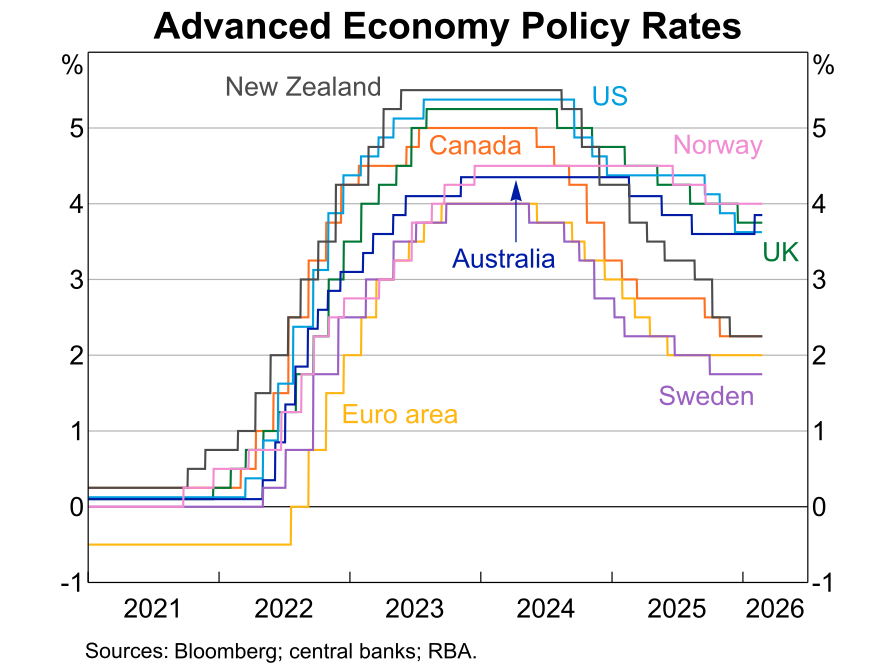
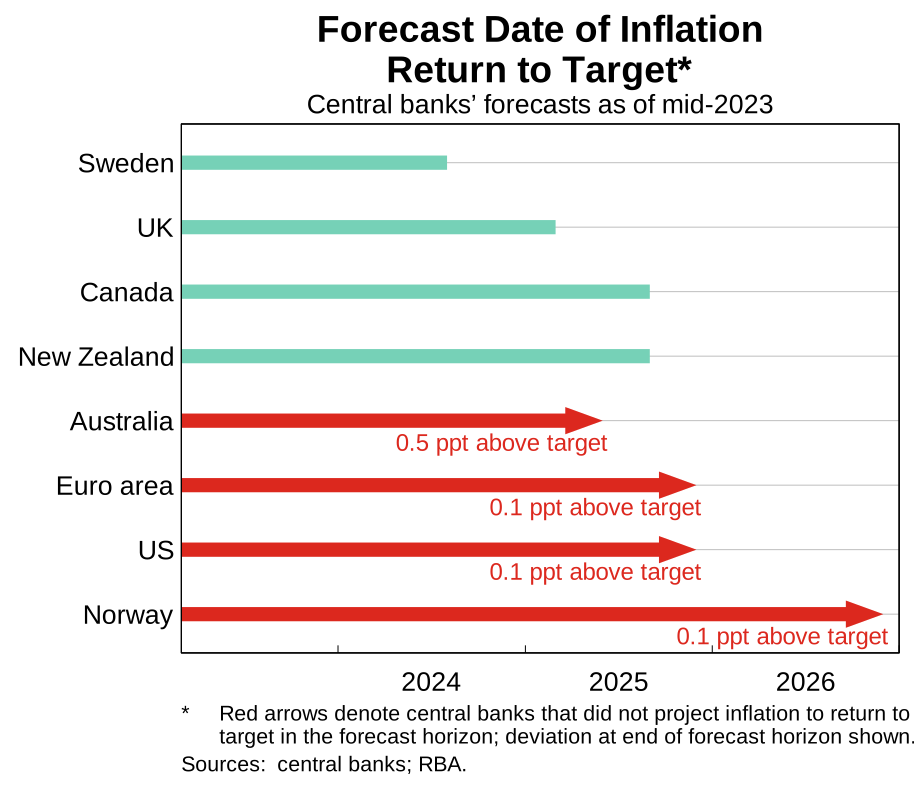
This strategy led to a somewhat different interest rate path to that chosen by some other central banks. While the RBA responded to these inflationary pressures by raising interest rates significantly, it raised the policy rate to a somewhat lower level than many others (Graph 1); in monetary policy parlance, the cash rate was set at a less restrictive level than in other economies.7 The different strategies adopted by central banks appeared to reflect a combination of factors, including their varying assessments of risks and differing tolerance for the speed of return of inflation to target (Graph 2). At the time, central banks that adopted a more aggressive approach to tightening policy, such as the Reserve Bank of New Zealand, tended to forecast inflation returning to target more quickly while expecting a materially negative output gap. By contrast, central banks that sought to return inflation to target at a slower pace, including the Norges Bank and the RBA, tended to expect the economy to return to balance more gradually or expected to create only a small degree of excess supply.
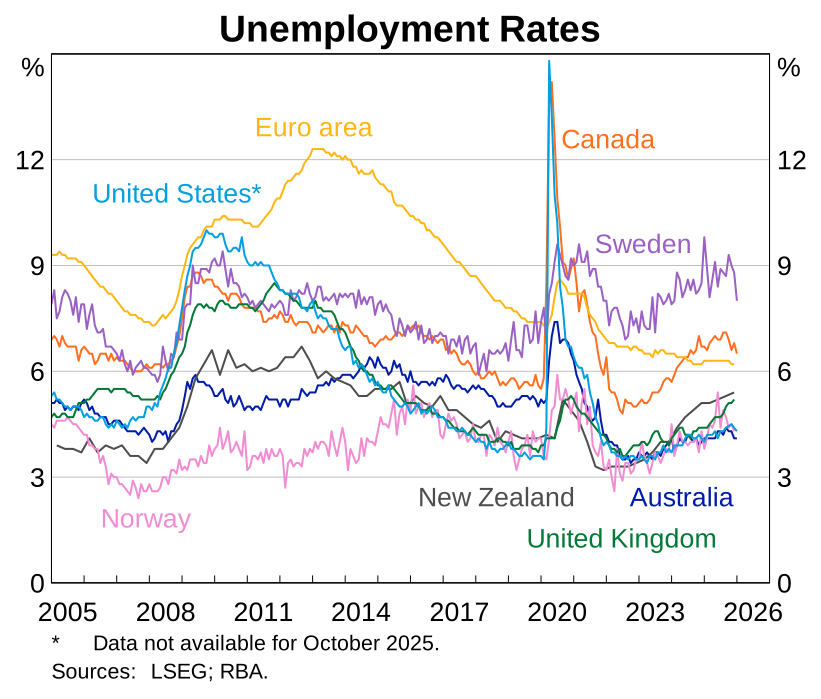
This period of higher interest rates helped improve the balance between aggregate demand and supply in the Australian economy and allowed us to make meaningful progress on bringing inflation down. At the same time, conditions in the labour market eased gradually, with the unemployment rate remaining relatively low (Graph 3).
By early 2025, the Board judged that it was appropriate to withdraw some policy restrictiveness, noting that inflation had continued to ease and was projected to ease further as the output gap closed, growth in private demand was subdued and given heightened uncertainty about the global outlook. Accordingly, the cash rate was gradually reduced from 4.35 per cent to 3.6 per cent between February and August 2025.
Given the strategy adopted by the Board, this easing was intentionally modest relative to many peer central banks that had initially tightened policy by more. In contrast to this sub-group of peers, although the Australian economy was moving towards balance, there was still judged to be a little excess demand in the labour market and ongoing capacity pressures in other parts of the economy. Although policy was eased slightly, it was still judged to be restrictive.
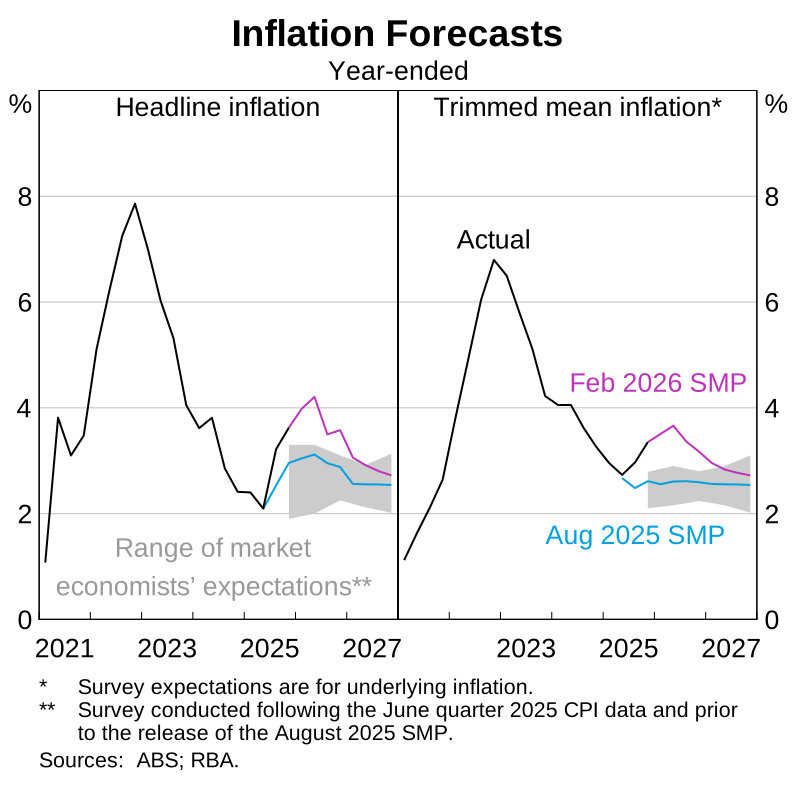
Conditions in the Australian economy have changed markedly since mid-2025. The global economy has shown more resilience and growth in private demand has been stronger than expected, and conditions in the labour market have stabilised rather than continuing to ease. Underlying and headline inflation were much stronger than anticipated by both the RBA staff and market economists (Graph 4). While much of the surprise is assessed as being due to sector-specific temporary factors that are expected to fade, RBA staff now think that economy-wide capacity constraints were and are currently tighter than was previously assessed.
In response to these developments and the updated staff assessment of the economy’s fundamentals, the Board judged that in order to achieve its strategy of returning inflation to target in a reasonable timeframe, it needed to tighten financial conditions and raise the cash rate to 3.85 per cent. This decision was consistent with the Board’s judgement that part of the recent acceleration in inflation is a result of tighter capacity constraints than previously thought; the economy is now assessed as being further away from balance and delivering their strategy required a tightening of monetary policy.
What if the Monetary Policy Board had followed a different strategy?
Given we are now several years into the current strategy, one way to answer this question is to simulate how the economy would have evolved had the Board followed a path for the cash rate that was closer to that of our peer central banks. That is, a strategy that put more weight on getting inflation back to target faster.
For this exercise, suppose the Board had increased the cash rate from the beginning of 2022 such that the path adopted by the Board was in line with the average of our peers; as shown in Graph 1, the average peer central bank tightened policy by more than the RBA.8
Then suppose that following the peak, the cash rate was cut at a similar speed to the average of our peers (Graph 5). It should be noted that this is a hypothetical path for the cash rate that amalgamates actual policy decisions across a range of central banks, each of which decided on their own strategy for tackling the post-pandemic inflation spike and faced country-specific shocks when making their policy decisions. In other words, this is a stylised path and is not intended to suggest a credible alternative strategy for monetary policy in Australia.
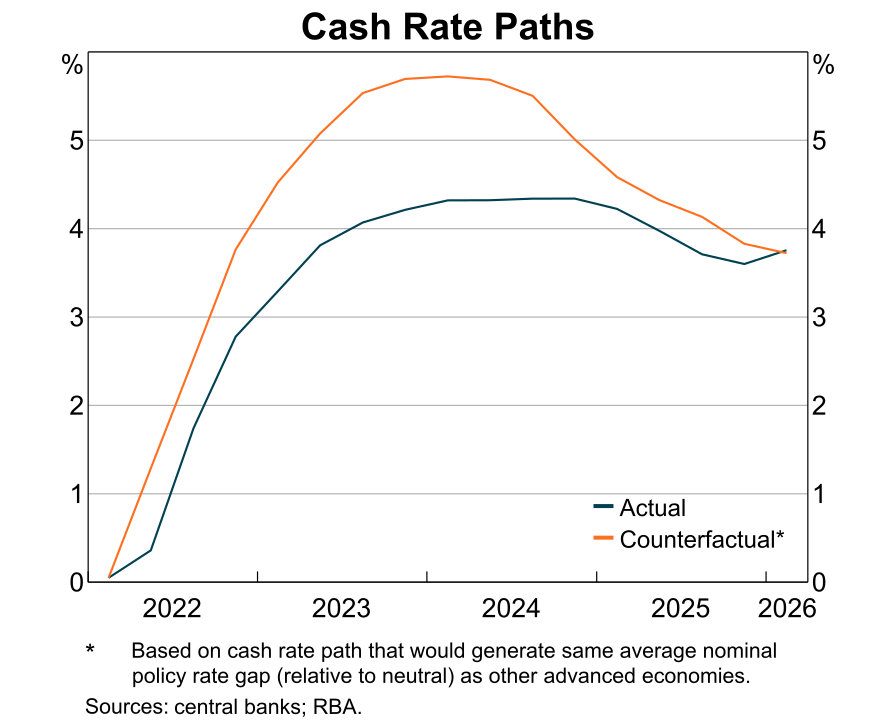
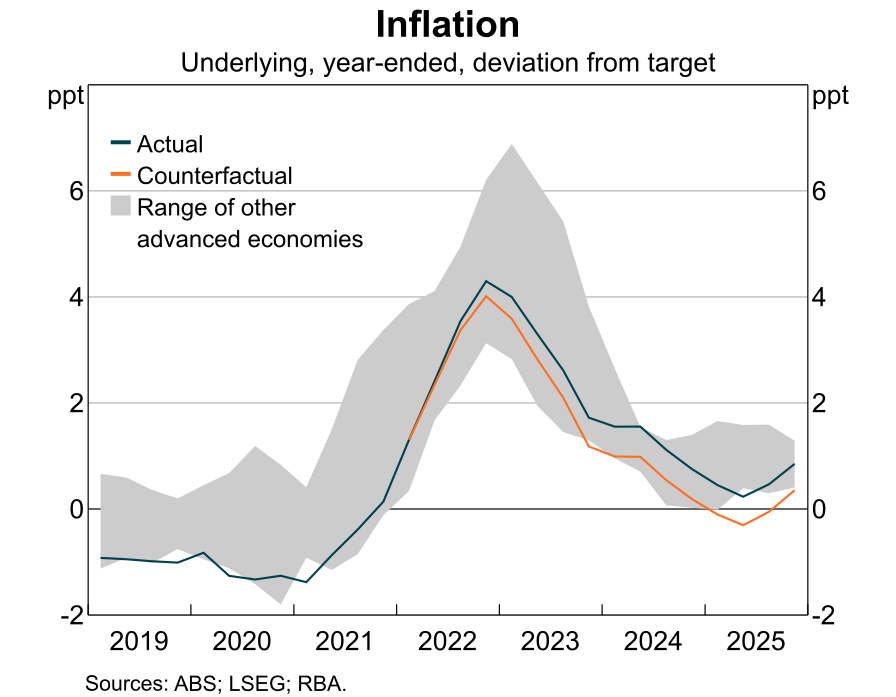
To assess how the economy would have evolved with this counterfactual path, while keeping everything else (including all shocks, data revisions and other events, that were not known in real time) the same, we used DINGO and MARTIN – two of the RBA’s core macroeconomic models.9 In what follows, we used an average of the results from these models.
Unsurprisingly, a sharper increase in interest rates would have reduced the peak level of inflation and increased the speed of subsequent disinflation (Graph 6). We estimate that with this counterfactual path, year-ended trimmed mean inflation would have reached the midpoint of the target band (2.5 per cent) by 2025. The surprise spike in inflation in late 2025 still occurs, as it is an unexpected shock, with year-ended trimmed mean inflation lifting to be slightly above target at the end of the horizon.
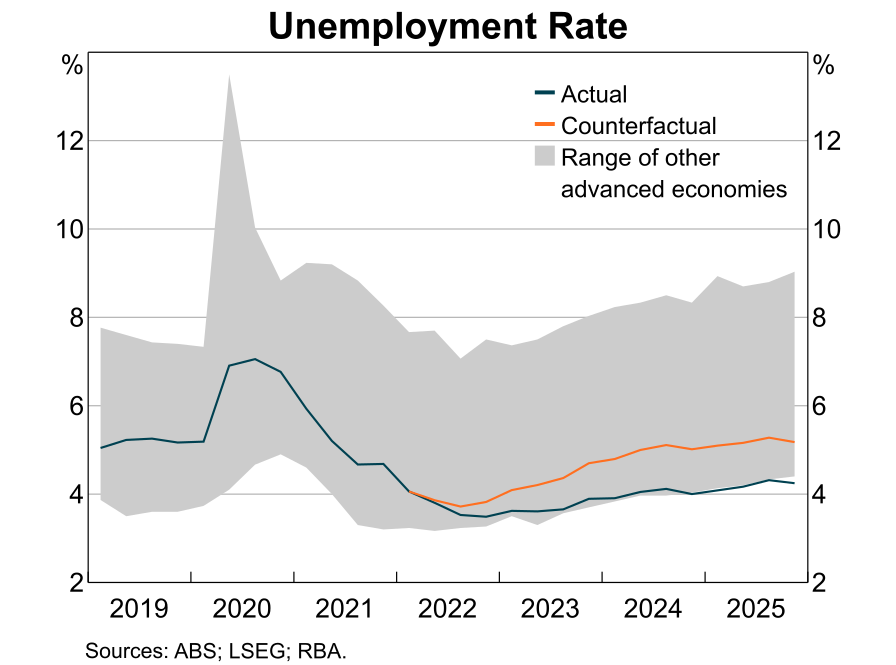
But the more contractionary policy path would have caused higher unemployment (Graph 7).10 We estimate that the counterfactual strategy would have caused unemployment to overshoot the level consistent with full employment in 2023. From then, the labour market would have continued to weaken through 2024 and 2025, peaking at 5.3 per cent in late 2025. This continued weakening after the peak in the counterfactual policy rate reflects the well-known lags in the transmission from monetary policy to economic activity and the labour market and is consistent with the experience of our peer economies that I showed in Graph 3.
When the economy is operating beyond what is sustainable, there is no unique path for policy to rebalance the economy. Most countries enacted substantial stimulus during the pandemic, and all suffered from supply disruptions, yet central banks made different choices in response to the resulting inflation. Some chose to increase policy rates sharply and slow their economy quickly. The RBA Board chose a more gradual increase and more gradual subsequent policy rate decline, while being very mindful that this strategy relies on inflation expectations remaining anchored.
Concluding remarks
Today I have largely focused on how the RBA’s dual mandate shaped its strategy in the years of high inflation immediately following the COVID-19 pandemic. The recent refinements to our mandate did not fundamentally alter how policy is conducted, but they did strengthen our ability to explain why we take the path we do, and the trade-offs faced when making monetary policy decisions.
Endnotes
* I would like to acknowledge and thank Anthony Brassil, Kate Hickie, Callum Ryan and Joyce Tan who substantially contributed to the drafting of this speech. I would also like to acknowledge Meredith Beechey-Osterholm, Tim Taylor, Andrew Hauser and Michele Bullock for their comments on earlier drafts. Any errors and omissions are my own. This speech was finalised on 27 February, prior to the escalation in conflict and instability in the Middle East.
1 With the change in legislation establishing a new Governance Board, the monetary policy decisions previously made by the Reserve Bank Board are now made by the Monetary Policy Board. For simplicity in this speech, I use the term Board to refer to whichever board made monetary policy decisions at that time.
2 See Australian Government (2023), ‘Review of the Reserve Bank of Australia’, March.
3 See The Treasurer and the Monetary Policy Board (2025), Statement on the Conduct of Monetary Policy, July. See Reserve Bank Act 1959.
4 See Lowe P (2023), ‘A Narrow Path’, Address at the Morgan Stanley 5th Australia Summit, Sydney, 7 June; Bullock M (2024), ‘Economic Conditions and the RBA’s Transformation’, Address at the Committee for Economic Development of Australia (CEDA) Annual Dinner, Sydney, 28 November; Bullock M (2025), ‘The RBA’s Dual Mandate – Inflation and Employment’, Anika Foundation Fundraising Lunch, Sydney, 24 July.
5 See Kennedy S (2023), ‘Post Budget Economic Briefing’, Address to the Australian Business Economists, 18 May.
6 Bullock M (2025), ‘Monetary Policy Decision’, Sydney, 18 February.
7 The midpoint of Australia’s inflation target is 2.5 per cent, which is 50 basis points higher than the targets set by many peer central banks. As a result, comparing headline policy rates across countries does not, on its own, provide a meaningful indication of relative monetary restrictiveness. Instead, measures such as the gap between the actual policy rate and estimates of the nominal neutral rate offer a more informative guide to the relative restrictiveness of policy settings across central banks.
8 Given we are assessing a counterfactual path we assume it would have been communicated in a similar way to the actual strategy. We therefore model the counterfactual policy path as partially anticipated by agents in the model: see Appendix A in Mulqueeney M, A Ballantyne and J Hambur (2025), ‘Monetary Policy Transmission through the Lens of the RBA’s Models’, RBA Bulletin, April.
9 We use two models because DINGO explicitly models individual behaviour and how people form expectations of the future, which is important because a clearly communicated counterfactual strategy would change people’s expectations and behaviour. On the other hand, MARTIN better reflects the historical relationships between economic aggregates and their historical persistence. For more details about the Dynamic Intertemporal New-Keynesian General-equilibrium Optimisation (DINGO) model, see Mulqueeney et al, n 8 (2025); Gibbs JJ, J Hambur and G Nodari (2021), ‘Housing and Commodity Investment Booms in a Small Open Economy’, Economic Record, 97(317), pp 212–242; Rees DM, P Smith and J Hall (2016), ‘A Multi-sector Model of the Australian Economy’, Economic Record, 92(298), pp 374–408. For more details about Macroeconomic Relationships for Targeting INflation (MARTIN), see Mulqueeney et al, n 8; Ballantyne A et al, (2020), ‘MARTIN Has Its Place: A Macroeconometric Model of the Australian Economy’, Economic Record, 96(314), pp 225–251.
10 Unemployment is not explicitly modelled in DINGO, but total hours worked is modelled. Here we use a simple estimated equation to determine what the total hours worked path implies for the unemployment rate.
Underlying data
This file contains all underlying data that are available for public release.
Some graphs in this speech were generated using Mathematica.