
Submissions – Payments System Commercial Cash Distribution – Application for Authorisation AA1000729-1
Submission to ACCC
Introduction
The Reserve Bank of Australia (RBA) has prepared this submission to the Australian Competition and Consumer Commission (ACCC) in response to the application for authorisation (AA1000729-1) by the four major banks dated 29 May 2026.1 The major banks have proposed to form a joint venture to establish a single cash pool (the Joint Cash Pool) managed by a new jointly owned incorporated entity (JVCo) (the Proposal).
The RBA remains committed to supporting the Australian Government’s policy objective for cash to remain a viable and low-cost means of payment for as long as Australians want or need to use it. It is in the public interest for cash to be a widely available and accepted means of payment, as part of an inclusive and resilient payments system. This requires a cash distribution system that is sustainable, resilient, efficient and accessible.
The decline in transactional cash use over recent decades has challenged the economics of providing cash services, leading to pressures in the cash distribution system. The system needs to evolve to support adequate access to cash across Australia. Industry collaboration will be important to achieving this objective, and the RBA welcomes industry-led proposals that could contribute to an efficient and affordable cash distribution system.
Over the past few years, banks, cash-in-transit (CIT) providers, major retailers and other industry participants have been engaging in discussions on how to address the challenges in cash distribution under the auspices of ACCC authorisations, including CIT Initiatives and Business Continuity Planning (AA1000680) and CIT Sustainability Measures (AA1000674).
The Proposal is for a cooperative model between the four major banks for wholesale cash distribution. Through JVCo, the four major banks would provide a joint commercial cash facility, replacing the current facility provided by Westpac. The Proposal is consistent with the major banks maintaining their central role in the cash distribution system. The major banks are well placed to fulfil this role, including because they have the large balance sheets needed to purchase banknotes from the RBA and the expertise to manage the associated risks and obligations.
Based on the available information, the RBA sees merit in the Proposal as it should contribute to resilience and efficiency of the cash distribution system. The RBA is supportive of the major banks continuing to play a key role in relation to operational resilience in the cash distribution system under the Proposal. However, it will be important for the Proposal to be implemented in a way that supports the broader public interest, including enabling wholesale cash to be available to other system participants on fair and reasonable terms.
This submission provides the RBA’s perspective based on its responsibility as the sole issuer of Australian banknotes, and on the high priority the RBA places on having a sustainable, resilient, efficient and accessible cash distribution system.
The Cash Environment
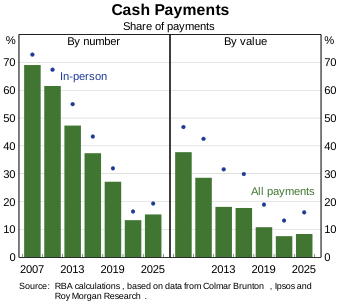
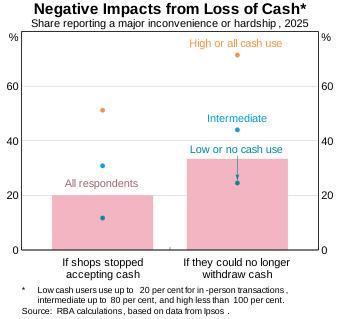
Cash remains important to Australians and supports an inclusive and resilient payments system. Cash use has stabilised in recent years, at around 15 per cent of consumer payments (Graph 1).2 Cash is used by around half of Australians in a typical week and about 1½ million Australians rely mainly on cash to make payments. One-third of Australians would face hardship or major difficulties if they could no longer withdraw cash (Graph 2). Cash also serves as a backup if electronic payments are unavailable and is an important store of value, particularly during periods of economic uncertainty. Cash also supports financial inclusion, including for vulnerable members of the community.
Convenient and affordable access to cash for consumers and businesses requires a sustainable, efficient and accessible cash distribution system which moves banknotes and coins to where they are needed around the country. For consumers to use cash, they first need to obtain it and then have merchants accept it for transactions.3 For businesses to accept cash, they need to be able to withdraw floats and deposit their takings. If access to cash becomes more difficult or expensive, consumers may become less likely to use cash and merchants less likely to accept it. This could create a self-reinforcing downward spiral where the declines in cash use and acceptance further reduce demand for cash. These issues are particularly relevant in regional areas where distances to cash access points are greater and the costs of transporting cash are higher.4
The decline in transactional cash use over recent decades and high fixed costs of cash distribution have placed parts of the cash distribution system under pressure. A combination of industry and government-led solutions will be required to support a sustainable and efficient cash distribution system. The regulations proposed under the Cash Distribution Framework Bill 2026 are intended to address some of these challenges by introducing safeguards to support the ongoing availability of cash in Australia.5
Cash Distribution System
The movement of physical cash from issuers to businesses and consumers involves a number of participants:
- The RBA and the Royal Australian Mint (RAM) issue Australia’s banknotes and coins to meet the community’s demand for cash.
- The major banks purchase banknotes and coins in wholesale quantities from the RBA and RAM and facilitate their distribution across Australia.
- CIT providers carry out the majority of the logistics associated with distributing and processing wholesale cash.
- The major banks supply cash to their branches, and to independent ATM deployers under bailment. Westpac also provides a commercial cash facility to CIT providers, to meet the needs of the CITs’ customers, including non-major banks, large retailers and Australia Post.
- The public then accesses this cash through a diverse range of physical infrastructure, including bank ATMs and branches, retailers, independent ATMs and post offices.
The four major banks play a central role in facilitating access to cash in the community as the sole purchasers of wholesale quantities of cash from the RBA and RAM. They hold this cash at CIT depots around the country and use it to meet the needs of their branch and ATM networks, as well as providing it to independent ATM deployers under bailment. Non-major banks, businesses and Australia Post also rely on the major banks, either directly as retail customers or indirectly through CITs. CITs purchase cash from Westpac’s commercial cash facility to fulfil direct orders from their customers (see ‘Commercial cash’ below).
The major banks are well placed to continue their longstanding central role in the cash distribution system. They are prudentially regulated and have the large balance sheets needed to purchase banknotes from the RBA. The major banks also have the historical experience and expertise to manage the risks and obligations associated with ensuring cash is available for individuals and businesses who need it.
The RBA is responsible for issuing secure and reliable banknotes, which it supplies in wholesale quantities to the major banks to meet the needs of their customers and the broader community. The major banks purchase these banknotes under the Banknote Distribution Framework (BDF) with the RBA.6 Under the BDF, the RBA pays interest compensation on quality-sorted banknote holdings in approved cash depots. This supports cash availability by offsetting some of the costs of funding cash within the wholesale distribution system. In 2024/25, the RBA paid the major banks $119 million in interest compensation, and $15 million in additional quality incentives.
The majority of the logistics of cash distribution, including storage, transport and processing, are undertaken by CIT providers. CIT providers distribute cash on behalf of the major banks, to the banks’ own branches and ATMs and to the broader community via retailers and other banks. These retail and non-major bank customers contract with CITs, which in turn purchase cash through Westpac’s commercial cash facility (see below). The CIT industry has been under pressure in recent years, and in 2023 the ACCC approved a merger between the two largest CIT providers. Despite the merger, the CIT industry remains under pressure.
Commercial cash
Commercial cash describes the provision of cash to the commercial customers of CITs, including non-major banks, large businesses and Australia Post. Under current arrangements, CIT providers obtain this cash from Westpac’s commercial cash facility. Commercial cash allows organisations other than the major banks to obtain cash and, in turn, provide cash services to the public. Australia Post and smaller regional banks are increasingly important cash access points for Australians, particularly in regional areas, because of the closure of major bank branches over recent years. Ongoing access to cash services by businesses is important to maintain the viability of cash by enabling businesses to access sufficient cash floats to meet the needs of customers who wish to pay in cash and for the collection of cash takings.
Accordingly, a reliable, long-term and industry-led solution for the provision of commercial cash is a key element of a more sustainable model of cash distribution. Under current arrangements, Westpac is the sole provider of the commercial cash facility to CIT providers but has indicated that it is unwilling to continue in this role as the sole provider.
The Application
The RBA welcomes industry initiatives aimed at supporting a more efficient and sustainable cash distribution system. A cooperative model for wholesale cash distribution could also promote shared responsibility for operational and other risks and enable cash services to be provided more efficiently.
Under the Proposal:
- The major banks would combine their existing cash pools to form the Joint Cash Pool, in which each of the four major banks would have equal interest (at inception). A new incorporated operating entity (JVCo) would hold (as bailee) and manage the Joint Cash Pool for the major banks (as bailors). JVCo would be owned in equal shares by the major banks, with the intention of recovering JVCo’s costs without recurring shareholder funding.
- The major banks would exclusively purchase banknotes and coins from the RBA and RAM under agreements revised to reflect the Joint Cash Pool and the joint bailment structure. Operational activities, such as coordinating the purchase of banknotes and coins, would be subcontracted to JVCo.
- The major banks would be customers of JVCo for cash required for their own branches and ATMs, as well as for the banknotes they supply under bailment to independent ATM deployers.
- JVCo would supply banknotes and coins from the Joint Cash Pool to CIT providers, replacing Westpac’s commercial cash facility. CIT providers would continue to supply commercial cash services to their business customers, including other banks, retailers and Australia Post.
The Proposal is consistent with the major banks maintaining their central role in wholesale cash distribution and providing cash services to the community. It has potential to help move the cash distribution system towards a more sustainable longer term model, if it manages risks and delivers efficiencies for the system as a whole.
Realising the public benefits of the Proposal will depend on how it is implemented, including: the fees charged for JVCo’s services and access to the Joint Cash Pool; how efficiency gains for the major banks contribute to the broader cash system; and how operational risks to cash distribution are managed. Experiences in peer economies suggest that cooperative cash distribution arrangements can support efficiencies, but clear alignment with the public interest is needed to mitigate potential risks to cash access (see Appendix).
As noted above, the major banks have proposed to purchase banknotes and coins exclusively via JVCo. This approach recognises that the benefits of the arrangement could be diminished if banks were to operate outside it. However, an implication is that individual banks would not be able to purchase banknotes directly from the RBA, which could have implications for system resilience in the event of operational disruptions at JVCo. This arrangement could be enhanced by updating BDF arrangements for the RBA to sell banknotes to one or more of the major banks individually in the event of disruption to JVCo. This would provide operational assurance for the RBA that it could issue sufficient quantities of banknotes to meet public demand in a range of scenarios.
Fair and reasonable access to wholesale cash
It will be important for wholesale cash to be provided to industry participants on fair and reasonable terms which support adequate access to cash at low or no cost for end users of cash. It is difficult to assess the impact of JVCo on pricing as the price and non-price terms for JVCo’s services are not detailed in the Proposal. The RBA notes that the major banks have proposed that JVCo will be self-sustaining without requiring recurring shareholder funding. This could have implications for pricing of the services JVCo provides to the major banks, distributors of commercial cash (including CITs) and the supply of the Joint Cash Pool to JVCo.
The structure underpinning this Proposal maintains the major banks’ role at the centre of wholesale cash distribution as they will be the JVCo’s sole shareholders, its largest customers, and its largest supplier (by providing the Joint Cash Pool under bailment). This structure has potential to support more efficient wholesale cash distribution arrangements for the major banks, including by consolidating their cash holdings, operating joint infrastructure and administrative arrangements. However, it is important that the pricing of JVCo’s services does not unduly affect the cost and/or availability of cash for other participants in the cash ecosystem, their customers (including smaller banks, Australia Post and large retailers) and end users of cash.
Resilience of the cash distribution system
Implementation of the Proposal should have regard to supporting the resilience of the wholesale cash distribution system. A resilient wholesale cash distribution system is robust to disruptions and is able to supply banknotes and coins to businesses and consumers despite external shocks.
In this regard, operational risk is a key consideration in the proposed structure. Under the Proposal, the entity responsible for facilitating wholesale cash distribution will transition from the major banks to JVCo, which is a new entity that would not be subject to the same prudential and reporting standards as the major banks. The RBA’s view is that the major banks should continue to be responsible for managing operational risk of the JVCo, to support operational resilience of the cash distribution system as a whole. Key considerations will include suitable frameworks for managing risks from third-party suppliers of important services, and appropriate business continuity arrangements.
Amendments to the Banknote Distribution Framework
The Proposal requires amendments to the RBA’s Banknote Distribution Framework (BDF), which is the legal framework that underpins banknote transactions between the RBA and the major banks as BDF participants. The BDF sets the conditions for the supply of wholesale banknotes and supports the effective functioning of the cash distribution system, including meeting demand, maintaining banknote quality and managing operational risks. The RBA anticipates discussing the proposed BDF arrangements with the broader industry, including approved cash centre operators (CIT providers that are authorised to transport banknotes to and from the RBA) in coming months.
The RBA will continue to work closely with the major banks to support the development of a wholesale distribution model that promotes a resilient, efficient and sustainable cash system. If the Proposal is authorised, the RBA will work with the major banks to finalise and support the implementation of these new BDF arrangements.
Conclusion
In the context of an evolving cash ecosystem, it is important that cash industry participants work collaboratively to support a sustainable, resilient, efficient and accessible cash system that operates in the public interest. In this context, the RBA in principle supports the Proposal. It has the potential to help move the cash distribution system towards a more sustainable footing. However, the public benefits of the Proposal will depend on the details of how it is implemented. The new arrangements should provide services on fair and reasonable terms that facilitate adequate access to cash at low or no cost to consumers and end users of cash. And JVCo should be robust to operational risks. The Proposal will need to take account of the needs of a range of stakeholders in the cash ecosystem.
Reserve Bank of Australia
25 June 2026
Appendix: International Examples of Industry Cooperative Models of Cash Distribution
Other advanced economies are facing similar challenges to cash distribution as Australia; declining transactional cash use has reduced the volume of cash transported and processed by CITs and increased financial pressures across the industry. One more comprehensive response considered by the banking sector in some countries is a private utility model – where the largest banks form a single consolidated entity to carry out cash distribution functions. Although cash distribution utilities can support efficiency in cash distribution, a lesson from overseas is that alignment with the broader public interest is important to mitigate potential risks to cash access.
The largest banks in Sweden and the Netherlands have operated shared utility models for cash distribution since the early 2010s.7 Bankomat (formerly BDB) is jointly owned by the largest five Swedish banks, and Geldmaat (formerly Geldservice) is owned by the largest three banks in the Dutch banking system. In both countries, the utility initially oversaw wholesale cash distribution activities, including cash storage and processing. Forming joint entities supported efficiencies in cash distribution through depot consolidation, optimisation of cash logistics and reductions in overall costs. These benefits were considered by regulators in both countries to outweigh competition concerns.8
Utilities in Sweden and the Netherlands have expanded into retail cash distribution, including the provision and servicing of ATM networks. This expansion has contributed to consolidation of cash access points and a broad reliance on ATMs rather than branches to provide cash access. These changes have delivered efficiencies, and shared ATM networks can benefit consumers by providing low-cost or fee-free access to cash. However, it has also been observed in Sweden and the Netherlands that these changes reduced cash accessibility for consumers and made it more difficult for businesses to deposit daily cash takings, which reduced their ability to accept cash. In mid-2025, Bankomat also launched its own CIT. However, Bankomat’s CIT faced major issues that significantly reduced the availability of cash for several months.9 Dutch authorities – including De Nederlandsche Bank (DNB) – have also linked the establishment of Geldmaat with significant reductions in ATM networks, and stronger incentives for participating banks to discourage the use of cash.10 In both jurisdictions, the public sector is considering placing stronger obligations on banks to maintain adequate access to cash services.11
Endnotes
Australia and New Zealand Banking Group Limited (ANZ), Commonwealth Bank of Australia (CBA), National Australia Bank Limited and National Australia Investment Capital Pty Ltd (NAB), and Westpac Banking Corporation (Westpac).1
MacGibbon K, M Royters and F Wang (2026), ‘Cash Use in Australia: What the 2025 Consumer Payments Survey Tells Us’, RBA Bulletin, April. 2
Guttmann R, T Livermore and Z Zhang (2023), ‘The Cash-use Cycle in Australia’, RBA Bulletin, March. 3
Faferko A, G Rylah and F Wang (2025), ‘Access to Cash in Australia’, RBA Bulletin, January; RBA (Reserve Bank of Australia) (2026), ‘Australian Banking Association – Application for Authorisation AA1000722-1’, Submission to the Australian Competition and Consumer Commission, May. 4
For further context, see CFR (Council of Financial Regulators) and ACCC (Australian Competition and Consumer Commission) (2026), ‘Regulating Cash Distribution in Australia’, Conclusions Paper, April. 5
The Banknote Distribution Framework replaced bilateral contractual arrangements with each of the four major banks in 2024, following the Reserve Bank’s 2021 Review of Banknote Distribution Arrangements: RBA (2022), ‘Review of Banknote Distribution Arrangements: Conclusions Paper’, August. 6
Sveriges Riksbank (2025), ‘The Flow of Cash’, 19 December, available at <https://www.riksbank.se/en-gb/payments--cash/how-payments-work/the-flows-of-cash/>; ABN AMRO (2017), ‘Partnership Joint ATM Network’, News Article, 14 November. 7
For relevant decisions in the Netherlands, see: ACM (2014), ‘Objection of Brink’s Against Geldservice Nederland Turned Down’, 12 June. For the Swedish context, see: Sveriges Riksbank (2010), ‘Follow-up of the New Depot Structure for Cash Management’, April. 8
Sveriges Riksbank (2026), ‘Continued Challenges for Cash’, Payments Report 2026; Sveriges Riksbank (2024a), ‘Cash Infrastructure Is Vulnerable to Market Changes’, Payments Report 2024; Sveriges Riksbank (2024b), ‘Åtgärder för att Upprätthålla Kontantkedjan’ [Swedish], submission to the Ministry of Finance inquiry, 3 September. 9
DNB (De Nederlandsche Bank) (2020), ‘The Role and Future of Cash’, DNB Occasional Studies, Vol 18 No 2; PwC Strategy& (2023), ‘Future Market Design of the Dutch Cash Cycle: Summary of the Report’, report prepared for DNB and the Ministry of Finance, February. 10
Sveriges Riksbank (2025), ‘Introduce Obligation to Accept Cash and Strengthen Banks’ Responsibility for Cash’, Press Release, 19 May; Tweede Kamer der Staten-Generaal (2025), ‘Memorie van Toelichting’ [Dutch], Parliamentary Paper 36 711 No 3, Wet Chartaal Betalingsverkeer, 25 March. 11