
Submissions – Payments System Australian Banking Association – Application for Authorisation AA1000722-1
Submission to ACCC
Introduction
The Reserve Bank of Australia (RBA) has prepared this submission to the Australian Competition and Consumer Commission (ACCC) in relation to the Australian Banking Association’s (ABA) application for authorisation (AA1000722-1) dated 20 April 2026. The ABA is making the application on behalf of its Member Banks and other industry participants to commence a Regional ATM Trial (the Trial) for a period of five years.
There is a need for the cash system to evolve so that cash remains a viable payment method for as long as Australians want or need to use it. The RBA welcomes consideration of initiatives to support cash access for Australians, particularly in regional and remote areas. The availability of withdrawal and deposit services in regional areas is critical to ensuring cash is a useable and accessible payment method for regional communities, which is in the public interest.
This submission provides the RBA’s perspective based on its responsibility as the sole issuer of banknotes in Australia and the high priority that the RBA places on the community continuing to have reasonable access to cash withdrawal and deposit services. The RBA has also agreed to be an observer on the Regional ATM Trial Coordination Committee.
Cash Use and Access
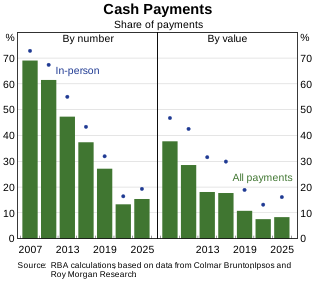
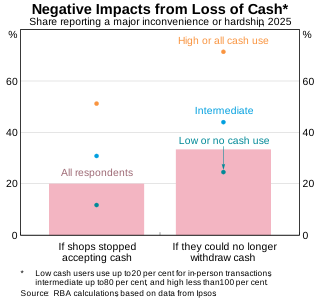
Cash remains an important part of an inclusive and resilient payment system. Results from the 2025 Consumer Payments Survey show that the use of cash for transactions has stabilised in recent years, at around 15 per cent of consumer payments (Graph 1)1. Cash is used by around half of Australians in a typical week and about 1½ million Australians rely mainly on cash to make payments. The Consumer Payments Survey suggests one-third of Australians would face hardship or major difficulties if they could no longer withdraw cash (Graph 2). Australians living in regional areas use cash only a bit more frequently than those living in capital cities, but their access to cash is more vulnerable to further withdrawal of cash services.
Lower transactional cash use than in the past has placed pressure on the economics of providing cash services. The challenges of cash distribution are particularly pronounced in regional and remote Australia, where per-unit transport costs are higher. In the RBA’s 2025 Consumer Payments Survey, respondents generally considered cash access to be convenient, but consumers’ perceptions of convenience have declined over time. Other survey data suggest that merchants’ perceptions of convenience have also declined; for example, more than two-thirds of cash-accepting merchants surveyed by RFI Global reported challenges accepting cash in 2025, including because it was difficult to withdraw cash for floats and deposit their takings.
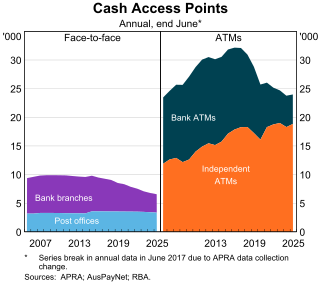
The number of cash access points has been declining for some time (Graph 3). The number of ATMs has fallen by around one-quarter since the peak in 2016, driven by a decline in bank-owned ATMs. Over the same period, the number of independent ATMs has increased substantially, partly because of some banks selling their off-branch ATM fleets to independent ATM deployers. Independent ATMs accounted for around 80 per cent of ATMs in Australia in 2025. These ATMs are less likely than bank-owned ATMs to offer deposit and coin functionality, and they generally charge a fee, while bank-owned ATMs are typically fee-free even to non-customers.2
RBA research shows that most Australians live reasonably close to cash withdrawal services and that the average distance to access cash has been little changed over recent years.3 However, the average distance to reach bank-owned service points – which are more likely to provide cash services that are fee-free and have deposit-taking capabilities – has increased moderately as the number of access points has declined.
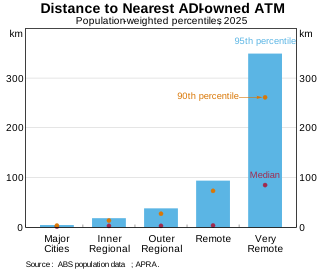
In 2019, 95 per cent of Australians lived within 9 km of a bank-owned ATM; such ATMs generally permit free withdrawals by customers of other financial institutions. This distance had increased to around 12 km by 2025 (Graph 4). Access is more difficult for Australians in regional and particularly remote communities. For Australians in inner regional areas, 95 per cent lived within 18 km of a bank-owned ATM, and residents in outer regional areas of Australia must travel significantly further, up to 38 km. This distance increases markedly for those living in remote and very remote areas, up to 94 km and 349 km respectively.
The number of bank branches has also fallen by around half since 2011. Since 2017, over one-third of these closures have been in regional and remote Australia. The closure of face-to-face cash access points, particularly in regional and remote areas, disproportionately affects people who rely on in-person services to withdraw or deposit cash, as well as businesses that require over-the-counter banking services. Face-to-face banking generally provides a broader range of cash (and other financial) services than ATMs (though ATMs can facilitate access to cash outside branch opening hours). These include higher deposit and withdrawal limits, the ability to access coins and change for businesses, and better accessibility for older Australians or those with disabilities (who may have more difficulty navigating ATMs and online banking services).
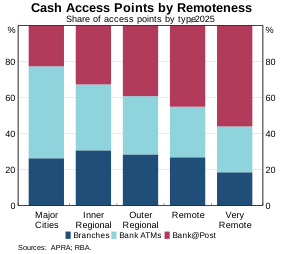
Of those communities in regional and remote Australia that still have a face-to-face access point, around one-fifth have only one location remaining. This makes these communities particularly vulnerable to further closures. In most of these cases, the last face-to-face cash access point is a Bank@Post outlet (Graph 5). Bank@Post plays an important role in facilitating cash access in regional and remote Australia, but the cash services provided by these outlets may not be commensurate with those offered by a bank branch – for example, because of limits on cash deposits and withdrawals.
International Experience
The ABA’s submission refers to collaborative efforts by the banking sector in other countries to establish multi-bank ATM networks. These networks can benefit consumers by providing low-cost or fee-free access to cash in these jurisdictions, and by creating efficiencies that contribute to the long-term sustainability of the cash ecosystem.
However, to realise the benefits of shared ATM networks, it is important that they are implemented with careful consideration of public interest objectives. International experience suggests that, if not well managed, shared ATM networks can lead to a consolidation of ATM and other cash-related services.4 Such an outcome could reduce access to cash within the community, particularly in rural or isolated areas. Consolidation can also pose a risk to system resilience, because there are fewer alternative operators in the case of a system outage, and because there are fewer alternative access points (particularly in the regions) in the case of a localised outage.
The Application
In view of the challenges facing the cash system, there is a need for operating models to evolve to support the future viability of cash in the public interest.5 In this context, the RBA welcomes proposals aimed at supporting the sustainability of cash distribution and the availability of cash as a payment method.
The Trial would see 20 ATMs installed or converted in regional and remote areas, and withdrawal services would be fee-free to all holders of an Australian-issued card. According to the application, all proposed locations are 10 km or more from the nearest alternative branch or ATM of a participating ABA Member Bank. No ATMs will be removed as part of the five-year Trial. At around half of the locations, the ABA intends to include deposit functionality, although this is subject to operational considerations including systems interoperability and the upgrade of ATM infrastructure. Fee-free deposit services would only be available to customers of participating banks. There are no plans to introduce coin deposit or withdrawal functionality at any Trial site.
Based on the available information, the RBA supports the ABA’s Regional ATM Trial in principle. It is important that participants across the cash ecosystem work collaboratively to facilitate good cash access for all Australians and the provision of high-quality banknotes. The RBA notes several considerations relevant to this proposal below.
Features of good access to cash
The RBA notes that the public benefit generated by the Trial will depend partly on the Trial ATM locations. The challenges of cash access are particularly pronounced in more remote areas. As noted in Graph 4 above, residents in outer regional and remote areas of Australia must travel substantially further to their nearest ATM compared with those living in inner regional or metropolitan areas. The public benefit will also depend in part on the distance from trial locations to existing access points, including the branches of non-ABA members and independent ATM operators.
The RBA notes the decision to trial multi-bank deposit capabilities at approximately 10 ATMs. The availability of deposit services is crucial to support cash access, use and acceptance, particularly because businesses need to be able to deposit and withdraw larger amounts of both banknotes and coins.6 Deposit services have become scarcer over the past decade and are viewed as less accessible than withdrawal services by the public.7 The RBA encourages trialling multi-bank deposit capabilities at as many locations as is practicable and encourages Trial participants to consider how these services can meet the needs of retailers and other local businesses across all locations.
Fee-free ATMs are one way to improve cash access in regional and remote Australian communities. Other current initiatives include a moratorium on regional branch closures by the major banks and the provision of fee-free ATM services to remote Indigenous communities. Since 2012, the latter program has played a role in supporting equitable cash access for people living in traditionally underserved communities. Such programs are important elements of an inclusive cash distribution system that serves all Australians.
However, ATMs do not fully address the diverse range of cash needs in the community, particularly for businesses and more vulnerable Australians. The banking sector should continue to consider how to support good cash access and availability for all consumers and businesses.
Quality considerations
Banknote quality is important to maintaining trust in cash as a payment method. High-quality banknotes can be readily authenticated to minimise counterfeiting risk (secure) and are reliable for people and businesses to use for transactions, and in machines, without issue. As such, evaluating the potential implications for banknote quality, including from cash recycling in deposit-taking ATMs, will be an important part of assessing the public benefit of the Trial.
Implications of the Trial for managing banknote quality are uncertain. It is possible that increasing the frequency with which banknotes circulate through ATMs may raise the likelihood that poor-quality banknotes are identified when deposited at the ATMs. This would facilitate the withdrawal of these banknotes from circulation. If people face lower costs of withdrawing and depositing banknotes in Trial locations, the frequency of ATM use may increase.
Alternatively, increased cash recycling in Trial locations could contribute to a deterioration in banknote quality if banknotes circulate in the community for longer without going back through an approved cash depot where fitness sorting takes place in line with RBA standards. If the Trial is authorised, the RBA is prepared to support the ABA in assessing banknote quality and the implications of the Trial for the security and reliability of banknotes in regional and remote areas through its role as an observer on the Coordination Committee.
Evaluation and reporting
The application notes that the Trial will inform the feasibility of a broader multi-bank model. Implementing suitable evaluation methods and reporting requirements will be essential to understanding the potential feasibility and public benefit of such a model. Evaluation plans should set out the Trial objectives and intended outcomes, with clear criteria for measuring success. It will be important to consider the broader public interest and needs of the community when evaluating the Trial. Timely reporting during the five-year trial period would support identification and early resolution of any issues as they arise, including in relation to trial design and any unintended consequences.
Concluding remarks
The RBA supports consideration of initiatives to support cash access, and on this basis is supportive of the proposed Trial. In the context of an evolving cash ecosystem, it is important that cash industry participants work to support all Australians having good access to cash. A particular focus should be on regional and remote communities, which face the largest obstacles to accessing cash, and where the distribution of cash faces the most significant challenges. A robust approach to evaluation and reporting on the Trial will be needed to assess the extent to which the initiative is succeeding in meeting these objectives.
Consideration of future models for cash distribution and access should include the needs of business customers, including withdrawal and deposit services for both banknotes and coins. Collaborative approaches are likely to be required given the challenging economics of providing cash services.
Reserve Bank of Australia
18 May 2026
Endnotes
MacGibbon K, M Royters and F Wang (2026), ‘Cash Use in Australia: What the 2025 Consumer Payments Survey Tells Us’, RBA Bulletin, April. 1
As laid out in ABA (Australian Banking Association) (n.d.), ‘ATMs That Are Free to Use: An Easy Read Guide’. 2
Faferko A, G Rylah and F Wang (2025), ‘Access to Cash in Australia’, RBA Bulletin, January. 3
For international context, see, for example, Sveriges Riksbank (2026), ‘Access to cash services needs to be improved’, Payments Report 2026; De Nederlandsche Bank (2023), ‘The role and future of cash’; Belgian Competition Authority (2025), ‘Q&A – Batopin’; and Panjwani A, L Booth and F Masala (2026), ‘Access to cash and banking services’, House of Commons Library Research Briefing, 16 March.4
Bullock M (2025), ‘Building Bridges in the Digital Economy: Modernising Australia’s Payments System’, Bradfield Oration, The Daily Telegraph’s Future Sydney, Sydney Opera House, 24 October. 5
Guttmann R, T Livermore and Z Zhang (2023), ‘The Cash-use Cycle in Australia’, RBA Bulletin, March. 6
Livermore T, J Mulqueeney, T Nguyen and B Watson (2023), ‘The Evolution of Consumer Payments in Australia: Results from the 2022 Consumer Payments Survey’, RBA Research Discussion Paper No 2023-08. 7