
Submissions – Payments System Australian Banking Association – Application for Authorisation AA1000746-1
Submission to ACCC
Introduction
The Reserve Bank of Australia (RBA) has prepared this submission to the Australian Competition and Consumer Commission (ACCC) in relation to the Australian Banking Association’s (ABA) application for authorisation (AA1000746-1) dated 2 October 2026. The ABA has made the application on behalf of itself, its member banks and other stakeholders to seek authorisation to exchange information, assess feasibility and reach agreement on potential industry solutions to support long-term access to regional banking services, including cash access. Solutions being considered include: voluntary regional service commitments; regional banking hubs and joint cash access points; and a shared funding model for these initiatives. The proposed conduct also includes a trial of up to 10 regional banking hubs, which may include joint cash access points.
This submission provides the RBA’s perspective based on its responsibility as the issuer of Australian banknotes and the high priority it places on the community having reasonable access to cash withdrawal and deposit services. Accordingly, it focuses on elements of the application relating to cash access, rather than broader banking services.
The RBA remains committed to supporting the Australian Government’s objective that cash remains available for as long as Australians want or need to use it. The decline in transactional cash use over recent decades has challenged the economics of providing cash services, given their high fixed costs. The cash system therefore needs to evolve, and industry collaboration will be important to support the ongoing availability of cash for Australian consumers and businesses. The RBA welcomes industry initiatives aimed at supporting access to cash, particularly in regional and remote Australia. The availability of cash withdrawal and deposit services, including face-to-face options, is critical to maintaining cash as a useable and accessible payment option for regional communities, including for people who may not have alternative means of payment.
The RBA supports the application on this basis, because it would enable cash industry stakeholders to design, test and evaluate potential solutions to support access to cash in regional Australia. It will be important that any industry proposals arising from the proposed conduct consider how they could be implemented in a way that supports the public interest. This would include providing adequate access to cash for consumers and businesses at low or no fees and responding to the particular needs of various regional communities. In addition, any transition to new service models should be carefully managed so that cash access does not deteriorate while alternative arrangements are being developed.
Cash use and access
Cash is an important part of an inclusive and resilient payments system. Transactional cash use has declined over the past couple of decades but has stabilised in recent years, at around 15 per cent of consumer payments.1 Around half of Australians use cash in a typical week and one third of Australians report that they would face hardship or major difficulties if cash was difficult to access. Around 1½ million Australians still primarily rely on cash to participate in the economy, including more vulnerable members of society. Cash also serves as a backup if electronic payments are unavailable, and it is an important store of value, particularly during periods of economic uncertainty.
Cash use, cash access and cash acceptance are linked via the ‘cash-use cycle’, whereby a decline in one can weaken the others.2 For consumers to use cash, they first need to obtain it and then have merchants accept it for transactions. For businesses to accept cash, they need to be able to withdraw cash to use as change and deposit cash they receive from customers. Businesses may also be less likely to accept cash if fewer customers use it, which can further reduce consumers’ opportunities to pay with cash.
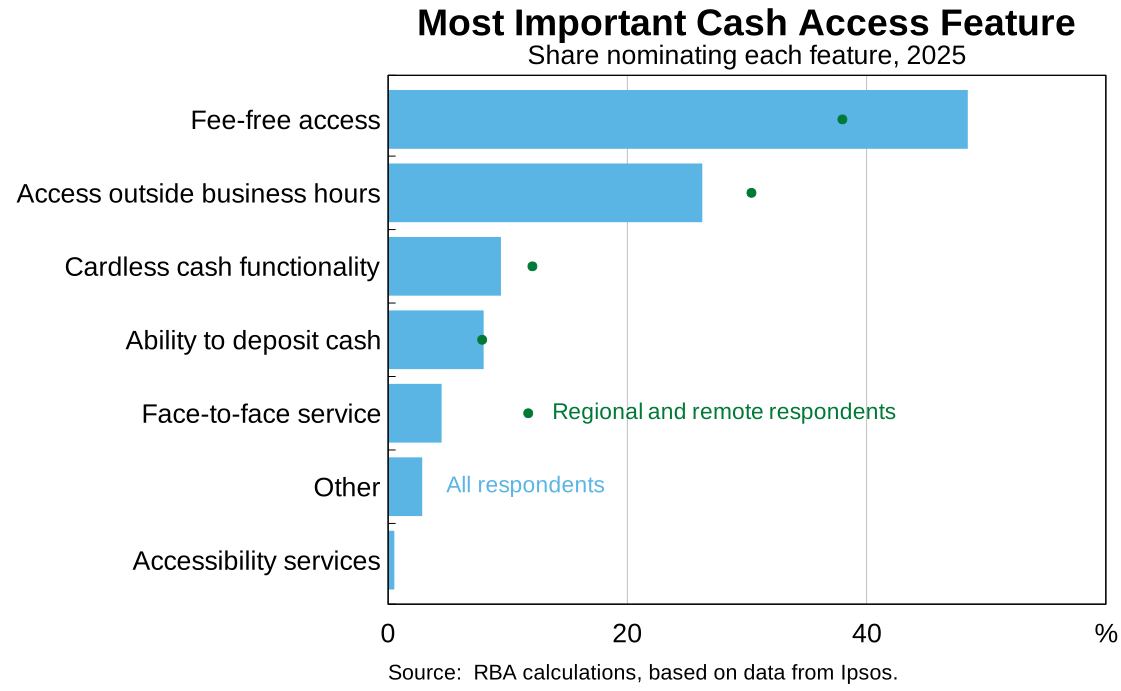
The ease with which consumers and businesses can access cash depends on the features provided by cash access points. According to the 2025 Consumer Payments Survey, the most important features for cash access were no fees and access outside business hours (Graph 1). While the features valued by respondents were broadly similar across metropolitan and regional areas, respondents living in regional areas were more likely to cite face-to-face services as the most important feature of a cash access point. The services and features of cash access points vary by channel; a mix of services is likely required to support cash access in different communities (Table 1). For example, ATMs generally provide services outside of business hours, whereas bank branches enable face-to-face transactions within normal business hours.
| Access Channel | Fee-free | Outside Business Hours | Without Physical Card | Face to face | Withdrawal(a) | Deposit(a) |
|---|---|---|---|---|---|---|
| Bank-owned ATM | ~ | ~ | ||||
| Independent ATM(b) | ~ | ~ | ||||
| Bank branch(c) | ||||||
| Bank@Post(c) | ||||||
| Retail cash-out | ~ | ~ | ~ | |||
|
- generally available; - generally unavailable; ~ - sometimes available Sources: ATM deployers, Australia Post, bank and retailer websites, RBA. |
||||||
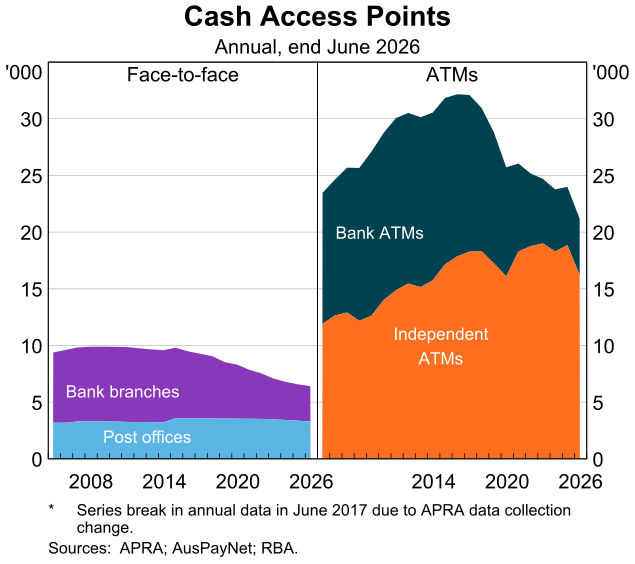
The number of cash access points has decreased substantially in Australia since the mid-2010s (Graph 2). The number of ATMs has declined by a quarter since 2017, driven by a decline in bank-owned ATMs. The number of bank branches has fallen by almost half since 2017 and one third of these closures have been in regional and remote Australia. The number of communities without bank branches has increased, which disproportionately affects people who rely on in-person branch support to withdraw or deposit cash, as well as businesses that require over-the-counter branch cash services. Meanwhile, the number of Bank@Post outlets has been broadly stable, partially substituting for branch services.
Although consumers and businesses can generally switch to alternative cash access points when branch services close, these cash access points may not necessarily provide a similar range of services. Survey evidence suggests that bank branches provide features that many Australians find important, including face-to-face service, higher deposit and withdrawal limits, access to coins and change for businesses, cardless access to cash, and they are typically fee-free. Face-to-face services also support accessibility for some members of the community who may have difficulty using ATMs and/or online banking services. The major banks have had a moratorium on closing bank branches in regional Australia since at least 2025.
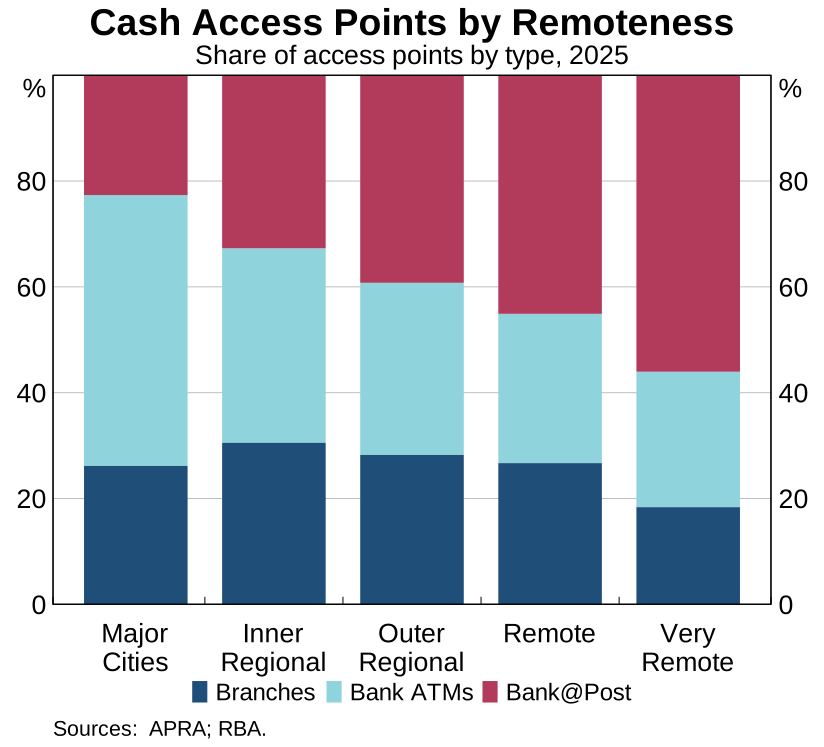
Most Australians live reasonably close to cash services, but regional and remote areas are vulnerable to further removal of cash access points. In 2026, 95 per cent of Australians in major cities lived within 4½ km of a bank-owned cash access point, while 95 per cent of residents in regional and remote areas lived within 29 km. The distance to reach bank-owned cash services for residents in regional and remote areas has increased over time and by more than for those living in major cities.3 Of the communities in regional and remote Australia that still have a face-to-face access point, around one-fifth have only one location remaining. In most cases, the last face-to-face cash access point is a Bank@Post outlet (Graph 3). Bank@Post plays an important role in facilitating cash access in regional and remote Australia, but the cash services provided by these outlets may not be commensurate with those offered by a bank branch – for example, because of limits on cash deposits and withdrawals.
Further removal of cash access infrastructure risks creating self-reinforcing downward momentum in cash use, acceptance and access that could potentially threaten the viability of cash as a payment method. If cash becomes more difficult or expensive to access, consumers may become less able to use cash and merchants less likely to accept it. These issues are particularly relevant in regional areas where end-users need to travel further than in metropolitan areas to the next closest cash access point if their most convenient point closes.
The application
In view of the challenges facing the cash system, there is a need for operating models to evolve to support the future viability of cash as a payment method in the public interest. In this context, the RBA welcomes consideration of industry proposals aimed at supporting the availability of cash across Australia.
The ABA has proposed to investigate the feasibility of measures to assist long-term access to regional banking services. The measures being considered are:
- Voluntary regional service commitments for access to cash and face-to-face banking services in regional communities. The ABA is seeking authorisation for banks to discuss, exchange information and reach agreement – but not implement – regional service commitments.
- Regional banking hubs trial to enable participating banks to provide their own banking services through shared physical infrastructure. The ABA proposes to undertake a trial of up to 10 regional banking hubs in communities located at least 20 km from the nearest bank branch. Participation would be open to all ADIs, including non-ABA members.
- Joint cash access points trial to provide cash withdrawal, inquiry and deposit services in some trial regional banking hubs. The joint cash access points may include shared ATM infrastructure and facilities for coin deposit, exchange and recycling.
- Shared funding models for the above initiatives. The ABA proposes to implement the shared funding model for the trials. It also proposes to discuss funding models for the regional service commitments and a potential future rollout of the trial models on a permanent basis.
Depending on the outcome of discussions regarding potential regional service commitments and the results of the banking hubs and joint cash access points trial, the ABA noted it would expect to apply for further authorisation in 2027 and/or 2028.
Based on the available information, the RBA supports the ABA’s application. The RBA considers there is a public benefit to participants across the cash ecosystem working collaboratively on initiatives to facilitate good cash access for all Australians. The proposed conduct complements the ABA’s regional trial of multi-bank ATMs which is also exploring ways to support regional cash access.4
The public benefits of any initiatives that arise from the proposed conduct will depend on their design and implementation. The initiatives should be designed to support adequate access to cash for consumers and businesses at low or no cost, taking into account the differing cash access needs across regional and remote communities and end-users of cash. Initiatives should also consider their interaction with the broader cash ecosystem, including maintaining banknote quality and contributing to a sustainable cash distribution system.
The RBA is listed in the ABA’s application as one of the parties that would be authorised to participate in discussions regarding the proposed conduct. The RBA welcomes consultation on the initiatives where they relate to cash access, cash distribution and banknote quality, consistent with our role as issuer of Australian banknotes.
Joint cash access points trial
The RBA supports the inclusion of joint cash access points as part of the trial of regional banking hubs. It would be beneficial to trial joint cash access points at several regional banking hubs, to evaluate potential benefits for regional communities that may have diverse needs.
The RBA notes the following considerations in relation to the design of the joint cash access points:
- Diverse needs of end-users of cash. The design of the joint cash access points should reflect the needs of end-users of cash, which includes consumers and businesses. Cash access needs and preferences vary across regional and remote communities, based on factors such as demographics, accessibility needs, the level of cash use, the reasons for accessing cash (for example, transactional or other purposes), and when and where cash is needed. The trial should test a range of service models for cash access, recognising that a mix of services may be needed to meet the differing needs of end-users. And the trial should consider how the joint cash access points operate together with other cash access points – such as bank branches, bank-owned and independent ATMs and Bank@Post – to support the availability of cash overall.
- Local cash recycling. The trial should consider how the design and operation of joint cash access points could facilitate recirculating banknotes and coins deposited by businesses and consumers within local communities. More local recycling has the potential to improve the efficiency of cash distribution by reducing the distance and frequency of cash movements, lowering transportation costs and helping to maintain the availability of cash in regional communities.
-
Banknote quality. Maintaining banknote quality supports cash as a payment method because high-quality banknotes can be readily authenticated to minimise counterfeiting risks and are reliable for consumers and businesses to use for transactions (and in machines). Poor-quality banknotes may affect efficiency in the cash ecosystem, for example by causing jams in ATMs.
The trial should consider potential implications for the quality of banknotes in regional communities. This could include assessing the ability of the cash infrastructure (such as deposit-taking ATMs) to identify and remove poor-quality banknotes before they are returned to circulation. Potential implications of local recycling for banknote quality in trial locations should also be evaluated; if banknotes circulate in the community for longer without going back to cash depots, banknote quality could deteriorate. The RBA is prepared to support the ABA in assessing banknote quality and the implications of the banking hub trial for the security and reliability of banknotes.
- Coins. To accept cash, businesses need the ability to withdraw and deposit coins so they can provide change. Although coins account for only a small share of the value of cash in circulation, convenient and affordable access to coins is essential for cash to be a viable payment method, especially for small purchases. The trial should test approaches to providing coin services in regional communities efficiently and sustainably.
- Integration with the cash system. The trials should consider the broader cash ecosystem, including how banknotes and coins will be transported to and from these sites.
-
Transition to future service models. The ABA and the banking industry should consider how access to cash will be maintained during any transition to new service models. The RBA acknowledges the regional branch closure moratoriums put in place by NAB until mid-2027, and ANZ, Commonwealth Bank and Westpac until late 2030.
The regional service commitments will take time to develop, and the trials will take time to implement and evaluate. Further declines in the number of branches and ATMs during this time would make it harder for consumers to use cash, and for businesses to accept it. This is particularly relevant for regional and remote communities, which are vulnerable to further closures in cash access points, particularly face-to-face services. It may also leave communities more reliant on alternative cash access points, such as Bank@Post, which may not provide the same range of cash services as a bank branch.
Trial evaluation
The ABA notes in its application that the outcomes of the trial of banking hubs and joint cash access points will inform whether they are rolled out more broadly, subject to further ACCC authorisation. Given the potential for the trial to shape the future delivery of banking and cash services in Australia, robust evaluation and reporting will be essential to assess the public and private benefits of the trial. Evaluation plans should be developed before the trial commences, setting out clear objectives, success criteria and methods for assessing outcomes. The evaluation should consider the extent to which the trials:
- support adequate access to cash in regional and remote communities
- improve access to cash in underserved communities
- meet the needs of customers, businesses and communities
- provide evidence on the scalability and long-term viability of the model to support cash access
- support cost-effectiveness of cash distribution to local communities
- identify any unintended consequences.
International experience
Banking hubs and joint cash access points have been implemented or trialled in some other countries, including the United Kingdom and New Zealand. Lessons from these initiatives could inform design and evaluation of trials in Australia.
In the United Kingdom, Cash Access UK has established around 250 banking hubs which are operated by the Post Office.5 These hubs provide face-to-face cash withdrawal and deposit services for consumers and businesses. In addition, representatives from participating banks attend the banking hubs on nominated days to assist their own customers with account-specific matters. Cash Access UK has also set up multi-bank deposit ATMs that offer fee-free deposit and withdrawal services for customers of participating banks. Banking hubs may be established in locations where community cash access needs are not being met – for example, following a proposed closure of a cash access point – based on an assessment under the UK Financial Conduct Authority’s cash access regime.6
The New Zealand Banking Association has trialled shared banking hubs which provided access to smart ATMs and online and telephone banking, supported by an on-site coordinator.7 While the model was being explored, New Zealand’s five largest banks committed to keeping their regional branches open. The Reserve Bank of New Zealand is also running a community cash trial which provides banknote deposit and withdrawal services, as well as coin exchange, at a local community centre in a regional town.8
Conclusion
The RBA places a high priority on Australians having reasonable access to cash withdrawal and deposit services at low or no cost, including in regional and remote areas. The cash system needs to evolve to support cash as an accessible and reliable means of payment for Australians who want or need to use it. The RBA welcomes initiatives that explore ways to support cash access in the public interest, as part of this evolution. The RBA supports the ABA’s application on this basis.
In designing the joint cash access point trial, it will be important for the ABA and other stakeholders to consider: the diverse needs of various regional communities and end-users; opportunities to facilitate local cash recycling and more efficient cash distribution; potential implications for banknote quality; access to coin deposit and withdrawal services; integration with the broader cash distribution system; and how cash access will be maintained through the transition to any new service models. The trials should also be supported by robust evaluation which considers the public interest and impact on the broader cash ecosystem. The RBA welcomes consultation on the proposed initiatives as they relate to cash access, given its policy interest in supporting access to cash in the community and our role as the issuer of Australian banknotes.
Reserve Bank of Australia
13 November 2026
Endnotes
1 MacGibbon K, M Royters and F Wang (2026), ‘Cash Use in Australia: What the 2025 Consumer Payments Survey Tells Us’, RBA Bulletin, April.
2 Guttmann R, T Livermore and Z Zhang (2023), ‘The Cash-use Cycle in Australia’, RBA Bulletin, March.
3 Faferko A, G Rylah and F Wang (2025), ‘Access to Cash in Australia’, RBA Bulletin, January.
4 The RBA’s submission on this application is RBA (2026), ‘Australian Banking Association – Application for Authorisation AA1000722-1’, Submission to the Australian Competition and Consumer Commission, May.
5 Cash Access UK (2026), ‘Banking Hubs’, accessed 6 November 2026. Available at <https://www.cashaccess.co.uk/hubs/>.
6 Financial Conduct Authority (2024), ‘PS24/8: Access to cash’, Policy Statement, July.
7 New Zealand Banking Association (2024), ‘Banks extend commitment to keep regional branches open for three more years’, media release, 31 May.
8 Reserve Bank of New Zealand (2025), ‘Community cash trials’, accessed 6 November 2026. Available at <https://www.rbnz.govt.nz/money-and-cash/future-of-money/community-cash-service-trials>.