
Speech The Role of Research in Monetary Policymaking

Renée Fry-McKibbin
Monetary Policy Board Member
Conference in Honour of Andy Stoeckel – The Changing Global Economy, Centre for Applied Macroeconomic Analysis, Crawford School of Public Policy, Australian National University
– Canberra
I am here this morning as a member of the Monetary Policy Board of the Reserve Bank of Australia, which I have served on for a year and a half.
I also served as a reviewer for the RBA in 2022–2023.1 Some of our recommendations focused on the central bank’s systematic communication practices and the importance of in-depth research for robust policy decisions. That is why Governor Bullock now holds a press conference after each monetary policy decision. This press conference gives every journalist an opportunity to ask the Governor questions about the Monetary Policy Board’s reasoning and to hear the Board’s views on the economic outlook. The goal is to communicate the Board decisions to as wide a range of people as possible, not just to people who have technical knowledge such as those in fields of finance or economics, but to the Australian public more broadly, making clear what those decisions mean for the economy and their everyday lives.
This is also why Monetary Policy Board members are required to give a speech or public engagement each year, providing more opportunities for Australians to hear directly from Board members and strengthening transparency and public engagement around monetary policy. This is why you have all been invited to see this panel on the role of research in policymaking today at this Conference in Honour of Andy Stoeckel.
I want to clarify that I am here today on my own behalf as a Monetary Policy Board member and not on behalf of the Monetary Policy Board or the RBA, and I make my comments having signed a declaration to maintain confidentiality in relation to my role.2
Back to Andy. Andy was an economist who spent his retirement in this building with us, generously sharing his knowledge and experience with many, many students and colleagues. He was a businessman and one of the founders of the Centre for International Economics. He was a farmer, a sailor, a great friend and family man, and he always had a huge smile and a positive outlook. He had a huge policy impact on Australia, particularly in trade and agricultural policy. He firmly believed in looking at the evidence and using common sense in making decisions. He was also an avid RBA watcher. Andy’s daughter told us that his advice to his family – Helen, Kate, Matt and Rebecca – was that when you heard on the news that the RBA had made a decision on interest rates, it was time to check the air in the tyres of their cars. Funnily enough, this is where research for policymaking comes in. It helps us to kick the tyres, so to speak, on policy decisions.
RBA research and analysis can be divided into two broad types. Some workstreams focus on foundational questions about the forces shaping the future of the Australian and global economies or on developing a deep understanding of lessons from the past. Other workstreams take a shorter-term perspective and aim to inform the Monetary Policy Board on issues relevant for immediate decisions, including those related to policy.
The Board plays an important role in shaping the priorities of the Economic Research Department. Its input helps inform the priorities3 that are published on the RBA website alongside Research Papers, Bulletin articles and RBA Staff Insights notes.4
There are currently five themes organising the research:
- Conducting monetary policy in a changing world, including monetary policy trade-offs.
- How monetary policy affects the economy.
- Economic policy and financial stability interactions.
- Labour market and inflation dynamics.
- Data, artificial intelligence and machine learning.
I want to share some examples of the important work the RBA’s researchers are doing on the first and last of these themes.
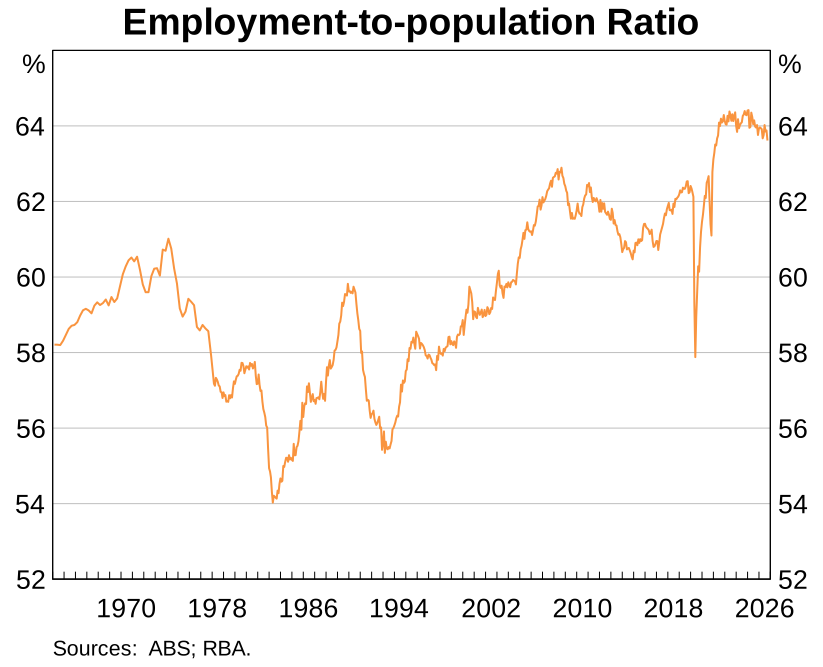
A key focus of the current research is monetary policy trade-offs, which is highly relevant to current and future policy decisions. The RBA’s mandate is to maintain price stability and full employment in the economy. While the mandate was recently tweaked, it has been in place since 1959. Flexible inflation targeting – the framework we use to deliver it – was introduced in the early 1990s. The RBA Review found that flexible inflation targeting, with the cash rate as the policy instrument, has served Australia well, as shown by inflation outcomes in Graph 1 and the share of the population employed in the orange line of Graph 2, noting that these are just two of many indicators of the health of the economy. Price stability and full employment are critical to the welfare of Australians – and monetary policy affects both.
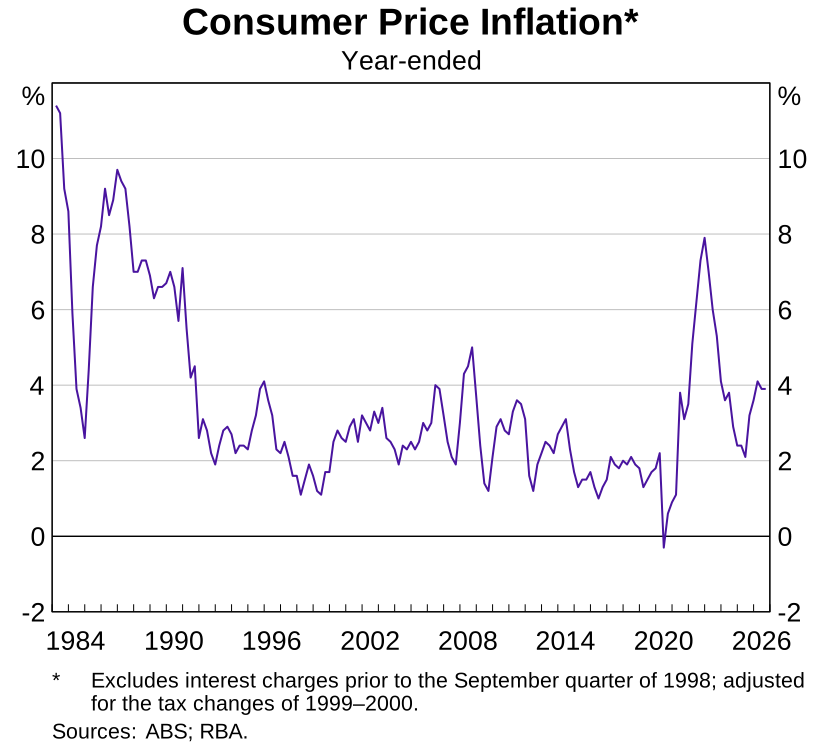
There are two main features of Australia’s flexible inflation targeting framework. First, the RBA aims to return inflation to the midpoint of its inflation-targeting range of 2–3 per cent. Inflation should hover around 2.5 per cent. This objective is clear. Second, the framework’s flexibility stems from recognising there are trade-offs in the economy that need to be considered in the pace of return to the midpoint.
The trade-offs in monetary policy are the difficult part. Sometimes monetary policy decisions need to place more weight on inflation and sometimes on the broader economy, as reflected in employment. Sometimes the objectives will be in tension with each other. Broad disagreement can exist on how to manage these trade-offs, even within the Monetary Policy Board, which is understandable because people are affected differently or have different preferences about the objectives. It does not mean the trade-offs can be ignored. This is the situation we are in now, with pockets of strong demand in Australia, and weakness elsewhere overlaid with a massive global oil supply shock following the conflict in the Middle East.
The 2026 RBA Annual Conference, held in October, focused on monetary policy trade-offs.5 The conference brought together central bankers, academics and related policymakers, where frontier work on different aspects of monetary policy trade-offs was presented and debated. The conference aimed to help the RBA step back from day-to-day decision-making to explore issues from a range of perspectives, challenge thinking, and build an evidence base to draw on when making decisions.
The conference also aimed to help us think through the trade-offs, including how they are affected by the current forces shaping the economy, how persistent those forces are, and how these forces may play out over time. We discussed how the costs of inflation and unemployment affect different groups of people, and how inflation expectations are anchored. Those costs are clearly felt. A recent RBA survey,6 designed to hear directly from the Australian community, found that 70 per cent of Australians said inflation is their key economic concern.
The conference ended with a panel of senior central bankers from South Korea, New Zealand, Canada and Australia to discuss how their countries are grappling with the issues raised from a practical perspective. Balancing central bank mandates requires judgement. Judgements are made amid uncertainty, incomplete information, and lags in policy effects, yet decisions still need to be made. The consensus was that when communicating difficult choices, central banks need to be honest and empathetic without making promises they cannot keep, to use plain language, to explain that – while monetary policy is a blunt tool – other policies can play a role, and to be accountable for past decisions.
The conference reinforced the view we formed during the RBA Review, and Ben Bernanke’s review of forecasting and communication at the Bank of England, of the value of scenario analysis. Scenario analysis builds on our long-term research about how the economy works, and helps to explore potential outcomes of alternative monetary policy strategies and think through risks to inflation and employment, both upside and downside, particularly when economic or geopolitical events fall outside the normal range for our economy. We need to be alert to the potential distribution of outcomes under the uncertainty that we face.
The RBA includes scenarios in its public communications. A good example is in the May Statement on Monetary Policy,7 produced after the start of the conflict in the Middle East when uncertainty about what might happen was extremely high. The statement presents a baseline scenario of what RBA staff thought might happen, as well as two adverse scenarios of how the conflict could affect the economy. When the Monetary Policy Board makes decisions, we consider what we think is most likely to occur, but we also challenge our thinking by considering the outcomes for inflation and employment and their trade-offs if we are wrong. We cannot control how the conflict might play out, but we can think about the consequences of the different paths the world may take. The public can also see where we think the risks lie under alternative circumstances.
The second theme I want to highlight – and that the Board is particularly interested in – is artificial intelligence (AI). The RBA needs to consider AI, as a force likely to shape the current and future workforce and economy and, in turn, inflation and employment; the interaction between labour and capital; how monetary policy might be improved by helping to eliminate some of the incomplete information available currently; and how it can improve the efficiency of the RBA as a workplace. RBA researchers are exploring ways AI can complement existing core models and help the Board understand the economy in ways that were infeasible before. Last year Governor Bullock8 and, as recently as last week, Assistant Governor (Economic) Sarah Hunter,9 spoke about this, but I think it is important for the public to know that the Board is watching the implications of AI extremely closely.
The RBA’s focus on AI is a good example of how research informs policymaking, with some workstreams focusing on how AI is shaping the economy over the longer term, and others taking a shorter perspective, with analysis helping the Board to understand how AI is currently affecting the economy for the purposes of making monetary policy decisions.
Four examples of the RBA staff’s shorter-term analysis were released just last week as part of the RBA Staff Series called Insights.10 These Insights are available on the RBA website11 and are easily accessible to members of the public who want to know more about what is happening in the AI sector. The Insights covered: the exposure of household wealth to AI; data centre investment in Australia; the likely effects of the rise in world export prices because of global AI-related investment; and the early effects of AI on the labour market.
An example of RBA staff’s longer-term research with clear capability building for monetary policy is documented in an RBA Research Paper published last year from Nicholas Gray, Finn Lattimore, Kate McLoughlin and Callan Windsor.12 These researchers had developed a new AI-powered tool to better understand the information coming out of the RBA’s liaison program. This program interviews businesses on a highly confidential basis and is one mechanism for real-time intelligence gathering on the state of the economy and the outlook.
Information from the program is de-identified, summarised and aggregated at an industry or economy-wide level to maintain confidentiality. The AI-powered tool can then be used to interrogate the data at a much faster rate than a human or team of humans at little cost. The tool can examine the 22,000 interactions the RBA has had with businesses over 25 years in the RBA’s secure information technology environment. It can filter, query and aggregate liaison messages at scale, greatly enhancing their efficiency and ability to respond to recent demands. It can analyse topics of interest, the tone of the interviews, and extract signals from new information. The RBA researchers showed that it was possible to integrate liaison-based indicators into model-based nowcasts for key variables, such as measures of wage growth, and significantly improved model performance. Much more can be done in this area to help us better understand the current state of the economy. It is an exciting avenue of research with potentially substantial benefits.
To conclude, research is critical to interrogating the trade-offs of monetary policy and ensuring we remain nimble in using and developing new tools to get the best possible understanding of current circumstances under the immense uncertainty that we face. Monetary policy affects people’s lives – their cost of living and their jobs. The research I have described here is designed to support the decision-making needed to help achieve price stability and full employment and to serve the economic prosperity and welfare of Australians – which, not coincidentally, is the RBA’s overarching purpose.
Endnotes
1 RBA (2023), ‘Review of the Reserve Bank of Australia’.
2 As required under the Reserve Bank Act 1959.
3 RBA (n.d.), ‘Our Research Agenda’.
4 RBA (n.d.), ‘Publications’.
5 RBA (2026), ‘Monetary Policy Trade-offs’, Proceedings of the RBA Annual Conference, Sydney, October.
6 RBA (2026), ‘Listening to Australians: A New RBA Survey of the Community’.
7 RBA (2026), Statement on Monetary Policy, May.
8 Bullock M (2025), ‘Technology and the Future of Central Banking at the RBA’, Address to the 60th Shann Memorial Lecture, Perth, 3 September.
9 Hunter S (2026), ‘What Happens to the Economy as ‘Intelligence’ Gets Cheaper?’, UBS Australasia Conference, Sydney, 9 November.
10 Insights are short analytical notes in which RBA staff present their own analysis of a range of topics in economics and central banking. The content could align with, extend or even directly challenge the findings of other work undertaken at the RBA and should not be interpreted as reflecting or advancing the views of the RBA or its Boards. Analytical notes are a part of standard economic practice. It is common to find that different data, methods and perspectives can lead to different or nuanced conclusions, particularly in relation to complex issues. The views expressed are those of the authors.
11 For the latest Insights from RBA staff, see RBA (n.d.), ‘Insights: An RBA Staff Series’.
12 Gray N, F Lattimore, K McLoughlin and C Windsor (2025), ‘An AI-powered Tool for Central Bank Business Liaisons: Quantitative Indicators and On-demand Insights from Firms’, RBA Research Discussion Paper No 2025-06, August.
Underlying data
You can download the underlying data for the graphs in this speech from our Chart Pack.