
Submissions – Payments System Cash Distribution Framework Bill 2026 and Cash Distribution Framework (Consequential Amendments and Transitional Provisions) Bill 2026
Submission to Economics Legislation Committee
The Reserve Bank of Australia (RBA) welcomes the introduction of the proposed Cash Distribution Framework Bill 2026 and Cash Distribution Framework (Consequential Amendments and Transitional Provisions) Bill 2026 (taken together ‘the proposed framework’) to Parliament.
The RBA supports the Australian Government’s priority of maintaining access to cash for Australians who want or need to use it. Cash supports economic inclusion, provides a fallback when electronic payment systems are unavailable, and serves as an important store of value, particularly during periods of economic and financial uncertainty.
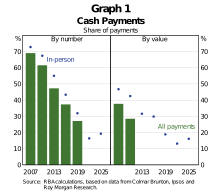
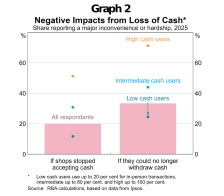
Transactional cash use has declined over the past couple of decades but has stabilised in recent years, at around 15 per cent of payments (Graph 1). Half of Australians use cash in a typical week and one-third would face hardship or major inconvenience if cash were to become difficult to access (MacGibbon, Royters and Wang 2026; Graph 2). If cash access were more difficult or expensive, consumers may be less likely to use cash and merchants less likely to accept it. This could create a self-reinforcing downward spiral where the declines in cash use and acceptance further reduce demand for cash (Guttman, Livermore and Zhang 2023).
The decline in the use of cash for transactions over recent decades and high fixed costs for distribution has placed pressure on parts of Australia’s cash distribution system. Lower processing volumes have led to underutilisation of cash distribution infrastructure and increased the average cost of transporting and processing banknotes. These challenges are particularly pronounced in regional and remote Australia.
The industry has consolidated, with a single provider of national-level cash distribution services. Lower cash use and excess capacity in cash distribution infrastructure (such as cash depots) were two factors cited in support for the merger of Australia’s two largest cash distribution service providers, Linfox Armaguard Pty Ltd (Armaguard) and Prosegur Australia Holdings Pty Ltd, in 2023.
In contrast to other sectors that provide critical services to the economy, there are currently limited regulatory arrangements to manage risks in the cash distribution system and to support the continuity of cash services. Challenges to the economics of cash distribution are evident in many other advanced economies, several of which have implemented, or are considering, policy and legislative responses to support the ongoing availability and usability of cash.
The proposed regulatory framework is designed to enable regulators to identify and manage risks in the cash distribution system and support the ongoing provision of cash services. The transparency and flexibility of the framework will enable exercise of regulatory powers in relation to designated entities, enabling regulators to respond effectively as conditions in the cash ecosystem continue to evolve.
This submission focuses primarily on the powers and responsibilities of the RBA under the proposed framework (noting the RBA also supports the proposed role of the ACCC in the reforms). The RBA is committed to coordination across regulators to enable effective oversight of service continuity by the RBA and competition and conduct regulation by the ACCC under the proposed framework.
Designation, Crisis Preparedness and Resolution Powers
The RBA’s overarching objective under the proposed framework would be maintaining the continuity of cash distribution services that are critical to the availability of cash across Australia. Under the proposed legislation, the RBA will be empowered to designate entities that it considers satisfy a statutory criterion relating to the role of the entity in the cash distribution system. The RBA would also have responsibility for preparing for the possibility of a crisis situation threatening the continuity of cash distribution and potentially intervening to resolve such a situation. The RBA’s new powers are intended to support improved operational resilience and crisis readiness at designated entities to reduce the risk of disruption while enabling orderly resolution should a disruption occur. This is intended to reinforce confidence in the cash distribution system and the ongoing availability of cash for the community and businesses.
The proposed designation powers will enable the RBA to identify and designate entities that it considers satisfy a statutory criterion relating to the role of the entity in the cash distribution system. The proposed framework also allows for flexibility in the approach taken by the RBA and ACCC in relation to the imposition of regulatory obligations on designated entities.
Under the proposed framework, the RBA would have crisis readiness powers that could be used to support the strengthening of designated entities’ resilience and preparedness for potential disruptions. These powers would enable the RBA to access timely information about relevant developments, set clear and proportionate standards for managing operations and resolving distress, and take action where necessary to address emerging risks. These powers are designed to enable the RBA to help reduce the likelihood and impact of disruptions, strengthen confidence in the cash distribution system, and support the continued availability of cash for businesses and the community.
The proposed reforms include a range of crisis management powers that will provide the RBA with flexibility to respond appropriately to a range of crisis scenarios. This flexibility is a critical feature of the proposed framework as the RBA must be able to determine the most suitable response based on the circumstances and information available during an unpredictable crisis scenario. While these powers are important to support continuity of cash services, the RBA expects ongoing industry cooperation, alongside supervisory engagement, to address issues that may lead to a crisis.
Transitional Provisions
It will take some time to fully operationalise the powers provided to the RBA and ACCC under the proposed framework. In the interim, the RBA strongly supports the ACCC having power to direct a designated entity to provide cash distribution services or facilities access to a customer on terms specified in the direction. These transitional powers will provide an important safeguard to support an orderly transition to the new framework.
Reserve Bank of Australia
16 July 2026
References
Guttman R, T Livermore and Z Zhang (2023), ‘The Cash-use Cycle in Australia’, RBA Bulletin, March.
MacGibbon K, M Royters and F Wang (2026), ‘Cash Use in Australia: What the 2025 Consumer Payments Survey Tells Us’, RBA Bulletin, April.