
Insight 2026-13 Australian Economy How Are Households Responding to Higher Interest Rates? Evidence From the RBA Community Research Survey
Insights are short analytical notes in which RBA staff present their own analysis of a range of topics in economics and central banking. The content could align with, extend or even directly challenge the findings of other work undertaken at the Bank.
Disclaimer – The views expressed are those of the authors and should not be interpreted as reflecting or advancing the views of the RBA or its Boards.
Key takeaways
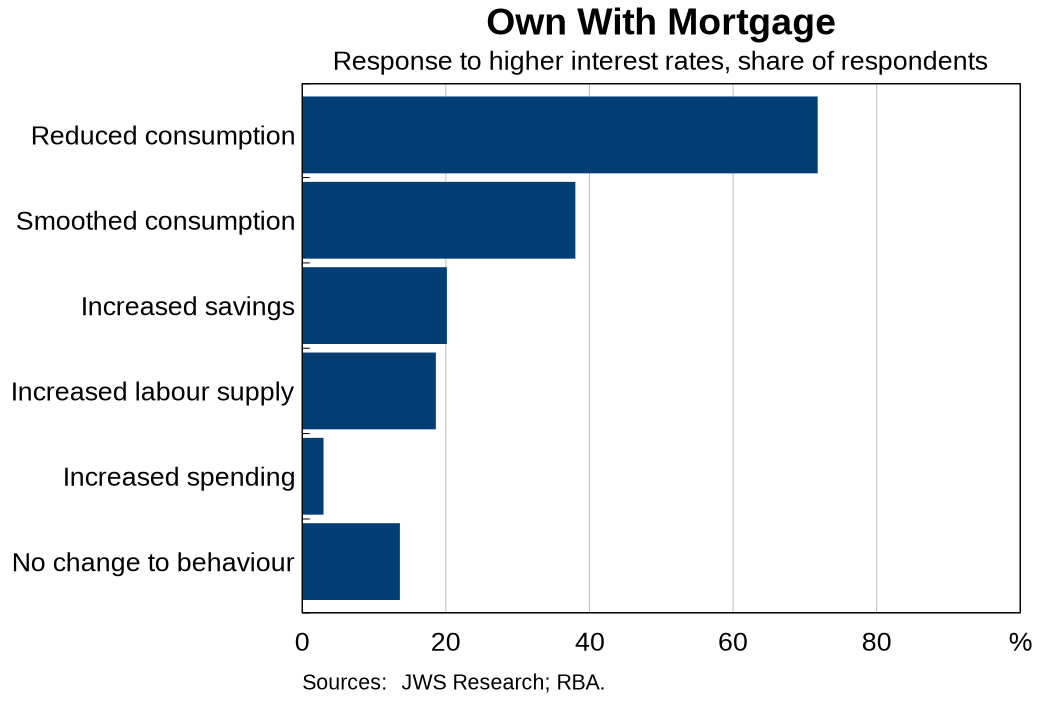
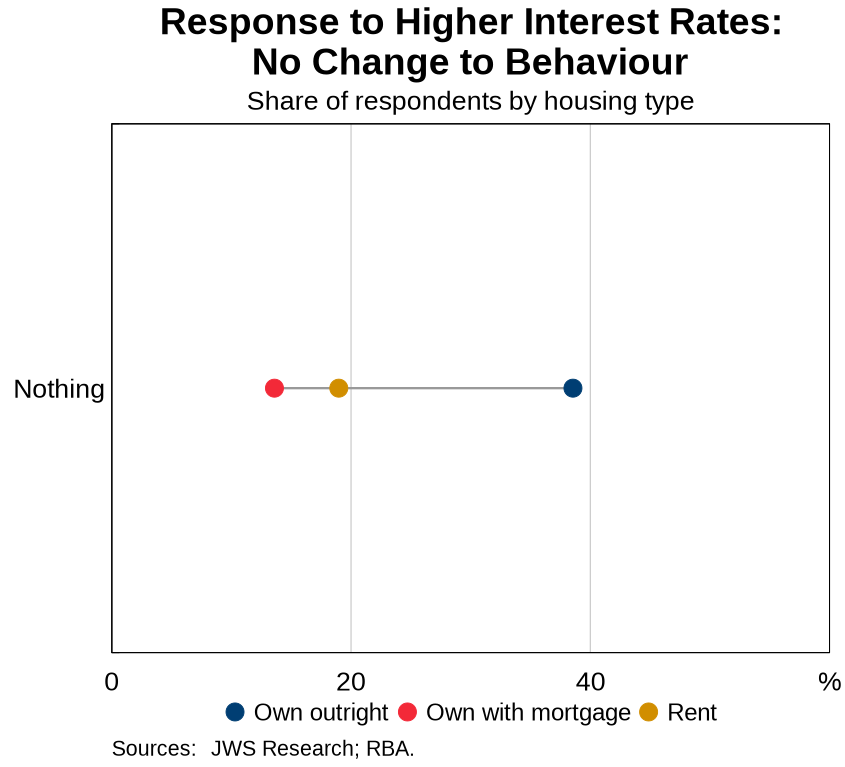
- Most households reported changing their behaviour in some way, including those without a mortgage. Only 14 per cent of mortgage holders, 19 per cent of renters and 39 per cent of outright homeowners reported no change to their behaviour.
- Mortgage holders nevertheless reported the broadest adjustment. Three-quarters of mortgage holders reported reducing their spending in response to higher interest rates this year.
- Labour supply responses are common among mortgage holders and renters. 20 per cent of mortgage holders and renters reported increasing their working hours in response to higher interest rates, with this response more common among younger respondents and part-time workers.
- Very few respondents reported increased spending. Only 2 per cent reported spending more in response to higher interest rates.
Introduction
One way that higher interest rates slow activity and lower inflation is by influencing household spending and saving. In the September 2026 wave of the RBA Community Research Survey (CRS), we asked households a new question about what actions they had taken in response to recent interest rate increases. The vast majority of mortgage holders reported making some changes, including reducing spending, drawing down on savings and/or increasing their hours of work. But most outright homeowners and renters also reported making changes. These self-reported responses are consistent with other evidence that indicates that higher interest rates affect the decisions of a broad range of households, not just those with mortgages.
What we asked households
We asked survey respondents the following:1
Which of the following, if any, have you or your household done as a result of interest rate increases this year? Please select all that apply.2,3
- Reduced spending on non-essentials (e.g. dining out, entertainment, holidays, electronics)
- Reduced spending on essentials (e.g. groceries, transport, medicines)
- Switched to cheaper brands, stores or alternatives
- Used savings to help pay everyday expenses
- Increased work hours to earn more
- Increased borrowing or put more on credit cards
- Increased savings
- Repaid debt more quickly
- Increased spending due to increased savings
- Nothing
These are self-reported responses rather than observed behaviour. We cannot rule out that some responses reflect other factors (such as broader cost-of-living pressures) that respondents may associate with higher interest rates.
How are households responding to higher interest rates?
Housing tenure provides a useful lens through which to understand household responses. Mortgage holders are directly exposed to higher interest rates because increases in mortgage repayments reduce the cash flow available for other spending. By contrast, outright homeowners and renters are insulated from this direct cash flow channel but are likely to be affected through other transmission channels.4
For the analysis, the responses are grouped into six broad behavioural responses: (1) reduced spending, (2) smoothed spending, (3) increased saving or debt repayments, (4) increased labour supply, (5) increased spending, (6) no change.5 Since households could select multiple options, they may be included in more than one category.
The majority of mortgage holders reported reducing spending, and many reported working more
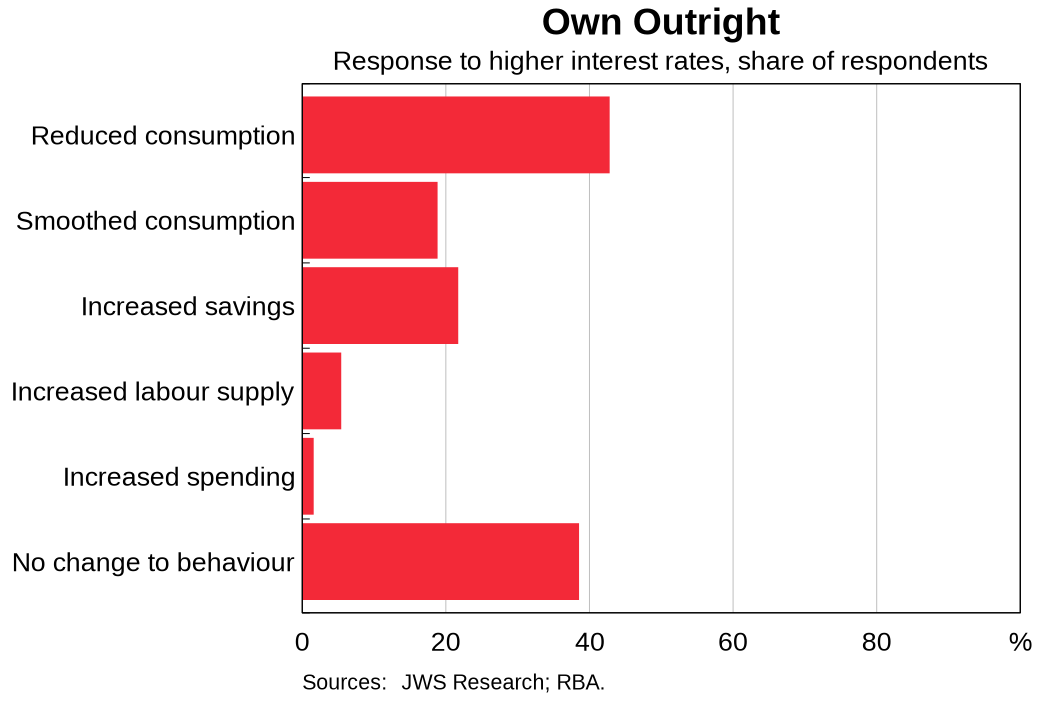
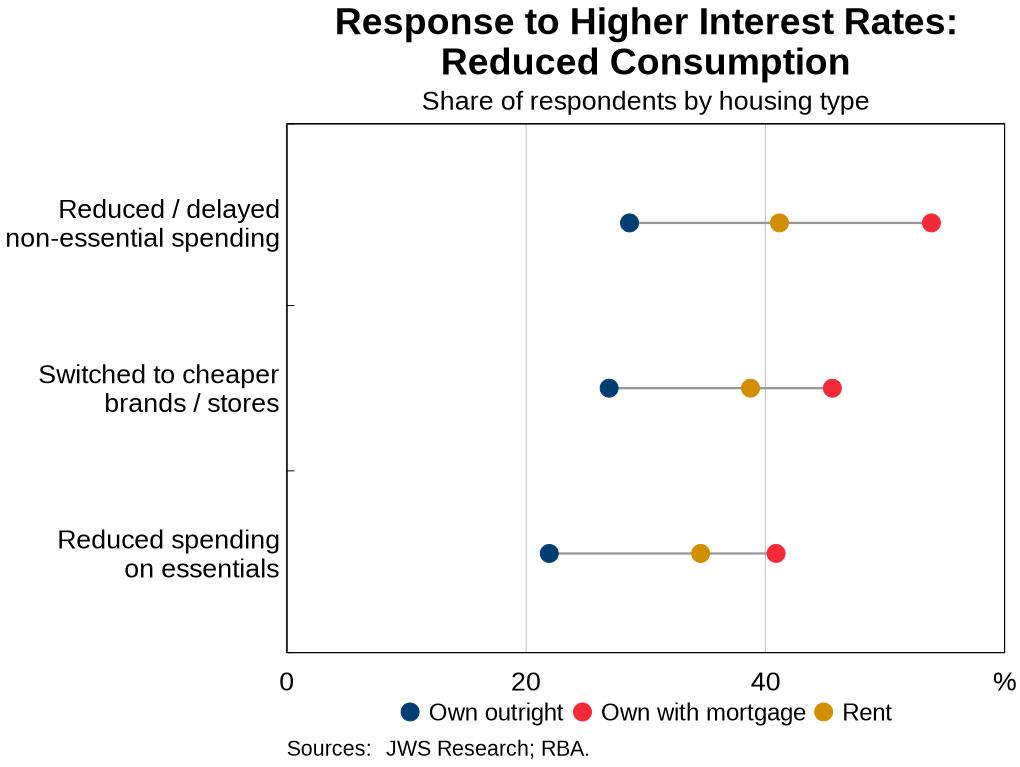
Around three-quarters of respondents with a mortgage reported reducing their spending in response to higher interest rates, compared with around 40 per cent of outright homeowners (Graph 1; Graph 2). Twice as many mortgage holders as outright homeowners reported reduced spending on non-essential items and switching to cheaper alternatives (Graph 4). Two-in-five mortgage holders reported reducing spending on essential items, double the one-in-five outright homeowners who selected this option.6
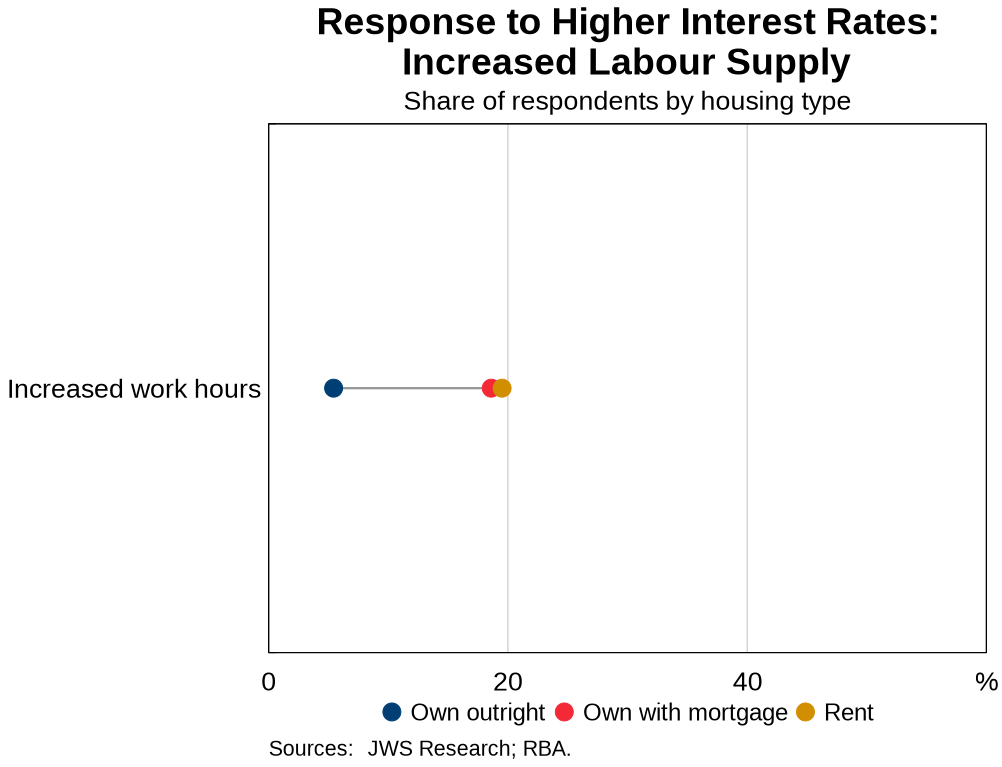
Mortgage holders also reported increasing their labour supply, consistent with the findings of Das et al (2026). Around 20 per cent reported increasing their working hours in response to higher interest rates, far greater than the 5 per cent of outright homeowners (Graph 1; Graph 2). This response is more common among younger respondents and part-time workers. One possible explanation is that part-time workers have greater scope to increase their hours. Younger mortgage holders may have larger mortgage burdens relative to their incomes.
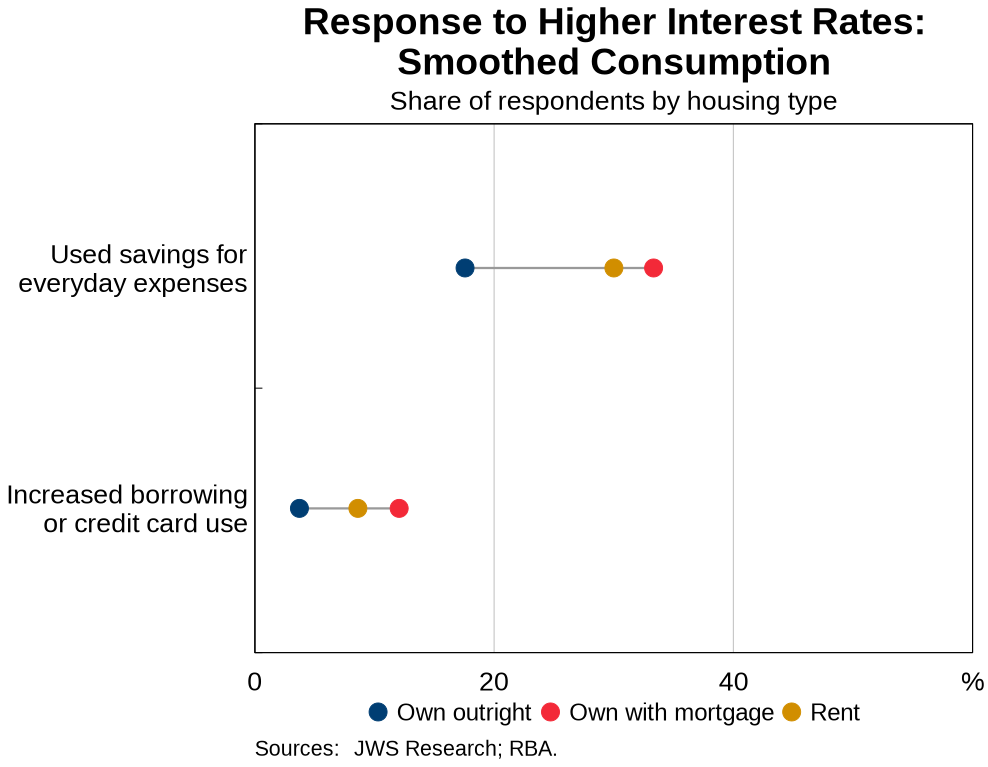
One-third of mortgage holders reported using savings to fund everyday expenses (twice the share of outright homeowners), while mortgage holders were also three times as likely to report increasing borrowing or credit card use (Graph 5). These actions may allow households to limit immediate reductions in spending but may ultimately leave them more vulnerable if financial pressures persist.
A modest majority of outright homeowners reported adjusting behaviour; 40 per cent reported no change
Around 40 per cent of outright homeowners reported no change to their behaviour in response to higher interest rates, compared with 14 per cent of mortgage holders. This is consistent with outright homeowners being less directly exposed to the cash flow channel: without mortgage repayments, they face less immediate pressure to reduce spending, draw on savings or increase their hours of work.
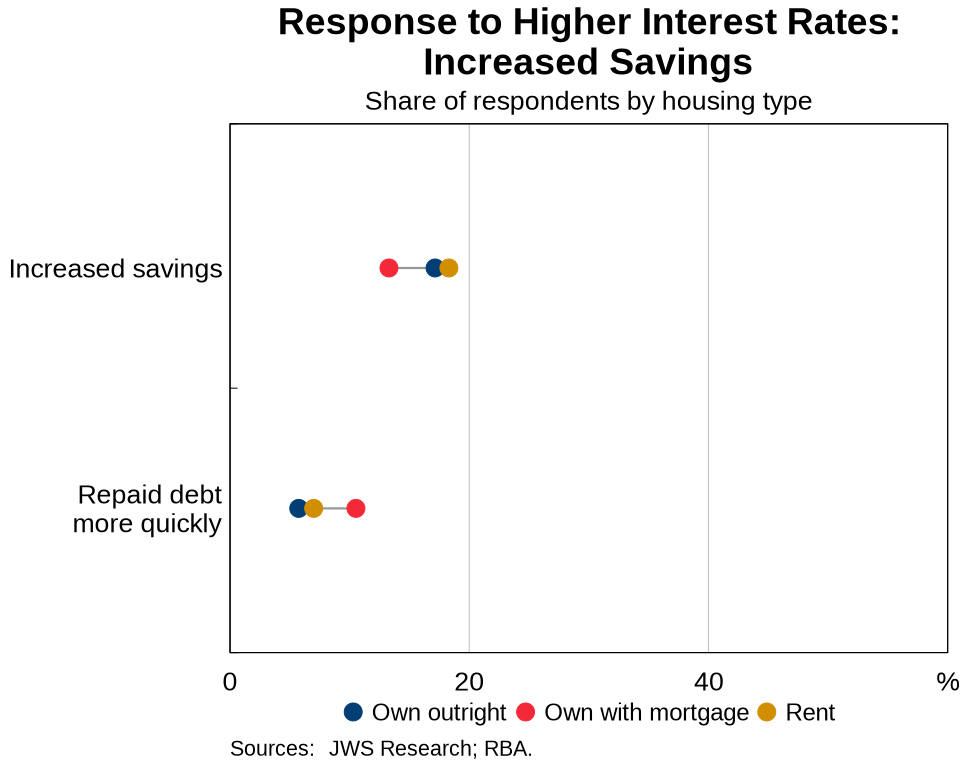
Nonetheless, a majority (60 per cent) of outright homeowners reported making at least one adjustment. Around 40 per cent reported reduced consumption (Graph 2) and around 20 per cent reported increased savings (Graph 2; Graph 6).7 Because these households are not directly facing higher mortgage repayments, these responses suggest that monetary policy is being transmitted through other channels.8
Some of this reduction in spending is consistent with the saving and investment channel of monetary policy transmission – where higher interest rates raise the return on savings, incentivising households to save more and therefore spend less. Other factors, including declines in household wealth related to lower housing prices, may also be influencing behaviour. These channels may operate more gradually than the cash flow channel, particularly where responses depend on changes in asset prices or adjustments to discretionary purchases. The sizeable share of outright homeowners reporting at least one change indicates that the effects of higher interest rates are not confined to households with mortgage debt.
Renting households also reported reduced consumption and increased labour supply
More than 60 per cent of renters reported actions consistent with reducing their spending and more than 20 per cent reported increasing their savings (Graph 3). Around 20 per cent also reported increasing their working hours, similar to the share of mortgage holders who reported the same. The survey does not establish why renters attribute these actions to higher interest rates. Possible explanations include higher returns to saving (which could be particularly salient for renters who are aspiring first home buyers) and anticipated or realised increases in rents that renters may attribute to higher interest rates.9
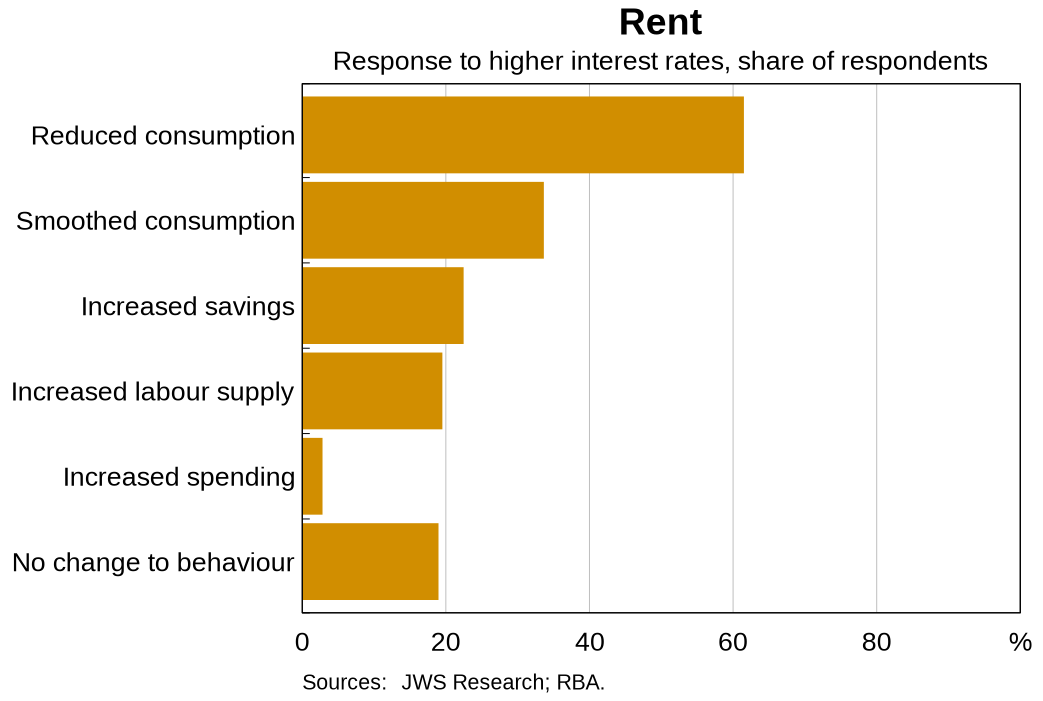
Taken together, the responses may reflect a combination of the savings and investment, wealth and cash flow channels. Differences in the demographic and financial characteristics of renters may also contribute.
Very few households reported increased spending due to higher interest rates
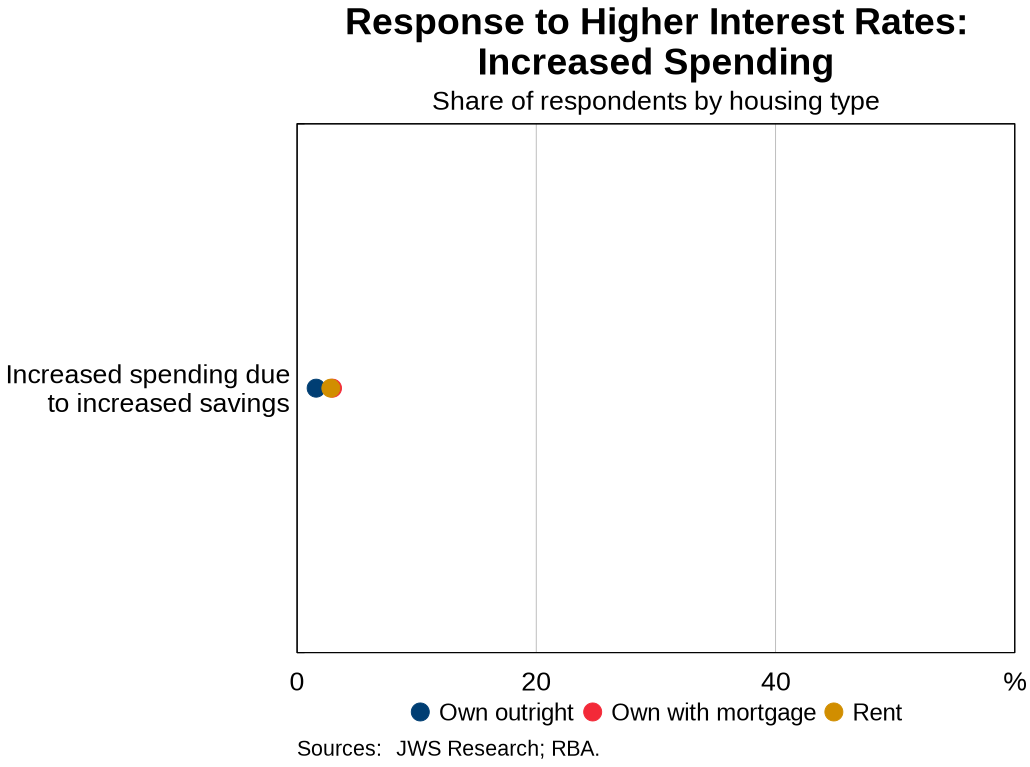
It is sometimes suggested that households receiving net interest income – particularly older outright homeowners – benefit from higher interest rates and respond by increasing spending. In the survey, however, only 2 per cent of households reported spending more in response to higher interest rates, and this was not especially concentrated among outright owners, those aged over 60 or retirees (Graph 8). Across all housing groups, respondents were much more likely to report spending less or saving more (Graph 4; Graph 6).
Detailed responses by housing tenure
Graphs 4 to 9 show the individual response options underlying the broader categories discussed above.
Endnotes
* We would like to thank Michelle Wright and Jonathan Hambur for their comments and suggestions.
1 The CRS is conducted twice a year with a nationally representative sample of 3,000 adults. Each wave includes a set of recurring core questions, alongside additional topical questions. This question was included as a topical question in the September 2026 wave. We randomised the ordering of the options, except for the last one. See Harden, Rickards and Wright (2026) for further detail on the CRS.
2 The reduced spending on essentials and non-essentials options do not distinguish between reduced volumes and reduced nominal spending. Households reporting reduced spending may be buying fewer items, purchasing less expensive alternatives, or both.
3 To keep the question simple, we did not ask how much households responded. This means we cannot answer whether the changes are material or larger on average for some groups. We instead report on the incidence.
4 Households with net deposits could also gain. However, very few households report increasing their spending because of this.
5 From the list of responses in the ‘What we asked households’ section above, the first three are categorised as ‘reduced spending’. The 4th and 6th are categorised as ‘smoothed spending’. The 7th and 8th are categorised as ‘increased saving or debt repayment’. The 5th is categorised as ‘increased labour supply’. The 9th is categorised as ‘increased spending’, and the 10th as ‘no change’. Graphs 4 to 9 make this grouping clear.
6 Because spending on essentials is, by definition, more difficult to reduce than non-essential spending, this is consistent with other evidence that some mortgage holders are facing substantial pressure on their household budgets. However, it is not possible to quantify this more precisely, as the survey does not identify the magnitude of spending reductions, or whether they have been achieved by decisions to substitute to cheaper alternatives or by forgoing purchases altogether.
7 While the survey asks respondents what they have done, it is possible that reported increases in savings reflect either higher interest earned on existing balances or households actively saving more, which have two different implications for consumption.
8 As detailed earlier, households may also attribute their responses to cost-of-living pressures more generally, to higher interest rates.
9 Renters may also attribute their responses to cost-of-living pressures more generally, to higher interest rates.
References
Das M, J Hambur, KP Hellwig and JA Spray (2026), ‘Labor Supply Effects of Monetary Policy: Evidence from Australia Mortgage Holders’, IMF Working Paper No 2026/071, April.
Harden J, P Rickards and M Wright (2026), ‘Listening to Australians: A New RBA Survey of the Community’, RBA Bulletin, July.
Underlying data
You can download the underlying data file for all data that are available for public release.