
Insight 2026-11 Australian Economy Data Centre Investment in Australia
Insights are short analytical notes in which RBA staff present their own analysis of a range of topics in economics and central banking. The content could align with, extend or even directly challenge the findings of other work undertaken at the Bank.
Disclaimer – The views expressed are those of the authors and should not be interpreted as reflecting or advancing the views of the RBA or its Boards.
Key takeaways
- Data centre investment in Australia has grown around 10-fold over the past three years and is expected to remain significant going forward. Its scale and timing will depend on demand for computing capacity and constraints on further development. The direct contribution to domestic activity is smaller than headline spending suggests, because much of the investment is in imported equipment.
- Beyond its direct effects, data centre investment will also support investment in supporting infrastructure – including electricity – and generate demand across other industries and labour markets. How much this adds to aggregate activity and inflation will depend partly on the availability of spare capacity, including in the industries and states most affected.
- The economic effects beyond the construction phase are more uncertain. The impacts of data centres during their operational phase will increasingly depend on the ongoing investment needed to service computing capacity demand, including whether Australian data centres primarily service domestic or overseas demand.
Given the rapid expansion of the sector is relatively recent, this note focuses on our initial assessment of the effects of data centre investment on economic activity during the sector’s expansion and offers some preliminary thoughts on the operational phase. We will continue to monitor data centre activity and its broader effects on activity, labour markets and inflation as the sector evolves.
Introduction
The rapid development and adoption of AI, alongside the broader digitalisation of economic activity, has increased global demand for computing capacity in recent years. Meeting this demand requires substantial investment in data centres that house the servers, storage systems and networking equipment used to process, store and transmit digital information. In turn, this can have flow-on effects to other parts of the economy through a variety of channels. Globally, firms have expanded or built new data centres and announced significant new investment, led by the large US firms often referred to as ‘hyperscalers’.
Investment in Australian data centres has also increased rapidly, and forward-looking indicators suggest it will remain significant over coming years. While data centres support the digital economy, their rapid expansion has also prompted debate in some communities about their demands on land, electricity and other infrastructure. This note examines the scale and composition of recent data centre investment in Australia, its broader economic effects and the outlook for the sector. Data centre financing in Australia is discussed in Speed (2026).
Recent trends
Data centre investment in Australia has increased markedly in recent years alongside growing demand for cloud computing and AI services. Data centre investment comprises both the construction of the building and its fit-out with specialised machinery and equipment. The building itself typically resembles a large warehouse and its construction is captured in measures of non-residential construction, including building approvals and capital expenditure. This construction constitutes a modest share of overall investment in data centres, at around a quarter of activity. The fit-out includes servers, storage and networking equipment. These components account for most of the overall cost of a data centre (at around three-quarters) and are largely imported – typically from Asian economies including Taiwan and South Korea.
Data centre investment is volatile quarter-to-quarter. This is particularly the case for the equipment used in their fit-out, which is imported by a small number of firms and at various stages in a project’s timeline. This lumpiness – as well as the rapid growth – is evident across several indicators that capture different stages and components of data centre investment (Graph 1).1
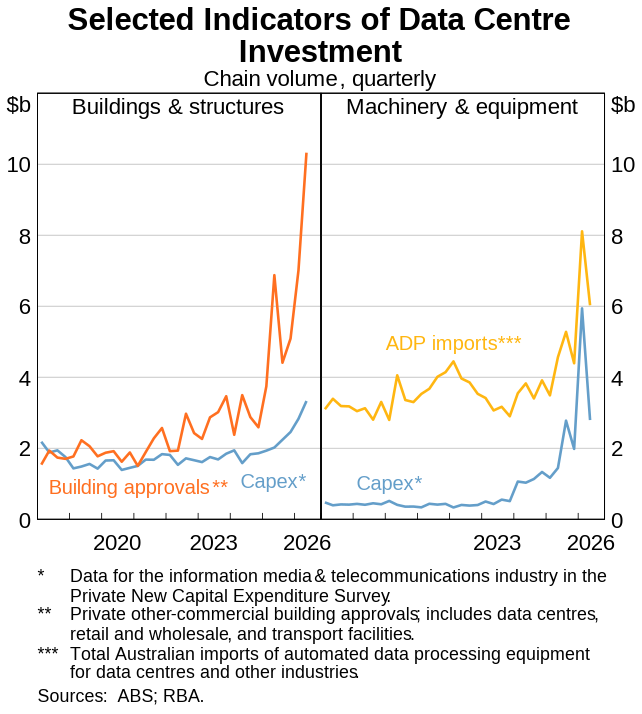
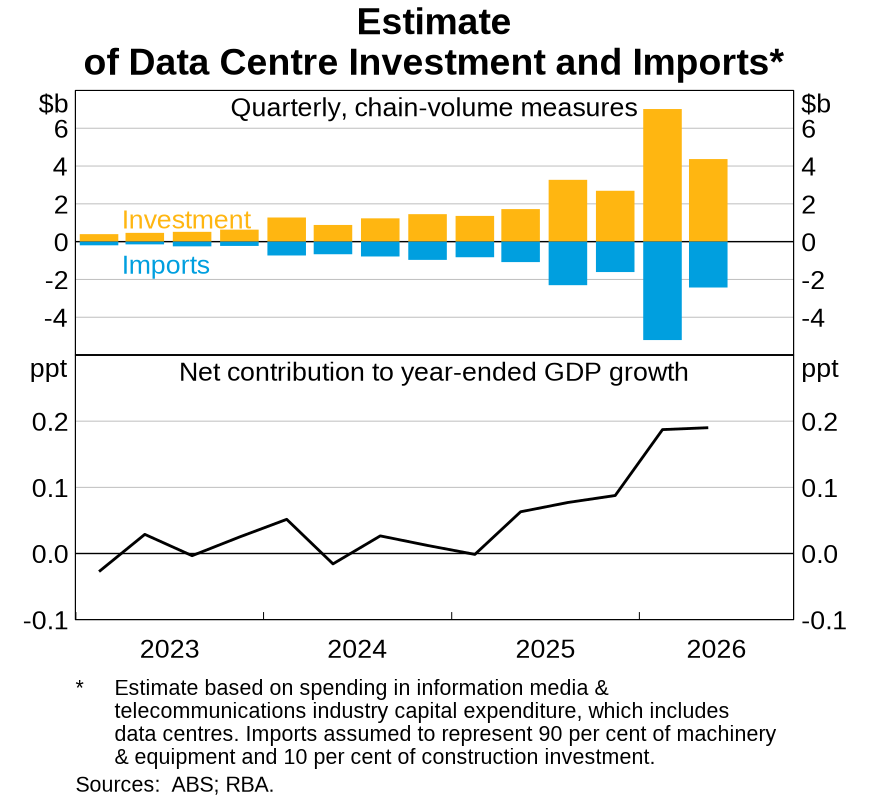
Based on the capital expenditure survey, we estimate total data centre investment in Australia has increased around 10-fold over the past three years. However, much of the machinery and equipment is imported, which means its net contribution to domestic activity is considerably smaller. We currently assume around 70 per cent is imported, within the range of external estimates (50–80 per cent). Therefore, data centres have directly accounted for up to around 0.2 percentage points of annual GDP growth over the past year after accounting for the offset from imports (Graph 2). The rapid increase in data centre investment has some similarities to the mining investment boom starting in the mid-2000s, although there are important differences in the scale (based on the current outlook for data centres), drivers and economic implications of the two episodes (see Box A).
The majority of existing and planned data centres in Australia are located within Sydney and Melbourne. This is because these locations have easier access to some infrastructure (i.e. grid power, water, fibre-optic connections), availability of skilled labour and are closer to end users to minimise latency issues. While these features have supported investment in data centres, some contacts from the RBA’s liaison program have raised concerns that data centres are diverting land away from industrial and residential property construction.2
Investment in Australian data centres has been undertaken by both domestic and foreign firms. Much of this investment to date has been in ‘colocation’ data centres, where operators lease data centre space and supporting infrastructure to customers, including businesses, governments and hyperscalers, who typically supply their own computing hardware. These have largely serviced demand for cloud computing and storage. By contrast, some firms build facilities and provide computing capacity directly, typically specialised chips used to run AI models. These data centres typically use advanced chips that are more expensive, meaning the imported content accounts for a larger share of total investment. Investment has expanded across both of these business models in recent years.
Spillovers
Beyond the direct impact of data centre investment on the industries involved in their construction, there are also spillover effects elsewhere in the economy. Data centre investment may generate additional investment in complementary infrastructure, including electricity generation and transmission. The construction and fit-out of data centres also draws on labour, materials and land used elsewhere, which could affect residential and other non-residential investment. As data centre investment continues to ramp up, its overall economic impact will depend on these spillovers and the extent of spare capacity elsewhere in the economy.
Utilities
Data centres require large and continuous supplies of electricity and water to power computing equipment and cooling systems. Electricity is a key input into data centre operations, such that capacity is commonly expressed in megawatts rather than by compute capacity. This makes the utilities sector one of the most visible channels through which data centre investment affects the broader economy. There are two main aspects to this: demand for these utilities and the capacity to connect to the transmission or distribution networks. In Australia, current and proposed data centres are predominantly reliant on grid-supplied electricity, although some facilities have their own generation and storage assets (sometimes referred to as behind-the-meter generation and storage).
Community concerns about data centre development have often centred on their electricity use, particularly given existing pressures on electricity infrastructure and the broader transition of the electricity system. The Australian Energy Market Operator (AEMO) estimates that in 2025/26, data centres were responsible for around 3 per cent of total operational electricity consumption in the National Electricity Market (NEM). Oxford Economics analysis, on behalf of AEMO, suggests data centres could be responsible for 7.5–17.1 per cent of operational consumption by 2035/36.
Strong growth in data centre electricity demand could support investment in new renewable electricity generation capacity. This is in line with Australian Government expectations that new data centre developments should secure new and additional renewable generation and storage capacity to offset their electricity demand, though the policies are subject to changes following government consultation processes (DISR 2026). Liaison contacts report that data centre operators have increased demand for renewable electricity generation power purchase agreements (PPAs) over the past year. These long-term contracts can improve the commercial viability of generation projects by providing greater revenue certainty and helping projects secure finance. Some contacts report that increased demand for PPAs has supported renewable energy projects that may not otherwise have proceeded. However, some data centres prefer contracts with projects that are well advanced, which suggests that they may compete for existing renewable supply rather than enable new additional generation capacity.
The expansion of renewable electricity supply may lag growth in demand from data centres. Liaison contacts report that data centres can typically be constructed more quickly than new renewable generation capacity can be brought online. As a result, some contacts suggest that strong growth in electricity demand from data centres could place upward pressure on wholesale electricity prices for a time. This would be consistent with evidence from the United States (Scalera et al 2026), although the effect on prices can be expected to vary between countries and electricity grids depending in part on their initial demand-supply balance and how quickly additional supply can be introduced.
Presently, the main constraint to data centre development reported in liaison is access to electricity network infrastructure, particularly in metropolitan areas. In some locations, accommodating new data centre connection requests requires investment to upgrade and expand transmission and distribution network infrastructure, which can extend the time required for a project to secure an electricity grid connection and become operational (Transgrid 2026). Accommodating connection requests and data centre development in some regional and rural areas could catalyse investment in broader infrastructure, generating spillovers for other users and industries in the region (CEFC and Baringa 2025).
Water supply has not been reported by many liaison contacts as a current significant constraint to data centre development across eastern states. Developers report adapting data centre designs to operate at higher temperatures and using more water-efficient cooling technologies, reducing pressure on water suppliers. However, similar to electricity networks, constraints in water infrastructure may affect the timing and viability of data centre developments in some locations, and investment in water infrastructure could be required (Water Services Association of Australia 2025). While water supply has attracted less attention than electricity, constraints could still emerge as demand from data centres increases.
Other industries
The broader economic effects of data centre investment extend beyond the utilities sector. A large share of data centre investment is spent on imported equipment, but the construction and fit-out of data centres draws on inputs from a wide range of industries. Those suppliers in turn purchase goods and services as inputs from their own suppliers, so spending on data centres affects demand throughout domestic supply chains.
The input-output (IO) tables can be used to trace how this spending is distributed across industries, in value-added and employment terms. Importantly, this shows where that activity occurs, but it does not necessarily indicate additional activity. For example, in an economy operating close to capacity, much of the labour and materials used in the construction of data centres might be drawn from other uses. IO table analysis was used to assess the effects of the mining investment boom on the broader economy (see Rayner and Bishop 2013).
Data centres are not separately identified in the IO tables, so undertaking similar analysis requires assumptions about how data centre investment is split between imports and domestic spending and how the domestic components map to broad industries in the IO tables.3 With these limitations in mind, the analysis points to some broad takeaways about which industries are most closely linked. A large share of activity is generated by the building and civil engineering contractors and the construction trades they subcontract. However, a similarly large share is generated by the industries that supply them, including professional, scientific and technical services, manufacturers of materials such as cement and fabricated metal, finance, transport, and wholesale trade. This reflects the inputs that firms contracted to build data centres purchase – design and engineering services, materials, freight, and finance and insurance – and the inputs that those suppliers in turn purchase.
Labour
Many firms in the RBA’s liaison program say that labour availability is not currently a constraint for data centre construction. However, several liaison contacts from the broader construction industry have indicated that the ramp-up in data centre activity is contributing to existing labour market tightness and capacity pressures for some specific skills. Evidence from SEEK (2026) suggests that demand for roles supporting data centres has more than doubled since mid-2025, including for planning, construction and maintenance.
Many of the key roles in the construction and outfitting of a data centre require skillsets that are transferable between different sectors. These include some electricians, plumbers, heating, ventilation and air conditioning (HVAC) technicians, and site supervisors who are readily able to move between data centre projects and other construction activities (particularly other non-residential construction projects). Contacts have indicated that strong demand and a focus on swift delivery have positioned data centre projects as a top bidder for these transferable skillsets, and that wages may be higher for workers involved in data centre projects. In a supply-constrained economy, this could place additional upward pressure on construction costs and wages. A mitigant to this is that New South Wales and Victoria – where the bulk of data centre activity is currently occurring – have a comparatively smaller overall construction pipeline and larger construction industry capacity than those in Queensland, Western Australia and South Australia. This means that competition for transferable construction skillsets is likely to be more subdued than would be the case if the bulk of data centre construction was taking place in other states.
The outlook
Forward-looking indicators suggest investment will be significant over coming years. Firms’ capital expenditure expectations have been revised up, and data centre developers and major tenants have announced a stream of new investment. While not all of these announced projects are likely to go ahead, most analysts expect strong data centre investment and the infrastructure that supports it in the coming years.4
Forecasts of data centre investment vary considerably, reflecting different assumptions about the demand for computing capacity and the capacity of the economy to accommodate investment. We currently expect a further $115 billion in real terms to be invested in Australian data centres alone (excluding supporting infrastructure) between mid-2026 and the end of 2028 – equivalent to almost 2 per cent of GDP each year in gross terms, although the net impact on GDP is smaller once accounting for imports. This reflects our assessment of the likely build-out in data centre capacity and is broadly in line with recent external estimates. Lower external estimates tend to place more weight on constraints to development, including access to electricity networks and other infrastructure, the availability of construction resources, and the possibility that some announced projects do not proceed. Higher estimates typically embody stronger assumptions about growth in demand for computing capacity. In particular, most estimates currently assume that Australian data centres will largely service domestic demand; estimates would be materially higher if Australia were instead assumed to become a significant exporter of compute services. Estimates will also depend on assumptions about technology costs and regulatory settings.
The economic effects will change as data centres move from construction to operation. Computing equipment can have relatively short economic lives, which could support significant replacement investment even as the expansion in data centre capacity slows. However, replacement cycles are uncertain and will depend on factors including technological change and equipment costs, and much of the equipment to be replaced is likely to be imported. Contacts in the liaison program also suggest that ongoing operations are likely to be less labour-intensive than the investment phase.
The build-out of data centres represents a meaningful increase in Australia’s stock of productive capital. Where the income from this capital goes will depend on ownership of data centres (and the servers inside them in the case of collocated data centres), as well as government policies. The broader implications for domestic activity and Australia’s balance of trade will depend importantly on the demand these facilities serve. If Australian data centres primarily meet domestic demand, they may substitute for computing services that would otherwise have been provided overseas (i.e. for services that we would otherwise have imported); the effects would be different if Australia were to develop into a significant exporter of compute services. Our understanding of these operational-phase effects will continue to evolve as the sector develops.
Conclusion
Data centre investment is likely to remain significant over coming years. While its direct contribution to domestic activity is limited by the high import share of investment, the build-out is generating broader demand for construction, electricity infrastructure and specialised labour. The economic implications will evolve as data centres move from construction to operation and will depend on the scale and nature of future investment and the demand these facilities ultimately serve. These developments remain uncertain and will continue to be monitored as the sector evolves.
Box A: Data centre investment – Comparisons with the mining boom
The rapid growth in data centre investment has prompted comparisons with Australia’s mining investment boom from the mid-2000s to the early 2010s. While the two episodes share some features, there are important differences in the factors driving investment and the broader economic implications.
Both episodes involve a surge in capital spending concentrated by industry and state: Western Australia and Queensland for mining, and New South Wales and Victoria for data centres. In both, investment plans were revised up repeatedly as the pipeline of projects grew in its early stages (Graphs A.1 and A.2). As mining investment continued to increase, shortages of labour, engineering and construction capacity, and bottlenecks in transport infrastructure contributed to project delays and cost escalation. These pressures were not confined to the resources sector, with competition for labour and other inputs adding to capacity pressures across the broader economy and placing upward pressure on inflation (Kearns and Lowe 2011). For data centres, liaison reports that access to electricity network infrastructure is currently the main constraint, alongside signs of competition for some construction trades. As with the mining boom, the nature and extent of capacity constraints could evolve if the investment pipeline continues to grow.
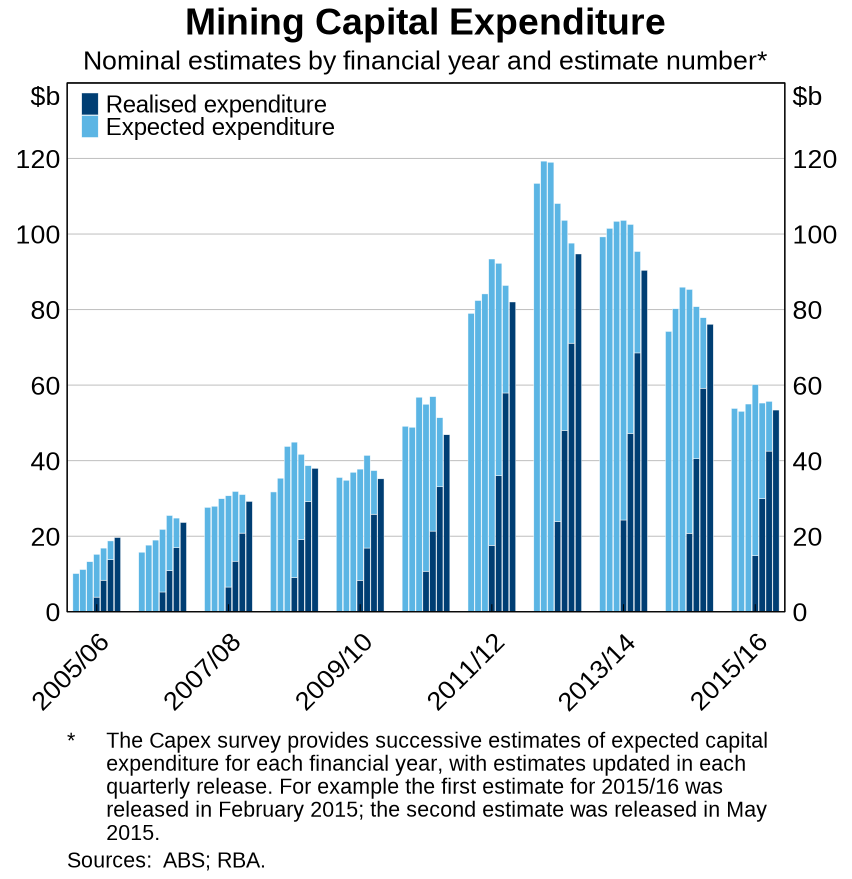
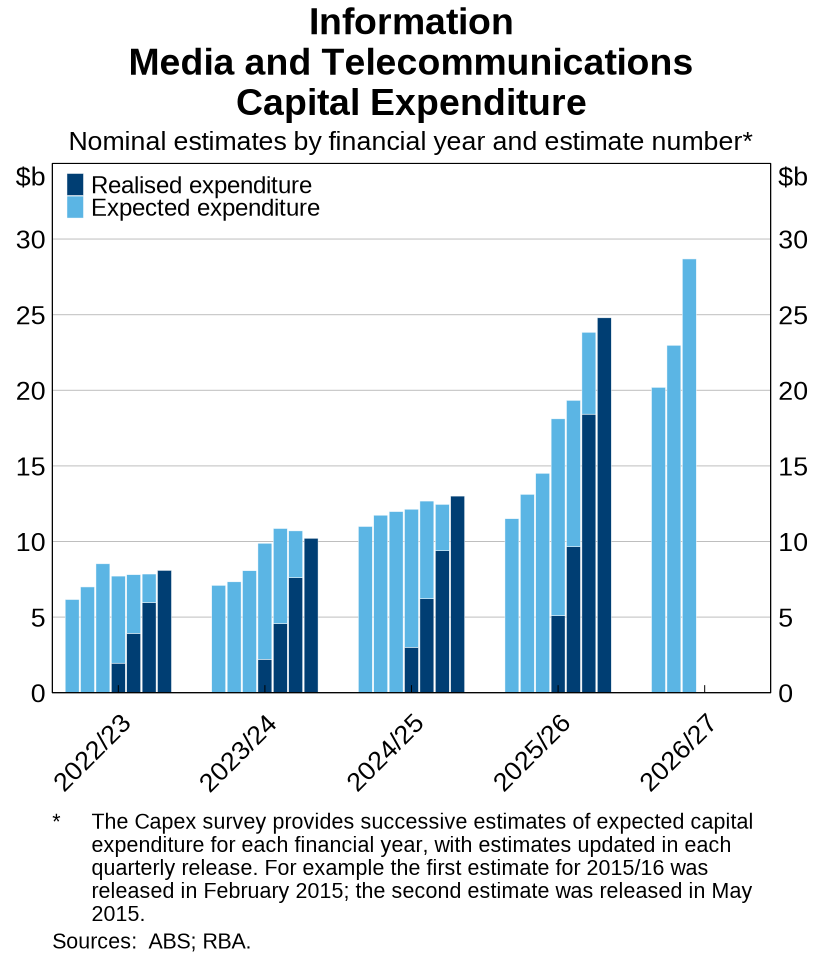
Data centre investment is expected to continue to increase but the scale and timing are highly uncertain, as was the case at the start of the mining investment expansion. That said, the central staff forecasts are for data centre investment to account for around 2 per cent of GDP by the end of 2028, which is comparable to the early stages of the mining boom but well below its peak (Graph A.3). Partly offsetting the increase in data centre investment in GDP, around 70 per cent is assumed to be imported. However, the experience from the mining boom suggests the import intensity of data centre investment is likely to vary across project types and over time (Connolly and Orsmond 2011).
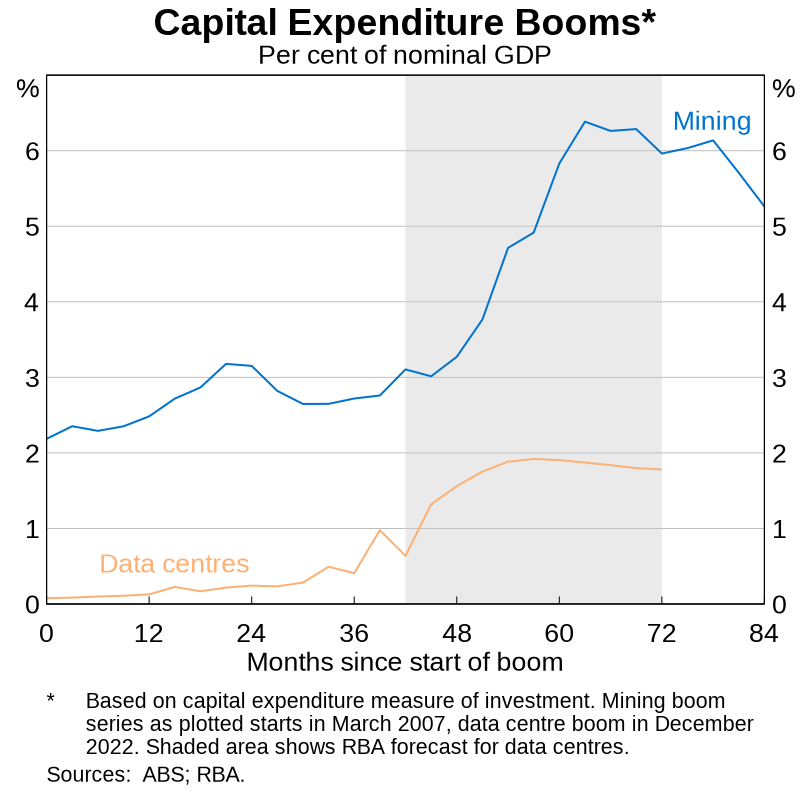
The amount of data centre investment that persists beyond the initial build-out will also depend on how quickly the existing capital needs to be replaced. The mining boom illustrates that investment can remain significant after the initial expansion phase as firms maintain and replace a larger capital stock, but there are several factors that this will depend on (Jenner et al 2018).
The drivers of the two booms differ, which has implications for the macroeconomic effects. China’s industrialisation increased demand for resources that Australia has a natural endowment in, leading to a surge in mining investment to expand export capacity. The mining boom lifted commodity prices and the terms of trade, which boosted national income before new capacity came online. Higher export volumes, tax revenues and mining sector employment followed. By contrast, the data centre build-out has been prompted by rising demand for computing services globally. The current investment outlook largely reflects an expectation that Australian data centres will meet domestic demand, although as discussed above it is possible that Australia ultimately becomes a net exporter of compute.
Endnotes
* Thank you to Kate Davis, Oscar Douglas, Anna Park and Tom Williams for useful comments and discussions on this note.
1 Because data centres are not explicitly identified in national data sources, we use the ABS’s Spotlight – Data Centres in Economics Statistics to identify relevant categories (ABS 2026).
2 The RBA’s liaison program engages with a range of firms, industry bodies, government agencies and community organisations. For more information, see Dwyer, McLoughlin and Walker (2022).
3 Another important limitation is that the IO tables provide a fixed representation of production relationships in the economy, whereas in practice firms may adjust their production processes, substitute between inputs, or increase imports in response to changes in demand.
4 For example, 36 per cent of projects in AEMO’s development pipeline were cancelled between 2025 and 2026 (AEMO 2026).
References
ABS (Australian Bureau of Statistics) (2026), ‘Spotlight – Data Centres in Economic Statistics’, 26 February.
AEMO (Australian Energy Market Operator) (2026), ‘2026 Electricity Statement of Opportunities for the National Electricity Market’, August.
CEFC and Baringa (2025), ‘Getting the Balance Right: Data Centre Growth and the Energy Transition’, December.
Connolly E and D Orsmond (2011), ‘The Mining Industry: From Bust to Boom’, RBA Annual Conference, August.
DISR (Department of Industry, Science and Resources) (2026), ‘Expectations of Data Centres and AI Infrastructure Developers’, March.
Dwyer J, K McLoughlin and A Walker (2022), ‘The Reserve Bank’s Liaison Program Turns 21’, RBA Bulletin, September.
Jenner K, A Walker, C Close and T Saunders (2018), ‘Mining Investment Beyond the Boom’, RBA Bulletin, March.
Kearns J and P Lowe (2011), ‘Australia’s Prosperous 2000s: Housing and the Mining Boom’, RBA Research Discussion Paper 2011-07, December.
Oxford Economics Australia (2026), ‘Data Centre Energy Demand – 2026 Forecast Update’, June.
Rayner V and J Bishop (2013), ‘Industry Dimensions of the Resource Boom: An Input-Output Analysis’, RBA Research Discussion Paper 2013-02, February.
Scalera C, V Bosetti and F Pecci (2026), ‘Large-Load Electricity Customers and Spillovers on Household Prices: Evidence from US Data Centers’, Discussion Paper 21854, August.
SEEK (2026), ‘Employment Report – July’.
Speed B (2026), ‘Data Centre Financing in Australia’, RBA Insight 2026-07, September.
Transgrid (2026), ‘2026 Transmission Annual Planning Report’.
Water Services Association of Australia (2025), ‘Data Centres and Water in Australia – A Resource for Sustainable Data Centre Development’, December.