
Insight 2026-07 Financial Markets Data Centre Financing in Australia
Insights are short analytical notes in which RBA staff present their own analysis of a range of topics in economics and central banking. The content could align with, extend or even directly challenge the findings of other work undertaken at the Bank.
Disclaimer – The views expressed are those of the authors and should not be interpreted as reflecting or advancing the views of the RBA or its Boards.
Key takeaways
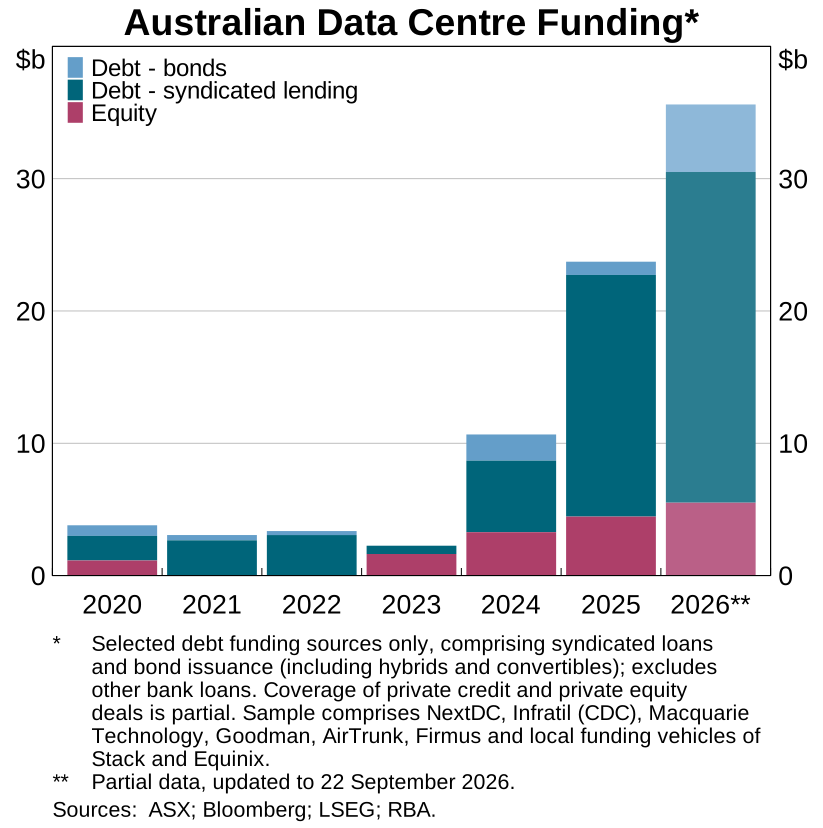
- Australian data centre operators have raised at least $35 billion in 2026 to date, up sharply from recent years, and equivalent to 16 per cent of funding raised by Australian non-financial corporates across the markets covered in this note.
- Australian data centre operators have made greater use of debt funding than equity relative to other non-financial corporations, consistent with patterns observed among similar firms overseas; however, in Australia syndicated lending has constituted most of this debt funding, while bonds and securitisation have played a larger role in the United States.
- Despite rapid growth, funding raised by Australian data centres operators remains small relative to Australian capital markets, suggesting that any crowding out of funding for other sectors is currently limited.
In this note, I estimate the amount of funding that has gone towards Australian companies that own and operate data centres in Australia over recent years. I do this by combining firm-level data on borrowing across a few key funding markets – syndicated lending, bonds and public and private equity. My estimates suggest that these firms have been raising increasing amounts of funding to facilitate their expansions.
Introduction
Data centre construction in Australia has grown strongly in the last few years, and more recently has contributed meaningfully to business investment. Data centres in Australia are generally built and operated by either: (1) large multinational companies, including US ‘hyperscalers’ which operate local facilities to support their cloud platforms and digital services;1 or (2) local firms which provide data centre services to organisations operating in Australia, including US hyperscalers and Australian governments.2 These local companies are mostly either listed on the ASX or privately owned by local investors, and primarily operate data centres in Australia and Asia. To date, local companies have made slightly larger contributions to investment in Australia’s data centre sector than foreign firms.3
This note explores how Australia-focused data centre operators (primarily group 2 above) are funding themselves. This is of interest for two reasons. First, the capital raised by these firms could provide a useful leading indicator for data centre investment in Australia. This is because local firms tend to use external capital to fund construction given their relative youth and the scale of investment underway, and (unlike with foreign firms) this capital could be linked to local projects.4 Second, the scale of AI-related fundraising in overseas markets (most notably the United States) has raised concerns about concentration risk and potential crowding out of financing for other sectors.5 Understanding the scale of data centre funding in Australian markets can help us assess whether similar dynamics are emerging here.
Funding for data centre operators has grown quickly but remains relatively small
I estimate that Australian data centre operators have raised $35 billion so far in 2026 (up from $24 billion in 2025), accounting for 16 per cent of funding raised by Australian non-financial corporates (NFC) across the markets covered in this note. This represents rapid growth from an annual average of $4.6 billion from 2020 to 2024. My estimates cover only syndicated lending, bond issuance and equity issuance, and some private deals (though I have limited visibility on private deals and may be missing some transactions). These estimates cover fundraising for Australian-domiciled companies including the six largest Australian data centre operators and two local funding vehicles of multinational operators.6 Smaller local firms are not present in my data, possibly due to this group funding itself through single-bank loans (which are not covered by our data sources for this note), though data on loan commitments to related sectors (e.g. commercial property construction) suggest that direct bank loans remain a relatively small source of data centre financing despite having also picked up of late. My estimates should therefore be treated as a lower bound.7
Debt plays a large role in data centre funding
Data centre operators in Australia are mostly funded using debt, which has accounted for 85 per cent of new funding raised so far in 2026 (Graph 1) – slightly higher than the estimated range in the United States of 60 to 80 per cent. Data centres have a business model particularly suited to debt financing for two reasons. First, they typically sell long-term leases, sometimes in advance of building a new facility, meaning that these investments have stable and predictable cash flows. Second, construction involves assets (notably real estate) which can serve as collateral for loans, while upside to revenue is capped by the data centre’s physical capacity (reducing the relative attractiveness of equity investment and hence increasing the cost of equity).
Debt funding has come largely from syndicated loans
Debt funding for local data centres has come from two main instruments:
- Syndicated lending ($25 billion of funding so far in 2026):
- Syndicated loans have provided around three-quarters of data centre financing in 2025 and 2026 to date (Graph 1).8 Loan growth has continued to be strong in 2026 to date, with data centres receiving 17 per cent of new syndicated lending (up from 6 per cent in 2025). An additional $13 billion of syndicated deals have been announced this year but are yet to be completed. The main local operators discussed in this note have all raised funds through syndicated lending, while two multinational data centre operators have used project finance for local sites from syndicates involving Australian banks.
- Syndicated loans are attractive for data centre operators as this market allows for greater loan sizes than with a single bank (as lenders can pool risk), while generally being more accessible than the corporate bond market for firms without an investment-grade rating (Liu 2023). Data centres’ higher use of syndicated lending is consistent with the rest of the Australian non-financial corporate sector.
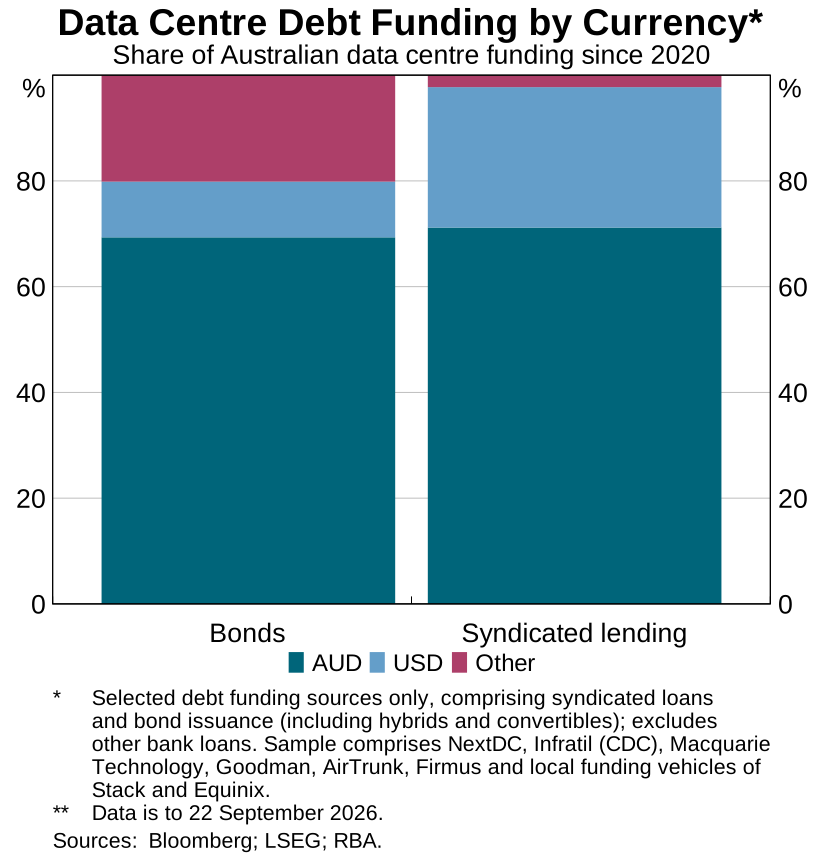
- About 70 per cent of capital raised through syndicated loans by Australian data centre operators is in Australian dollars, with the remainder mostly in US dollars (Graph 2). Data centres have accounted for 7 per cent of new Australian dollar syndicated borrowing so far in 2026.
- Spreads on syndicated loans to data centre operators are in line with those to other NFCs (median since 2024 of 185 basis points vs 175 basis points for other NFCs), suggesting that investors perceive the sector’s credit risk to be broadly comparable to that of the typical syndicated borrower. This may reflect the mitigating effect of tenant pre-commitments on risks associated with rapid sector expansion.
- Corporate bonds ($5 billion of funding so far in 2026):
- Bonds have accounted for 14 per cent of funding for domestic data centres in 2026 to date – a significant increase from 4 per cent of funding in 2025 (Graph 1). Bonds, which in our sample include hybrid securities and convertible notes, nonetheless continue to account for a small share of data centre funding relative to syndicated lending, potentially reflecting the higher fixed costs of issuing bonds, such as mandatory disclosures or the need for a credit rating. While four of the main local operators have issued bonds, the only two with credit ratings accounted for most of this. These two companies have also been issuing more in US and European bond markets, where credit ratings are likely to be more important (given a lack of name recognition) but which also offer greater access to capital for high-yield issuers than Australia (Lowe 2014).
- Bonds issued by data centre operators have had comparable yields and tenors to their syndicated loans, suggesting these factors are unlikely to have been drivers of the lower bond use. Among bonds issued by local data centre operators since 2024, the average spread to swap is 187 basis points, while the average for BBB-rated NFCs is 60–110 basis points depending on tenor. Costs are higher for unrated data centre operators with spreads to swap ranging from 250–350 basis points.
- Bonds may become a more attractive source of funding as these companies continue to grow, as the benefits of having more diversified funding and no financial maintenance covenants could outweigh the costs associated with accessing the bond market. Consistent with this, liaison with debt market participants suggested that they expect those data centres operators that have not accessed the bond market to do so.
- Among capital raised through bonds by domestic data centre operators, 65 per cent have been in Australian dollars, with the remainder in foreign currencies, mostly US dollars and euros (Graph 2). Australian dollar issuance by domestic data centre operators has made up 10 per cent of NFC bond issuance in AUD in 2026 to date.
Data centre operators in the United States have sourced more of their funding through bonds than Australian firms, likely reflecting the smaller scale and higher risk profile of local firms relative to the hyperscalers that dominate US data centre investment. US firms also raised US$25 billion in 2025 by securitising future data centre rents. No Australian operators have used securitisation yet, though industry commentary suggests this may begin in the coming months.9
Equity raisings have increased modestly
While data centre operators have funded most of their investment through debt, some have also raised additional equity funding to help maintain reasonable leverage ratios. By type:
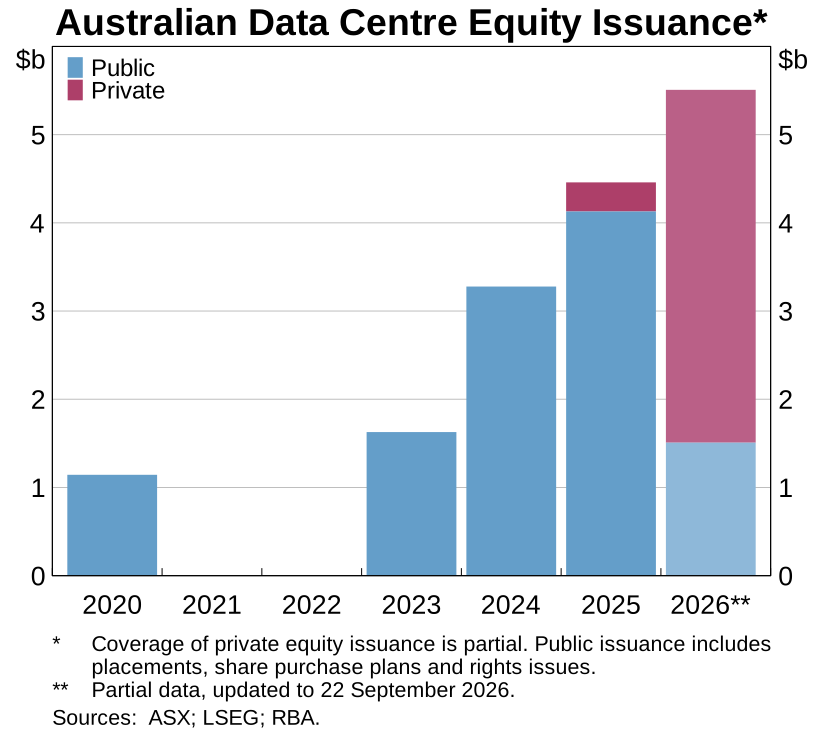
- Public raisings ($1.5 billion so far in 2026): ASX-listed data centre operators (three of six firms in my sample), all of which IPO’d at least a decade ago, have each conducted secondary share issuances. These transactions have been lumpy – only NextDC has issued in 2026 to date, while Goodman Group accounted for all the publicly raised equity in data centres in 2025. Firmus is expected to list on the ASX later this year.
- Private raising ($4 billion so far in 2026): Private equity financing has played a relatively small role until this year (Graph 3). Recent private equity raisings have mostly been for Firmus, which conducted three private equity issuances. However, as discussed above, we have imperfect visibility over private deals and so may be missing some private equity funding.
Funding could become more diversified as the sector continues to grow
Data centre operators have so far been able to fund their investment needs with relative ease, and there is no evidence that access to finance is currently limiting investment. While funding requirements are likely to increase further as the sector expands, data centre financing remains small relative to Australian capital markets. Consistent with this, there is little evidence that growth in the domestic sector has materially affected financing conditions for other borrowers. As data centre operators continue to grow, they are likely to make greater use of a broader range of domestic and offshore funding sources, as has occurred in other infrastructure-intensive sectors.
Endnotes
* I would like to thank Marcus Miller for his feedback on this note.
1 ‘Hyperscalers’ refers to a group of technology companies that are major users of cloud computing and data centre infrastructure, including Alphabet, Amazon, Meta and Microsoft.
2 Foreign companies have demand for data centres physically located in Australia as they allow these firms to provide services that require data to be stored and/or processed domestically, and to reduce latency for Asia-Pacific users.
3 Australian data centre operators are responsible for around two-thirds of the data centre projects that have appeared in the Deloitte Access Economics Investment Monitor between December 2018 and June 2026. This includes projects which are under construction, committed, or under consideration.
4 The financing–investment relationship may be stronger in the data centre sector than the generally weak relationship observed at the aggregate level.
5 See Aldasoro et al (2026) and Crouch et al (2026).
6 The data sample in this note includes Australian-domiciled companies, including subsidiaries of foreign companies, which operate data centres at least partly in Australia and have raised funds in the markets covered in this note. This includes Airtrunk, CDC, Firmus, Goodman, Macquarie Technology, NextDC, and subsidiaries of Stack Infrastructure and Equinix. I do not include Iren Ltd in my sample despite it being domiciled in Sydney, as Iren has primarily built data centres in North America. I also exclude funding raised by overseas companies that has not been clearly linked to specific investment in Australian data centres, such as a recent Australian dollar bond issued by Alphabet.
7 For details on coverage issues in the RBA’s private credit data, see Appendix A of Chinnery et al (2024).
8 A syndicated loan is extended by a group of lenders to a single borrower.
9 See Sawjani (2026).
References
Aldasoro I, S Doerr and D Rees (2026), ‘Financing the AI Boom: From Cash Flows to Debt’, BIS Bulletin No 120, Bank for International Settlements.
Australian Bureau of Statistics (2026), ‘Spotlight – Data Centres in Economic Statistics’, ABS Article.
Chinnery A, W Maher, D May and J Spiller (2024), ‘Growth in Global Private Credit’, RBA Bulletin, October.
Crouch K, W Hu and J Velazquez (2026), ‘The Rise and Concentration Risk of Data Centers in Private Markets’, MSCI Research Insights Blog, 16 April.
Deloitte (2018–2026), Deloitte Access Economics Investment Monitor, Quarterly Reports, December–June.
Liu Q (2023), ‘Syndicated Lending’, RBA Bulletin, June.
Lowe P (2014), ‘Opportunities and Challenges for Market-based Financing ’, Speech to the Australian Securities and Investments Commission, Sydney, 25 March.
Sawjani N (2026), ‘The Infrastructure Revolution: Understanding Data Center Securitisation’, RBC Capital Markets Insights, 13 January.