
Submissions – Labour Market and Inflation Submission to Senate Select Committee on Productivity in Australia
The importance of productivity[1]
Productivity, both current outcomes and its trend pace of growth over time, is a key determinant of the economy’s supply capacity – often referred to as potential output. Understanding recent developments and the expected trend is therefore important for a central bank; in order to assess whether current and expected demand conditions will generate capacity and inflationary pressure, we need to understand the economy’s supply capacity. Given this, productivity is also the key driver of growth in living standards. Productivity growth makes goods and services cheaper to produce and consume, supports sustainable growth in real wages and incomes and, more generally, drives growth in real per capita incomes. As such, the observed slowdown in productivity growth has important implications for Australians’ living standards.
Australia’s productivity performance
Over the longer term, growth in aggregate labour productivity has slowed in recent decades, compared with the 1990s and early 2000s. Similar slowdowns have been observed across several advanced economies (Graph 1).
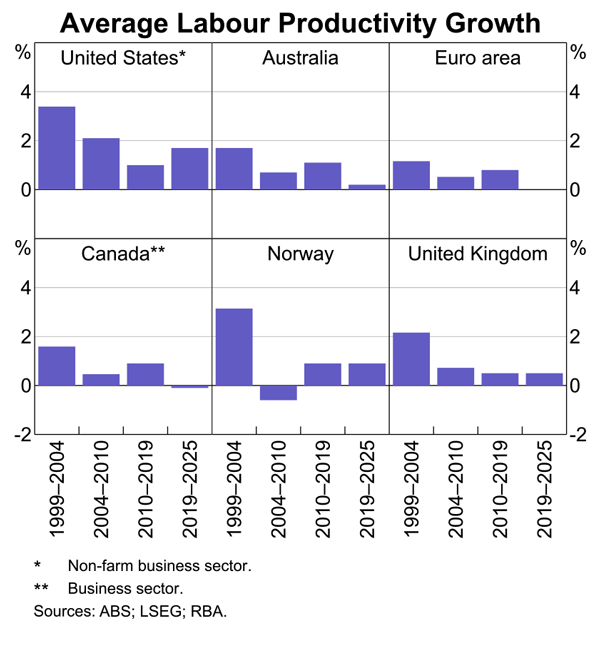
Productivity growth has been particularly weak in recent years, with labour productivity currently sitting at around 2019 levels. Some sector-specific – and likely temporary – factors partly explain some of the weakness in aggregate productivity over the past five or so years. These include strong growth in the non-market sector’s share of the economy, where measured productivity is low, and sharp declines in productivity in the mining sector, possibly as some mining companies have tapped less-productive deposits.[2]
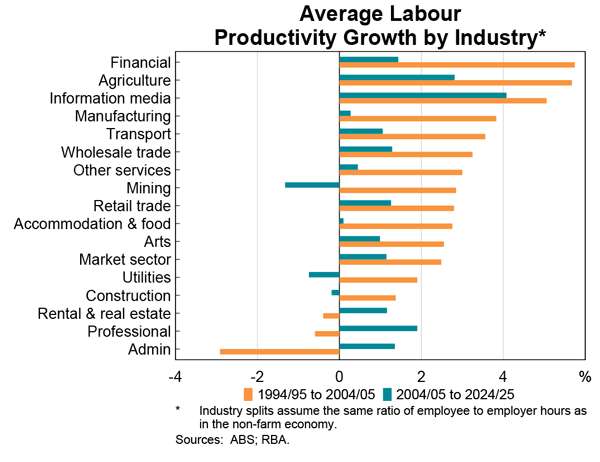
Still, looking over the longer term the slowdown in productivity growth has been quite broadly based. Productivity growth was slower in almost all industries over the past 20 years, compared with the prior decade (Graph 2).
Reflecting these outcomes, in August 2025 the RBA downgraded its assumption for trend annual productivity growth from 1.0 per cent to 0.7 per cent.[3] This rate reflects the average rate of annual productivity growth the economy returns to by the end of the two-year forecast period. Productivity trends evolve slowly over time and a two-year horizon is relatively short period to consider meaningful changes in productivity. The RBA will continue to assess this assumption to incorporate the latest developments in productivity in our forecasts.
Drivers of the productivity slowdown
The ultimate drivers of the productivity slowdown in Australia are still not fully understood and likely to reflect a combination of domestic and global factors. Still, there are several key structural trends that appear to be important:
- Growth in labour productivity has slowed across most economies. Research by the OECD and Australian Treasury has found that technological diffusion has slowed, with Australian firms taking longer to catch up to the global technological frontier – something mirrored in some other advanced economies.[4] Significant investment in artificial intelligence globally may lift productivity over time, but the measured benefit of this is yet to be observed in Australia.
-
Business and labour market dynamism has declined, with firm entry and exit rates falling and
people becoming less likely to change jobs. These two factors appear linked, with much of the
decline in job-switching reflecting fewer people moving to new or young businesses (Hambur
2023).[5]
Lower dynamism has weighed on productivity by slowing the rate at which capital and
labour to move to higher productivity firms.[6]
- Part of this may reflect regulatory barriers. For example, joint work by RBA staff and the NSW Productivity Commission found that dynamism tended to be lower in industries in which occupational entry regulations were more restrictive.[7]
- Joint work by staff at the RBA and the Australian Treasury finds that competition in the Australian economy appears to have declined over the past two decades, and indeed this is one factor that has potentially contributed to declining dynamism and slowing technological diffusion.[8],[9]
- Capital deepening, which measures the rate of increase in the amount of capital available to each worker, is occurring more slowly. That said, this could be a symptom as well as a cause, as slower growth in total-factor productivity should, in theory, lead to slower capital deepening.[10]
- The entry of new workers with fewer skills and less human capital may also have weighed on productivity – an argument that has been put forward over recent years as younger, less educated or less experienced workers were drawn into a strong labour market. However, work done by RBA staff suggested that this factor could explain only a small share of the productivity slowdown.[11]
Reserve Bank of Australia
19 February 2026
Endnotes
This submission draws heavily from material contained in Plumb (2025), Hunter (2025) and RBA (2025). [1]
For a detailed discussion of productivity outcomes over the COVID period, see Productivity Commission (2025), ‘Productivity before and after COVID-19’, Productivity Commission Research Paper, August. [2]
See RBA (2025), ‘Chapter 4: In Depth – Drivers and Implications of Lower Productivity Growth’, Statement on Monetary Policy, August. [3]
Andrews D, C Criscuolo and P Gal (2016), ‘The Best versus the Rest: The Global Productivity Slowdown, Divergence across Firms and the Role of Public Policy’, OECD Productivity Working Paper No 5; Andrews D, J Hambur, D Hansell and A Wheeler (2022), ‘Reaching for the Stars: Australian Firms and the Global Productivity Frontier’, Treasury Working Paper No 2022-01. [4]
Hambur J (2023), ‘Did Labour Market Concentration Lower Wages Growth Pre-COVID?’, RBA Research Discussion Paper 2023-02. [5]
See Hambur J and D Andrews (2023), ‘Doing Less, with Less: Capital Misallocation, Investment and the Productivity Slowdown in Australia’, RBA Research Discussion Paper No 2023-03; Andrews D and D Hansell (2021), ‘ProductivityEnhancing Labour Reallocation in Australia’, Economic Record, 97(317), pp 157–169. [6]
Bowman J, J Hambur and M Markovski (2024), ‘Examining the Macroeconomic Costs of Occupational Entry Regulations’, RBA Research Discussion Paper No 2024-06. [7]
Hambur J (2023), ‘Product Market Competition and its Implications for the Australian Economy’, Economic Record, 99(324), pp 32–57. [8]
Hambur J and O Freestone 2025, ‘How Costly are Mark-ups in Australia? The Effect of Declining Competition on Misallocation and Productivity’, RBA Research Discussion Paper No 2025-05. [9]
In a standard growth model with labour-augmenting technology, the ratio of capital to labour in the economy should grow at the same rate as technology. So if underlying technology and productivity growth is slower, the amount of capital deepening should also be slow. For an excellent treatment of this, see Acemoglu D (2011), ‘14.452 Economic Growth: Lectures 2 and 3 The Solow Growth Model’, Lecture Slides, MIT, 1 and 3 November. [10]
Bruno A, J Hambur and L Wang (2025), ‘A (Closer to) Real Time Labour Quality Index’, RBA Bulletin - July 2025. [11]