
Insight 2026-08 Financial Markets How Important is the Corporate AUD Bond Market?
Insights are short analytical notes in which RBA staff present their own analysis of a range of topics in economics and central banking. The content could align with, extend or even directly challenge the findings of other work undertaken at the Bank.
Disclaimer – The views expressed are those of the authors and should not be interpreted as reflecting or advancing the views of the RBA or its Boards.
Key takeaways
- There has been record issuance in 2026 to date of Australian dollar (AUD) denominated non-government bonds, with the pace of issuance higher than for many other developed market currencies.
- Growth in the AUD non-government bond market has been driven increasingly by foreign (‘kangaroo’) issuers attracted by greater market depth and funding diversification opportunities.
- A larger and deeper AUD bond market may improve funding flexibility for Australian firms and reduce the sensitivity of their funding conditions to disruptions in offshore markets.
The AUD-denominated non-government bond market has grown and deepened over recent years. Record issuance in 2026 to date has further increased its prominence as a funding currency in global bond markets. This note considers the drivers of that growth and the implications of a deeper AUD corporate bond market for Australian firms’ funding.
The AUD has become a more important funding currency for non-government bond issuers
Recent market commentary has noted the growing importance of the Australian bond market, with some describing it as the world’s third-largest or third-most important bond market; however, it is often unclear what metric has been used for these claims. Some sources refer to issuance volumes,1 while others use the term more broadly to describe the attractiveness of Australian bond markets.2 This note focuses on non-government bond issuance as it provides a consistent basis for comparing the AUD’s importance as a funding currency for corporates over time and across markets. The note does not consider outstanding market size and secondary market liquidity.
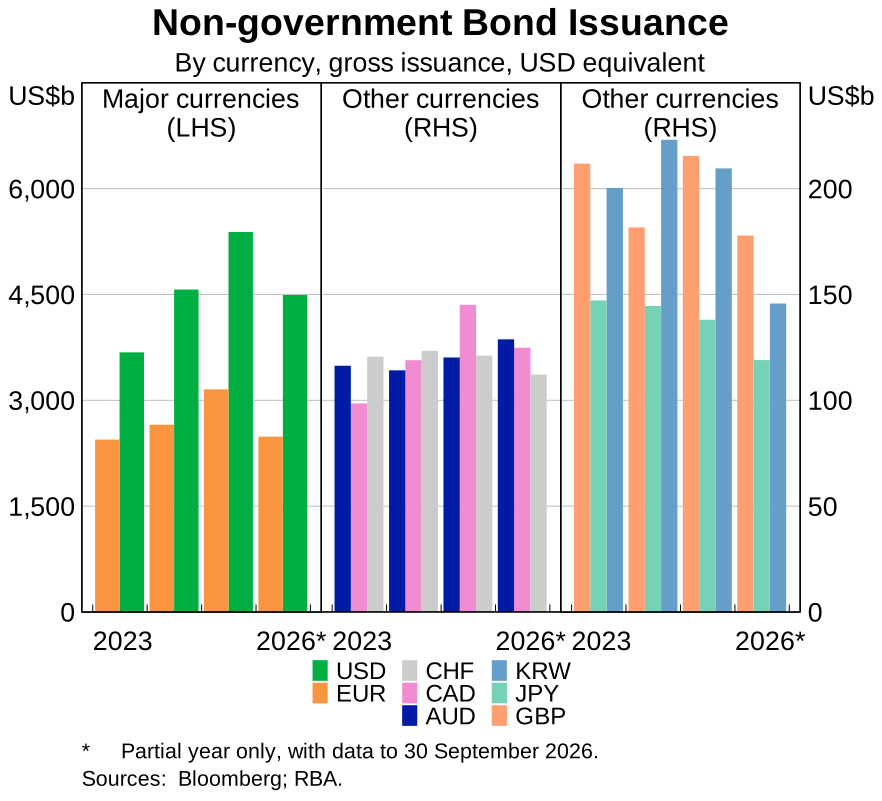
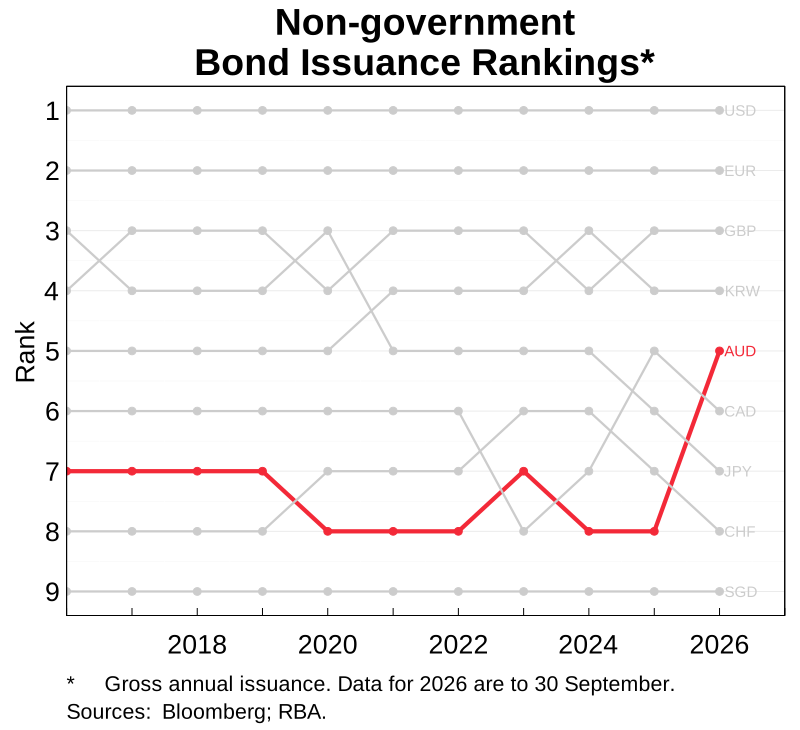
AUD-denominated non-government bond issuance captures both domestic and foreign borrowers choosing to issue in AUD. AUD issuance has historically ranked around 7th or 8th globally among developed market currencies; strong issuance in 2026 to date has lifted the AUD into the top five (Graph 1; Graph 2).3 Within non-government bonds, issuance in AUD in 2026 to date is now behind the US dollar (USD), euro (EUR), pound sterling (GBP) and Korean won (KRW), and larger than the Canadian dollar (CAD), Japanese yen (JPY) and Swiss franc (CHF).
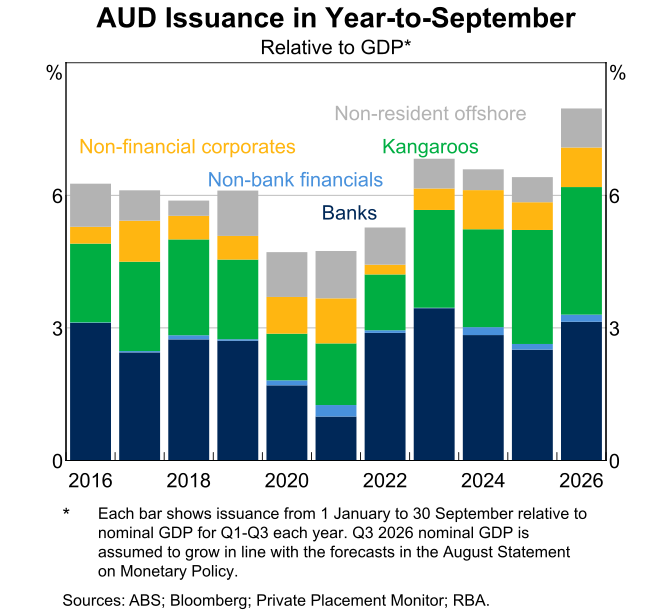
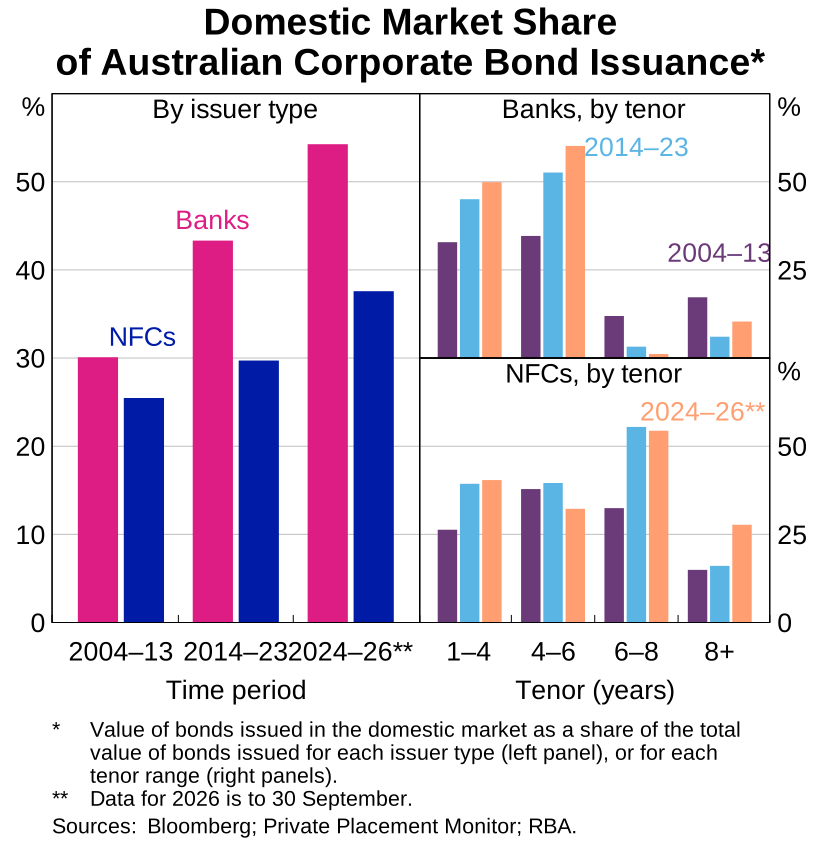
Year-to-date AUD issuance has also reached a record level relative to GDP (Graph 3). Domestic issuance from Australian banks and non-financial corporates (NFCs) has increased over the past two decades, including as a share of their overall issuance (Graph 4). More recently, however, growth in overall AUD issuance has been driven increasingly by kangaroo bond issuance, with more foreign issuers raising funds in the AUD market and issuing in larger deal sizes.
Greater market depth has supported strong AUD issuance
The AUD bond market appears to have deepened over time, evidenced by its capacity to absorb larger transactions, support longer tenors, and accommodate a broader range of issuers. Several factors may have contributed to this. First, growth in Australia’s superannuation sector has increased the pool of funds available for fixed-income investments. Second, market participants have noted that being in the Asian time zone allows participation from a large pool of offshore investors. Third, strong growth in some Asian economies in recent decades and a desire to diversify away from USD assets may also have added to investor demand.
These developments have created a positive feedback loop. Greater issuance supports market development and investor participation, which in turn increases the market’s capacity to absorb additional issuance and attracts a broader range of issuers. While it is difficult to disentangle the effect of this feedback loop from other factors, it is notable that Australian banks now issue over half their bonds domestically (up from 30 per cent in the decade to 2013) and domestic issuance now accounts for 38 per cent of non-financial corporates’ overall issuance, with the increase particularly prominent at the longer end (Graph 4).
Funding diversification has become increasingly important for foreign issuers
Foreign issuers increasingly view the AUD market as a complementary funding source alongside traditional USD and EUR markets, particularly as part of broader funding diversification strategies (Thomson 2026).4 Recent inaugural kangaroo bond issuance by Asian corporate issuers such as CLP Power and MTR Corporation illustrates this trend. In addition, Alphabet’s record kangaroo bond issuance in August provides an example of a hyperscaler accessing the AUD market, with reports suggesting interest from other hyperscalers in AUD issuance.5
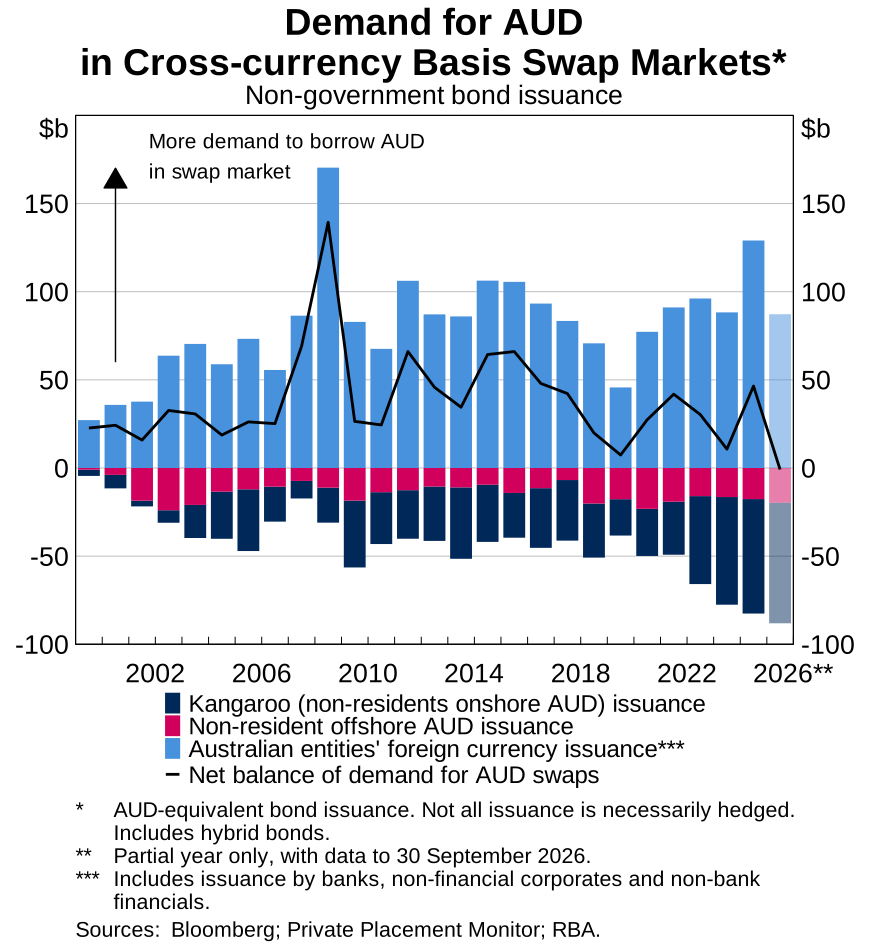
Historically, favourable cross-currency basis swap pricing provided an additional incentive for foreign borrowers to issue in AUD. More recently, however, this basis advantage has narrowed as growing kangaroo issuance has led to more balanced supply and demand of AUD in cross-currency swap markets (Graph 5). Despite this, kangaroo issuance has continued to grow, suggesting that funding diversification and other non-price factors have become increasingly important drivers of issuance decisions.
These bond market developments may have increased financing flexibility for Australian firms
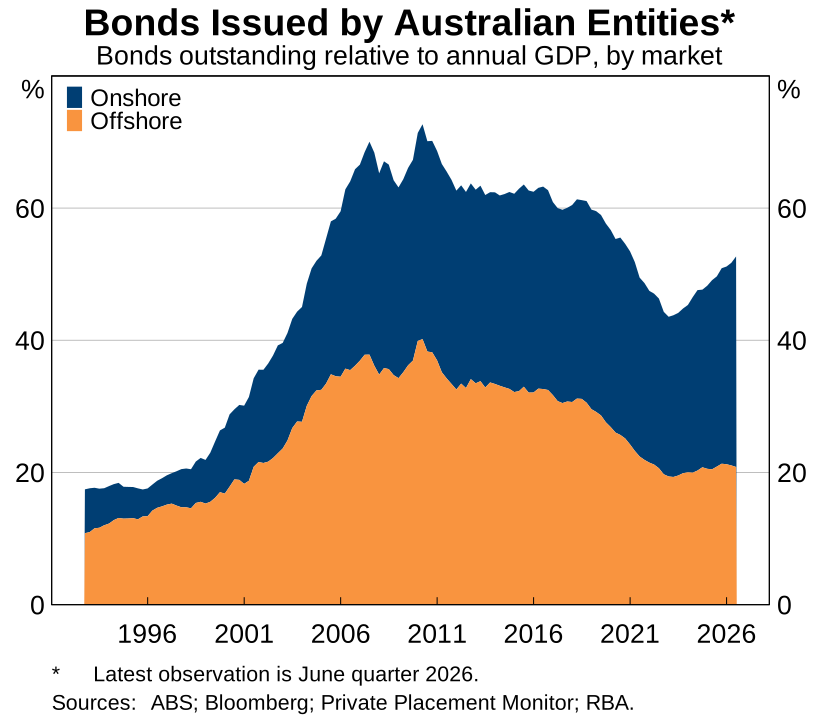
The growth and deepening of the AUD corporate bond market have potentially expanded the financing options available to Australian firms. In line with this, firms have increasingly shifted to onshore issuance even as they continue to raise a substantial share of their funding offshore (Graph 6). While financial conditions are highly influenced by global conditions, a larger and more developed market for AUD issuance should increase firms’ ability to substitute across funding sources and investor bases. These developments should, at the margin, reduce the sensitivity of corporate funding conditions to disruptions and place downward pressure on the risk premium on AUD debt (and hence lower borrowing costs overall).
Endnotes
* I would like to thank Ben Watson and Iris Chan for their feedback on this note.
1 For example, FC Capital (2026) and Poidevin (2026) noted that AUD bond issuance ranked third globally, behind only USD and EUR markets.
2 For instance, Commonwealth Bank of Australia (2025), KangaNews (2026) and Corrs Chambers Westgarth (2026) highlighted the growing importance of the Australian bond market for global issuers.
3 Relative rankings can vary over the course of the year as issuance patterns differ across currencies. Comparisons of cumulative issuance at similar points in recent years suggest that the AUD’s ranking has been higher in 2026 than in previous years.
4 See issuer announcements from Telefonica (2026) and CaixaBank (2026), which noted funding diversification and access to new investors as motivations for issuing in the Australian market.
5 See Lefort and Shapiro (2026).
References
CaixaBank (2026), ‘CaixaBank Debuts in the Australian “Kangaroo” Market, Raising A$1bn Across Two Senior-Preferred Bond Tranches’, News, 14 May.
Commonwealth Bank of Australia (2025), ‘Kangaroo Bonds Power Record Surge in Australian Debt Market’, Newsroom, 28 October.
Corrs Chambers Westgarth (2026), ‘Australia’s Debt Capital Market: Growth, Reform and the Road Ahead’, Insights, 29 May.
FC Capital (2026), ‘Record AUD Bond Issuance’, Insights, 17 February.
KangaNews (2026), ‘Australia Joins the Podium for Global Bank Issuers’, News, 29 May.
Lefort C and J Shapiro (2026), ‘Amazon Poised to Follow Alphabet with $A Jumbo Bond Offer’, Australian Financial Review, 31 August.
Poidevin S (2026), ‘Why Kangaroo Bonds are Bouncing Back’, Insights, 28 January.
Telefonica (2026), ‘Telefonica Executes a Successful 700 million Australian Dollars Inaugural Bond Issuance’, Press Room, 23 June.
Thomson M (2026), ‘Australian Fixed Income Leaps Forward on Kangaroo Bond Growth’, Australian Securities Exchange, 26 March.