
Insight 2026-06 Australian Economy Inflation Expectations and the ‘Last Mile’ of Disinflation1
Insights are short analytical notes in which RBA staff present their own analysis of a range of topics in economics and central banking. The content could align with, extend or even directly challenge the findings of other work undertaken at the Bank.
Disclaimer – The views expressed are those of the authors and should not be interpreted as reflecting or advancing the views of the RBA or its Boards.
Key takeaways
- This note was written in November 2025 and sets out the authors’ views on possible upside risks to inflation at the time. In 2025, households’ short-term inflation expectations had drifted above a level that was consistent with the mid-point of the RBA’s inflation target range. This represented an upside risk to forecasted inflation, suggesting that achieving the ‘last mile’ of disinflation may have required a more pronounced slowing in demand than had been thought at the time.
- Model-based analysis suggested this increase in household inflation expectations reflected the continued influence of the recent high inflation episode on households’ expectations and that the earlier decline in expectations to around the target mid-point during 2024 may have been temporary.
- This drift in short-term inflation expectations posed a risk that inflation could prove more persistent than forecasted at that time. In this context, closing the unemployment gap (rather than opening a positive gap) may have been insufficient to return inflation to the mid-point of the target within a reasonable timeframe.
Motivation
Inflation expectations are an important input into people’s price/wage decisions (Weber et al. 2022). Expectations above the target midpoint could therefore make inflation more difficult to bring down relative to when expectations remain at the midpoint. While we normally focus on long-term expectations to assess whether inflation remains ‘anchored’, temporary drifts in short-term expectations could mean policy needs to do more to bring inflation back to target in the near-term.2
In this note, we seek to understand whether households’ short-term expectations have drifted higher, what has caused this upward drift, and what this might mean for policy.
Results
Households’ one-year ahead expectations have drifted higher recently, to a level inconsistent with the midpoint of the inflation target (Graph 1).3 These elevated expectations are consistent with how households have historically formed expectations (according to the model estimated in Brassil et al. 2024), suggesting the drop in expectations during 2023 and 2024 may have been temporary.4
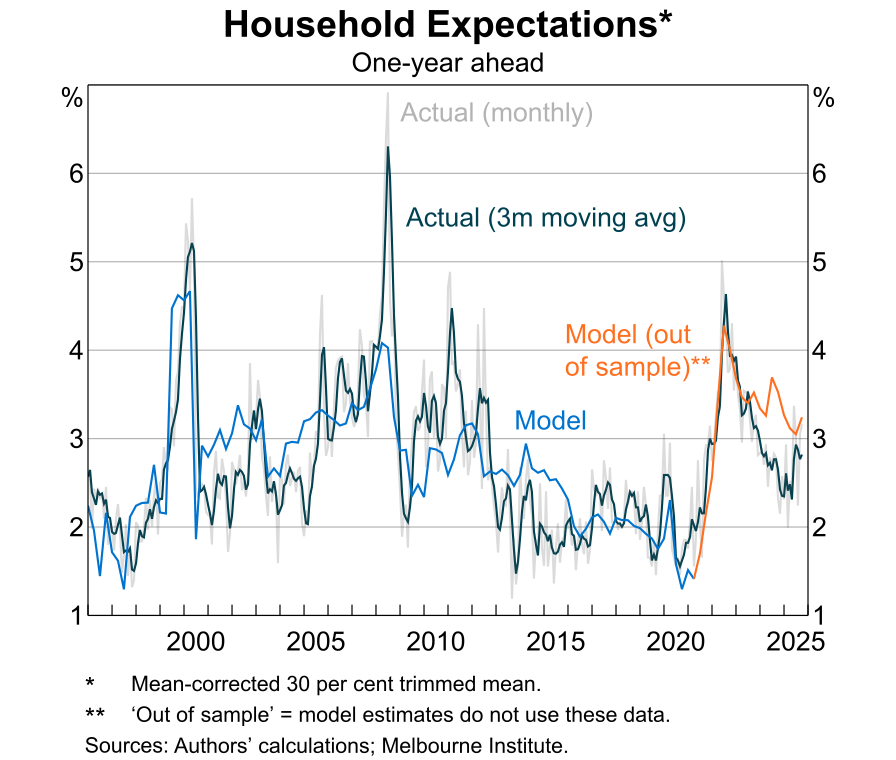
Half to three-quarters of households are estimated to base their expectations on their lived experience, with the remainder incorporating more forward-looking information. With the ‘lived experience’ households estimated to update their expectations slowly, the upward drift in their expectations resulting from the recent high inflation episode is predicted to keep aggregate short-term expectations elevated and could persist for some time even after inflation returns to the midpoint (see Appendix). While the model may of course be wrong, this does suggest an upside risk to inflation expectations.
Policy implications
Previous internal RBA work has not found much additional forecasting power from incorporating short-term expectations into our forecasting models, meaning these elevated short-term expectations do not directly feed into our forecasting models. They could, however, be partially incorporated via other modelled relationships (e.g. lagged inflation) and therefore be important for decision making (as suggested by economic theory).
Given the potential incomplete capture of these expectations in our forecasts, this drift in short-term expectations represents an upside risk to inflation, and is consistent with the idea that the ‘last mile’ of disinflation will be harder to achieve. This is because, in a Phillips curve framework, closing the unemployment gap will only be sufficient to bring inflation in line with expectations. If expectations have drifted, a closed unemployment gap would mean inflation would remain above the midpoint until these expectations drift back.
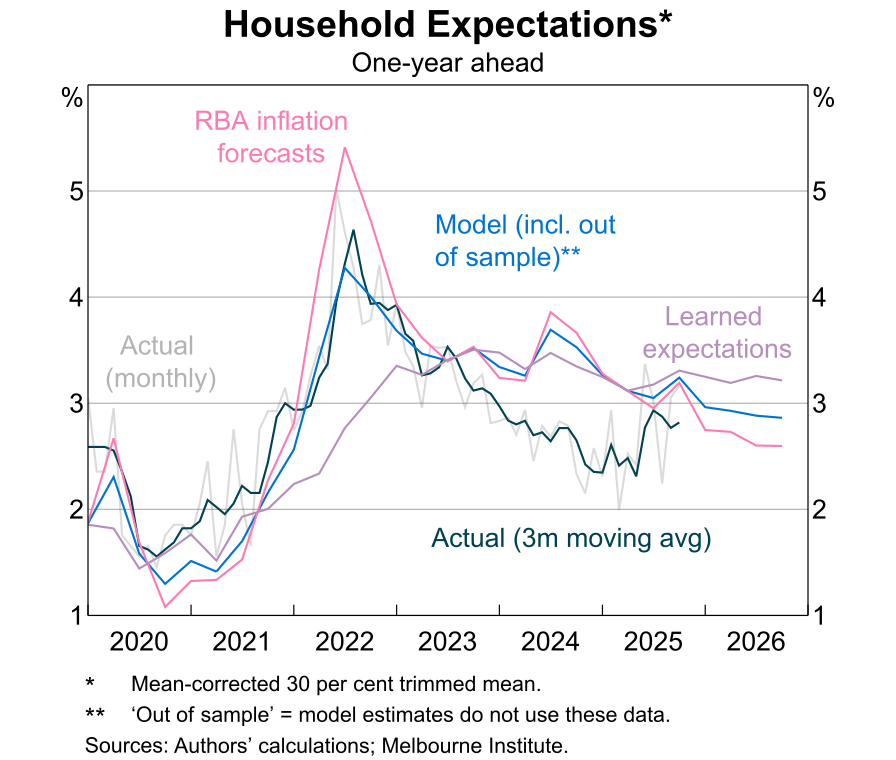
With a closed unemployment gap, this drift back could take a long time (Graph 2), and it is possible that expectations and inflation could get stuck above the midpoint. A positive unemployment gap would both ensure this downward drift in expectations occurs and would achieve it faster.
Appendix
The model-predicted short-term expectations can be projected forward assuming inflation outcomes are in line with current RBA forecasts. The ‘lived experienced’ (learned) expectations remain elevated even as RBA forecasts continue to decline towards the midpoint (Graph 2). This causes the model-predicted aggregate short-term expectation to decline slowly.
Understanding the cause of the unpredicted decline in expectations during 2023 and 2024 is beyond the scope of this note.5 Previous work has looked into salient prices, but has found limited evidence of significant effects (Brassil et al. 2024). While this previous work was able to identify fuel as a significant salient price—and large fuel price falls explain some of the persistent deviation between expectations and the model around 2015 (Graph 1)—including fuel prices in the model does not explain the gap in 2024.
The recent drift in expectations is much larger than can be explained by the roll-off of energy rebates (according to the model). The roll-off entered the RBA one-year-ahead forecasts in 2024Q3, with little change in actual expectations at that time. The roll-off then feeds into the learned expectations after it is experienced (from 2025Q4), later than the drift in actual expectations.
References
Beaudry P, C Hou and F Portier (2024), ‘The Dominant Role of Expectations and Broad-Based Supply Shocks in Driving Inflation’, NBER Working Paper No 32322.
Brassil A, J Hambur and C Ryan (2024), ‘Understanding and Predicting the Inflation Expectations of Australian Households’, RBA Research Discussion Paper 2024-07.
Coibion O and Y Gorodnichenko (2015), ‘Information Rigidity and the Expectations Formation Process: A Simple Framework and New Facts’, American Economic Review, 105(8), pp 2644–2678.
Coibion O and Y Gorodnichenko (2025), ‘Inflation, Expectations and Monetary Policy: What Have We Learned and to What End?’, NBER Working Paper No 33858.
D’Acunto F, F De Fiore, D Sandri and M Weber (2025), ‘A Global Survey of Household Perceptions and Expectations’, BIS Quarterly Review, September.
Haidari Y and G Nolan (2022), ‘Sentiment, Uncertainty and Households’ Inflation Expectations’, RBA Bulletin, September.
Pfäuti O (2025), ‘The Inflation Attention Threshold and Inflation Surges’, EMPCT Working Paper Series No 2025-06.
Werning I (2022), ‘Expectations and the Rate of Inflation’, NBER Working Paper No 30260.
Weber M, F D’Acunto, Y Gorodnichenko and O Coibion (2022), ‘The Subjective Inflation Expectations of Households and Firms: Measurement, Determinants, and Implications’, Journal of Economic Perspectives, 36(3), pp 157–184.
Endnote
1 For their thoughtful feedback and suggestions, we would like to thank Meredith Beechey Österholm, Sarah Hunter, Tommy Iao, Joseph Kachovec, Kevin Lane, Gulnara Nolan, Matthew Read, Ekaterina Shabalina and Anirudh Yadav.
2 In standard models, short-term inflation expectations are more important for pricing decisions than long-term inflation expectations (e.g. Werning 2022). Some studies suggest that the increase in households’ short-term inflation expectations explains the majority of the recent inflation surge (e.g. Coibion and Gorodnichenko 2025; Beaudry, Hou and Portier 2024).
3 Household expectations have a large upward bias relative to inflation outcomes (Haidari and Nolan 2022). In this graph, we follow the standard approach of mean-correcting the survey results to be more directly comparable to inflation.
4 The R2 of the model is 0.55. Re-estimating the model up to the most recent period produced insignificantly different estimates and conclusions. This model is just a small part of a long literature aimed at understanding expectation formation (e.g. see Coibion and Gorodnichenko 2015, Weber et al. 2025 and Pfäuti 2025).
5 Allowing for time variation in the parameter estimates cannot explain the temporary decline in expectations. This is because the decline in expectations was faster than predicted by either forward- or backward-looking expectations (Graph 2).