
Bulletin – May 2026 Australian Economy The Bank’s Story in Ten Objects
Abstract
The Reserve Bank of Australia has an unusually large and rich historical archive. This is because we descend from the original government-owned Commonwealth Bank of Australia (which had itself absorbed earlier government banks of colonial origin). As a result, our collection captures over 200 years of Australia’s economic, financial and social history. The collection supports many veins of research. It also enables us to trace the development of our central banking responsibilities and the events that have shaped our place in history and character as an institution. In this article, we tell the Bank’s story in ten objects.
The beginning of things
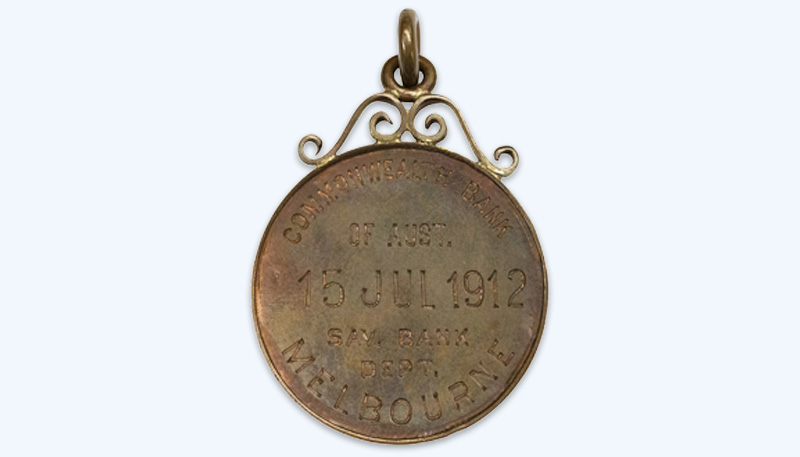
The original government-owned Commonwealth Bank, from which we descend, was established by the Commonwealth Bank Act 1911 before opening its doors for business on 15 July 1912. The new Bank was to operate as both a trading and savings bank. Known as ‘the people’s bank’, expectations for the institution were high and its opening was of national significance. Just before the opening, a storeman found a halfpenny on the floor of the strongroom. He considered it to be a ‘good omen’ that the Bank would never be without a ‘shot in the locker’. He had the coin mounted as a memento for the first Governor, Denison Miller, and engraved with a date stamp for the Bank’s opening. In an eloquent letter (reproduced in full in Appendix A) that accompanied the halfpenny, the storeman expressed these wishes to the Governor:
… In years to come when the great institution over which you have been called to preside has been established throughout Australia and has even extended its operations beyond our own territories it may serve to recall the beginning of things. It [the halfpenny] records the date on which the Commonwealth Bank of Australia first opened its doors for the receipt of the people’s savings, and for that reason alone may be of interest.
Yours sincerely,
W. Campbell Milne
What has come to be known as the ‘lucky penny’ (shown in Figure 1) has been shown to Governors and staff over the years, but perhaps most pertinently to Governor Glenn Stevens after the collapse of Lehman Brothers, as central banks were confronted with the most defining moment of the global financial crisis.1 The coin is among a number of rare and symbolic items in our rich numismatic collection.2
A war-time bond
At the commencement of the First World War, the Commonwealth Bank had been established for just two years. The enormity of the challenge facing the institution is unimaginable to us today. The Bank was seeking to establish itself as a national institution at the same time as it grappled with the consequences of war for the nation – and for its staff. When the war broke out, the Bank had 228 male staff; of those, 206 would enlist. As the Bank took on very few men of military service age in the years that followed, this contribution was remarkable.
During the war, Ernest Hilmer Smith, the Superintendent of the Hobart Branch, was among those who wrote moving and detailed descriptions of life on the frontline to Governor Denison Miller, highlighting the rapport the Governor had with officers of the Bank. These letters include one that Hilmer Smith wrote after the landing at Gallipoli (reproduced in full in Appendix B). An extract of his letter is provided below and an image in Figure 2.
Anzac
Gallipoli Pen
near Gaba Tepe
27/6/15… Our first week of service here was one that none of us are likely to forget. Landing at 4 am on the 25th April we were kept exceedingly busy for over a week, in beating off the Turks, who are by no means an enemy to treat lightly. We had a slight cessation of hostilities for about two days and then at it again. The final effort so far was made by the enemy on the 18th/19th May when he fought for all he was worth, but failed to dislodge us.
It is estimated that there were 7000 casualties in these two days, so you can imagine the vigor with which the attack was made. …
I have no more paper with which to continue so will postpone giving further news till more paper arrives. Wishing yourself and members of the Staff all happiness & prosperity – Believe me – Sir – Sincerely yours, E. Hilmer Smith Lt. Col. of 12th Bn.
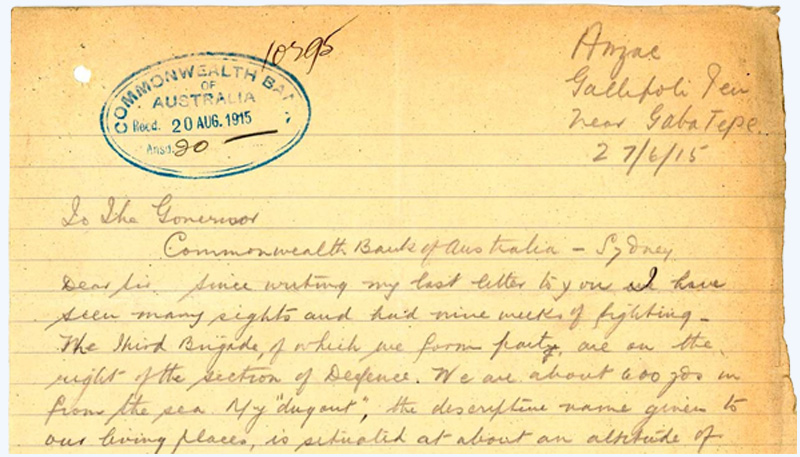
Hilmer Smith, who would be awarded the Companion of the Order of the Bath (CB), arrived in one of the first landing parties at Gallipoli on 25 April 1915. He remained there for most of that campaign (including as Commandeer of the 12th Battalion) before serving in France and Belgium. His letters to the Governor were not only poignant but at times poetic, humorous and heartbreaking.3 They provide a firsthand account of the realities of war, a deep appreciation of the pastoral care provided by the Governor, and a vocational commitment to the new institution. Like most letters written to the Governor by staff on the frontline, of which our archives contains a rich collection, they closed with well wishes for the Bank.
The First World War presented the Bank with the great challenge of how to finance the war effort, and how to finance Australia’s international trade under war conditions. In addressing these matters, we established our first central bank function of being banker to the government, and a leadership role in what would later become our responsibility for the payments system. We did so amid a deep war-time bond between all staff.
When war first broke out, three of Governor Miller’s sons volunteered for service. The eldest, Clive Miller, served throughout the Gallipoli campaign before being killed in action at Messines, Belgium on 4 July 1917. News of his death was met with deep sorrow among Bank staff, who raised funds to commission a portrait of Clive for the Governor and his wife. Condolences were received from across Australia and overseas, including from King George V and Queen Mary, with many of these preserved in our archives.
In June 1920, Governor Miller was knighted by the visiting Prince of Wales (later Edward VIII). The honour recognised his personal leadership as Governor and the significant achievements of the Commonwealth Bank during his tenure, especially during the war years.4 When Sir Denison Miller died suddenly in office on 6 June 1923, the response was extraordinary. Staff, political and business leaders and the general public in Australia and abroad expressed profound grief. Miller’s leadership during the War, his public service and influence had earned him a reputation as a father figure. At a public meeting in Sydney on 10 June 1923, it was unanimously resolved that the title ‘Governor’ should not be used for his successors, and that a new title, such as ‘President’, should be created so that ‘the people down through the centuries to come will think of Sir Denison Miller as always being with them as Governor of their Commonwealth Bank assisting in the shaping of Australia’s great destiny’ (RBA Archives GDM-23-10). The title of Governor was ultimately retained. However, this episode indicates the public’s expectation of permanency of the central bank, its importance for the nation’s economic welfare and their deepest regard for its first leader.
The central bank’s first economist
In 1930, Bank of England officials came to Australia to assist Australian governments with their budgetary problems and found, to their surprise, that the Commonwealth Bank did not have a professional economist on its staff. They urged the Governor to appoint a qualified economist and recommended Leslie Melville, Professor of Economics at the University of Adelaide.
Melville immediately established what became known as the Economist’s Branch. He began to collect and analyse economic data, and prepared regular reports for the Bank’s Board on economic and financial conditions in Australia and overseas. He established intellectual traditions and approaches to policy deliberation – including objectives for monetary policy – that shaped the institution and laid the foundations for more central banking functions.5
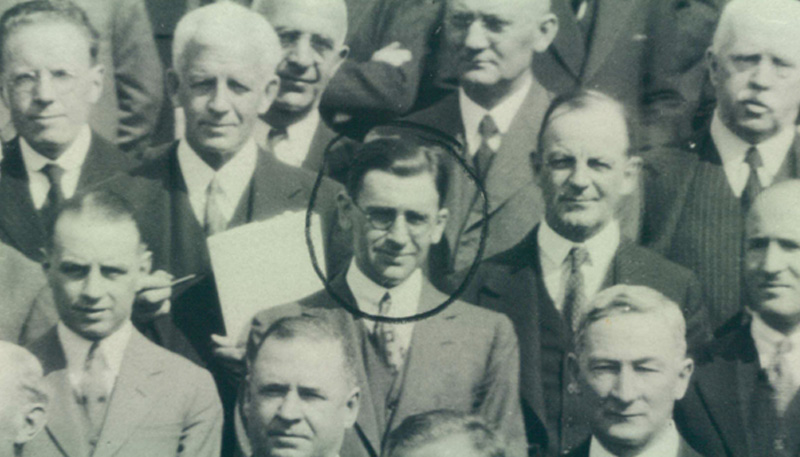
The importance of Melville’s appointment and contribution to public policy is detailed in Cornish (2021). In brief, before joining the Bank, Melville had already helped shape Australia’s economic response to the Great Depression. In 1931 he served on the Copland Committee that crafted the Premiers’ Plan, a program of economic stabilisation later praised by John Maynard Keynes as having ‘saved the economic structure of Australia’ (Keynes 1932). Melville subsequently attended the historically significant Imperial Economic Conference in Ottawa in 1932 – for which we have a photograph – and the World Economic Conference in London in 1933, where he contributed to debate about how to manage economic recovery from the Great Depression (Figure 3).6 Returning home from the conference in Ottawa via London, he sought the views of economic experts there, notably Keynes. Keynes invited Melville to his home, and later to his famous Monday evening discussion group at King’s College, Cambridge. Melville was to meet Keynes on a number of occasions and they became frequent correspondents, with this relationship a measure of Keyne’s regard for our first central bank economist.
Melville would go on to play a defining role in how countries responded to the dismantling of trade barriers at the end of the Second World War, with the United States and other powerful nations committing to domestic policies aimed at maintaining full employment (the ‘Full Employment Approach’ or ‘Positive Approach’). Melville would also lead Australia’s delegation to the United Nations (UN) Monetary and Financial Conference at Bretton Woods, which created the International Monetary Fund (IMF) and the World Bank. However, in 1948 his career was set back when Prime Minister and Treasurer, Ben Chifley, nominated Dr HC Coombs to be Governor of the Commonwealth Bank – a position that Coombs himself had argued to the Prime Minister should have gone to Melville.
Governor Ian Macfarlane gave the public lecture at the Australian National University to celebrate the 100th birthday of the then Sir Leslie Melville. Having researched Melville’s contribution to the Bank, Macfarlane concluded that ‘you could be forgiven for thinking that Melville was the central bank’. In assessing Melville’s influence as a central banker and adviser to Australian governments (from the 1920s to the 1970s), Macfarlane said that ‘any objective assessment of achievements would place Sir Leslie among the most distinguished Australians of the past century’ (Macfarlane 2002).
A gold standard7
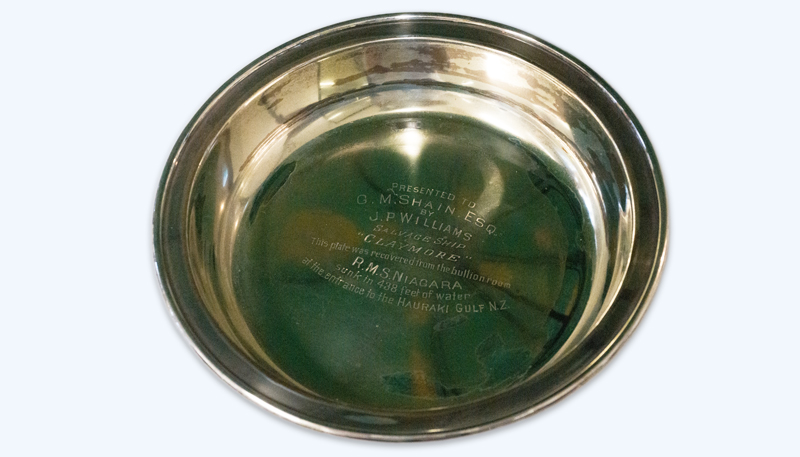
Both depression and war present central banks with unique responsibilities, with the Second World War furthering the Bank’s role as banker to the government and requiring new approaches to delivering these services, given the geographic scale of the war. In fact, battleships became floating Bank branches that ensured the continuation of banking business and payment of service personnel. But perhaps one of the most surprising and dramatic episodes in our history relates not to a battleship but to the sinking of the RMS Niagara – a passenger steamer that served the route between Australia, New Zealand and Canada. On 19 June 1940, during a regular voyage from Sydney to Vancouver, it struck a German mine off New Zealand’s North Island and sank.8 All passengers and crew were rescued. Unbeknown to the public, however, the ship was carrying a consignment of gold on behalf of the British Treasury. Stored in the Niagara’s bullion room were 295 boxes containing nearly eight tons of gold bullion (valued then at approximately £2.5 million – around $1.7 billion today). Intended as payment to the United States for munitions, recovery of the gold was essential to the allied war effort.
The Commonwealth Bank, acting as the Bank of England’s agent in Australia, was asked to assist. Gordon Murray Shain, Deputy Governor of the Bank, was appointed to coordinate what would become one of the most remarkable salvage operations of the Second World War, and an extraordinary commitment to another central bank and our responsibilities as banker to the government.
Captain John Protheroe Williams and the United Salvage Pty Ltd syndicate were assigned the salvage task. Williams was an experienced master mariner and salvor, who would later be knighted for his service to the Empire. Wartime shortages meant that the salvage vessel had to be improvised. A small 200-ton coastal steamer, the Claymore, was found in Auckland Harbour and hastily restored for the operation.
For months, Williams and his crew of 10 men worked in heavily mined waters in an active theatre of war, battling strong currents and frequent storms. Operating in secrecy, they attempted a salvage at what was then a record depth; they twice struck unexploded mines. Despite these dangers, they located the Niagara, blasted an entry to its hull, and began the delicate task of retrieving the bullion. The first box of gold was recovered in October 1941. By December, over 90 per cent of the lost gold had been raised.9
Various silver items and utensils were also recovered from the wreck, among them a silver-plated dish cover located in the ship’s bullion room. Captain Williams had the dish inscribed and presented it to the Deputy Governor in recognition of his leadership in co-ordinating the recovery. Shown in Figure 4, the dish stands as both a personal tribute and an artefact from what was one of the most ambitious and successful salvage operations in maritime history. On 12 March 2002, the dish was donated to the Bank by Gordon Murray Shain’s daughter (Mrs Dorothy Todhunter), ensuring its long-term preservation and connection to our wartime service and history.
A sign of the times
During the post-war period, the Commonwealth Bank progressively acquired more responsibilities of a central bank. The scale of these responsibilities warranted a separate body. But there was also a conflict of interest as the Bank had become both a regulator and a competitor of other banks. Ultimately, there was ‘separation’ of its commercial and central banking functions under the Reserve Bank Act 1959. The Commonwealth Bank would be renamed the Reserve Bank of Australia and act as the nation’s central bank, while the newly created Commonwealth Banking Corporation would operate as a trading bank. We commenced operations on 14 January 1960.
Dr HC Coombs was our first Governor, having been the last of the Commonwealth Bank – where he had served as Governor from 1949, following his leading roles in Australia’s war-time administration and post-war reconstruction, including development of employment policy and a white paper on ‘Full Employment in Australia’.10 Furthermore, along with Melville and LF Giblin, Coombs was an architect of the ‘Full Employment Approach’ that supported growth in small open economies like Australia as war-time trade barriers were removed. Often described as the nation’s greatest civil servant, he was renowned for facilitating progress – including beyond policy advice to government and central banking. Dr Coombs won acclaim for his work in promoting the arts, the rights and welfare of First Nations Australians, and preservation of the natural environment.
Coombs’ ethos was to build a central bank that was ‘planned for progress’.11 As explained by the Bank’s Curator, John Murphy, this would be evident in the new head office building at 65 Martin Place, which adopted the modern international style of architecture and, for a central bank, was symbolic of transparency to the public and an openness to international developments. It was also evident in his choices for the building’s interior design, artworks, technology and approaches to engaging staff.12
Among his progressive ideas was an enthusiasm for abstract forms, nowhere more so than in the artworks selected for our public spaces and our logo. Coombs commissioned the renowned industrial designer Gordon Andrews to create the logo. It proved to be a challenging commission for the designer who ultimately sought advice from the Governor. Andrews wrote in his autobiography that Coombs’ suggestion of producing something abstract ‘liberated his creativity’. In being abstract, the logo attracted much public interest and comment. In response, Andrews said:
The Reserve Bank’s design … does not imitate or symbolise anything. It is quite distinctive, with its own personality. It is simply a design which echoes something from heraldry, from coinage, and is therefore suitable for a bank. I feel that the emblem will last because it is a sound and stable design. … But only time will tell. If, five years from now, people agree that it is a successful emblem, recognisable everywhere as the Reserve Bank’s, then I will be content. (RBA 1960)
Of course, 65 years on, the logo is recognisable as ours (shown in Figure 5). Importantly, unlike those of other central banks, it is not an appropriation of an existing national symbol or representation of a central bank building, but a unique form that was very much a sign of the times.

The decimal revolution13
In the late 1950s, the Australian Government began thinking about the practicalities of replacing pounds, shillings and pence with decimal currency – a money system that would greatly simplify calculations and increase financial efficiency, but entail radical change to the way the nation undertook all of its transactions. In 1963, the government announced its intention to make the change with a conversion date (known as ‘C-Day’ for Changeover Day) set for 14 February 1966. Such a change required a vast program of work – both educational and logistical that would reach every household and business. The government established the Decimal Currency Board to oversee the conversion and the Bank played a critical role. We were responsible for the design, production and distribution of the new banknotes ($1, $2, $10 and $20 denominations at the time). This brought to public consciousness the central bank function of note issuance and associated us with a major milestone in the nation’s social and economic history.
Dr HC Coombs invited seven renowned designers to take part in a competition to design the new decimal currency banknotes. Four agreed: Gordon Andrews, Richard Beck, Max Forbes and George Hamori.14 Beyond the use of the Queen on the $1 banknote, few instructions were given regarding themes and portraits other than the designs should capture the diverse and unique aspects of Australia (and a list of suggested historical characters and topics was supplied). While all the designs were considered highly commendable, the advisory committee was unanimous in its selection of Andrews’ designs, which was approved by Coombs and the Treasurer and Prime Minister.
In keeping with Andrews’ innovative design of our logo, his banknote designs were bolder and more vivid in colour than Australia’s previous banknotes and the alternative designs put forward. As Andrews explained:
… I had envisaged a bold, colourful note. My rationale was that we are a strong vigorous nation and our currency should reflect this characteristic (Andrews 1993).
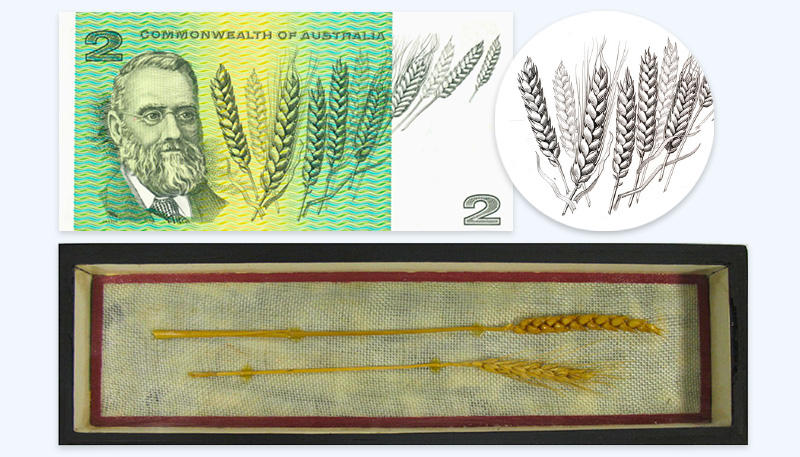
Andrews viewed banknotes as vehicles for representing national identity and his designs included carefully researched imagery. Many of the inspirational materials used for the design of the decimal currency banknotes remain in our archives. Among these are some remarkably fragile objects, like the original shaft of wheat used in the design of the $2 banknote (shown in Figure 6).15
The revolutionary design of Australia’s decimal currency banknotes would continue to be a signature of future Australian banknotes series, with innovation and distinct national character evident in our polymer banknotes.
The floating of the dollar
The floating of the Australian dollar on 12 December 1983 was one of the most significant economic policy decisions in Australia’s history. Having a market-determined exchange rate would fundamentally change Australia’s economy. It gave the Bank control over the amount of cash in the money market so that we could set the short-term price of money based solely on domestic considerations – the ‘hallmark of modern monetary policy’ (Stevens 2013).16 It also enabled the economy to better respond to events, acting as a ‘shock absorber’ and reducing swings in inflation and activity.
The Hawke Government’s decision to float was made on Friday 9 December and enacted by the Bank when markets opened on Monday 12 December. Ultimately, the regime change was abrupt. But it was a long time in the making. As Cornish and Hawkins explained, the idea first took hold in 1953 when Dr Coombs visited Canada – one of the few countries with a floating exchange rate at that time and with an economy similar in many respects to Australia (Cornish and Hawkins 2023). On his return, Coombs wrote that the Bank should consider Canada’s experience and Austin Holmes, Chief Manager of our Research Department, became an advocate of the change. By 1966, Holmes had made a formal proposal advising that the Bank should consider floating the currency in the event of a balance of payments crisis. As Cornish noted, Holmes would continue to advance reasons in favour of floating the dollar, and his successors in Research Department did the same (Cornish 2014). Following the collapse of the Bretton Woods system of pegged exchange rates in the early 1970s,17 there were ongoing discussions about whether to float, as exchange rates around the world were becoming increasingly flexible (Debelle and Plumb 2006). However, as Governor Stevens said, ‘the right combination of intellectual climate and circumstances did not arrive until 1983’ (Stevens 2013). Broader recognition of the economic merit of a market-determined exchange coincided with an episode of destabilising capital flows during 1983 that saw speculators gain at the expense of the public interest. This triggered the final decision to float.18
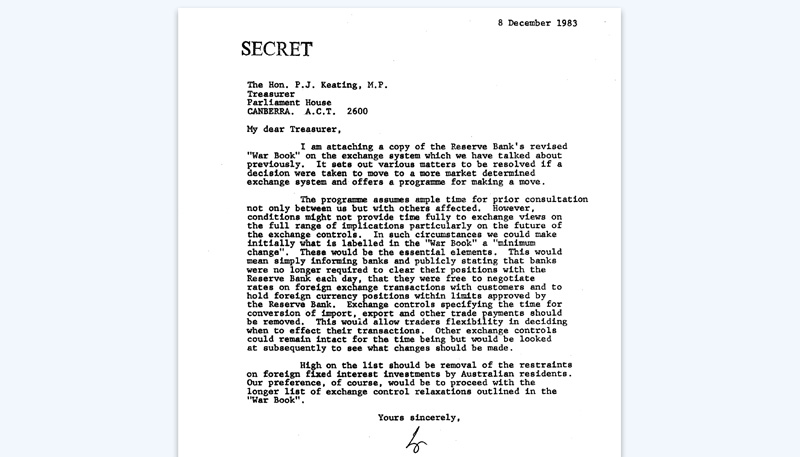
Given the possibility that the Bank might need to execute a regime change suddenly, operational readiness was key. We have long maintained a ‘War Book’ that detailed the procedures to be followed in the event of a decision to float; an updated version was delivered to the Treasurer the day before the decision (shown in Figure 7). The War Book was a hefty file rather than a book, and its title was intriguing. It was closely guarded and for many years after the float, remained in the safe of the Assistant Governor (Financial Markets). On the occasion of the 40th anniversary of the float, it was released to the public on our digital archive, Unreserved.
The reinvention of banknotes19
When Australia’s decimal currency banknotes were introduced in 1966, in addition to their bold and innovative design, they were thought to contain the most advanced security features available.20 However, within a year of issuance, the $10 banknote had been counterfeited. Dr Coombs saw the need to develop stronger security features. He sought a long-term solution from Australia’s scientific community, leading to a partnership between the Bank and Commonwealth Scientific and Industrial Research Organisation (CSIRO) that would yield one of Australia’s great inventions.
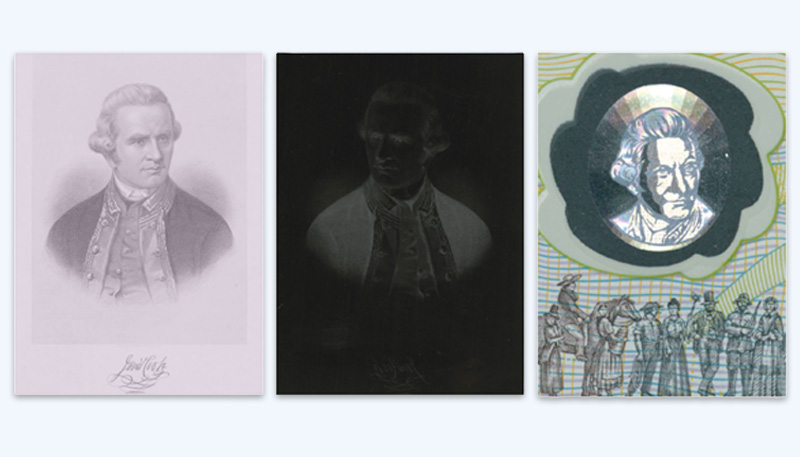
The initial idea was to develop a banknote that could not be copied through photographic means. This led to exploration of a hologram-like ‘optically variable device’, the appearance of which would change according to changes in external factors, like the angle of viewing. The device produced better optical effects when applied to a smooth, transparent surface. This led to development of a clear plastic film (polymer) as the substrate of the banknote. By 1974, experimental polymer banknotes had been successfully developed and the Bank officially engaged the CSIRO on a project that would reinvent our banknotes. In 1988, Australia became the first country to produce a banknote that incorporated an optically variable device and was printed on polymer – the Australian Bicentenary commemorative $10 banknote. It was released on 26 January 1988, the bicentenary of Governor Arthur Phillip’s naming of the colony at Sydney Cove. The banknote was designed by Harry Williamson and incorporates an optically variable device that portrays Captain James Cook. On one side, it incorporates a representation of HMS Supply, the first ship to drop anchor in Sydney Cove, and a frieze of figures beginning with convicts and continuing with subsequent waves of migration to Australia. On the other side, it incorporates representations of the culture of Aboriginal people, through layered imagery and patterns with an Aboriginal youth surrounded by ancient rock paintings from Deaf Adder Gorge, Western Arnhem Land, a ceremonial Morning Star Pole and details from different styles of Aboriginal artwork.
The commemorative banknote served as a trial and its success resulted in a decision to develop an entire series of polymer banknotes known as the ‘New Note Series’. For this series, the focus shifted from the optically variable device to less expensive alternatives, resulting in the introduction of a clear window that was equally as effective in hindering counterfeiting (shown in Figure 8). With the introduction of the New Note Series, issued between 1992 and 1996, Australia became the first nation to successfully convert its paper-based currency to polymer banknotes.
Targeting inflation
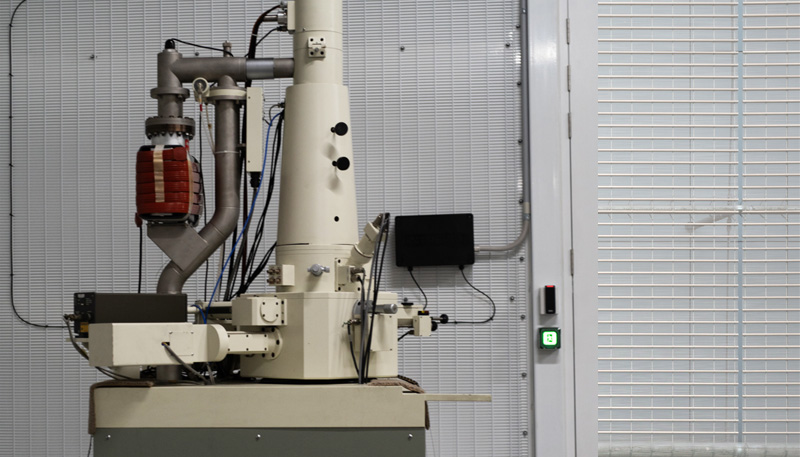
In the early 1990s, along with other central banks, the Bank introduced a new framework for monetary policy – inflation targeting. Central banks embraced inflation targeting in different contexts and in different ways. In Australia, the move was motivated by a desire to ‘lock in’ the benefits of the low inflation that had accompanied the early 1990s recession, including the opportunity to structurally reduce inflation expectations.21 In a speech in March 1993, Governor Bernie Fraser said, ‘[t]he appropriate degree of price stability to aim for is a matter of judgment. My own view is that if the rate of inflation in underlying terms could be held to an average of 2 to 3 per cent over a period of years, that would be a good outcome’ (Fraser 1993). This statement would mark the practical beginnings of inflation targeting in Australia (with formalisation in August 199622 and the target variable later evolving to be the headline rate of inflation in 1998).
As Stevens explained, the choice of ‘2 to 3 per cent’ recognised that the best average inflation performances since the Second World War were in the vicinity of ‘two point something’, with a wide variation around that average (Stevens 2003). The idea of Australia seeking to achieve an inflation outcome ‘on average’ over a period of years, rather than at times or within hard edged boundaries, differed from the approach of most other central banks at the time. This difference was motivated by our judgement that inflation was hard to control precisely, and that attempts to hit a narrowly defined target over short periods risked exacerbating the sort of economic instability that we were trying to lessen (Stevens 2003, pp 3–4). This argument was considered especially relevant for a small open economy, like Australia, where swings in world prices or exchange rates can drive significant short-term fluctuations in inflation.
When it was introduced, the Australian approach to inflation targeting was widely thought to be ‘a bit too soft’. However, Stevens and Debelle (1995) said that ‘if, some years hence, we can look back and observe that the average rate of inflation has a “2” in front of the decimal place, that will be regarded as a success’. Decades on, inflation targeting in Australia has been a success. As noted in the RBA Review, ‘over the past 30 years, inflation has averaged around the midpoint of the RBA’s target of 2 to 3 per cent, and the variability of output and unemployment has been lower than in earlier decades’ (Australian Government 2023).. Importantly, Debelle noted, ‘The flexible nature of [our] framework, which was there at its inception, has proven to be resilient to the quite substantial changes in the macroeconomic environment that have taken place since’ (Debelle 2018).
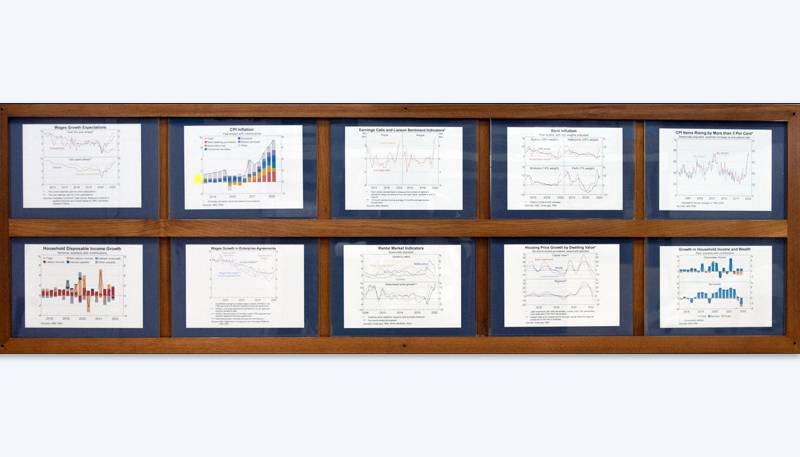
The introduction of inflation targeting was a time of great economic debate at the Bank. And debates about the efficacy and durability of the regime have been sustained. One of the rooms in which they occurred was the ‘chart room’ – an annex to the office of the Assistant Governor (Economic). It contained a mounted display of graphs of the key economic variables in prevailing monetary policy discussions. In a quaint tradition, the graphs in the chart room were replaced after each meeting of the then Reserve Bank Board. Figure 9 shows the last occasion on which they were changed, as the head office building in 65 Martin Place was decommissioned ahead of its refurbishment.
A real-time settlement solution
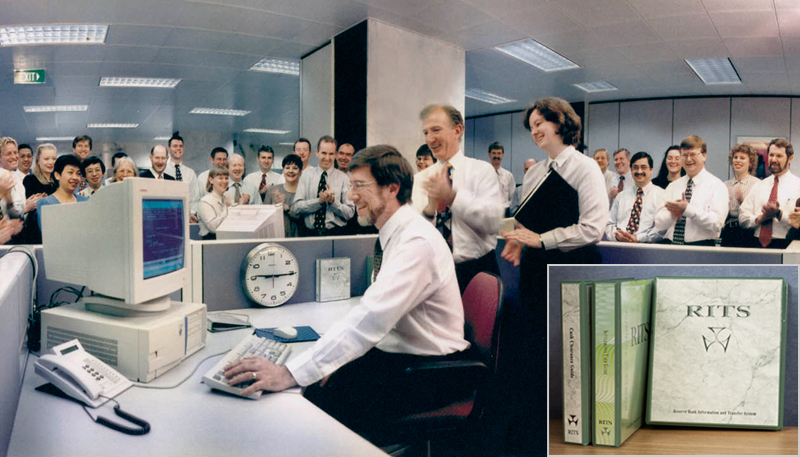
In June 1998, the Bank introduced real-time, high-value settlement to Australia. Commonly known as RITS, the Reserve Bank Information and Transfer System allowed banks, and other payments service providers, to pay each other securely and efficiently in real time. The implementation of this real-time gross settlement (RTGS) functionality was transformational. Instead of banks and other payments service providers building up ‘promises to pay’ to each other throughout the day, with settlement occurring later, settlement occurred immediately. This eliminated the build-up of large unsecured credit exposures between payments service providers and materially reduced systemic risk in the financial system. It also fundamentally increased the speed with which payments could be sent between providers’ payments services. As a result of this reform, we became the custodian and operator of critical national infrastructure.
Payments processed through RITS are settled via funds in Exchange Settlement Accounts (ESAs) held with the Bank. Each transaction is completed via simultaneous credits and debits in these accounts, ensuring that settlement is final and irrevocable. Payments may be submitted directly into RITS or through approved feeder systems.23 While RITS primarily supports real-time settlement of high-value and time-critical payments, it also facilitates deferred net settlement of lower-value transactions, such as cheques, direct entry payments and retail card transactions.
In February 2018, Australia’s payments system was further transformed for the digital age with the introduction of the New Payments Platform (NPP), a 24/7 real-time fast payments system supporting online payments services (Osko and others). To enable real-time settlement of NPP payments between financial institutions, the Bank developed the RITS Fast Settlement Service (FSS) allowing continuous RTGS settlement across ESAs on a 24/7 basis. The Bank also built services utilising the NPP for government customers.
RITS and the NPP remain hallmarks of innovation in Australia’s payments system, with confidence and trust in these systems dependent on their reliability.
This photograph (shown in Figure 10) is one taken on the day the RTGS platform went live, marking the culmination of years of planning, development and coordination with banks, financial institutions and governments in Australia and overseas. While real-time payments are now an accepted part of daily life, the launch of RITS at the time, and later the NPP and FSS, was a monumental achievement, as captured in the expressions of those present and marking a significant moment in our history. The photograph is accompanied by images of the old spiral bound manuals that were used to instruct those in make this transition to real-time payments.
More stories
The 10 objects discussed in this article have been chosen to capture milestones in our development as a central bank. Many more stories can be told. Our archival collection not only covers a span of over 200 years. It comprises nearly 5 kilometres of physical records and items of different forms and millions of digital records. Together, these physical and digital collections contain rich material about the institution and its place in our economic, financial and social history. They also enable stories to be told about others. Our archives house primary source information about the people, places and organisations that we – and government banks before us – have interacted with. Readers wishing to find more information, or conduct their own research, can explore:
- Unreserved, the Reserve Bank of Australia’s digital archive
- The Reserve Bank of Australia’s Official Oral History (see the Series Guide)
- The Reserve Bank of Australia’s Museum website.
Appendix A: The ‘lucky penny’
Dear Sir,
When my assistant, Mr Batty, and I were arranging stores, etc, in the Strongroom at the Melbourne Savings Bank Agency on 13th ultimo, he found the enclosed halfpenny on the floor where it had escaped the observation of the workmen who swept the place out for us. He handed it to me but I told him to keep it as it might bring him luck. Evidently the youth is lacking in sentiment, for he said he did not want it and I might have it, and as no true Scotsman was ever known to refuse a bawbee* I accepted it, because it had, to me, a special value.
It seemed a good omen to find cash in the strongroom even before the business had commenced, and I trust we may take it as a sign the Commonwealth Bank will never be without “a shot in the locker”. I gave the coin, together with an impression of the date stamp you designed for the office, to the firm that made the stamp and asked that it might be engraved as shown on the stamp. The result does not quite please me though, but such as it is I beg your acceptance of it as a small memento of the opening of the Savings Bank.
Yours sincerely,
W. Campbell Milne
* A bawbee is a halfpenny, name of the Laird of Sillebawby, 16th century.
Source: RBA Archives GDM-21-1.
Appendix B: A war-time bond
Anzac
Gallipoli Pen (Peninsula)
near Gaba Tepe
27/6/15To the Governor
Commonwealth Bank of Australia – Sydney
Dear Sir, since writing my last letter to you I have seen many sights and had nine weeks of fighting – The Third Brigade, of which we form part, are on the right of the section of Defence. We are about 600yds in from the sea. My “dugout”, the descriptive name given to our living places, is situated at about an altitude of 300ft above sea level, and looks out immediately on the Islands of Imbros and Samothrace. Our conditions are hardly what can be described as pleasant but everybody is wonderfully cheerful and the health generally is good. We have been in the firing line now for nine weeks continuously and have done a tremendous lot of digging in addition to fighting. The hills we occupy are just a maze of underground tunnels and fire pits. I have rather lost touch with the members of the Bank staff whom I met in Egypt. Brooke of the Hobart Branch was wounded on the first day. I have not yet heard how he is progressing. Chambers also of the Hobart Branch joined the 12th Bn recently, since the 25th April I have been in command of the 12th Bn and have been promoted to the Rank of Lieut. Colonel. I find Sir that the worries of a Battalion on active service are even more than those of managing a Savings Bank. Our Battalion however is doing very well and we are all looking forward to the day when we will advance. We are continuously under shell fire. It’s a grand sight to see a bombardment. Recently the HMS ------- came close into shore and heavily bombarded the Turkish fortifications. Watching the effect of the shells from our lines was awe inspiring. The whole of the position shelled was one mass of fire. It’s hard to imagine how anyone could live through it. Yet on the first day we had a similar experience for eight hours and although we suffered very heavily a good % of us escaped, how it was I do not know. Personally I had some miraculous escapes. My clothing & equipment was perforated in no less than six places. One learns rapidly however, the art of this warfare and does not waste much time in not taking precautions. The main thing is to get underground if you want to live. There are very many items of interest I would like to describe to you but unfortunately censorship has not yet been raised. We hear very little news about the war and have to be content by reading news some weeks old. I hear occasionally from Mr Douglas & other members of the Staff and am pleased to know that the Bank is still making good progress. We are unable to state yet the probable date of our return but all sincerely hope it will be before Xmas. Our first week of service here was one that none of us are likely to forget. Landing at 4am on the 25th April we were kept exceedingly busy for over a week, in beating off the Turks, who are by no means an enemy to treat lightly. We had a slight cessation of hostilities for about two days and then at it again. The final effort so far was made by the enemy on the 18th /19th May when he fought for all he was worth, but failed to dislodge us. It is estimated that there were 7000 casualties in these two days, so you can imagine the vigor with which the attack was made. We were fortunate in having a good strong position and our Machine Guns & Rifles did great damage, in 250 yds we buried over 200 Turks, and got many wounded into our lines. My Hd Qtrs after the battle more resembled an auction room than anything else. We had articles of equipment, rifles, Coppers, tents, belts, crockery, trinkets and all sorts of articles which were collected at night time from the valley on our front. I have no more paper with which to continue so will postpone giving further news till more paper arrives. Wishing yourself and members of the Staff all happiness prosperity – Believe me – Sir – Sincerely yours, E. Hilmer Smith Lt. Col. of 12th Bn.
Source: RBA Archives ST-PR-22.
Endnotes
* Jacqui Dwyer is Head of Knowledge Management Department and Virginia MacDonald is the Manager of the Bank’s Archives. We would like to thank the following people who have assisted in the preparation of this article: Carol Au, Elisabeth Grace, Maggie Ma, Tessa Morris, Bryan Oh and Juraj Vidovenec. The approach in this article borrows from that used by the Bank of England. See Adam (2019).
1 While the global financial crisis is considered to have commenced in mid-2007, the collapse of Lehman Brothers on 15 September 2008 generated a peak in financial stress and triggered a panic in financial markets globally.
2 The earliest item in our collection is a 1666 Great Britain gold sovereign. Other early coins held are Indian Mohur, Dutch Gulden (Guilder) and gold sovereigns from the Melbourne and Adelaide mints, all from the 1800s.
3 Letters from Ernest Hilmer Smith to the Governor can be found at Letters from the Front in the online exhibition on our Museum website From Bank to Battlefield, which commemorates the role of Bank staff in the First World War. After the war ended, Hilmer Smith returned to the Bank.
4 A film held in our archives and available on the RBA website captures Sir Denison Miller being congratulated by senior staff on the day the knighthood was announced. See Knighthood of Sir Denison Miller, 1920 (RBA Archives AV-000001).
5 In 1932, Melville appointed Mary Willmott Debenham, a distinguished graduate of the University of Sydney with first-class Honours in Economics, who joined his department as an assistant. For the times, this appointment was a progressive one, but Melville simply saw her as the best person for the role. As was the norm, Willmott Debenham was obliged to resign in 1935 when she married John Grant Phillips, who would later be appointed Governor of the RBA.
6 Melville had a particular interest in how monetary and exchange rate management could secure desired outcomes for output and employment.
7 This section draws on various files from our archives, mostly RBA Archives S-a-1311 to S-a-1337.
8 It sank in 133 metres of water at the entrance to the Hauraki Gulf.
9 Later salvage operations on the wreck recovered all but five bars of gold.
10 See Cornish (1982) for a detailed account.
11 This aspiration of Coombs is captured in a promotional film about the independent central bank and the construction of its new head office building. See Planned for Progress. It is further explored in a retrospective exhibition in our Museum about the Bank for its 50th anniversary, similarly titled Planned for Progress.
12 For a summary of the extent to which the Bank’s head office building and interiors were progressive, see RBA (2009a; 2009b). Furthermore, Dr HC Coombs noted, ahead of the opening of the new head office building: ‘The massive walls and pillars used in the past to emphasise strength and permanence in bank buildings are not seen in the new head office. Here, contemporary design and conceptions express our conviction that a central bank should develop with growing knowledge and a changing institutional structure and adapt its policies and techniques to the changing needs of the community within which it works …’. See A Modern Building on our Museum website.
13 This section draws on contributions by the Bank’s Curator, John Murphy, to a physical exhibition for the 50th anniversary of decimal currency held at the Bank entitled The Decimal Revolution, a hardcopy booklet that accompanied the exhibition, and a comprehensive online resource available on our Museum website also entitled The Decimal Revolution.
14 They were guided by an advisory committee that included Australian artist Russell Drysdale, along with eminent designers Hal Missingham, Douglas Annand and Alistair Morrison.
15 Similarly, the original skene of wool used in the design of John MacArthur’s merino sheep on the other side of the $2 banknote is also preserved in our archives.
16 The ability to set the short-term price of money arose because we were now free of obligations to stand in the foreign exchange market at a particular price. An earlier decision (by the Fraser government) to issue government debt at tender meant that the Bank did not have to stand in the government debt market either. Both changes contributed to control of monetary policy.
17 The Bretton Woods system (1944–1971) was a global system of pegged currencies, in which the US dollar became the reserve currency and was convertible to gold.
18 In March 1983, a large outflow of capital occurred in the lead-up to an expected change of government and causes a spike in interest rates. After the government was reinstated, a decision to devalue contributed to a large capital inflow as money that had left the country before the devaluation returned, with speculators making sizeable profits.
19 This section draws on an earlier exhibition in our Museum entitled The Reinvention of Banknotes, its accompanying pocket guide and an online resource available on our Museum website also entitled The Reinvention of Banknotes.
20 They contained a watermark, metal thread, quality rag paper and sophisticated printing techniques that were intended to make counterfeit difficult.
21 This history is discussed in an RBA research conference devoted to the 25th anniversary of inflation targeting (Simon and Sutton 2018).
22 Following verbal endorsement of the approach to inflation targeting in 1993, there was a formal statement of the ‘common understanding’ of the Governor and the Government about this new monetary policy framework. See The Treasurer and RBA (1996).
23 These include the SWIFT Payment Delivery System, Austraclear and the Continuous Linked Settlement (CLS) system, which is a global multi-currency settlement platform. See RBA (2025).
References
Adam J (2019), ‘An Anniversary Exhibition for the Bank of England: 325 Years, 325 Objects’, Bank of England Quarterly Bulletin, Quarter 2.
Andrews G (1993), A Designer’s Life, UNSW Press, Sydney, 1993.
Australian Government (2023), ‘An RBA Fit for the Future’, Review of the Reserve Bank of Australia, March.
Cornish S (1982), ‘Full Employment in Australia: The Genesis of a White Paper’, Research Report No 1, Department of Economic History, Australian National University.
Cornish S (2014), ‘The Long Road That Led to the Floating of the Australian Dollar’, Australian Financial Review, 21 November.
Cornish S (2021), ‘The Central Bank’s First Economist’, RBA Bulletin, December.
Cornish S and J Hawkins (2023), ‘Happy Birthday AUD: How Our Australian Dollar Was Floated, 40 Years Ago This Week, The Conversation, 10 December.
Debelle G (2018), ‘Twenty-five Years of Inflation Targeting in Australia’, in Simon J and M Sutton (eds), Central Bank Frameworks: Evolution or Revolution?, Proceedings of the RBA Annual Conference, Sydney.
Debelle G and M Plumb (2006), ‘The Evolution of Exchange Rate Policy and Capital Controls in Australia’, Asian Economic Papers, 5(2), pp 7–29.
Fraser B (1993), ‘Some Aspects of Monetary Policy’, Talk to Australian Business Economists (ABE), Sydney, 31 March.
Keynes JM (1932), ‘World-Famous Economist Praises Our Efforts’, Melbourne Herald, 27 June, p 1.
Macfarlane I (2002), ‘Sir Leslie Melville: His Contribution to Central Banking in Australia’, Inaugural Sir Leslie Melville Memorial Lecture, Canberra, 22 March.
RBA (1960), ‘The Reserve Bank Emblem’, Currency, 1(2), April, p 28.
RBA (2009a), ‘Our Heritage: A Coombs Legacy’, Currency, 51(1), January, pp 5–8.
RBA (2009b), ‘An Abstract Matter’, Currency, January, 51(1), p 9.
RBA (2025), ‘About RITS’.
RBA Archives GDM-21-1 – GOVERNORS & SENIOR PERSONNEL – Denison Miller – General Matters – 1912 – 1921.
RBA Archives GDM-23-10 – GOVERNORS & SENIOR PERSONNEL – Denison Miller – Death.
RBA Archives S-a-1311 to S-a-1337 – SECRETARY’S DEPARTMENT – Gold “Niagara” Salvage.
RBA Archives ST-PR-22 – Staff Department – Officers’ Personnel Records – Smith, Ernest Hilmer (former Accountant, State Savings Bank, Tasmania) – 1912–1951.
Simon J and M Sutton (eds) (2018), Central Bank Frameworks: Evolution or Revolution?, Proceedings of the RBA Annual Conference, Sydney.
Stevens G (2003), ‘Inflation Targeting – A Decade of Australian Experience’, Address to the South Australian Centre for Economic Studies April 2003 Economic Briefing, Adelaide, 10 April.
Stevens G (2013), ‘The Australian Dollar: Thirty Years of Floating’, Speech to the Australian Business Economists’ Annual Dinner, Sydney, 21 November.
Stevens G and G Debelle (1995), ‘Monetary Policy Goals for Inflation in Australia’, in AG Haldane (ed), Targeting Inflation, Bank of England, London, pp 81–100.
The Treasurer and RBA (1996), ‘Statement on the Conduct of Monetary Policy’, 14 August.